Behavior
Frenchie or French Spaniel - which should you pick?
The Frenchie for apartment living and low exercise needs; the French Spaniel if you're active and want a lower-cost, structurally healthier dog.

Quick answer
Frenchie or French Spaniel - which should you pick?
The Frenchie for apartment living and low exercise needs; the French Spaniel if you're active and want a lower-cost, structurally healthier dog.
French Bulldog or French Spaniel? On paper they differ most on exercise need, and on the scales French Spaniel is the heavier at 45–60 lbs. Here is how the two compare on everything that shapes an ordinary week.
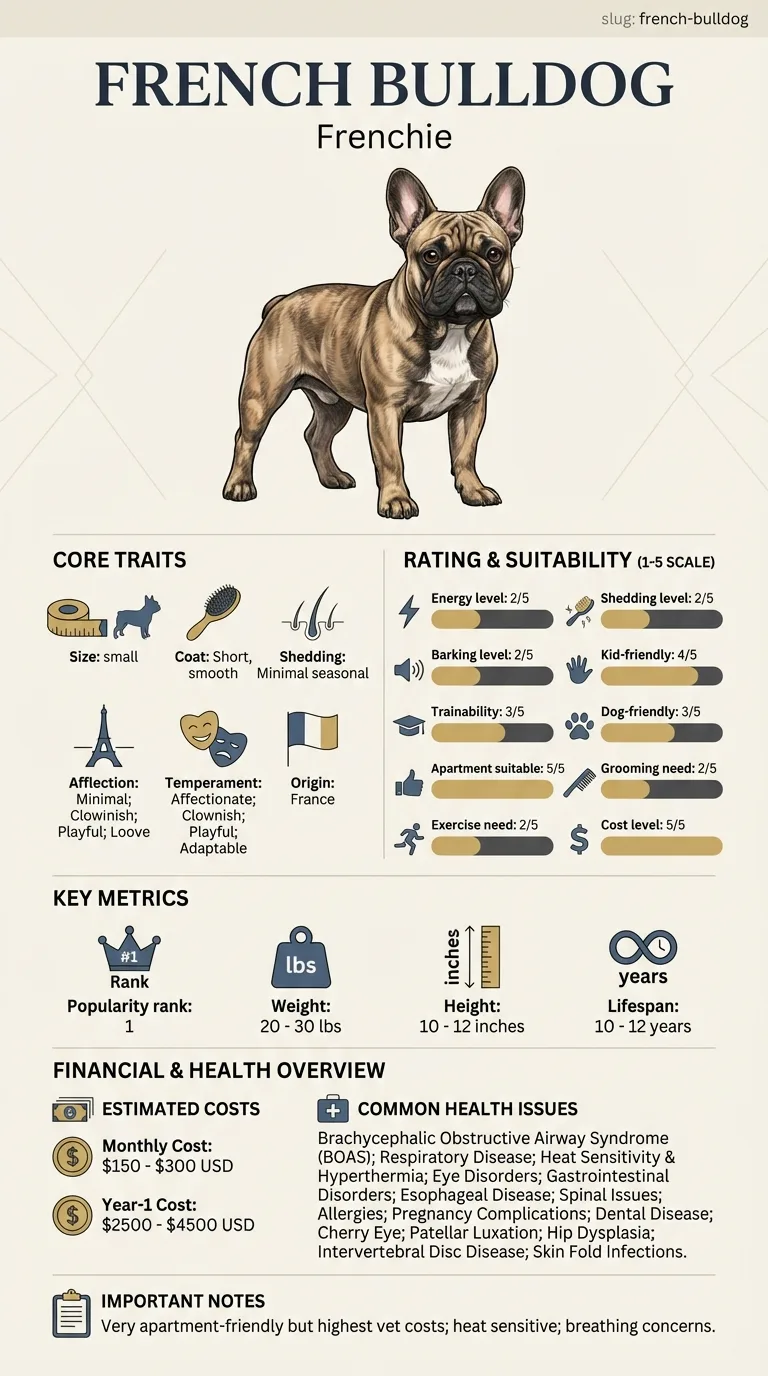
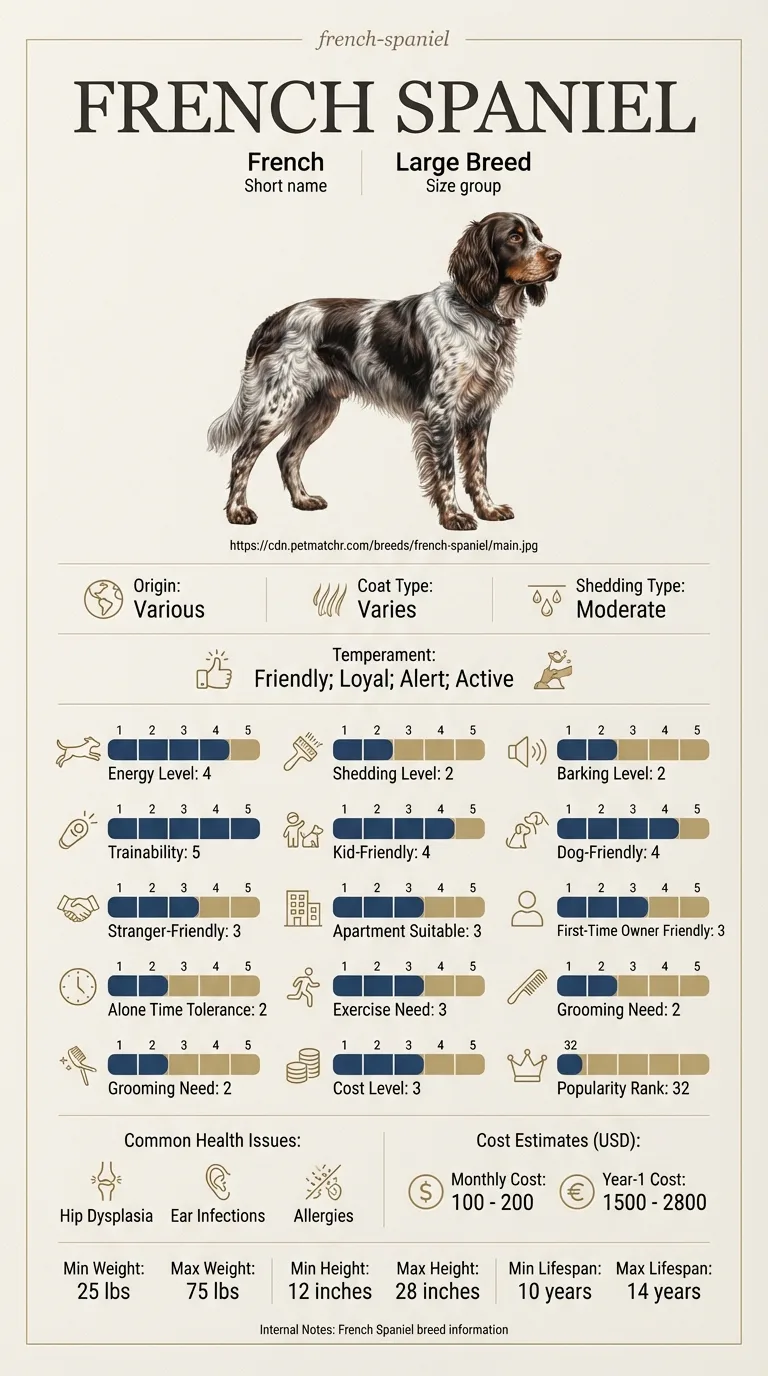
This is for someone already down to French Bulldog and French Spaniel and deciding between them. For this pair the decision usually turns on exercise need and apartment suitability, so those are covered first and in most detail. Anyone choosing from a flat has a clear answer here: French Bulldog rates 5/5 against 2/5. Breed history is left out; what follows is what you will actually live with.
Between French Bulldog and French Spaniel, exercise need is what separates them, and French Bulldog is the lower-effort dog of the two to keep.
Choose French Bulldog if you are in a flat or a smaller home, this is your first dog and you do not want a standing grooming appointment.
Choose French Spaniel if you already have another dog, you want a dog that picks up training quickly and you want a dog that can keep up with an active routine.
| Feature | french bulldog | french spaniel | Winner |
|---|---|---|---|
| Size class | small | medium | Equal |
| Weight | 20–30 lbs | 45–60 lbs | Equal |
| Height | 10–12 in | 21–24 in | Equal |
| Lifespan | 10–12 years | 10–12 years | Equal |
| Exercise need | Low (2/5) | Very high (5/5) | french bulldog |
| Grooming need | Low (2/5) | Moderate (3/5) | french bulldog |
| Shedding | Low (2/5) | Moderate (3/5) | french bulldog |
| Energy level | Low (2/5) | High (4/5) | Equal |
| Barking | Low (2/5) | Low (2/5) | Equal |
| Apartment suitability | Very high (5/5) | Low (2/5) | french bulldog |
| Good for first-time owners | Very high (5/5) | Moderate (3/5) | french bulldog |
| Tolerates being alone | Very high (5/5) | Low (2/5) | french bulldog |
| Trainability | Moderate (3/5) | High (4/5) | french spaniel |
| Good with kids | High (4/5) | High (4/5) | Equal |
| Good with other dogs | Moderate (3/5) | High (4/5) | french spaniel |
| Friendly to strangers | Moderate (3/5) | High (4/5) | french spaniel |
| Cost level | Very high (5/5) | Moderate (3/5) | french spaniel |
| Coat | Short, smooth | Medium, flat and feathered | Equal |
| Origin | France | Various | Equal |
| Typical monthly cost | $150–$300 | $100–$200 | Equal |
| Typical first-year cost | $2,500–$4,500 | $1,400–$2,900 | Equal |
These two barely belong on the same comparison page by weight - 20-30 lbs for the Frenchie against 45-60 for the French Spaniel, and a full foot of height difference, 10-12 inches versus 21-24. Sharing part of a name is about where the resemblance ends; structurally and functionally these are two very different dogs bred for entirely different original purposes centuries apart.
The French Spaniel wants real exercise, 5/5, the top of the scale, while the Frenchie sits at just 2/5. This single number probably matters more than any other on this page: a dog built for a couch and short walks set against a dog built to work a field for hours, and that difference shapes almost every other category that follows below it.
Both breeds are relatively low-maintenance on coat care, though the Frenchie edges lower on both counts, grooming at 2/5 versus the French Spaniel's 3/5, and shedding at 2/5 versus 3/5. Neither will demand daily brushing sessions, but the French Spaniel's feathered coat does need a bit more regular attention than the Frenchie's short, smooth one, especially around the ears and legs after a muddy walk.
The Frenchie is close to an ideal apartment dog on paper, 5/5 for apartment suitability and 5/5 for tolerating time alone, both maximum scores on this scale. The French Spaniel rates much lower on both counts, 2/5 and 2/5, directly reflecting its build as an active field companion rather than a dog suited to a quiet, small-space, low-activity lifestyle in a city apartment.
The French Spaniel trains a bit more readily, 4/5 versus the Frenchie's 3/5, but first-time-owner suitability strongly favors the Frenchie, 5/5 against 3/5. Its low exercise needs and easygoing nature outweigh a slightly lower trainability score for someone new to dog ownership who wants fewer daily demands to manage day to day, especially during that busy first year of ownership.
Both breeds are good with kids, 4/5 tied. The French Spaniel edges ahead with other dogs, 4/5 versus 3/5, and with strangers, 4/5 versus 3/5, matching a temperament list built around gentle and sociable rather than the Frenchie's more clownish, home-focused personality that tends to save most of its warmth for its own household first, well before it extends that warmth to anyone else.
Lifespans tie at 10-12 years, but the health picture is where this comparison turns serious - the Frenchie's list runs to fifteen documented conditions, most tied to its flat-faced, short-spined build: BOAS, respiratory disease, spinal issues, and IVDD all trace back to the same underlying structural cause. The French Spaniel's list is a fifth the length, five conditions, with no overlap at all against the Frenchie's list.
This is the clearest gap on the page. The Frenchie rates 5/5 on cost, the maximum possible, running $150-300 a month and $2,500-4,500 in the first year, against the French Spaniel's moderate 3/5, $100-200 a month, and $1,400-2,900 for year one. Higher vet costs tied to the Frenchie's structural health issues are the most likely driver of that considerable gap.
French Bulldog weighs 20–30 lbs and lives 10–12 years; French Spaniel weighs 45–60 lbs and lives 10–12 years. The two diverge most on exercise need, apartment suitability and tolerates being alone and 3 other rated axes. They are level on barking and good with kids, so those cannot decide it. The comparison marks an easier option only where one exists. Facts like weight and country of origin are not scored. Both dogs are rated from the same dataset, which is what makes the numbers comparable with each other even though any individual dog sits somewhere inside its breed's range.

Substantially - the Frenchie weighs 20-30 lbs and stands 10-12 inches; the French Spaniel weighs 45-60 lbs and stands 21-24 inches. Despite the shared name, they're built nothing alike.
The French Spaniel, by far - 5/5 against the Frenchie's 2/5. It's a field breed built for sustained activity.
The Frenchie, 5/5 versus the French Spaniel's 3/5, thanks to its low exercise needs and high tolerance for apartment living and alone time.
The Frenchie is close to ideal, 5/5 for apartment suitability and 5/5 for tolerating being alone. The French Spaniel rates 2/5 on both - it wants space and activity a small apartment can't provide.
Large. The Frenchie runs $150-300 a month and $2,500-4,500 in year one; the French Spaniel runs $100-200 a month and $1,400-2,900 for year one, roughly 40-55% less.
No, not on this data - the two lists share nothing in common. The Frenchie's fifteen conditions are largely tied to its brachycephalic, short-spined structure; the French Spaniel's five are unrelated to build.
Yes - fifteen documented conditions against the French Spaniel's five. That's the single biggest gap in this whole comparison and it tracks with the cost difference too.
The Frenchie for apartment living and low exercise needs; the French Spaniel if you're active and want a lower-cost, structurally healthier dog.
The Frenchie, $150-300 versus the French Spaniel's $100-200.
The French Spaniel, 5/5 versus the Frenchie's 2/5.
The Frenchie, with fifteen listed conditions against the French Spaniel's five, mostly tied to its brachycephalic build.
Secure checkout on Stripe. We never see your card.
7-day money-back guarantee. Instant access.

Health information here is general and is not veterinary advice. If your dog shows pain, sudden behaviour change, or worsening symptoms, consult a licensed veterinarian.
Some links on this site are affiliate links. We may earn a commission at no extra cost to you, and we only suggest products we believe are helpful for dog owners.
We research and check what we publish, but we do not warrant that any figure, date, price, or statement is accurate, complete, or current, and we accept no liability for any loss, cost, injury, or other harm arising from the use of this site. Use it as one reference among several. You remain responsible for your own decisions and for your dog's care - confirm anything that matters with a licensed veterinarian or another qualified professional before you act on it. Full disclaimer.
Match your lifestyle to the right dog.
Take quizNot sure which breed is right for you? Take our 2-minute quiz to find out.
Take the quiz