Health
What does a torn cruciate ligament look like in a dog?
A sudden, persistent non-weight-bearing limp on a back leg that doesn't improve after a day or two of rest.

Quick answer
What does a torn cruciate ligament look like in a dog?
A sudden, persistent non-weight-bearing limp on a back leg that doesn't improve after a day or two of rest.
A Frenchie that suddenly won't put weight on a back leg after a jump or an awkward landing, and stays that way instead of walking it off within a day, is describing a classic cruciate injury.
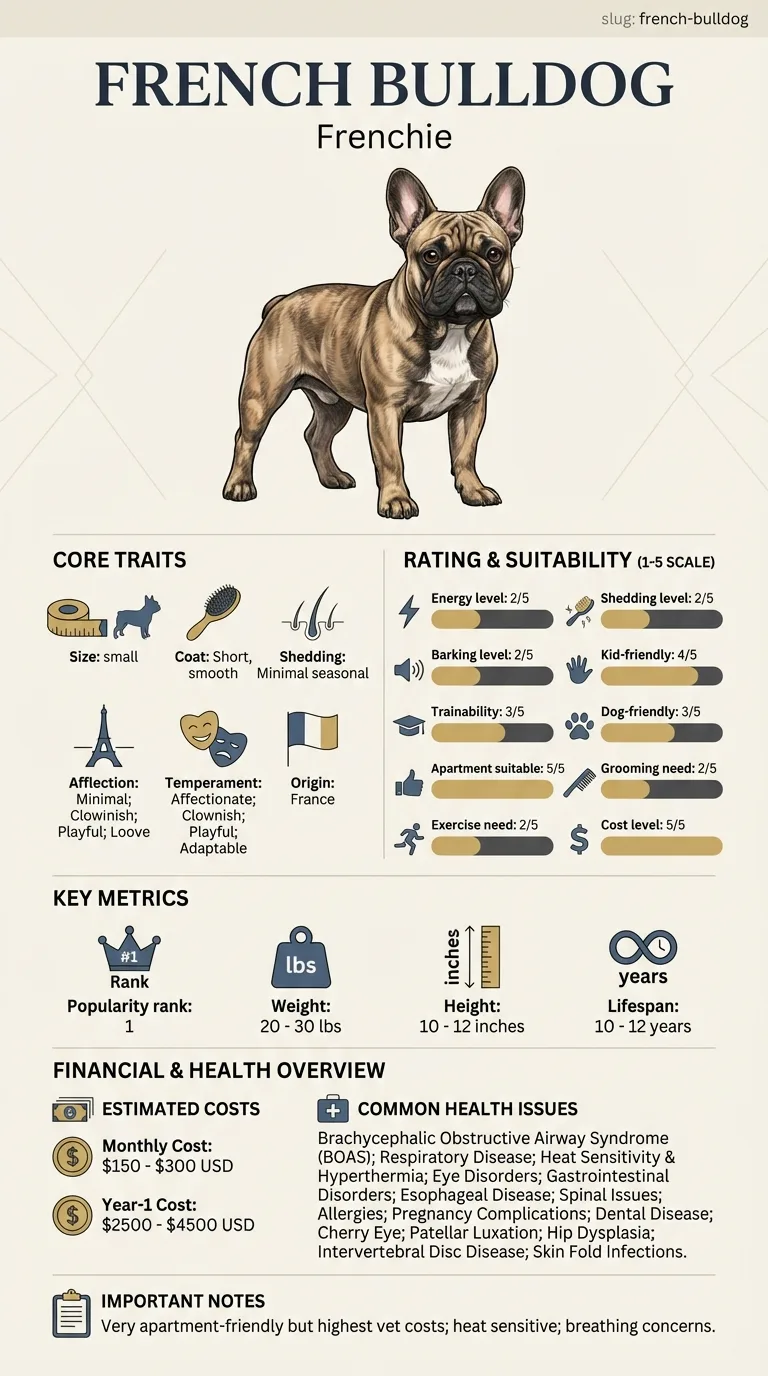
Overweight and middle-aged dogs are disproportionately affected, which means owners who've let weight creep up gradually are often facing this at the same time they're facing a harder conversation about overall body condition.
This guide is not medical advice. If your dog shows pain, sudden behavior change, or worsening symptoms, consult a licensed veterinarian.
Some links may be affiliate links. We may earn a commission at no extra cost to you. We only suggest products we believe are helpful for dog owners.
We research and check what we publish, but we do not warrant that any figure, date, price, or statement is accurate, complete, or current, and we accept no liability for any loss, cost, injury, or other harm arising from the use of this site. Use it as one reference among several. You remain responsible for your own decisions and for your dog's care - confirm anything that matters with a licensed veterinarian or another qualified professional before you act on it. Full disclaimer.
A cruciate ligament injury involves damage to the cranial cruciate ligament inside the knee, the structure that keeps the thigh bone and shin bone properly aligned during movement. In dogs, this typically results from gradual degeneration of the ligament rather than a single traumatic event, though the actual rupture often appears suddenly during ordinary activity like a jump or an awkward turn.
Cruciate ligament injuries are among the most common orthopedic conditions seen in dogs of many breeds and sizes, and French Bulldogs, given their frequent weight management challenges and compact build, are represented in that broader pattern.
French Bulldogs' muscular, heavier-than-they-look build concentrates real weight through relatively small joints, and any existing knee instability (such as patellar luxation) can add uneven stress to the cruciate ligament over time. This isn't a uniquely breed-specific mechanism so much as a case where the breed's typical body composition and common weight challenges overlap unfavorably.
Excess body weight is the single largest environmental contributor, chronically loading the ligament beyond what it was built to bear. A single acute event — an awkward jump off furniture, a hard stop during play — is often what pushes an already-weakened ligament to full rupture.
Seek care promptly for a sudden, persistent limp that doesn't improve within a day of rest, especially if the dog holds the leg up entirely or you notice swelling around the knee — a torn cruciate ligament needs a specific diagnosis, not a wait-and-see approach.
Because this injury often develops gradually and can partially tear before it fully ruptures, several common responses make the eventual outcome worse.
See all French Bulldog health problems, which breeds are prone to cruciate ligament injuries, or the full French Bulldog breed guide for temperament, exercise needs and ownership costs.
Diagnosis is typically confirmed within a single vet visit through a physical exam and often X-rays. Surgical recovery generally takes eight to twelve weeks of restricted, structured activity before a full return to normal exercise.
Success means a stable, comfortable knee that supports normal daily activity, achieved through surgery and full rehabilitation in most dogs above small toy-breed size — a good outcome is common but depends heavily on following the recovery plan completely.
For dogs above roughly 20 pounds, surgical stabilization is generally recommended over conservative management, though the full picture depends on severity, age, and overall health.

Chunk, a five-year-old Frenchie who'd been carrying a few extra pounds for a couple of years, suddenly stopped putting weight on his left back leg mid-game of fetch. His family expected it to be a simple sprain that would ease overnight, but the next morning he still wouldn't touch the leg to the ground. An exam revealed knee instability consistent with a torn cruciate ligament, confirmed on X-ray. Given his weight and the complete nature of the tear, his vet recommended surgical stabilization. Chunk's family also committed to a weight-loss plan alongside the surgery. Ten weeks of structured rehab later, he's back to full activity, several pounds lighter, and his vet is watching the other knee closely given the elevated risk of a second tear.
Key takeaway: A sudden limp that doesn't ease within a day is different from a passing strain, and the weight conversation that often comes with a cruciate diagnosis is as important as the surgery itself.
A combination of excess body weight, the joint stress of a compact and muscular build, and gradual ligament degeneration over time makes cruciate injuries a recognized issue in the breed, similar to many other small and medium breeds.
It's the equivalent structure and often called the same thing informally, though in dogs it's more often called the cranial cruciate ligament, and the injury pattern (gradual degeneration rather than sudden sports trauma) tends to differ from typical human ACL tears.
For dogs over about 20 pounds, surgery is generally recommended for the best long-term function; smaller, lighter dogs sometimes do reasonably well with strict conservative management, though outcomes vary.
Surgical repair commonly runs from about $3,500 to $6,500 per knee depending on the technique used and the region, not including post-operative rehabilitation.
There's a meaningfully elevated risk of the opposite knee tearing within one to two years, given that the same underlying joint mechanics and weight factors apply to both legs.
Most dogs need eight to twelve weeks of restricted, structured activity and rehabilitation before returning to full, unrestricted exercise.
Weight control significantly reduces the mechanical stress that contributes to ligament degeneration, making it one of the most effective preventive steps an owner can take.
A sudden, persistent non-weight-bearing limp on a back leg that doesn't improve after a day or two of rest.
Generally yes for dogs over about 20 pounds, since surgery gives more reliable long-term knee stability than rest alone.
Roughly $3,500–$6,500 per knee, not including rehabilitation afterward.
There's a real elevated risk of the opposite knee tearing within one to two years due to shared joint mechanics.
Typically eight to twelve weeks of structured, restricted activity before full return to normal exercise.
A one-page prep sheet for this condition: the signs, the questions to ask, what to get priced. Unlocks here.
You get: Vet visit prep sheet
No spam. One-click unsubscribe. See our privacy policy.
Preview page 1 before you decide.