Health
What does CDDY stand for?
Chondrodystrophy — a genetic trait affecting cartilage growth that produces short limbs and a compact body.

Quick answer
What does CDDY stand for?
Chondrodystrophy — a genetic trait affecting cartilage growth that produces short limbs and a compact body.
Chondrodystrophy isn't a disease your dog 'catches' — it's baked into the breed standard itself, and understanding it explains why so many other Frenchie health pages keep circling back to the spine.
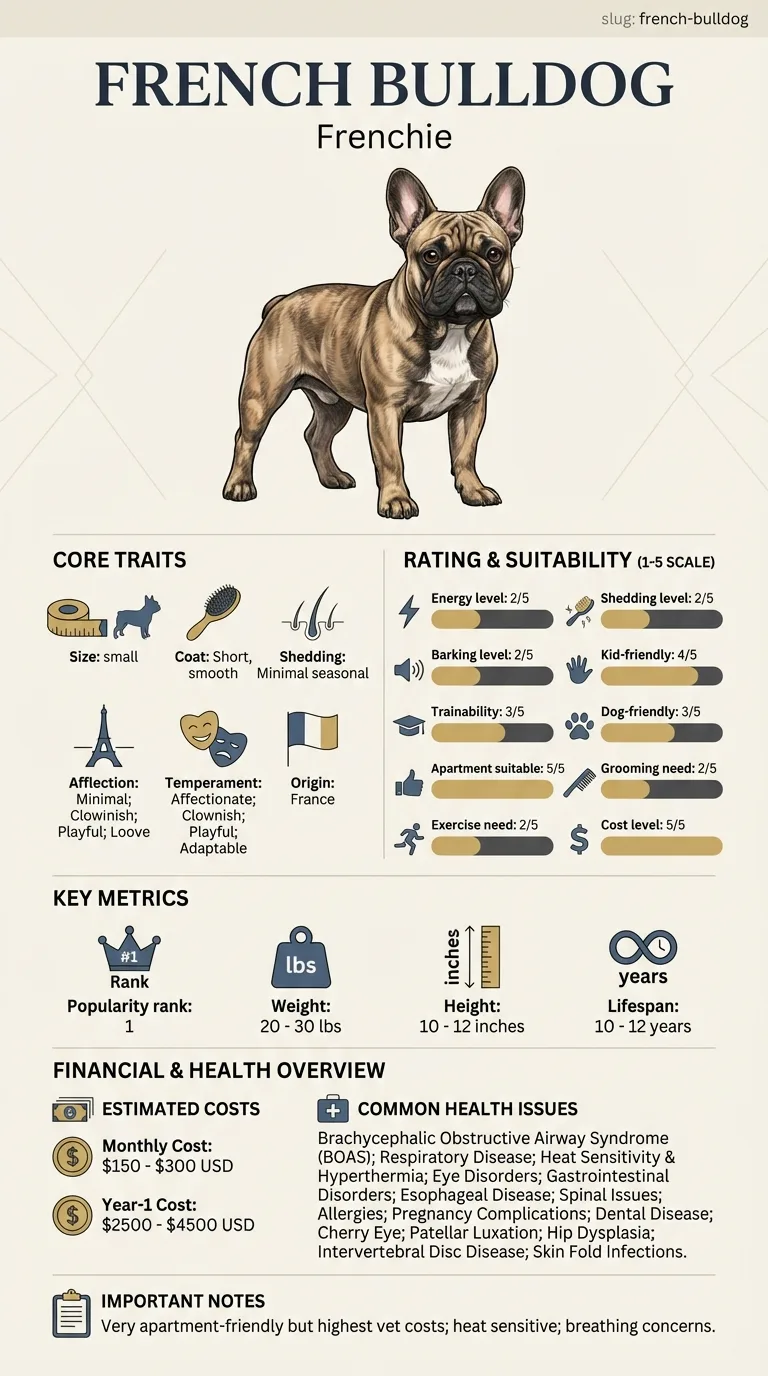
New Frenchie owners are often surprised to learn that the trait giving their dog its signature stocky shape is the same trait loading the dice toward back problems later. It's a harder conversation for owners who picked the breed specifically for that low, compact build without knowing the tradeoff.
This guide is not medical advice. If your dog shows pain, sudden behavior change, or worsening symptoms, consult a licensed veterinarian.
Some links may be affiliate links. We may earn a commission at no extra cost to you. We only suggest products we believe are helpful for dog owners.
We research and check what we publish, but we do not warrant that any figure, date, price, or statement is accurate, complete, or current, and we accept no liability for any loss, cost, injury, or other harm arising from the use of this site. Use it as one reference among several. You remain responsible for your own decisions and for your dog's care - confirm anything that matters with a licensed veterinarian or another qualified professional before you act on it. Full disclaimer.
Chondrodystrophy (often abbreviated CDDY) is a genetic trait affecting the FGF4 retrogene, altering how cartilage converts to bone during a puppy's growth. It's responsible for the short, sturdy legs and compact torso that define the French Bulldog's build. The same disrupted cartilage development affects the intervertebral discs along the spine, causing them to calcify and become brittle years earlier than in dogs without the trait.
Because chondrodystrophy underlies the breed's defining body type, the trait itself is extremely widespread in French Bulldogs. What varies is how much clinical trouble it causes — many dogs carry the trait their whole lives without ever developing a symptomatic disc problem, while others herniate a disc as young adults.
The FGF4 retrogene insertion responsible for chondrodystrophy is deeply embedded in the French Bulldog's genetic standard, which is precisely why the short-legged look breeds true so reliably. Selecting for that appearance over generations has meant selecting for the same cartilage changes that predispose the spine to early disc problems.
The trait itself isn't environmental, but how much trouble it causes is shaped by environment: body weight, exercise style, and everyday mechanical stress on the spine (jumping, rough play, stairs) all influence whether an already-vulnerable disc actually herniates or stays quiet for life.
This isn't a condition you 'treat' directly, but talk to your vet about baseline spine health at annual visits, and seek same-day care if your dog suddenly won't jump, walks with a hunched back, drags a paw, or yelps when picked up — those can signal an actual disc event happening on top of the underlying trait.
Because CDDY itself isn't 'treated,' most mistakes come from ignoring the risks it sets up rather than the trait itself.
See all French Bulldog health problems, which breeds are prone to chondrodystrophy cddy, or the full French Bulldog breed guide for temperament, exercise needs and ownership costs.
Chondrodystrophy itself is permanent and present from birth; there's no timeline for it to change. What you're managing is a lifelong elevated risk, which means the habits described here apply from puppyhood through old age, not just during a flare-up.
Success looks like a dog that reaches old age without ever having a clinically significant disc event, achieved through consistent weight control and reduced mechanical stress rather than any single fix.
Chondrodystrophy affects a gene involved in cartilage growth plates, and the visible result is the short, curved limbs seen in French Bulldogs, Dachshunds, and several other breeds. Less visible is what it does to the intervertebral discs that cushion the spine — the same abnormal cartilage development causes those discs to calcify and stiffen years earlier than in a normal-limbed dog.
A disc that calcifies loses its shock-absorbing gel center and becomes brittle. Under normal daily stress — jumping, twisting, an awkward landing — a brittle disc is far more likely to rupture or bulge into the spinal canal than a healthy, pliable one.
This is why chondrodystrophy isn't discussed as a standalone problem so much as the upstream reason French Bulldogs top the list for early intervertebral disc disease. Anything you do to protect your dog's spine over its lifetime is really a response to this underlying trait.

Bruno's owner had always let him leap onto the couch and back down dozens of times a day — it seemed harmless, even endearing. A routine vet visit at age three included a conversation about chondrodystrophy after the vet mentioned Bruno's build put him at real risk for disc problems down the line. Bruno's owner hadn't realized the short legs she loved were linked to anything beyond looks. She added a small ramp by the couch, cut back on trampoline-style play on the bed, and kept closer watch on his weight. Two years on, Bruno has had no signs of back trouble, and his owner credits the early conversation with changing habits before anything went wrong.
Key takeaway: Chondrodystrophy can't be undone, but the daily habits built around it can meaningfully change whether it ever becomes a real problem.
Not in itself — it's a genetic body-type trait affecting cartilage and bone growth that gives the breed its short legs and compact frame. The concern is what it does downstream, mainly accelerating disc calcification and raising the risk of intervertebral disc disease.
Yes, genetic tests for the CDDY variant are commercially available and increasingly used by breeders to understand risk in a line, though testing an already-owned pet is mainly informative rather than something that changes day-to-day care.
No. It substantially raises the odds compared to non-chondrodystrophic breeds, but plenty of affected dogs go their whole lives without a clinical disc herniation, especially with good weight and activity management.
You can't change the trait itself, but you can manage its consequences: keep your dog lean, limit repetitive jumping and hard landings, use ramps or steps for furniture and vehicles, and know the early warning signs of disc trouble.
Yes, it's the underlying genetic cause of the short, sturdy limb structure that defines the breed's look, alongside related effects on the spine and rib cartilage.
The trait is extremely common across the breed given how central it is to the standard body type, though individual variation exists and genetic testing is the only way to confirm status in a specific dog.
That's a personal decision, but it's worth going in informed: this trait is tied to elevated spine risk for the dog's whole life, and budgeting for that possibility — both financially and in daily habits — is part of responsible ownership of the breed.
Chondrodystrophy — a genetic trait affecting cartilage growth that produces short limbs and a compact body.
No, CDDY is the underlying genetic trait; IVDD (disc disease) is a downstream condition it substantially raises the risk of.
Genetic testing lets breeders make informed choices, but the trait is deeply tied to the breed's defining body shape.
No — risk is elevated, not guaranteed, and lifestyle factors like weight and activity meaningfully affect the odds.
Keep your dog lean and limit repetitive jumping onto and off furniture to reduce mechanical stress on the spine.
A one-page prep sheet for this condition: the signs, the questions to ask, what to get priced. Unlocks here.
You get: Vet visit prep sheet
No spam. One-click unsubscribe. See our privacy policy.
Preview page 1 before you decide.