Behavior
Which is the better overall choice?
It depends entirely on space and experience — the Chihuahua suits small spaces and lower activity, the Corso needs an experienced owner with room to spare.

Quick answer
Which is the better overall choice?
It depends entirely on space and experience — the Chihuahua suits small spaces and lower activity, the Corso needs an experienced owner with room to spare.
Cane Corso or Chihuahua? On paper they differ most on apartment suitability, and on the scales Cane Corso is the heavier at 90–110 lbs. Here is how the two compare on everything that shapes an ordinary week.
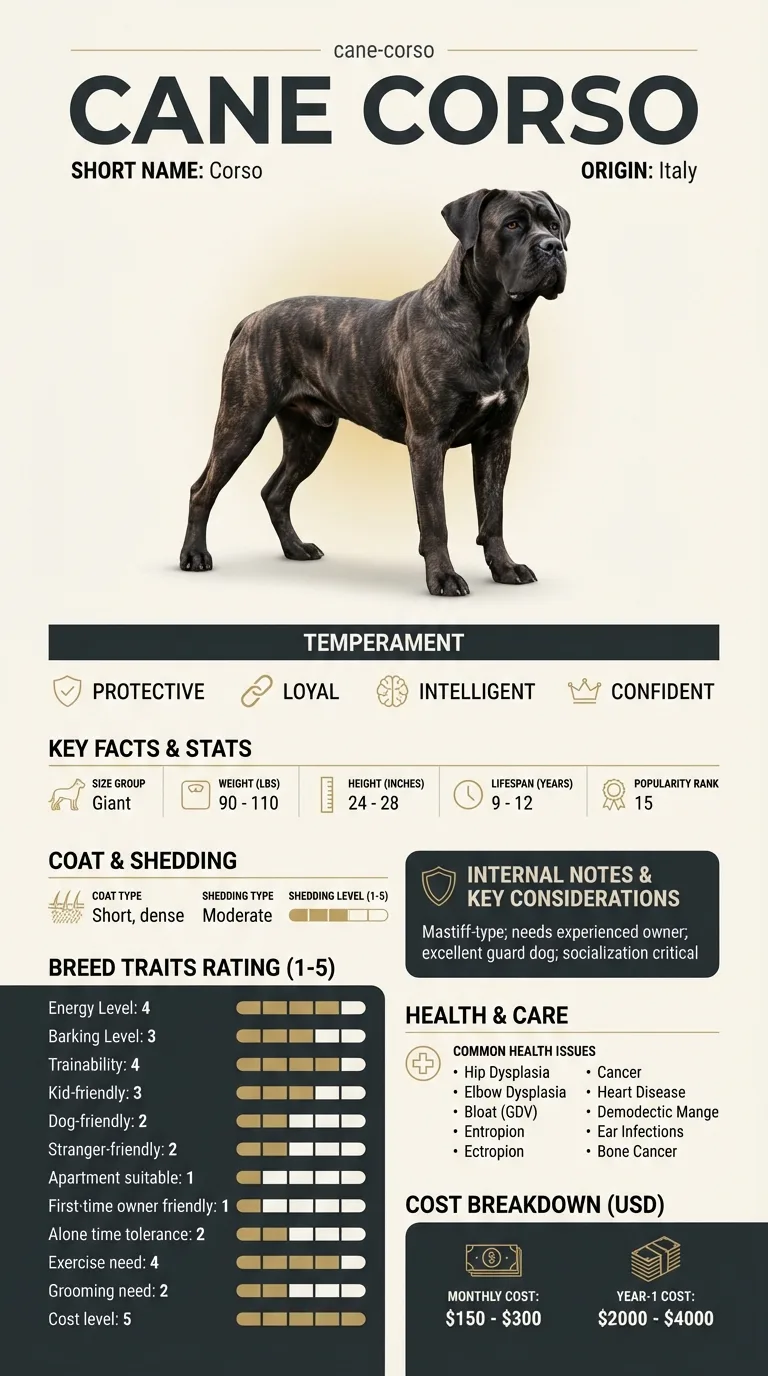
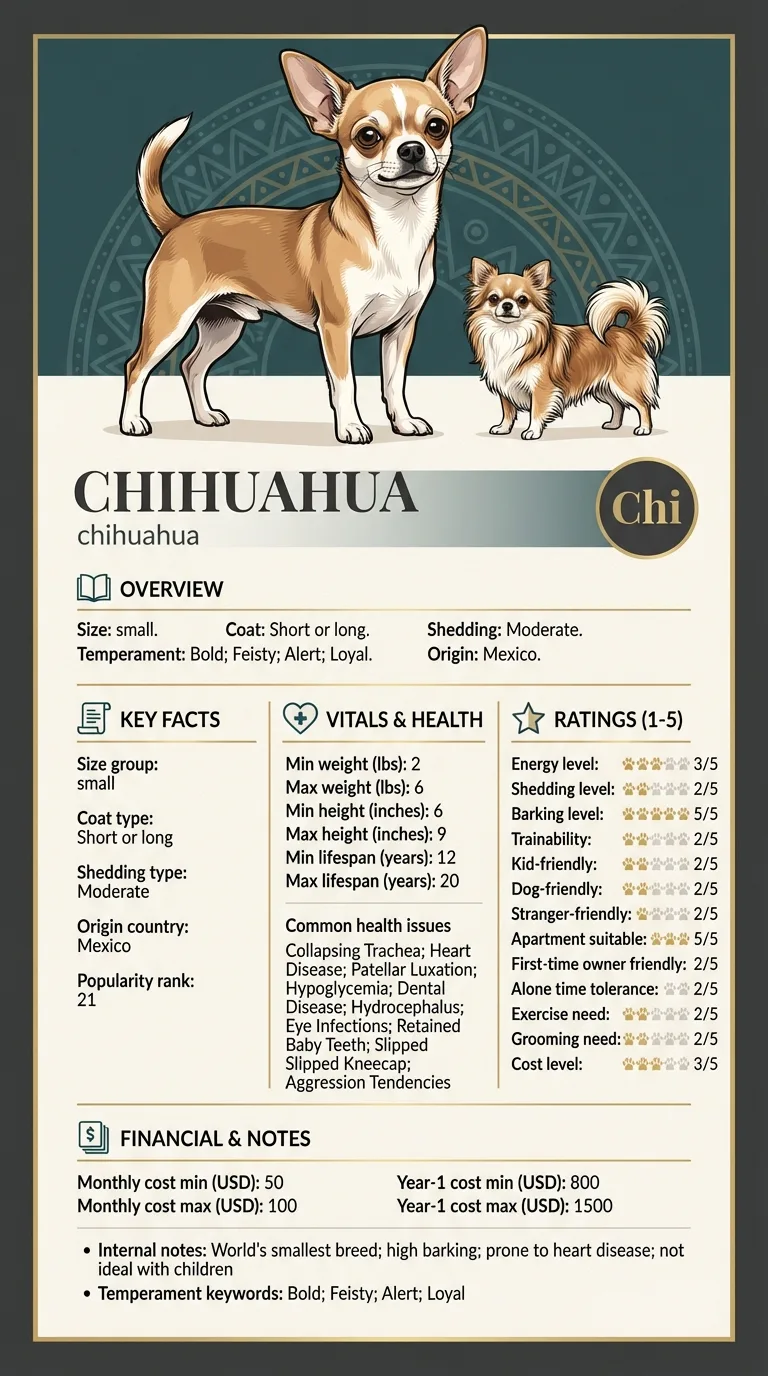
This is for someone already down to Cane Corso and Chihuahua and deciding between them. For this pair the decision usually turns on apartment suitability and exercise need, so those are covered first and in most detail. Anyone choosing from a flat has a clear answer here: Chihuahua rates 5/5 against 1/5. The focus throughout is on daily consequences rather than breed background.
Between Cane Corso and Chihuahua, apartment suitability is what separates them, and Chihuahua is the lower-effort dog of the two to keep.
Choose Cane Corso if you want a dog that picks up training quickly and you want a dog that can keep up with an active routine.
Choose Chihuahua if you are in a flat or a smaller home, shedding is a problem in your house and your walking routine is modest.
| Feature | cane corso | chihuahua | Winner |
|---|---|---|---|
| Size class | giant | small | Equal |
| Weight | 90–110 lbs | 2–6 lbs | Equal |
| Height | 24–28 in | 6–9 in | Equal |
| Lifespan | 9–12 years | 12–20 years | chihuahua |
| Exercise need | High (4/5) | Low (2/5) | chihuahua |
| Grooming need | Low (2/5) | Low (2/5) | Equal |
| Shedding | Moderate (3/5) | Low (2/5) | chihuahua |
| Energy level | High (4/5) | Moderate (3/5) | Equal |
| Barking | Moderate (3/5) | Very high (5/5) | cane corso |
| Apartment suitability | Very low (1/5) | Very high (5/5) | chihuahua |
| Good for first-time owners | Very low (1/5) | Low (2/5) | chihuahua |
| Tolerates being alone | Low (2/5) | Low (2/5) | Equal |
| Trainability | High (4/5) | Low (2/5) | cane corso |
| Good with kids | Moderate (3/5) | Low (2/5) | cane corso |
| Good with other dogs | Low (2/5) | Low (2/5) | Equal |
| Friendly to strangers | Low (2/5) | Low (2/5) | Equal |
| Cost level | Very high (5/5) | Moderate (3/5) | chihuahua |
| Coat | Short, dense | Short or long | Equal |
| Origin | Italy | Mexico | Equal |
| Typical monthly cost | $150–$300 | $50–$100 | Equal |
| Typical first-year cost | $2,000–$4,000 | $800–$1,500 | Equal |
This is the most extreme size gap this site tracks: a 90-110 lb, 24-28 inch Cane Corso against a 2-6 lb, 6-9 inch Chihuahua. A large adult Corso can outweigh a Chihuahua by a factor of thirty or more. There is genuinely no overlap in what handling the dog means between these two breeds — one is carried in a bag, the other can pull you off your feet if it wants to.
The Corso needs considerably more daily exercise, rated high (4/5) against the Chihuahua's low (2/5). A guardian breed of the Corso's size needs structured activity to stay manageable; a Chihuahua's needs are met with short walks and indoor play, which is part of why it travels and apartment-lives so much more easily. Even a Chihuahua's version of a "big walk" is a fraction of what a working guardian breed needs just to feel settled.
Both are low-maintenance coat-wise, tying at low (2/5) for grooming, though the Chihuahua sheds slightly less, 2/5 versus the Corso's moderate 3/5. Neither breed demands much brushing or trimming — this is one of the few categories where size doesn't drive the difference. Long-coated Chihuahuas need a bit more brushing than short-coated ones, but even then it's a fraction of the effort a double-coated breed would require.
Apartment suitability flips the expected size logic on its head only partway: the Chihuahua rates very high (5/5) against the Corso's very low (1/5), as expected for the size gap. But the Chihuahua is also the louder dog by far — very high barking (5/5) against the Corso's moderate (3/5) — so a small apartment with a Chihuahua isn't automatically a quiet one.
The Corso is rated far more trainable, high (4/5) against the Chihuahua's low (2/5), which runs counter to the size-based instinct that a small dog must be the easier one. Neither breed is rated well for first-time owners — 1/5 for the Corso given its size and protective instincts, 2/5 for the Chihuahua given its stubborn streak and tendency toward reactivity.
The Corso rates better with kids, moderate (3/5) against the Chihuahua's low (2/5) — the Chihuahua's health list even flags Aggression Tendencies directly, and its temperament is described as bold and feisty rather than tolerant. Both tie at low with other dogs and low with strangers; neither is naturally the welcoming type. Small children and small dogs are a genuinely risky combination in both directions, and this pair is worth close supervision either way.
The Chihuahua's lifespan range is remarkable — 12-20 years, the longest range and highest ceiling in this entire comparison, against the Corso's 9-12. Their health risks barely overlap; heart disease is the one shared item. The Chihuahua's list runs toward small-dog issues like collapsing trachea, hypoglycemia, and dental disease, while the Corso's centers on joint problems, bloat, and cancer tied to its size.
The Corso costs substantially more to keep: very high (5/5) cost level against the Chihuahua's moderate (3/5), $150-300 monthly versus $50-100, and $2,000-4,000 in year one against just $800-1,500. Feeding and treating a 100-pound dog costs multiples of what a 4-pound dog costs, and the numbers here reflect that directly, from food volume to medication dosing to the size of the crate or bed you'll need to buy.
Cane Corso weighs 90–110 lbs and lives 9–12 years; Chihuahua weighs 2–6 lbs and lives 12–20 years. The two diverge most on apartment suitability, exercise need and barking and 2 other rated axes. They are level on tolerates being alone, good with other dogs and grooming need, so those cannot decide it. The table below marks a winner only where one breed is genuinely easier for a typical owner; size and origin are facts rather than merits and stay level. Ratings come from one source applied to both breeds, so they are meaningful against each other rather than as absolute scores.

By a huge margin — 90-110 lbs versus 2-6 lbs for the Chihuahua. This is the widest size gap tracked anywhere on this site.
The Chihuahua, rated very high (5/5) against the Corso's moderate (3/5) — small size doesn't mean small voice with this breed.
Neither scores well — the Corso rates a very low 1/5 due to its size and protective instincts, and the Chihuahua only slightly better at 2/5, given its stubborn, sometimes reactive temperament.
The Chihuahua, at 5/5 versus the Corso's very low 1/5 — though its high barking tendency is worth planning around even in a small space.
The Chihuahua, substantially — $50-100 a month and $800-1,500 in year one, against $150-300 and $2,000-4,000 for the Corso. Body size drives most of that gap.
Only heart disease overlaps directly. The Chihuahua's list is dominated by small-dog issues like collapsing trachea and hypoglycemia; the Corso's by joint and size-related conditions like bloat and bone cancer.
The Chihuahua, dramatically — up to 20 years against the Corso's 9-12. That's among the longest lifespans this site tracks for any breed.
It depends entirely on space and experience — the Chihuahua suits small spaces and lower activity, the Corso needs an experienced owner with room to spare.
The Chihuahua, at $50-100 versus the Corso's $150-300.
The Cane Corso, rated 4/5 against the Chihuahua's 2/5.
The Chihuahua, potentially up to 20 years, versus 9-12 for the Corso.
Secure checkout on Stripe. We never see your card.
7-day money-back guarantee. Instant access.

Health information here is general and is not veterinary advice. If your dog shows pain, sudden behaviour change, or worsening symptoms, consult a licensed veterinarian.
Some links on this site are affiliate links. We may earn a commission at no extra cost to you, and we only suggest products we believe are helpful for dog owners.
We research and check what we publish, but we do not warrant that any figure, date, price, or statement is accurate, complete, or current, and we accept no liability for any loss, cost, injury, or other harm arising from the use of this site. Use it as one reference among several. You remain responsible for your own decisions and for your dog's care - confirm anything that matters with a licensed veterinarian or another qualified professional before you act on it. Full disclaimer.
Match your lifestyle to the right dog.
Take quizNot sure which breed is right for you? Take our 2-minute quiz to find out.
Take the quiz