Health
What are comedones on a dog?
Hair follicles blocked with keratin and sebum, appearing as small dark plugs in the skin. They are a finding with many possible causes rather than a diagnosis.

Quick answer
What are comedones on a dog?
Hair follicles blocked with keratin and sebum, appearing as small dark plugs in the skin. They are a finding with many possible causes rather than a diagnosis.
Blackheads on a dog are a description, not a diagnosis. The same bump means different things depending on where on the body it sits.
Owners who have found small dark plugs on a Boston's belly, groin or back and have searched the appearance rather than the location, landing on a Schnauzer condition.
This guide is not medical advice. If your dog shows pain, sudden behavior change, or worsening symptoms, consult a licensed veterinarian.
Some links may be affiliate links. We may earn a commission at no extra cost to you. We only suggest products we believe are helpful for dog owners.
We research and check what we publish, but we do not warrant that any figure, date, price, or statement is accurate, complete, or current, and we accept no liability for any loss, cost, injury, or other harm arising from the use of this site. Use it as one reference among several. You remain responsible for your own decisions and for your dog's care - confirm anything that matters with a licensed veterinarian or another qualified professional before you act on it. Full disclaimer.
Comedones are plugged hair follicles, visible as small dark bumps. Schnauzer comedo syndrome is one specific breed-restricted cause of them. In a Boston Terrier the same appearance is produced by a different set of conditions, and distinguishing between them relies on where the lesions are, whether the dog is itchy, and what a microscope shows.
Comedones as a finding are common in short-coated dogs and frequently incidental. Schnauzer comedo syndrome specifically is confined almost entirely to Miniature Schnauzers and is not documented in Boston Terriers. Skin problems in general are one of the more frequent reasons Boston owners visit a vet, but the diagnoses behind them are allergy, infection and fold dermatitis rather than a follicular keratinisation disorder.
The Boston Terrier's short smooth coat with low grooming needs means skin is visible and lesions are noticed early, which explains why owners of this breed spot comedones that would be hidden in a fluffy dog. Two genuine breed features contribute to follicular problems: facial folds around a shortened muzzle, and the fold that commonly accompanies a screw tail. Both trap moisture against skin, which is the setup for inflamed and blocked follicles. Neither is a keratinisation disorder.
Sun exposure on a thinly haired abdomen contributes to comedone formation in dogs that sunbathe. Humidity and inadequate drying after baths or swimming keep folds moist. Harsh or inappropriate shampoos strip the skin barrier. Bedding that is not washed regularly, and pressure points where a dog lies on hard surfaces, both concentrate follicular irritation in predictable locations.
Book an appointment if lesions are increasing, becoming red or painful, developing discharge, or if the dog is scratching, licking or rubbing the area. Ask for cytology and a skin scrape rather than accepting a treatment trial without testing. Seek urgent care for rapidly spreading skin lesions, ulceration, sores that will not heal, or skin problems accompanied by lethargy or fever. Do not squeeze lesions or apply human acne treatments while you wait.
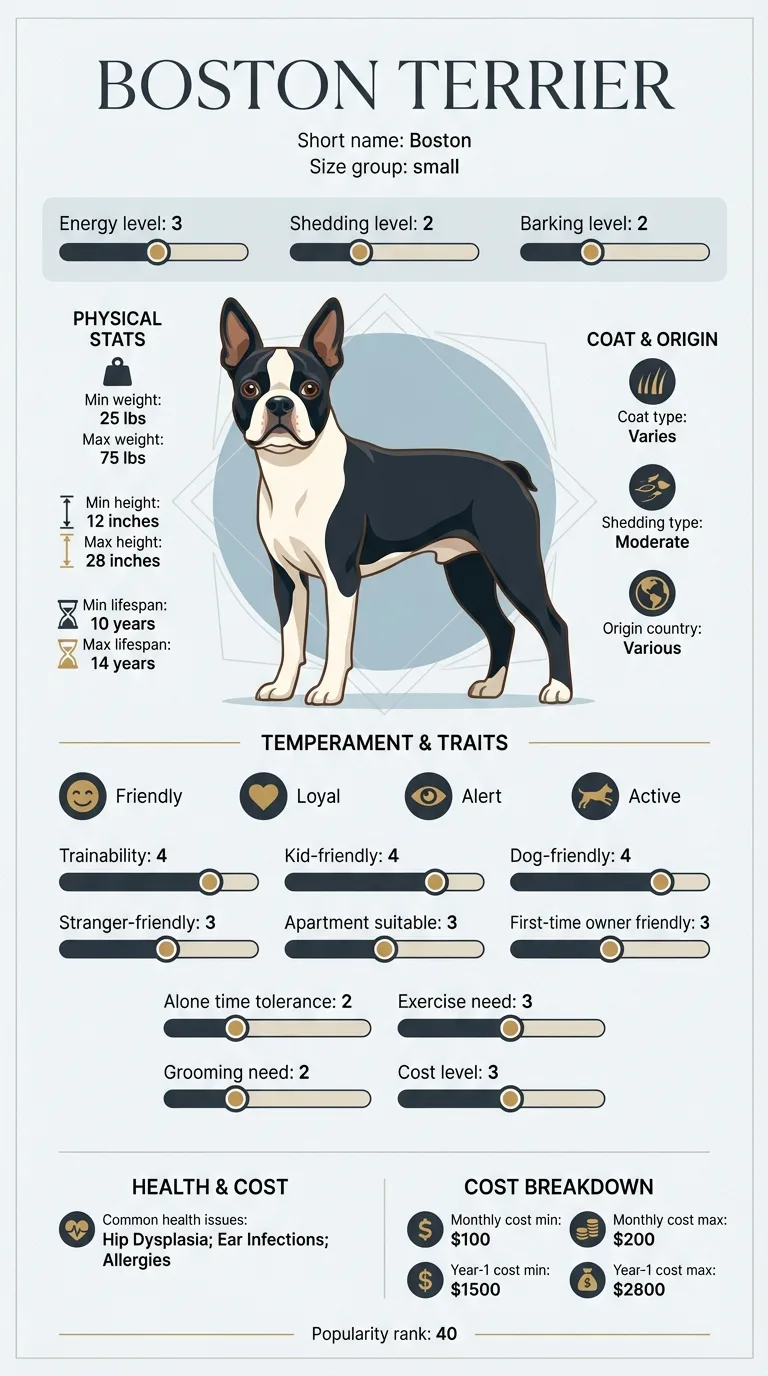
See all Boston Terrier health problems, which breeds are prone to schnauzer comedo syndrome, or the full Boston Terrier breed guide for temperament, exercise needs and ownership costs.
Cytology and a scrape give answers the same day. Bacterial infection typically clears over two to four weeks. Mite treatment runs for weeks to months with repeat testing. Allergic disease has no endpoint and is managed continuously. Incidental comedones on the belly may simply be monitored indefinitely and never need anything.
A named cause, a treatment aimed at it, and a dog that is comfortable. For many Bostons with belly comedones, success is being told confidently that nothing needs doing, which is a legitimate and common outcome rather than a brush-off.
In dermatology, where a lesion sits narrows the list faster than what it looks like. These are the patterns that matter in a short-coated dog.
The first step is almost always cytology. A sample is taken by pressing tape or a slide against the affected skin, stained, and examined under a microscope. It takes minutes and distinguishes bacterial infection, yeast overgrowth and inflammatory cells from a purely structural plug. Skipping this step is how dogs end up on the wrong treatment for months.
A skin scrape checks for mites. Demodex mites live in hair follicles and produce exactly the follicular plugging, patchy hair loss and secondary infection that owners describe as blackheads. In a young dog with follicular lesions, mites are near the top of the list and are entirely treatable once identified.
If the lesions are itchy and recurrent, the investigation turns toward allergy: flea control first because it is cheap and rules out the most common trigger, then a structured elimination diet or environmental workup depending on the pattern and seasonality.
If there is symmetrical hair loss without itching, alongside weight change or lethargy, endocrine testing follows.
Biopsy is reserved for cases that do not fit, and it is what would actually confirm a follicular keratinisation disorder rather than the appearance alone.
What owners should not do is squeeze the lesions or scrub them with human acne products. Both damage the follicle wall, drive infection deeper, and turn a cosmetic finding into a painful one.

If you think your Boston has schnauzer comedo syndrome, the plan is three steps: write down what you have seen and when it started, book a veterinary appointment rather than waiting for the next flare, and take video of the behaviour or symptom before you go — the thing you are worried about rarely happens in the consulting room. Screening in the parents covers brachycephalic airway syndrome (boas), patellar luxation, cataracts.
What the vet visit should produce is a diagnosis and a written plan, not just reassurance: what is being ruled out, what the monitoring interval is, and which signs mean you come back sooner. Ask what the treatment costs across a year rather than per visit, because that is the number that decides whether you are managing this condition or reacting to it.
Between appointments, keep a short log — dates, what you saw, what changed. It is the single most useful thing an owner brings to a follow-up, and for schnauzer comedo syndrome it is often what separates a clear pattern from a guess.
Elsie was three when her owner Dominic found a run of small dark bumps along her groin. He searched the appearance, found a Schnauzer condition that matched the photographs closely, and bought a keratolytic shampoo online. He bathed her twice weekly for six weeks. The bumps did not change, and her skin became dry and flaky, which he took as a sign it was working. At her annual vaccination he mentioned it. The vet took a tape sample and a scrape, both in the consulting room. The scrape found Demodex mites. Elsie had a follicular mite infestation, which produces exactly the plugged, bumpy appearance he had photographed. She was treated appropriately over eight weeks with repeat scrapes, and the skin cleared. Dominic's shampoo had not caused the problem, but it had not touched it either, and the six weeks he spent on it were six weeks the mites were multiplying.
Key takeaway: Two conditions can look identical and have nothing in common. A tape sample and a skin scrape cost very little and would have redirected this whole story on day one.
It is described almost exclusively in Miniature Schnauzers and is not a documented Boston Terrier condition. The breed's recognised health issues are brachycephalic airway syndrome, patellar luxation, cataracts, corneal ulcers and deafness. Follicular plugging in a Boston is far more likely to reflect allergy, mites, fold dermatitis or a hormonal cause.
Small comedones on the sparsely haired belly and groin are a common incidental finding, particularly in dogs that sunbathe on their backs. If they are not inflamed, not itchy, and not increasing, many vets will simply note them. Changes in number, redness or discomfort shift that assessment.
No. Squeezing ruptures the follicle wall and pushes keratin and bacteria into the surrounding tissue, which converts a harmless plug into an inflamed, painful nodule that then needs treating. This is the single most common way owners make the situation worse.
Not without veterinary direction. Some ingredients used in canine dermatology overlap with human products, but concentrations, formulations and pH differ, and a dog will lick treated skin. Ask your vet for a product intended for dogs and for the specific diagnosis.
That is fold dermatitis, and it is genuinely common in this breed because a screw tail often comes with a deep fold that traps moisture and debris. It responds to keeping the area clean and dry, and to veterinary treatment when infected. It is a mechanical and hygiene problem rather than a follicular disease.
It depends entirely on the cause. Mites need weeks to months of treatment with repeat scrapes. Bacterial folliculitis typically responds over two to four weeks. Allergic skin disease is managed rather than cured and needs ongoing work. A structural plugging disorder would be lifelong management with medicated bathing.
Hair follicles blocked with keratin and sebum, appearing as small dark plugs in the skin. They are a finding with many possible causes rather than a diagnosis.
Cytology, taking a sample of the skin surface and examining it under a microscope, usually alongside a skin scrape for mites. Both are quick and inexpensive.
It can be. The fold beside a screw tail traps moisture and needs regular cleaning and drying, otherwise it becomes an inflamed and often infected area.
Follow your vet's schedule for the medicated product prescribed. Over-bathing with the wrong shampoo strips the skin barrier and makes most conditions worse.
A one-page prep sheet for this condition: the signs, the questions to ask, what to get priced. Unlocks here.
You get: Vet visit prep sheet
No spam. One-click unsubscribe. See our privacy policy.
Preview page 1 before you decide.