Health
What is Schnauzer comedo syndrome?
A follicular keratinisation disorder producing comedones — blackheads — in a band along the dog's back. It is named for the Miniature Schnauzer and is uncommon in Yorkshire Terriers.

Quick answer
What is Schnauzer comedo syndrome?
A follicular keratinisation disorder producing comedones — blackheads — in a band along the dog's back. It is named for the Miniature Schnauzer and is uncommon in Yorkshire Terriers.
Run your fingers along your Yorkie's spine and you feel them before you see them — small, firm bumps under the coat, like grit worked into the skin. Part the hair and they resolve into dark plugged pores, blackheads in everything but name, marching in a band down the midline of the back. That is comedo syndrome, and the coat is exactly why it goes unnoticed for so long.
Owners of long-coated dogs, because a dense, silky coat hides the affected skin completely. Also anyone whose dog has been on a rotation of allergy treatments without real improvement — this breed carries documented allergies, so an itchy, bumpy back has an obvious explanation available, and comedo syndrome does not respond to it.
This guide is not medical advice. If your dog shows pain, sudden behavior change, or worsening symptoms, consult a licensed veterinarian.
Some links may be affiliate links. We may earn a commission at no extra cost to you. We only suggest products we believe are helpful for dog owners.
We research and check what we publish, but we do not warrant that any figure, date, price, or statement is accurate, complete, or current, and we accept no liability for any loss, cost, injury, or other harm arising from the use of this site. Use it as one reference among several. You remain responsible for your own decisions and for your dog's care - confirm anything that matters with a licensed veterinarian or another qualified professional before you act on it. Full disclaimer.
A follicular keratinisation disorder in which hair follicles along the back plug with keratin and oily debris, forming comedones — blackheads. The plugs themselves are not painful, but they can rupture and become secondarily infected, producing sore, crusted spots. It is managed with topical care rather than cured, and it is not an allergy.
Genuinely uncommon in Yorkshire Terriers. It is named for and classically described in the Miniature Schnauzer, where it is well recognised. In this breed it should be considered when the presentation fits — a distinct band of comedones along the topline — and particularly when allergy-directed treatment has repeatedly failed to hold.
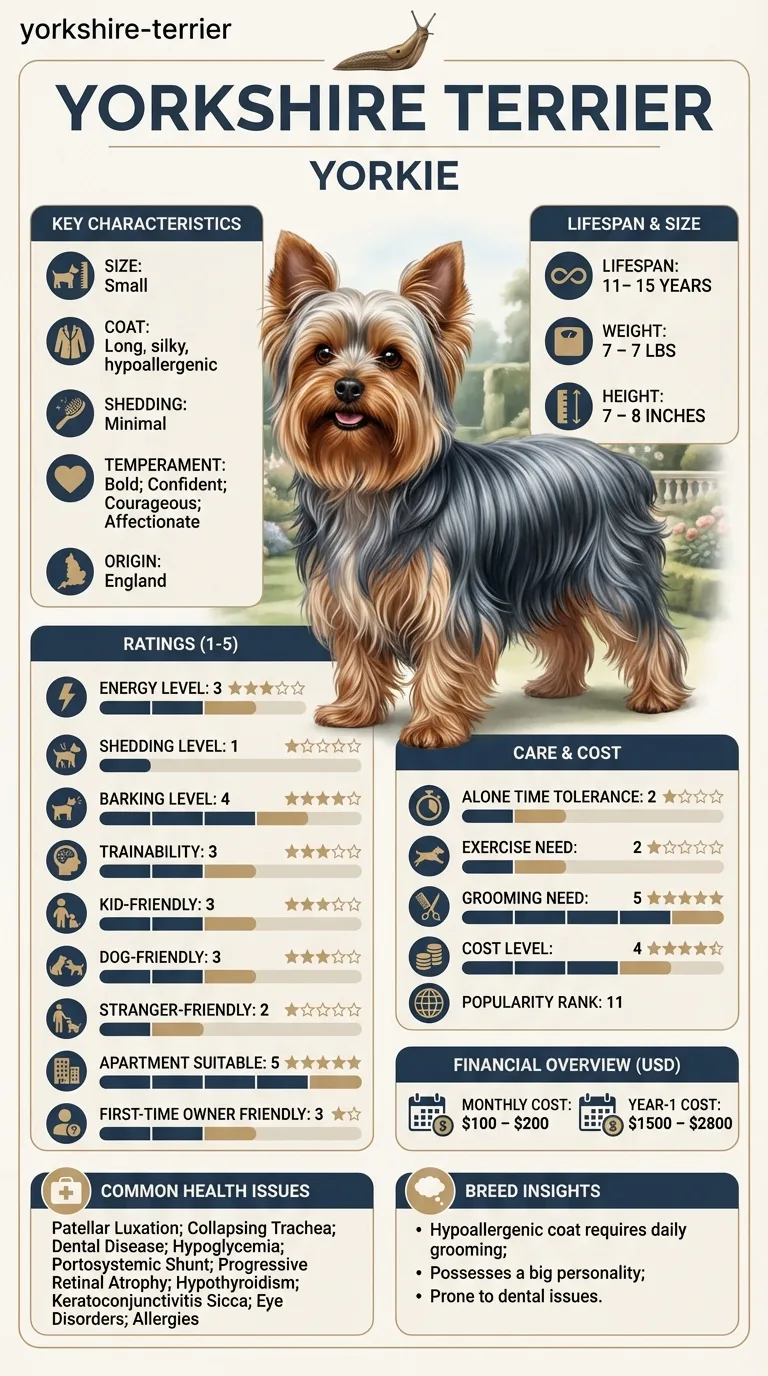
The mechanism is follicular rather than breed-specific, and it is honest to say that this condition is not typical of Yorkshire Terriers. What the breed contributes is concealment and confusion: a long, silky coat hides the affected skin so the problem is found late, and the breed's documented allergies supply a competing diagnosis that absorbs months of treatment. The breed's documented top-tier grooming need is relevant in a useful way — a dog already being handled and bathed frequently gives an attentive owner more chances to feel the change.
Environment does not cause the follicular defect, but grooming routine strongly affects how it behaves. Long gaps between baths let oil and debris accumulate in already-sluggish follicles. Heavy conditioning products left on the skin can add to the load. Rough clipping along the topline can traumatise the area. Damp coat left to dry slowly against the skin favours the secondary infections that turn quiet comedones into painful ones.
Book an appointment for any persistent bumpy band along the spine, particularly if previous allergy treatment has not held. Describe the location and the plugged-pore texture explicitly. Seek prompt attention if spots become red, swollen, painful, ooze or crust, or if the dog becomes reluctant to be touched along the back — that indicates secondary infection needing treatment rather than home management. Ask specifically whether this is a keratinisation disorder rather than an allergy, and what topical protocol your vet recommends; medicated shampoos for this purpose are veterinary decisions, not shelf purchases. Any dog that becomes systemically unwell — off food, feverish, lethargic — needs to be seen promptly rather than managed at home.
Start here: Yorkshire Terrier Most Common Genetic Disorders: Screening
See all Yorkshire Terrier health problems, which breeds are prone to schnauzer comedo syndrome, or the full Yorkshire Terrier breed guide for temperament, exercise needs and ownership costs.
This is controlled, not cured. With an appropriate topical routine, existing comedones soften and reduce over weeks rather than days, and secondary infections clear on their own treatment timeline. Expect to keep some version of the routine permanently — most dogs relapse within weeks to months if maintenance stops, because the underlying follicular defect has not gone anywhere.
Success is skin that stays quiet: comedones present but not multiplying, no painful ruptured spots, no repeated courses of antibiotics, and a dog comfortable being handled along the back. Owners expecting the bumps to disappear entirely will feel like the treatment is failing when it is in fact working exactly as well as it can.
In a short-coated dog, comedones are visible. In a Yorkshire Terrier with a long, silky coat, they are not, and almost every owner who finds this finds it while grooming or bathing rather than while looking at the dog.
The distribution is the most useful diagnostic clue available to an owner. Comedo syndrome sits along the topline — the midline of the back, roughly from behind the shoulders toward the tail base. It is a band, not a scatter. Allergic skin disease in this breed tends to go elsewhere entirely: belly, armpits, groin, paws, face and ears.
What you feel is a texture, like coarse sand under the skin. Parted coat shows dark plugs sitting in the pore openings. Some remain quiet indefinitely. Others rupture, become infected, and turn into inflamed, painful spots with crusting — and it is usually at that point, not at the blackhead stage, that a vet visit finally happens.
This is the practical trap. Allergies are on this breed's documented health list, so a Yorkie with a bumpy, occasionally sore back gets an allergy work-up, a diet trial, and often a course of steroids or an anti-itch medication. Some of that helps the secondary infection. None of it addresses the plugged follicles, because the underlying problem is a keratinisation defect rather than an immune reaction to something in the environment.
The pattern that should prompt a rethink is treatment that partly works and then relapses in exactly the same place. Antibiotics clear the infected spots, the skin settles, and weeks later the same band along the spine flares again — because the comedones were never resolved, only the infection sitting on top of them.
Diagnosis is usually clinical, based on that characteristic topline distribution and appearance, sometimes with skin cytology to identify secondary infection or a biopsy where the picture is unclear. Say to your vet specifically that the bumps are along the spine and that you can feel plugged pores, because that framing points somewhere different than 'my dog is itchy.'

If you think your Yorkie has schnauzer comedo syndrome, the plan is three steps: write down what you have seen and when it started, book a veterinary appointment rather than waiting for the next flare, and take video of the behaviour or symptom before you go — the thing you are worried about rarely happens in the consulting room. Screening in the parents covers patellar luxation, collapsing trachea, dental disease.
What the vet visit should produce is a diagnosis and a written plan, not just reassurance: what is being ruled out, what the monitoring interval is, and which signs mean you come back sooner. Ask what the treatment costs across a year rather than per visit, because that is the number that decides whether you are managing this condition or reacting to it.
Between appointments, keep a short log — dates, what you saw, what changed. It is the single most useful thing an owner brings to a follow-up, and for schnauzer comedo syndrome it is often what separates a clear pattern from a guess.
A five-year-old Yorkie spent most of a year being treated for suspected allergies after developing recurring sore spots on her back. Two diet trials and several courses of medication produced the same pattern each time: the infected spots cleared, the skin looked fine for a month, and then the same stretch behind her shoulders flared again. It was a new groomer who mentioned, almost in passing, that the dog's back felt gritty under the coat. Parted in good light, the midline was a clear band of plugged pores. The revised diagnosis changed the whole approach — a medicated topical routine, careful drying after baths, and no more squeezing or picking. She still has comedones. She has not had an infected spot in two years.
Key takeaway: Allergy treatment that keeps working and then keeps relapsing in the same spot is a hint that the diagnosis, not the drug, is the problem.
Because it was described in and is classically associated with the Miniature Schnauzer. The name reflects where it is most recognised, not a requirement that your dog be one. It is genuinely uncommon in Yorkshire Terriers.
Location and mechanism. Allergic skin disease in this breed tends to hit belly, armpits, groin, paws and face; comedo syndrome forms a band along the spine. One is an immune reaction, the other a follicular plugging defect — which is why allergy treatment does not resolve it.
No. Rupturing a plugged follicle is exactly how a harmless comedone becomes an infected, painful sore. Leave them alone and manage the skin topically.
It makes monitoring and topical treatment easier, and your vet may suggest it. But clipping must be gentle — grooming trauma along an already-compromised topline can aggravate the area.
The comedones themselves usually are not. Once one ruptures and becomes infected, that spot genuinely is, and dogs often start objecting to being touched along the back at that stage.
Realistically no. The follicular defect persists, so the goal is long-term control with maintenance skin care rather than a cure.
No — human products can be irritating or unsafe on canine skin. Medicated shampoos used for this condition are a veterinary decision, and the wrong product can make an inflamed topline considerably worse.
A follicular keratinisation disorder producing comedones — blackheads — in a band along the dog's back. It is named for the Miniature Schnauzer and is uncommon in Yorkshire Terriers.
By touch. Run fingers along the spine against the coat; it feels like coarse grit under the skin. Parting the coat shows dark plugged pores along the midline.
No. Allergies affect belly, armpits, groin and face; this forms a band along the spine and does not respond to allergy treatment, which is the usual clue.
It is controlled rather than cured. Topical maintenance keeps it quiet, and most dogs relapse within weeks to months if the routine stops.
When spots turn red, swollen, painful, oozing or crusted — that is secondary infection and needs veterinary treatment rather than home care.
A one-page prep sheet for this condition: the signs, the questions to ask, what to get priced. Unlocks here.
You get: Vet visit prep sheet
No spam. One-click unsubscribe. See our privacy policy.
Preview page 1 before you decide.