Health
Is hypothyroidism common in Australian Shepherds?
Yes — it's one of the documented common health issues for this breed.

Quick answer
Is hypothyroidism common in Australian Shepherds?
Yes — it's one of the documented common health issues for this breed.
This is the condition where a normally tireless dog starts seeming, for no obvious reason, like a different dog.
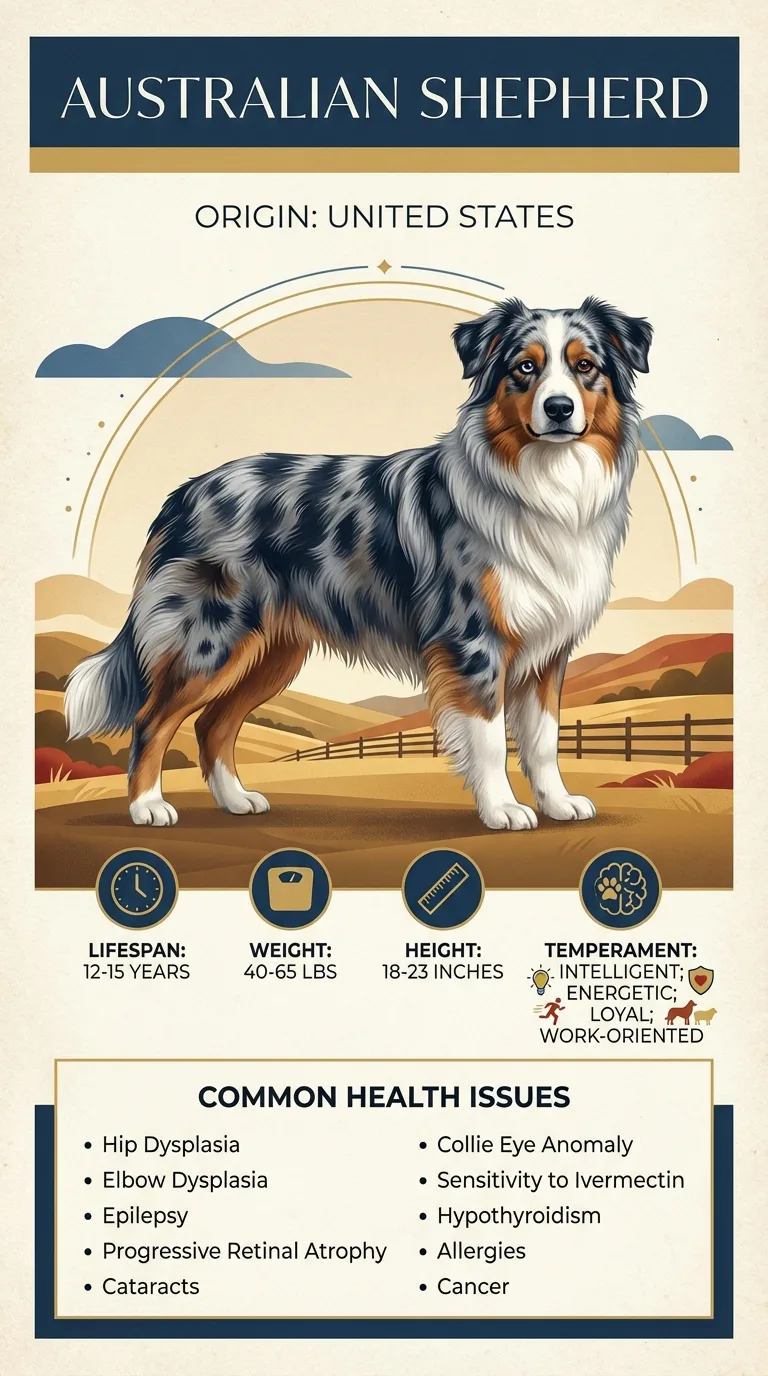
Owners who've noticed their Aussie gaining weight despite an unchanged routine, or seeming unusually flat and uninterested in activity it used to love.
This guide is not medical advice. If your dog shows pain, sudden behavior change, or worsening symptoms, consult a licensed veterinarian.
Some links may be affiliate links. We may earn a commission at no extra cost to you. We only suggest products we believe are helpful for dog owners.
We research and check what we publish, but we do not warrant that any figure, date, price, or statement is accurate, complete, or current, and we accept no liability for any loss, cost, injury, or other harm arising from the use of this site. Use it as one reference among several. You remain responsible for your own decisions and for your dog's care - confirm anything that matters with a licensed veterinarian or another qualified professional before you act on it. Full disclaimer.
Hypothyroidism is a documented health issue in Australian Shepherds where the thyroid gland no longer produces enough hormone to keep metabolism running normally. Because this breed's baseline is so much drive and stamina, the resulting weight gain and drop in enthusiasm for activity tend to stand out clearly once owners know to look for the pattern, even though the changes themselves creep in gradually.
Hypothyroidism is documented as a common health issue for this breed, most often diagnosed in middle-aged dogs, and it responds well to daily management once identified.
Hypothyroidism is a documented common health issue in Australian Shepherds, and in a significant share of cases it stems from an underlying autoimmune process that gradually damages thyroid tissue over time.
There's no strong environmental trigger for hypothyroidism itself; it develops from within the thyroid gland's own tissue changes rather than from diet, exposure, or activity level, though obesity can sometimes compound and mask the picture.
Talk to your vet about thyroid testing if you notice unexplained weight gain, a sustained drop in energy lasting more than a few weeks, coat thinning, or recurring skin or ear infections. This isn't an emergency condition, but it shouldn't be left unaddressed for months either, since symptoms will typically persist or worsen without treatment.
See all Australian Shepherd health problems, which breeds are prone to hypothyroidism, or the full Australian Shepherd breed guide for temperament, exercise needs and ownership costs.
Diagnosis typically takes a single blood test, occasionally with a follow-up if initial results are ambiguous. Noticeable improvement in energy often begins within a few weeks of starting management, with coat and weight changes taking longer, often a few months.
Success looks like a return to something close to the dog's normal energy, body condition, and coat quality, maintained through consistent daily management and periodic blood rechecks rather than a one-time fix.
Thyroid hormone sets the pace for metabolism throughout the body, so when levels drop, the effects show up broadly rather than in one specific spot. The most commonly reported pattern is weight gain despite no change in food or exercise, a general drop in enthusiasm for activity, a duller or thinning coat, and increased sensitivity to cold. Some dogs also develop recurring skin or ear infections as their skin's normal barrier function weakens.
None of these signs happen suddenly. They drift in over weeks to months, which is exactly why hypothyroidism is so easy to attribute to something else — normal aging, a change in food, or simply 'settling down' as a dog matures. In a breed known for near-constant drive, though, a genuine and sustained drop in enthusiasm is a specific enough pattern that it's worth mentioning directly to a vet rather than assuming it's just a phase.
Hypothyroidism is confirmed through a blood panel measuring thyroid hormone levels, sometimes alongside additional tests if the initial numbers are ambiguous. It's a straightforward, reliable test once a vet is looking for it specifically — the harder part is usually recognizing that the symptom pattern warrants testing in the first place.
Once confirmed, hypothyroidism is a lifelong condition managed daily, not something that resolves. Most dogs respond well and gradually return to something close to their normal energy and body condition once management is underway and levels are rechecked periodically to make sure things stay on track.

If you think your Aussie has hypothyroidism, the plan is three steps: write down what you have seen and when it started, book a veterinary appointment rather than waiting for the next flare, and take video of the behaviour or symptom before you go — the thing you are worried about rarely happens in the consulting room. Screening in the parents covers hip dysplasia, elbow dysplasia, epilepsy.
What the vet visit should produce is a diagnosis and a written plan, not just reassurance: what is being ruled out, what the monitoring interval is, and which signs mean you come back sooner. Ask what the treatment costs across a year rather than per visit, because that is the number that decides whether you are managing this condition or reacting to it.
Between appointments, keep a short log — dates, what you saw, what changed. It is the single most useful thing an owner brings to a follow-up, and for hypothyroidism it is often what separates a clear pattern from a guess.
Maple had always been the Aussie who brought her ball to anyone sitting down, without fail, multiple times a day. Over about four months, her owner noticed she'd started leaving the ball by the couch instead, and had put on a visible amount of weight despite eating the same food in the same amounts. At first her owner chalked it up to Maple simply getting a bit older. But when a friend mentioned hypothyroidism after hearing the description, her owner brought it up specifically at the next vet visit rather than waiting for a routine annual exam. Bloodwork confirmed low thyroid hormone. Within about a month of starting management, Maple was reliably bringing the ball back again, and her weight gradually came back down to normal over the following months with the same food and activity level as before.
Key takeaway: A specific, sustained change in a dog's normal personality — not just 'getting older' — is worth naming directly to a vet, since hypothyroidism is easy to test for once someone thinks to look.
Weight gain without a change in diet or activity, low energy or reduced enthusiasm for exercise, a dull or thinning coat, increased cold sensitivity, and sometimes recurring skin or ear infections.
With a blood test measuring thyroid hormone levels. If initial results are unclear, your vet may run additional or follow-up testing to confirm the diagnosis before starting management.
No — it's a lifelong condition that requires ongoing daily management and periodic monitoring, but it isn't reversed or cured. Most dogs manage very well long-term once a plan is established.
Many owners notice improved energy within a few weeks of starting management, with coat and weight changes typically taking longer, often a few months, to fully normalize.
They're closely related but distinct topics. The autoimmune process is often what's actually destroying thyroid tissue behind the scenes; hypothyroidism describes the resulting hormone deficiency and its symptoms once enough tissue has been affected.
It most commonly appears in middle-aged dogs, generally between about four and ten years old, though it can occur outside that range as well.
Yes — periodic blood rechecks are needed to make sure levels stay in a healthy range over time, since needs can shift gradually even after initial improvement.
Yes — it's one of the documented common health issues for this breed.
Unexplained weight gain or a noticeable, sustained drop in energy and enthusiasm for activity.
No — it's a lifelong condition that's managed, not cured, though most dogs do very well long-term.
With a simple blood test measuring thyroid hormone levels.
Energy often improves within a few weeks; coat and weight changes typically take a few months to fully normalize.
A one-page prep sheet for this condition: the signs, the questions to ask, what to get priced. Unlocks here.
You get: Vet visit prep sheet
No spam. One-click unsubscribe. See our privacy policy.
See a sample page before you decide.
Early access list
The free prep sheet covers the same-day warning signs, a symptom log and the questions to ask. We are considering a fuller kit that adds a cost worksheet for the usual tests and treatments (US price ranges with their sources) and a plain-English guide to ways of covering the bill. It is not built yet; this list tells us whether it is worth building.
One email, no spam, unsubscribe anytime. Information only, not veterinary advice.