Health
Is chondrodystrophy (CDDY) a real concern for Australian Shepherds?
No, it's documented in breeds like Dachshunds and Corgis, not in Australian Shepherds.

Quick answer
Is chondrodystrophy (CDDY) a real concern for Australian Shepherds?
No, it's documented in breeds like Dachshunds and Corgis, not in Australian Shepherds.
CDDY defines an entire category of short-legged breeds, but an Aussie's legs and back simply aren't built that way.
This page is for owners who spotted "CDDY" on a genetic panel or breed health forum and want to know whether it's something to actually worry about in an Australian Shepherd.
This guide is not medical advice. If your dog shows pain, sudden behavior change, or worsening symptoms, consult a licensed veterinarian.
Some links may be affiliate links. We may earn a commission at no extra cost to you. We only suggest products we believe are helpful for dog owners.
We research and check what we publish, but we do not warrant that any figure, date, price, or statement is accurate, complete, or current, and we accept no liability for any loss, cost, injury, or other harm arising from the use of this site. Use it as one reference among several. You remain responsible for your own decisions and for your dog's care - confirm anything that matters with a licensed veterinarian or another qualified professional before you act on it. Full disclaimer.
Chondrodystrophy (CDDY) is a well-documented gene variant that produces the short, curved legs and long back characteristic of Dachshunds, Corgis, Basset Hounds, and similar chondrodystrophic breeds, along with an elevated risk of early disc disease. Australian Shepherds have a proportional medium-sized build and are not classified as a chondrodystrophic breed, so CDDY is not part of their documented health picture.
CDDY is essentially universal in chondrodystrophic breeds like Dachshunds but has no established presence in Australian Shepherd bloodlines, making it far less relevant to this breed than the hip dysplasia, elbow dysplasia, and eye conditions that are actually documented in Aussies.
CDDY results from a specific inserted gene sequence affecting cartilage development, identified and fixed in the population of chondrodystrophic breeds like Dachshunds and Corgis through selective breeding for that short-legged look. Australian Shepherd breeding has never selected for this trait, and there's no established genetic pathway connecting the variant to Aussie bloodlines.
Because the underlying gene variant isn't present in the breed, there are no environmental triggers that would cause CDDY to appear in an Australian Shepherd. General orthopedic stressors like rapid growth, excess weight, or high-impact exercise on an immature joint remain relevant to the breed's actual hip and elbow risks instead.
Talk to a vet if your Aussie shows persistent limping, reluctance to rise, a change in gait, or back pain, since these warrant a real orthopedic or neurological workup rather than concern about a condition this breed doesn't carry.
CDDY is a well-studied variant, but it's easy to misapply its warnings to a breed it doesn't affect. Watch for these missteps when researching an Australian Shepherd.
See all Australian Shepherd health problems, which breeds are prone to chondrodystrophy cddy, or the full Australian Shepherd breed guide for temperament, exercise needs and ownership costs.
There's no meaningful timeline to track for CDDY in an Australian Shepherd because the condition isn't part of the breed's documented genetics.
Success here means redirecting attention and testing budget toward the breed's genuinely documented risks, hip dysplasia, elbow dysplasia, eye disease, and MDR1 sensitivity, rather than a gene variant that belongs to a different group of breeds entirely.
Chondrodystrophic breeds share a specific look: short, often bowed legs relative to a long torso, the result of a gene variant that interrupts normal long-bone growth during development. Australian Shepherds have none of these proportions; they're built as balanced, athletic herding dogs with legs sized to match their body for sustained work.
That structural difference is exactly why CDDY tracks with certain breeds and not others: it's a specific inherited trait, not a general risk that applies across all dogs equally. A vet examining an Aussie's gait or back has no clinical reason to consider CDDY in the differential.
When an Aussie does show back pain or leg stiffness, the more productive path is ruling out arthritis, soft tissue injury, or hip and elbow dysplasia, the joint issues actually documented in this breed.

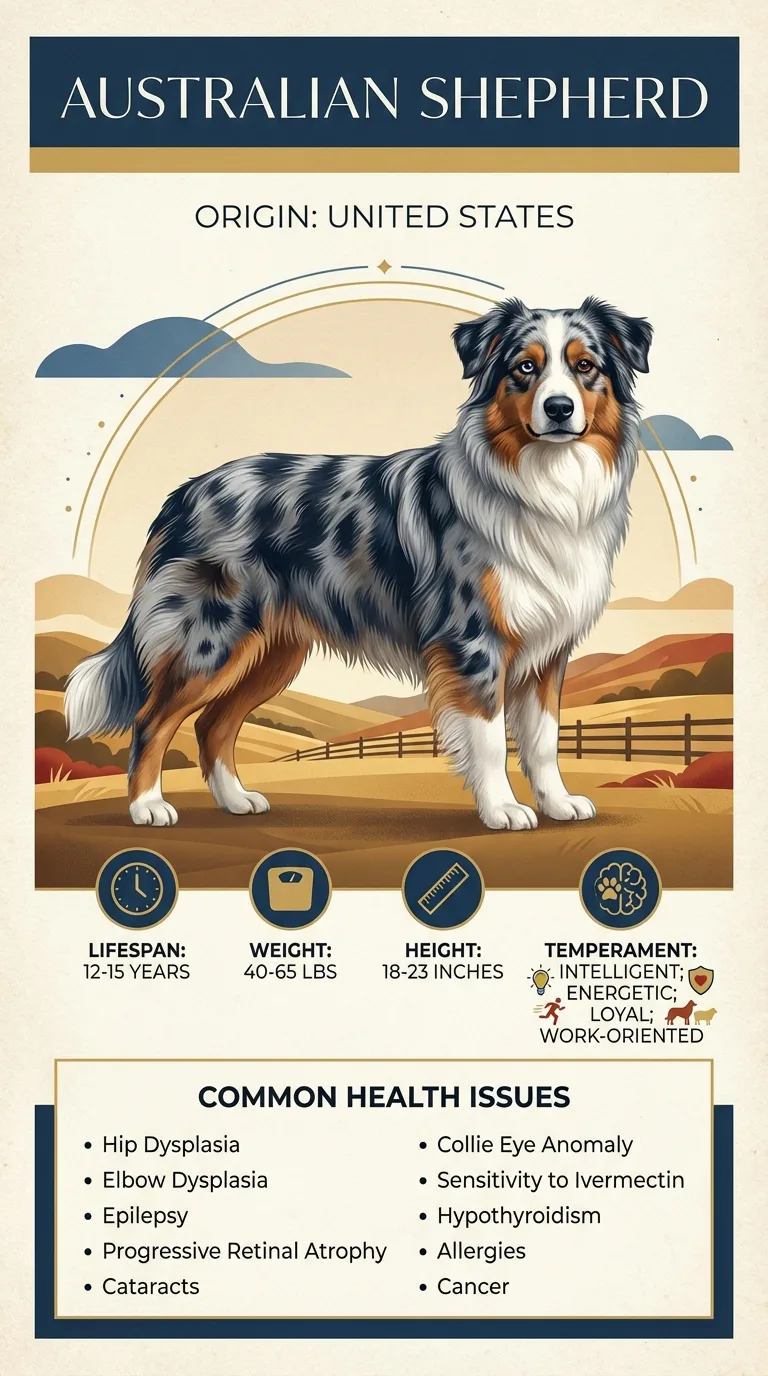
Australian Shepherds have two well-documented orthopedic concerns: hip dysplasia and elbow dysplasia, both involving how the joint surfaces form and fit together rather than how long the leg bones grow. These are screened through OFA radiographs or a PennHIP evaluation, ideally before breeding and again if a dog shows lameness or reluctance to jump.
Because Aussies are active working and sport dogs, joint health has real practical stakes for agility, herding, and general mobility through their 12-15 year lifespan. Owners get more value from tracking weight, exercise surfaces, and joint screening results than from a CDDY panel that has no bearing on this breed.
If a breeder or panel raises CDDY for an Aussie litter, it's worth asking directly whether hip and elbow scores are available instead, since those numbers actually predict this breed's orthopedic future.

Renata was vetting breeders for an Australian Shepherd puppy in Boise when a breeder's website listed "CDDY risk testing available" alongside hip and eye panels, and she assumed it was a routine Aussie concern worth asking about. Her vet explained that chondrodystrophy is the gene variant behind the short, curved legs of Dachshunds, Corgis, and Basset Hounds, and an Australian Shepherd's proportions rule it out as a relevant screening target. They redirected the conversation to the panels that actually matter for the breed: hips, elbows, eyes, and MDR1 status for ivermectin sensitivity.
Key takeaway: A screening test marketed for chondrodystrophic breeds isn't a meaningful check for an Australian Shepherd's normal-proportioned skeleton — the breed's real orthopedic attention belongs on hip and elbow dysplasia.
CDDY is a specific gene variant that disrupts normal cartilage-to-bone growth, producing the short legs and long back seen in Dachshunds, Corgis, Basset Hounds, and other chondrodystrophic breeds. It also raises those breeds' risk of premature intervertebral disc disease.
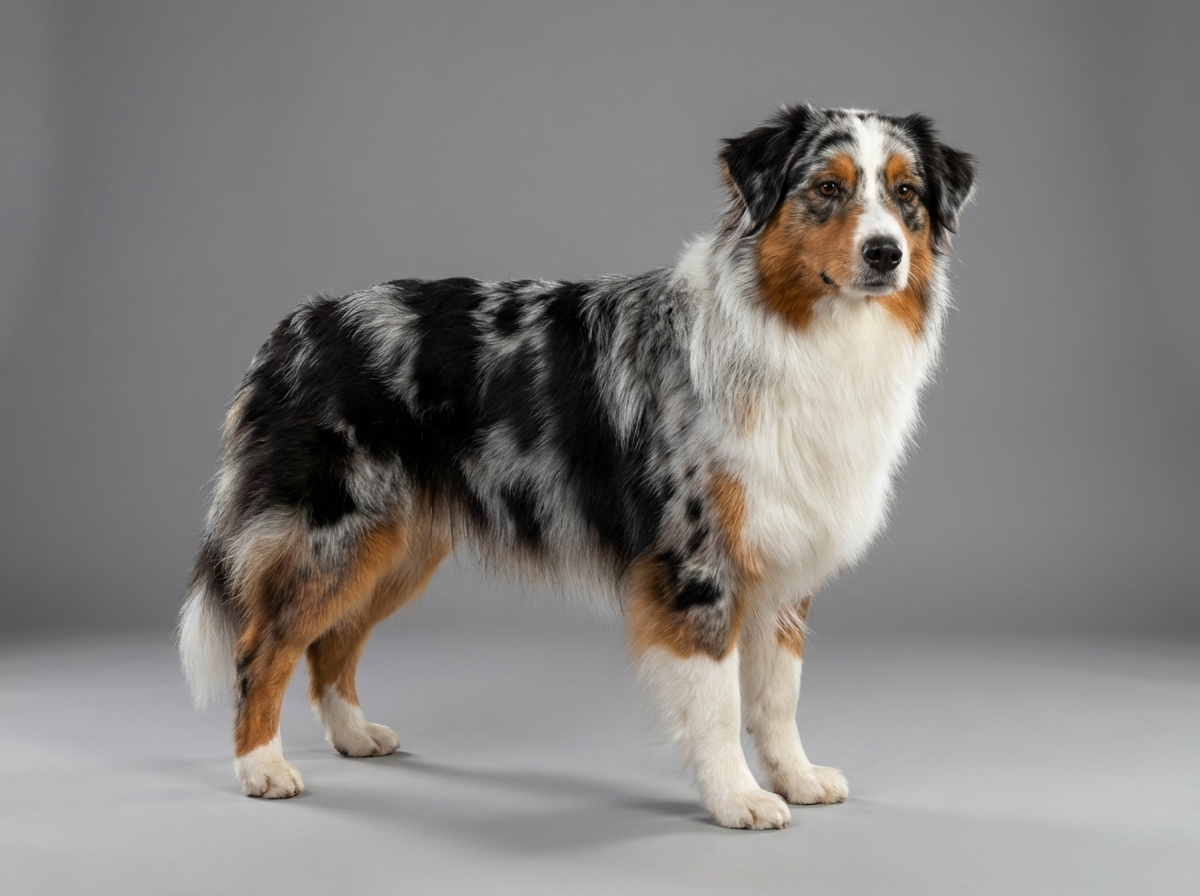
Australian Shepherds are a moderately built herding breed with proportional legs and a level topline, not a chondrodystrophic body type. The condition is not documented as occurring in the breed.
Yes, any dog can develop intervertebral disc disease from age, injury, or general wear, but an Australian Shepherd's risk is not elevated by CDDY the way a Dachshund's is. A vet evaluating back pain in an Aussie will look at trauma, arthritis, and activity level first.
Hip dysplasia and elbow dysplasia are the breed's documented orthopedic concerns, both involving joint conformation rather than leg-bone shortening. Screening through OFA or PennHIP evaluation is the relevant tool, not a CDDY panel.
Broad commercial DNA panels often test for dozens of variants across many breeds in one run, so a report may include a CDDY result even when it's not clinically meaningful for that dog's breed. A vet or genetic counselor can help interpret which results are actually relevant to an Australian Shepherd.
In chondrodystrophic breeds, CDDY-linked disc disease can require surgery and affect quality of life, but this pathway doesn't apply to Australian Shepherds since they don't carry the trait. An Aussie's expected 12-15 year lifespan is more affected by conditions like cancer or epilepsy, which are documented in the breed.
It's a reasonable question if it appears on a panel, but a breeder who prioritizes hip, elbow, eye, and MDR1 testing is addressing the risks that actually matter for the breed. CDDY testing adds little useful information for Australian Shepherd litters.
No, it's documented in breeds like Dachshunds and Corgis, not in Australian Shepherds.
Short, curved legs and a long back, the build that defines chondrodystrophic breeds.
Hip dysplasia and elbow dysplasia are the breed's genuinely documented joint concerns.
It adds little useful information; hip, elbow, eye, and MDR1 panels are more relevant.
No, training isn't relevant here since CDDY isn't a documented issue in this breed.
A one-page prep sheet for this condition: the signs, the questions to ask, what to get priced. Unlocks here.
You get: Vet visit prep sheet
No spam. One-click unsubscribe. See our privacy policy.
Preview page 1 before you decide.