Health
What is the most urgent sign of a disc problem in this breed?
Dragging a hind leg, knuckling, or sudden loss of bladder control are the clearest signs that need emergency evaluation.

Quick answer
What is the most urgent sign of a disc problem in this breed?
Dragging a hind leg, knuckling, or sudden loss of bladder control are the clearest signs that need emergency evaluation.
A dog that suddenly won't put weight on a hind leg, or seems unable to feel where its back paws are, isn't dealing with ordinary stiffness — that's a spinal cord emergency.
Older dogs and those with a history of repeated hard landings or jumps face the highest risk, and owners are often caught off guard because the onset can be abrupt rather than a slow build.
This guide is not medical advice. If your dog shows pain, sudden behavior change, or worsening symptoms, consult a licensed veterinarian.
Some links may be affiliate links. We may earn a commission at no extra cost to you. We only suggest products we believe are helpful for dog owners.
We research and check what we publish, but we do not warrant that any figure, date, price, or statement is accurate, complete, or current, and we accept no liability for any loss, cost, injury, or other harm arising from the use of this site. Use it as one reference among several. You remain responsible for your own decisions and for your dog's care - confirm anything that matters with a licensed veterinarian or another qualified professional before you act on it. Full disclaimer.
Back and spine issues in this context mean intervertebral disc disease — the discs cushioning the spine bulging or rupturing and pressing on the spinal cord. Unlike ordinary muscle strain, this can cause neurological signs like knuckling, dragging a hind leg, or loss of bladder control, and it can progress from mild discomfort to significant weakness within hours.
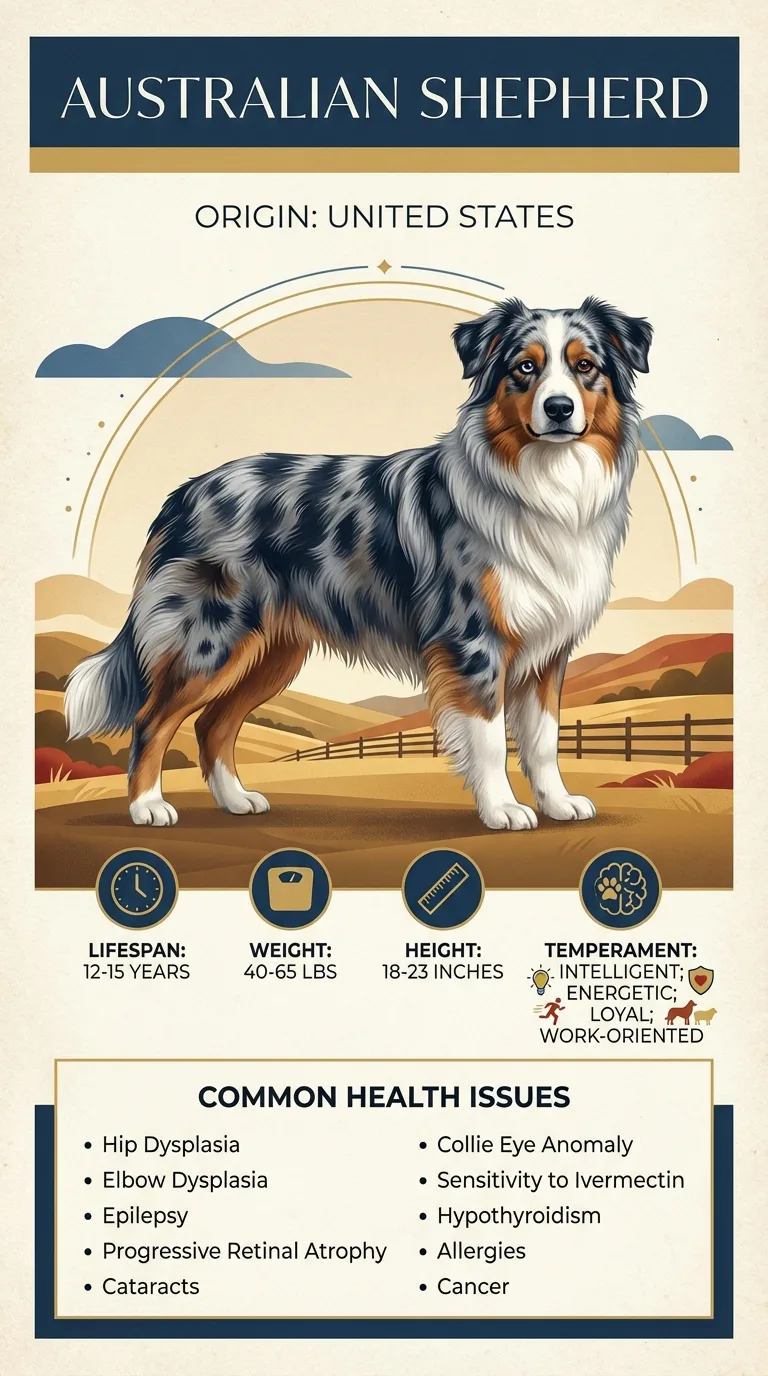
Disc disease can occur in any breed, and an active, athletic dog that spends years jumping and landing has meaningful cumulative spinal stress. It's less common than simple muscle strain but serious enough that owners of active Aussies should know the warning signs.
An active, athletic build means this breed's spine absorbs frequent high-impact stress from jumping, sprinting, and hard turns over a working or sport life. That cumulative stress can, over time, contribute to disc wear even in a well-proportioned dog with no structural spinal defect.
Repeated jumping on and off hard surfaces, a single hard fall, and general aging all play a role. Excess weight adds load to the spine, and dogs without a gradual conditioning routine face more risk from sudden intense activity.
Call your vet immediately, the same day, for any dragging of a hind leg, knuckling, sudden weakness, or loss of bladder or bowel control. This is a genuine emergency where speed affects the outcome — do not wait overnight to see if it improves.
See all Australian Shepherd health problems, which breeds are prone to backspine issues, or the full Australian Shepherd breed guide for temperament, exercise needs and ownership costs.
Recovery time varies widely depending on severity, from a couple of weeks of strict rest for mild cases to several months of rehabilitation after surgery for severe ones. Prompt treatment gives the best chance of a shorter, more complete recovery.
Success means the dog regains functional mobility, even if some residual weakness remains in severe cases. The realistic goal is fast recognition and fast treatment, not prevention of every possible disc issue.
Disc disease often announces itself through the nervous system, not just through pain, and those neurological signs are the clearest signal to act fast.
When a disc ruptures and compresses the spinal cord, the window for the best recovery odds is often measured in hours, not days. Dogs that lose the ability to walk and are treated quickly have meaningfully better odds of regaining function than dogs whose treatment is delayed.
This is different from the muscle strain most active dogs experience after a hard play session, which usually improves with a few days of rest. Any sign of hind-leg weakness, dragging, or loss of bladder control should be treated as an emergency requiring same-day imaging and evaluation, not a wait-and-see period at home.

Rio was a normal, active eight-year-old Aussie until one morning he wouldn't put weight on his back legs at all. His owner, Devon, rushed him to an emergency vet within the hour, where imaging confirmed a ruptured disc compressing his spinal cord. Rio had surgery that same day, and after eight weeks of strict rest and rehabilitation, he regained the ability to walk, though with a slightly altered gait. Devon later learned Rio had shown subtle knuckling for a few days beforehand that had gone unnoticed as simple clumsiness.
Key takeaway: Early neurological signs are easy to dismiss as clumsiness, but they're often the first clue before a more serious collapse. Acting on subtle signs early can change the whole outcome.
It's a condition where the cushioning discs between spinal vertebrae bulge or rupture, putting pressure on the spinal cord and causing pain, weakness, or in severe cases paralysis.
Ordinary strain causes soreness but even weight-bearing on all legs. Disc disease causes neurological signs like knuckling, dragging a paw, or hind-leg weakness, which point to spinal cord involvement rather than muscle soreness.
Not every case is severe, but any sign of hind-leg weakness, dragging, or loss of bladder control needs same-day veterinary evaluation, since the best recovery odds depend on how quickly treatment starts.
Many dogs recover well, especially with prompt treatment, though the degree of recovery depends on how severe the spinal cord compression was and how quickly it was addressed.
Not always — mild cases may be managed with strict crate rest and medication, while more severe cases with significant neurological signs often need surgical decompression for the best chance of recovery.
Repeated hard landings from jumps, a history of back trauma, and normal disc aging all contribute, though it can occur without an obvious single cause.
In some cases a dog can go from mild discomfort to significant hind-leg weakness within hours, which is why any early neurological sign should prompt an immediate vet call rather than overnight monitoring.
Dragging a hind leg, knuckling, or sudden loss of bladder control are the clearest signs that need emergency evaluation.
Same day — the best recovery odds depend heavily on how quickly spinal cord compression is treated.
No, mild cases can be managed with strict rest and medication, though severe neurological signs often need surgery.
Imaging and surgical treatment for severe cases can be a significant expense, while milder cases managed with rest cost considerably less.
There's no guaranteed prevention, but using ramps, maintaining a healthy weight, and avoiding repeated hard landings can reduce overall spinal stress.
A one-page prep sheet for this condition: the signs, the questions to ask, what to get priced. Unlocks here.
You get: Vet visit prep sheet
No spam. One-click unsubscribe. See our privacy policy.
Preview page 1 before you decide.