Living
Akita vs Pembroke Welsh Corgi: which should I choose?
The Corgi if you want a small, capable, characterful dog and will walk it properly and keep it lean. The Akita if you want quiet, less exercise and no spinal vulnerability to manage.

Quick answer
Akita vs Pembroke Welsh Corgi: which should I choose?
The Corgi if you want a small, capable, characterful dog and will walk it properly and keep it lean. The Akita if you want quiet, less exercise and no spinal vulnerability to manage.
The Corgi rates 4/5 for exercise and 4/5 for energy, and it stands ten to twelve inches at the shoulder. It is a cattle-driving breed that was shortened, not a lap dog that was given a job, and almost every problem in the breed comes from that combination of working drive and an unusual skeleton.
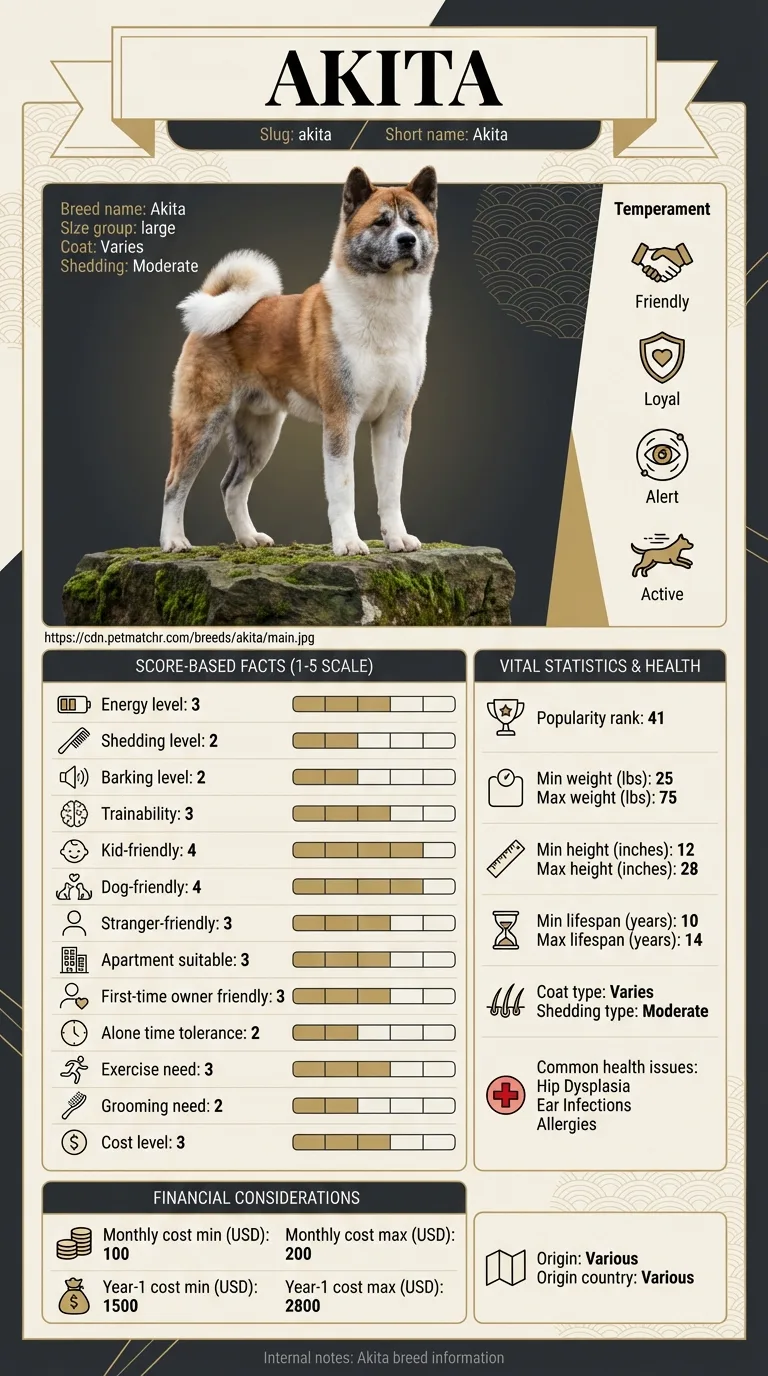
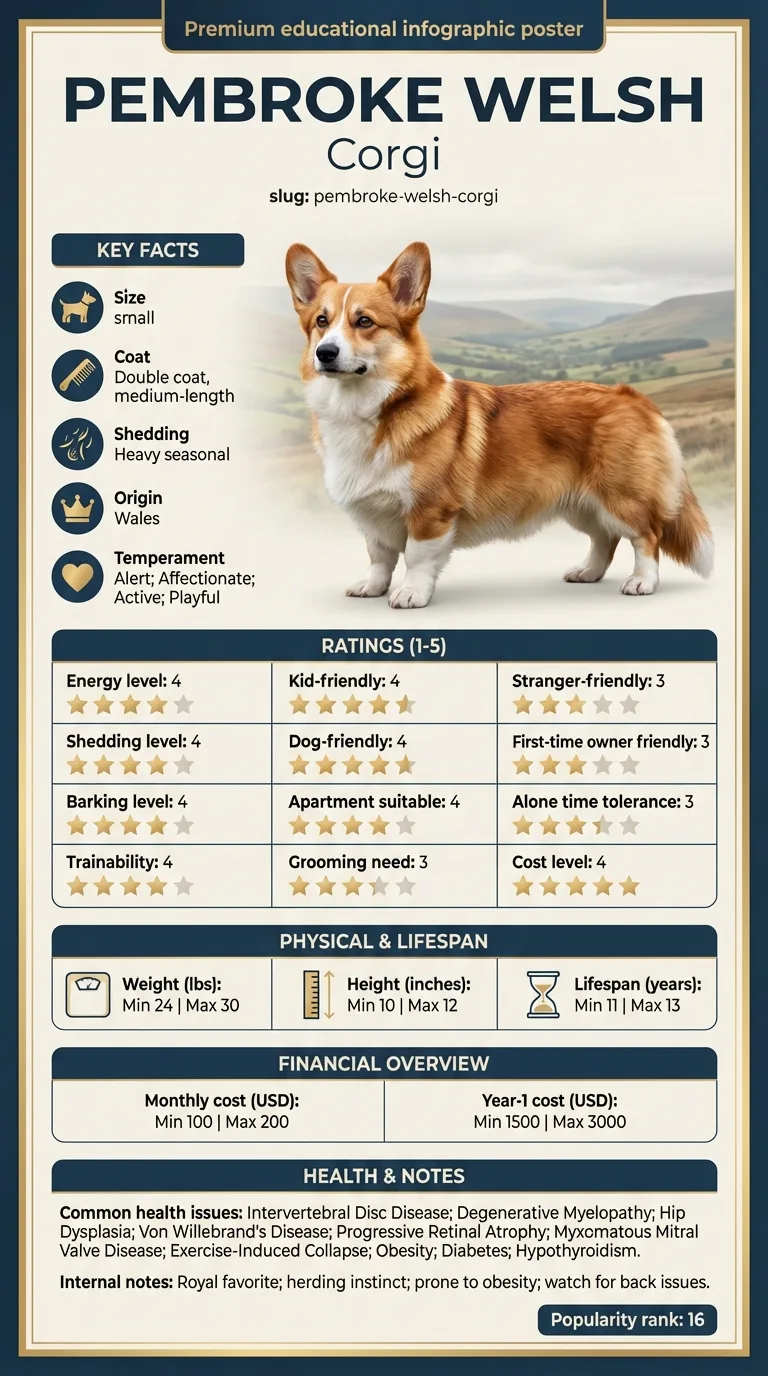
This page is for someone weighing a small, active, vocal herding breed against a large guardian. It covers the exercise requirement people underestimate, spinal disease and degenerative myelopathy, why weight matters so much here, barking, and cost.
The Corgi is a working dog in an inconvenient body that needs more exercise and more weight discipline than its size suggests; the Akita is a bigger dog with a simpler skeleton and a much smaller claim on your day.
Choose the Akita if you want quiet and less exercise. It barks at 2/5 against the Corgi's 4/5 and needs 3/5 exercise against 4/5, with no spinal vulnerability to manage. You are accepting 5/5 shedding rather than 4/5, 1/5 for first-time owners, 2/5 with other dogs and strangers, and up to 130 pounds.
Choose the Pembroke Welsh Corgi if you want a small, capable, characterful dog and will walk it properly. It rates 4/5 for trainability, children and other dogs, 4/5 for apartments, tolerates being alone at 3/5 and costs $100–$200 a month. You are accepting 4/5 barking, heavy shedding and a back that needs protecting.
| Feature | akita | pembroke welsh corgi | Winner |
|---|---|---|---|
| Weight | 70–130 lbs | 24–30 lbs | Equal |
| Height | 24–28 in | 10–12 in | Equal |
| Lifespan | 10–13 years | 11–13 years | pembroke welsh corgi |
| Coat | Dense double coat | Medium double coat | Equal |
| Grooming need | Moderate (3/5) | Moderate (3/5) | Equal |
| Shedding | Very high (5/5) | High (4/5) | pembroke welsh corgi |
| Energy level | Moderate (3/5) | High (4/5) | Equal |
| Exercise need | Moderate (3/5) | High (4/5) | akita |
| Trainability | Moderate (3/5) | High (4/5) | pembroke welsh corgi |
| Barking | Low (2/5) | High (4/5) | akita |
| Good with kids | Moderate (3/5) | High (4/5) | pembroke welsh corgi |
| Good with other dogs | Low (2/5) | High (4/5) | pembroke welsh corgi |
| Friendly to strangers | Low (2/5) | Moderate (3/5) | pembroke welsh corgi |
| Apartment suitability | Low (2/5) | High (4/5) | pembroke welsh corgi |
| Good for first-time owners | Very low (1/5) | Moderate (3/5) | pembroke welsh corgi |
| Tolerates being alone | Moderate (3/5) | Moderate (3/5) | Equal |
| Typical monthly cost | $110–$240 | $100–$200 | pembroke welsh corgi |
| Typical first-year cost | $1,700–$3,200 | $1,500–$3,000 | pembroke welsh corgi |
A Corgi wants an hour to ninety minutes a day and a job to think about. Herding breeds do not stop being herding breeds because their legs are short.
The outlets that work are the ones that use its brain: obedience, trick training, scent games, herding classes where available, and agility adapted for the frame. At 4/5 trainability it takes to all of them.
An under-exercised Corgi becomes vocal, bossy and inclined to herd whatever is available — which usually means the children, the vacuum cleaner, and anything that runs. Heel-nipping is the breed's default tool and it needs redirecting early rather than being found funny.
The constraint is what the exercise looks like. Repeated jumping on and off furniture, long flights of stairs and high-impact landings are hard on a chondrodystrophic spine, so the mileage should be flat and steady rather than acrobatic.
The Akita at 3/5 wants forty-five to sixty minutes of walking, has no need for mental work, and does not deteriorate without it.
Intervertebral disc disease and obesity both appear on the Pembroke's condition list, and they are the same problem seen from two ends.
The short legs come from chondrodystrophy, which also causes the spinal discs to degenerate and calcify earlier than they should. A degenerated disc can herniate and press on the spinal cord, producing anything from a reluctance to jump through to hind limb weakness or paralysis — a surgical emergency in severe cases.
Every extra pound loads that spine, and Corgis gain weight extremely easily. They are food-motivated, low to the ground, and easy to over-feed because a small dog's portion looks small.
The management is straightforward and lifelong: weigh the food rather than scooping it, use part of the daily ration for training instead of adding treats, ramp the furniture the dog actually uses, limit stairs, and keep the dog visibly lean. A Corgi should have a waist.
Diabetes also appears on the list, and weight is the main modifiable factor there too.
The Akita is not a notably greedy breed and has no comparable spinal vulnerability.
Degenerative myelopathy sits high on the Pembroke's list, and the breed carries one of the higher rates of it anywhere.
It is a progressive disease of the spinal cord that begins in middle age or later. The first signs are subtle and mechanical: a hind foot that scuffs, one nail wearing faster than the others, a slight sway. It progresses over months to hind limb weakness and eventually paralysis. It is not painful, which is precisely what makes it easy to dismiss early.
There is a DNA test, and it should be part of any Corgi purchase conversation. Ask for both parents' results by name.
It also needs distinguishing from disc disease, which can look similar at the start and is treated completely differently — so any hind limb change in a Corgi deserves proper investigation rather than a wait-and-see.
Von Willebrand's disease, a clotting disorder with a DNA test, is worth screening before any surgery. Hip dysplasia, progressive retinal atrophy, mitral valve disease and exercise-induced collapse complete the list.
The Akita's burden is autoimmune and endocrine, with hip dysplasia and bloat.
The Corgi's 4/5 barking is a droving trait — a dog moving cattle needs a voice — and it is loud and insistent for the size. It rises when the dog is under-exercised or bored, and it responds to training the way most herding-breed barking does: reduced substantially, never eliminated.
At 4/5 for apartments the breed is otherwise well suited to a flat, and the noise is the caveat that needs managing from the first week rather than the first complaint.
On money the Corgi runs $100–$200 a month against the Akita's $110–$240, and $1,500–$3,000 against $1,700–$3,200 in the first year.
The cost to watch is spinal. Surgery for a herniated disc is a four-figure sum, and insurance for chondrodystrophic breeds is priced accordingly — check whether spinal cover is limited before buying a policy rather than after.
Grooming ties at 3/5 for both. Neither coat should be clipped, and both need a good undercoat rake for the shedding seasons.
Lifespan runs 11 to 13 years against 10 to 13.
Grooming ties at 3/5 and time alone ties at 3/5. Both are double-coated dogs that manage a normal working day.
The Corgi needs more exercise than the Akita — 4/5 against 3/5 — which is the single most misunderstood fact about the breed. People buy a twelve-inch dog expecting a twelve-inch dog's requirements and get a cattle drover's.
On sociability the Corgi is much the easier animal: 4/5 with children and other dogs, 3/5 with strangers, against 3/5, 2/5 and 2/5.
The Akita's two clear wins are noise, 2/5 against 4/5, and structure — it has no spinal vulnerability of the kind that shapes Corgi ownership.
Both shed heavily. The Akita at 5/5 concentrates it into two annual blows; the Corgi at 4/5 sheds substantially all year with two worse periods, and the volume of hair from a small dog genuinely surprises new owners.

An hour to ninety minutes a day at 4/5 exercise — more than an Akita, which surprises most buyers. It is a cattle-driving breed that was shortened, not a small dog given a job. It also needs mental work: obedience, trick training, scent games or herding classes all suit its 4/5 trainability.
The short legs come from chondrodystrophy, the same genetic condition that shapes a Dachshund, and it also makes the spinal discs degenerate and calcify early. A herniated disc can cause anything from reluctance to jump through to hind limb paralysis. Keep the dog lean, ramp furniture and limit stairs.
A progressive spinal cord disease starting in middle age, and Pembrokes carry one of the higher rates of it. The first signs are mechanical — a scuffing hind foot, one nail wearing faster than the others — and it is painless, which makes it easy to dismiss. There is a DNA test; ask for both parents' results.
Because every extra pound loads a spine that is already vulnerable, and Corgis gain weight very easily — food-motivated, low to the ground and easy to over-portion. Weigh the food rather than scooping it, use part of the ration for training, and keep the dog visibly lean with a defined waist.
Yes — 4/5, against the Akita's 2/5, and loud for the size. A dog moving cattle needs a voice, and the breed kept it. Barking rises sharply when the dog is under-exercised or bored, so a well-worked Corgi is considerably quieter than the rating alone suggests.
More than people expect from a small dog — 4/5, against the Akita's 5/5. The Corgi sheds substantially all year with two heavier periods, while the Akita is undemanding for ten months and then blows its undercoat in clumps. Neither coat should ever be clipped.
They tie at 3/5. Both manage a normal day without distress, which is unusual for a small herding breed. The difference is what a bored Corgi does about it — barking and herding the household — while the Akita simply sleeps.
The Corgi if you want a small, capable, characterful dog and will walk it properly and keep it lean. The Akita if you want quiet, less exercise and no spinal vulnerability to manage.
The Corgi runs $100–$200 a month and the Akita $110–$240, with first-year totals of $1,500–$3,000 and $1,700–$3,200. Check whether a Corgi policy limits spinal cover before buying it.
Weighing the food. Obesity is the main modifiable risk for both the spine and the breed's diabetes risk, and a small dog's portion looks small enough that scooping by eye reliably over-feeds it.
Yes, at 4/5 against the Akita's 3/5, with one caveat: heel-nipping. A droving breed may try to gather running children, and that needs redirecting early rather than being treated as a party trick.
Secure checkout on Stripe. We never see your card.
7-day money-back guarantee. Instant access.
Health information here is general and is not veterinary advice. If your dog shows pain, sudden behaviour change, or worsening symptoms, consult a licensed veterinarian.
Some links on this site are affiliate links. We may earn a commission at no extra cost to you, and we only suggest products we believe are helpful for dog owners.
We research and check what we publish, but we do not warrant that any figure, date, price, or statement is accurate, complete, or current, and we accept no liability for any loss, cost, injury, or other harm arising from the use of this site. Use it as one reference among several. You remain responsible for your own decisions and for your dog's care - confirm anything that matters with a licensed veterinarian or another qualified professional before you act on it. Full disclaimer.
Match your lifestyle to the right dog.
Take quizNot sure which breed is right for you? Take our 2-minute quiz to find out.
Take the quiz