Living
Bichon Frise or Golden Retriever for apartment living?
Bichon Frise, rated very high (5/5) versus the Golden's low (2/5) on apartment suitability.

Quick answer
Bichon Frise or Golden Retriever for apartment living?
Bichon Frise, rated very high (5/5) versus the Golden's low (2/5) on apartment suitability.
Bichon Frise or Golden Retriever? On paper they differ most on shedding, and on the scales Golden Retriever is the heavier at 55–75 lbs. Here is how the two compare on everything that shapes an ordinary week.
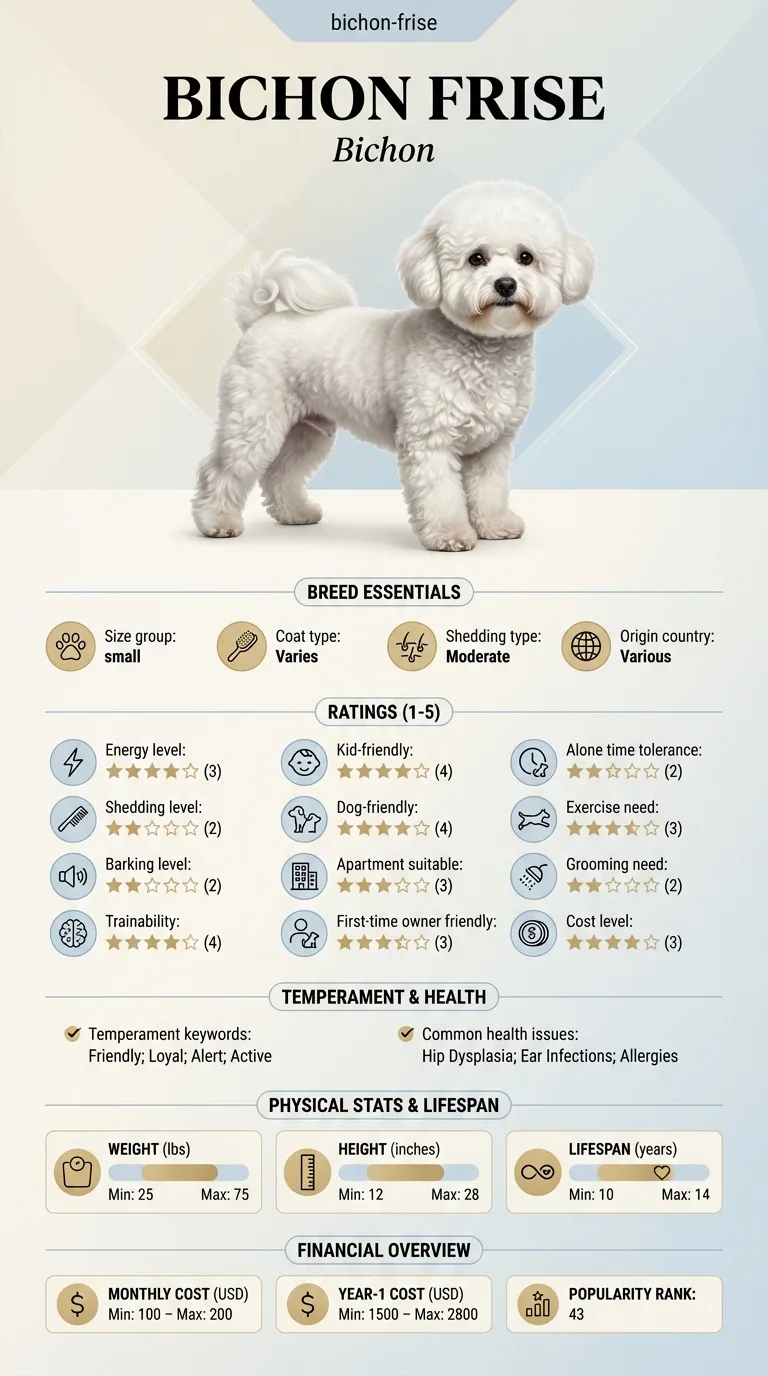
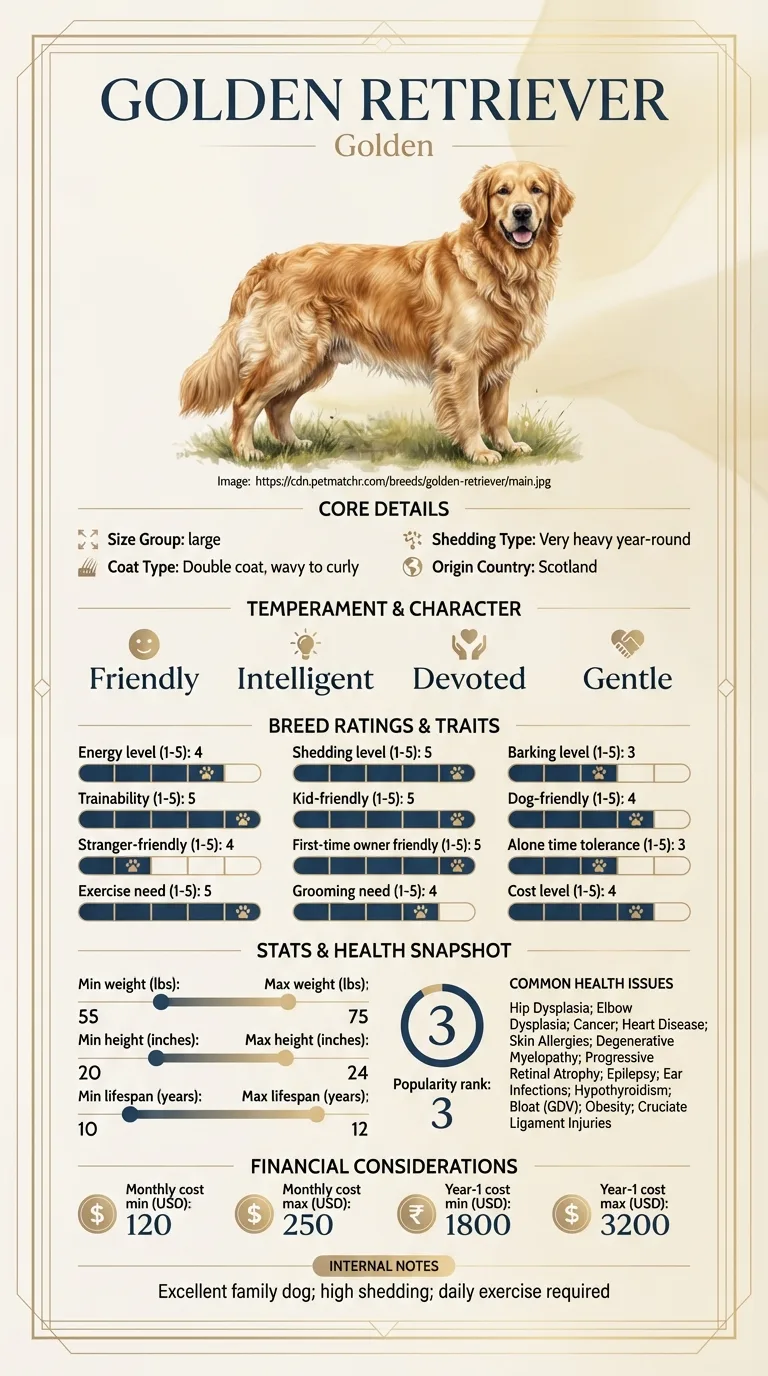
This is for someone already down to Bichon Frise and Golden Retriever and deciding between them. For this pair the decision usually turns on shedding and exercise need, so those are covered first and in most detail. Anyone choosing from a flat has a clear answer here: Bichon Frise rates 5/5 against 2/5. Breed history is left out; what follows is what you will actually live with.
Between Bichon Frise and Golden Retriever, shedding is what separates them, and Bichon Frise is the lower-effort dog of the two to keep.
Choose Bichon Frise if you are in a flat or a smaller home, shedding is a problem in your house and your walking routine is modest.
Choose Golden Retriever if this is your first dog, you do not want a standing grooming appointment and the dog will be alone during the working day.
| Feature | bichon frise | golden retriever | Winner |
|---|---|---|---|
| Size class | small | large | Equal |
| Weight | 12–18 lbs | 55–75 lbs | Equal |
| Height | 9–12 in | 20–24 in | Equal |
| Lifespan | 14–15 years | 10–12 years | bichon frise |
| Exercise need | Low (2/5) | Very high (5/5) | bichon frise |
| Grooming need | Very high (5/5) | High (4/5) | golden retriever |
| Shedding | Very low (1/5) | Very high (5/5) | bichon frise |
| Energy level | Moderate (3/5) | High (4/5) | Equal |
| Barking | Moderate (3/5) | Moderate (3/5) | Equal |
| Apartment suitability | Very high (5/5) | Low (2/5) | bichon frise |
| Good for first-time owners | High (4/5) | Very high (5/5) | golden retriever |
| Tolerates being alone | Low (2/5) | Moderate (3/5) | golden retriever |
| Trainability | Moderate (3/5) | Very high (5/5) | golden retriever |
| Good with kids | High (4/5) | Very high (5/5) | golden retriever |
| Good with other dogs | High (4/5) | High (4/5) | Equal |
| Friendly to strangers | High (4/5) | High (4/5) | Equal |
| Cost level | Moderate (3/5) | High (4/5) | bichon frise |
| Coat | Curly, dense double coat | Double coat, wavy to curly | Equal |
| Origin | Various | Scotland | Equal |
| Typical monthly cost | $80–$150 | $120–$250 | Equal |
| Typical first-year cost | $1,100–$2,300 | $1,800–$3,200 | Equal |
A Golden Retriever's 55-75 lb, 20-24 inch frame stands in sharp contrast to the Bichon Frise's compact 12-18 lbs and 9-12 inches, roughly four to five times the body weight packed into a much taller dog. The Golden's build reflects its retrieving heritage: a sturdy, athletic frame with a broad chest for swimming and carrying game. The Bichon's build is purely companion-sized, made for laps and small spaces. Anyone weighing whether a dog needs to fit easily into a car back seat or a compact home should treat this size gap as the deciding factor before anything else on this page.
The Golden Retriever's exercise need sits at very high (5/5), with energy level rated high (4/5), a dog that wants daily runs, swims, or fetch sessions and genuinely enjoys the work. The Bichon's low (2/5) exercise need and moderate (3/5) energy make it satisfied with a couple of shorter walks. A Golden that doesn't get enough physical outlet tends to redirect that energy into chewing or restlessness, while an under-exercised Bichon is more likely to simply seek more attention and play indoors. Families who already have an active outdoor routine will find the Golden slots right into it.
Both breeds carry double coats, but the numbers tell different stories: the Bichon rates very high (5/5) on grooming with very low (1/5) shedding, while the Golden rates high (4/5) on grooming with very high (5/5) shedding. In practice this means the Bichon requires more active maintenance, regular brushing and professional trims, but leaves less hair behind, while the Golden sheds heavily, especially during seasonal blowouts, despite needing somewhat less hands-on styling. Anyone with allergy sensitivities in the household should lean toward the Bichon; anyone who just wants to skip the grooming salon can better tolerate the Golden's shedding.
The Bichon rates very high (5/5) for apartment living against the Golden's low (2/5), driven mostly by the Golden's much higher exercise requirement rather than its temperament; Goldens are famously easygoing indoors when properly exercised. Interestingly, the Golden actually tolerates being alone better, rated moderate (3/5) versus the Bichon's low (2/5), so a Golden may handle solo hours slightly more gracefully even in a smaller space, provided its exercise needs are met elsewhere. Both breeds share a moderate (3/5) barking level, so neither stands out as notably quiet or notably vocal.
Golden Retrievers are famous for trainability, and the data backs it up: very high (5/5), among the top ratings on this page, paired with a very high (5/5) rating for first-time owners; this is a breed built to be easy to raise even for someone new to dogs. The Bichon rates lower on both counts, moderate (3/5) trainability and high (4/5) for first-timers, meaning it's still a reasonably beginner-friendly dog, just not quite as eager a student. For anyone prioritizing obedience training or a working relationship with their dog, the Golden has a clear edge here.
The Golden Retriever edges out the Bichon in nearly every household category: very high (5/5) with kids versus the Bichon's high (4/5), high (4/5) friendliness to strangers matching the Bichon's high (4/5), and equal high (4/5) ratings with other dogs. This is one of the more lopsided comparisons on family-friendliness across this site; the Golden's reputation as an ideal family dog holds up in the numbers. The Bichon is still a strong choice for families, just a step behind a breed specifically renowned for its gentle patience with children of all ages.
Lifespan favors the Bichon substantially, 14-15 years versus the Golden's 10-12, and the health lists explain part of the gap. The Golden Retriever carries thirteen listed conditions, the longest list in this comparison, including cancer, heart disease, hip and elbow dysplasia, degenerative myelopathy, and bloat (GDV); cancer rates in Golden Retrievers are well documented as unusually high for the breed. The Bichon's five conditions, skin allergies, patellar luxation, bladder stones, cataracts, and dental disease, are comparatively contained. Golden owners should prioritize cancer screening and joint health; Bichon owners should stay ahead of dental and skin issues.
The Golden costs more to keep at every stage: cost level rates high (4/5) versus the Bichon's moderate (3/5), monthly spending runs $120-250 versus $80-150, and first-year costs land at $1,800-3,200 versus $1,100-2,300. Food volume for a 55-75 lb dog is a major driver, and the Golden's extensive health-risk list means more preventive veterinary spending is money well spent over its lifetime. The Bichon's costs skew almost entirely toward grooming rather than food or vet bills, making its overall spending pattern more predictable month to month even if the totals land lower.
Bichon Frise weighs 12–18 lbs and lives 14–15 years; Golden Retriever weighs 55–75 lbs and lives 10–12 years. The two diverge most on shedding, exercise need and apartment suitability and 1 other rated axes. They are level on barking, good with other dogs and friendly to strangers, so those cannot decide it. The comparison marks an easier option only where one exists. Facts like weight and country of origin are not scored. Both dogs are rated from the same dataset, which is what makes the numbers comparable with each other even though any individual dog sits somewhere inside its breed's range.

Yes; it's rated very high (5/5) for first-time owners and very high (5/5) for trainability, making it one of the most beginner-friendly large breeds. The Bichon Frise is also solid for beginners at high (4/5), just with a lower trainability score of moderate (3/5).
The Golden Retriever, rated very high (5/5) on shedding versus the Bichon's very low (1/5); expect regular vacuuming and seasonal coat blowouts with a Golden.
Cancer appears on the Golden's health list alongside heart disease, hip and elbow dysplasia, and bloat, thirteen conditions total, the longest list in this comparison, so proactive screening matters.
The Golden Retriever rates very high (5/5) with kids versus the Bichon's high (4/5); both are good choices, but the Golden has a slight edge and a long-standing reputation for gentleness with children.
About $700-900 more in the first year ($1,800-3,200 vs $1,100-2,300) and $40-100 more per month, mostly from food volume and larger-dog veterinary care.
Not strictly, but its very high (5/5) exercise need and low (2/5) apartment rating mean it does best with regular access to space to run, whether that's a yard or committed daily outings.
The Bichon Frise, at 14-15 years versus the Golden Retriever's 10-12 years, a meaningful gap tied partly to the Golden's higher cancer risk and larger body size.
Bichon Frise, rated very high (5/5) versus the Golden's low (2/5) on apartment suitability.
The Golden Retriever, rated very high (5/5) versus the Bichon's moderate (3/5).
The Bichon Frise, by a wide margin, very low (1/5) versus very high (5/5).
The Bichon Frise, at roughly $1,100-2,300 in year one versus $1,800-3,200 for the Golden.
Secure checkout on Stripe. We never see your card.
7-day money-back guarantee. Instant access.
Health information here is general and is not veterinary advice. If your dog shows pain, sudden behaviour change, or worsening symptoms, consult a licensed veterinarian.
Some links on this site are affiliate links. We may earn a commission at no extra cost to you, and we only suggest products we believe are helpful for dog owners.
We research and check what we publish, but we do not warrant that any figure, date, price, or statement is accurate, complete, or current, and we accept no liability for any loss, cost, injury, or other harm arising from the use of this site. Use it as one reference among several. You remain responsible for your own decisions and for your dog's care - confirm anything that matters with a licensed veterinarian or another qualified professional before you act on it. Full disclaimer.
Match your lifestyle to the right dog.
Take quizNot sure which breed is right for you? Take our 2-minute quiz to find out.
Take the quiz