Living
Which breed is better for apartments?
The Maltese.

Quick answer
Which breed is better for apartments?
The Maltese.
Golden Retriever or Maltese? On paper they differ most on shedding, and on the scales Golden Retriever is the heavier at 55–75 lbs. Here is how the two compare on everything that shapes an ordinary week.
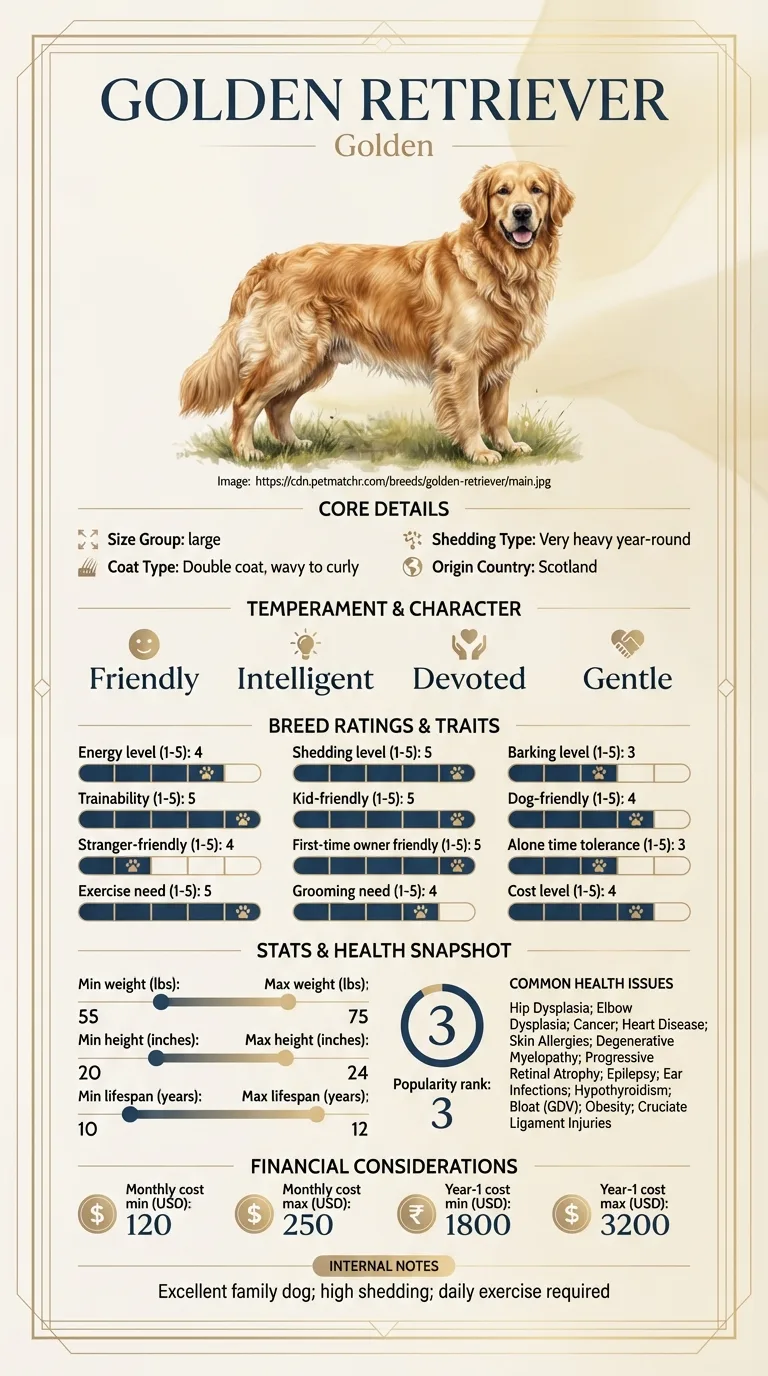
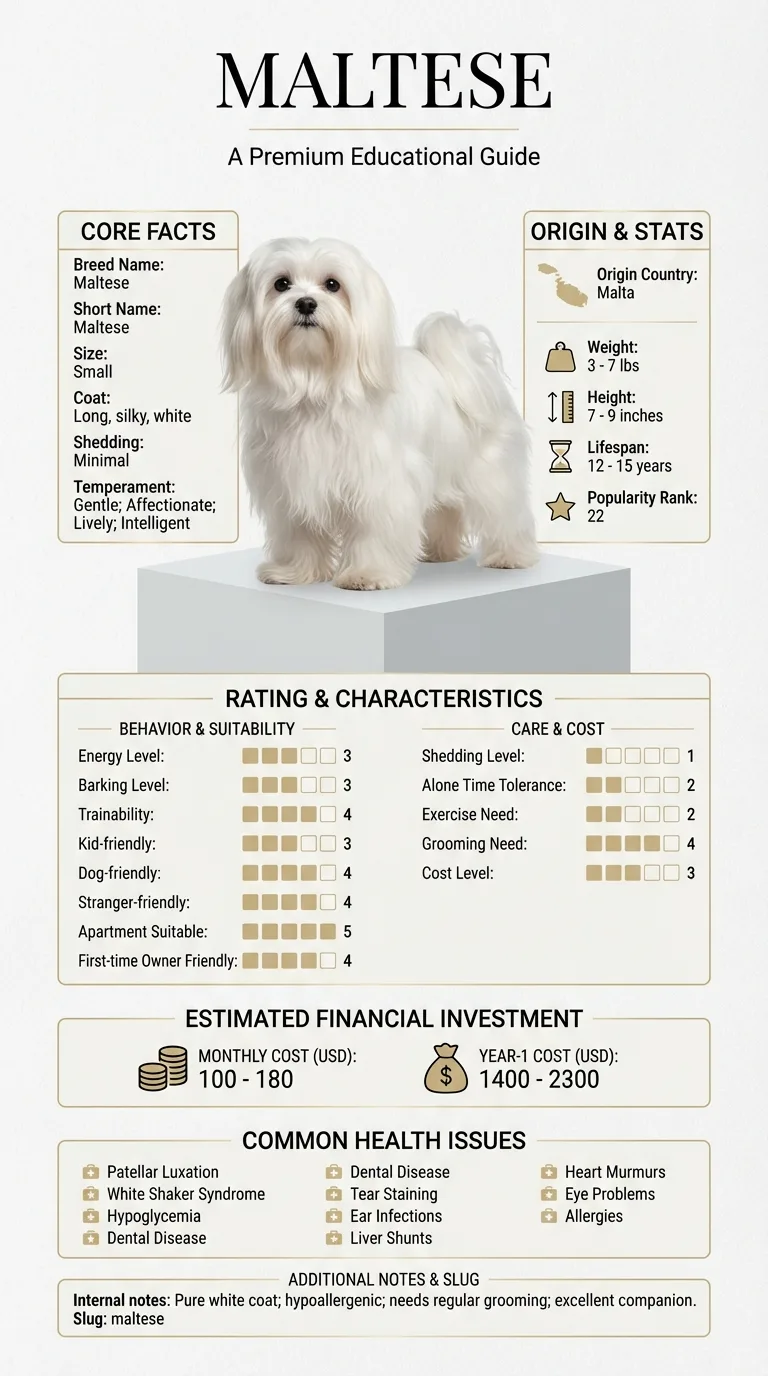
This is for someone already down to Golden Retriever and Maltese and deciding between them. For this pair the decision usually turns on shedding and exercise need, so those are covered first and in most detail. Anyone choosing from a flat has a clear answer here: Maltese rates 5/5 against 2/5. Breed history is left out; what follows is what you will actually live with.
Between Golden Retriever and Maltese, shedding is what separates them, and Maltese is the lower-effort dog of the two to keep.
Choose Golden Retriever if this is your first dog, the dog will be alone during the working day and there are young children at home.
Choose Maltese if you are in a flat or a smaller home, shedding is a problem in your house and your walking routine is modest.
| Feature | golden retriever | maltese | Winner |
|---|---|---|---|
| Size class | large | small | Equal |
| Weight | 55–75 lbs | 3–7 lbs | Equal |
| Height | 20–24 in | 7–9 in | Equal |
| Lifespan | 10–12 years | 12–15 years | maltese |
| Exercise need | Very high (5/5) | Low (2/5) | maltese |
| Grooming need | High (4/5) | High (4/5) | Equal |
| Shedding | Very high (5/5) | Very low (1/5) | maltese |
| Energy level | High (4/5) | Moderate (3/5) | Equal |
| Barking | Moderate (3/5) | Moderate (3/5) | Equal |
| Apartment suitability | Low (2/5) | Very high (5/5) | maltese |
| Good for first-time owners | Very high (5/5) | High (4/5) | golden retriever |
| Tolerates being alone | Moderate (3/5) | Low (2/5) | golden retriever |
| Trainability | Very high (5/5) | High (4/5) | golden retriever |
| Good with kids | Very high (5/5) | Moderate (3/5) | golden retriever |
| Good with other dogs | High (4/5) | High (4/5) | Equal |
| Friendly to strangers | High (4/5) | High (4/5) | Equal |
| Cost level | High (4/5) | Moderate (3/5) | maltese |
| Coat | Double coat, wavy to curly | Long, silky, white | Equal |
| Origin | Scotland | Malta | Equal |
| Typical monthly cost | $120–$250 | $100–$180 | Equal |
| Typical first-year cost | $1,800–$3,200 | $1,400–$2,300 | Equal |
A 55-75 lb Golden Retriever and a 3-7 lb Maltese occupy opposite ends of the size spectrum, with the Maltese standing just 7-9 inches tall against the Golden's 20-24. This is fundamentally a large-versus-toy comparison, and everything downstream, exercise needs, apartment fit, even how a vet calculates medication dosing, flows from that gap rather than from any similarity implied by a shared good-with-kids rating. Buyers should treat this pairing as a lifestyle choice about dog size itself first, and worry about temperament and coat differences second.
The Golden's Very High (5/5) exercise need dwarfs the Maltese's Low (2/5), and energy level follows the same pattern, High (4/5) against Moderate (3/5). A Maltese was bred purely as a companion lapdog, and its exercise needs reflect that heritage, short walks and indoor play satisfy most days, while the Golden's gundog background demands genuine daily exertion, hiking, fetch, swimming, something that actually taxes it. Owners drawn to the Maltese's Gentle, Affectionate, Lively temperament get a dog whose energy expresses itself in enthusiasm rather than a physical need to run for an hour, a real practical difference for anyone without a big yard or lots of free time.
Grooming ties at High (4/5) for both, but shedding is where the Maltese pulls dramatically ahead, Very Low (1/5) against the Golden's Very High (5/5). The Maltese's long, silky white coat needs regular brushing and often professional trimming to prevent matting and staining, similar effort to keeping a Golden's double coat brushed out, but with far less hair actually ending up on the floor. For owners weighing time spent grooming against mess left behind, this pairing shows those aren't the same variable, both dogs ask for comparable grooming time, only one of them sheds heavily while doing it.
The Maltese is built for small spaces, Very High (5/5) apartment suitability against the Golden's Low (2/5), while barking ties at Moderate (3/5) for both, so noise isn't the differentiator size might suggest. Tolerating alone time favors the Golden though, Moderate (3/5) against the Maltese's Low (2/5), which fits the Maltese's companion-breed history and its Affectionate, attached nature, a dog literally bred to be near its person constantly. City apartment dwellers get an easy answer here on space, but should still plan for a Maltese that wants company, not just square footage, to actually thrive.
The Golden edges ahead on both metrics, Very High (5/5) trainability and first-time-owner suitability against the Maltese's still-strong High (4/5) on both. A Maltese's Intelligent, Lively temperament makes it a capable learner, but its small size means owners sometimes skip consistent training, assuming a lapdog doesn't need it, which can produce a stubborn, poorly socialized adult regardless of the breed's actual trainability. The Golden's larger size tends to force more consistent training simply because an untrained 65 lb dog is harder to live with than an untrained 5 lb one, not because the Maltese is inherently less capable of learning.
The Golden rates meaningfully higher with kids, Very High (5/5) against the Maltese's Moderate (3/5), reflecting real safety concerns around a 3-7 lb dog and boisterous children rather than any temperament flaw in the Maltese itself. Other dogs and strangers tie at High (4/5) for both. Families with young, rough-playing kids should weigh the size mismatch seriously, a Maltese can be injured by handling that a Golden would barely notice, while households with older kids or no kids at all may find the Maltese's Gentle, Affectionate nature just as rewarding a companion as the Golden's.
The Maltese's 12-15 year lifespan beats the Golden's 10-12, and its ten-item health list, Patellar Luxation, White Shaker Syndrome, Hypoglycemia, Liver Shunts and Tear Staining among them, reflects small-breed-specific fragility rather than the Golden's Cancer-heavy, orthopedic thirteen-item list. Ear Infections and Allergies appear on both lists, but otherwise the two breeds face genuinely different veterinary futures, joint and cardiac monitoring for the Golden, blood sugar and dental vigilance for the Maltese. Prospective Maltese owners should ask specifically about hypoglycemia management in puppyhood, a real risk for very small breeds that Golden owners never have to think about.
The Maltese is the cheaper dog to keep, $100-180 monthly and $1,400-2,300 in year one, against the Golden's $120-250 and $1,800-3,200, and it rates Moderate (3/5) overall cost versus the Golden's High (4/5). Food costs explain most of the everyday gap given the size difference, but grooming costs may run closer than expected since both breeds need comparable coat-care time. The Maltese's small-breed health risks, hypoglycemia and dental disease particularly, can generate their own recurring vet costs that partly offset the lower food bill, so budget for frequent dental cleanings specifically if choosing the Maltese.
Golden Retriever weighs 55–75 lbs and lives 10–12 years; Maltese weighs 3–7 lbs and lives 12–15 years. The two diverge most on shedding, exercise need and apartment suitability and 1 other rated axes. They are level on barking, good with other dogs and grooming need, so those cannot decide it. The comparison marks an easier option only where one exists. Facts like weight and country of origin are not scored. Both dogs are rated from the same dataset, which is what makes the numbers comparable with each other even though any individual dog sits somewhere inside its breed's range.

Partly — the Maltese's Gentle, Affectionate nature echoes the Golden's warmth, but it's rated lower with kids (Moderate versus Very High) mostly due to its fragile small size.
The Maltese by a wide margin, Low (2/5) against the Golden's Very High (5/5).
The Maltese, rated Very Low (1/5) versus the Golden's Very High (5/5).
The Maltese, 12-15 years compared to the Golden's 10-12.
With caution — its small 3-7 lb size makes it easy to injure during rough play, which is why it rates Moderate rather than Very High on the kids metric.
The Maltese, roughly $100-180 a month versus $120-250 for the Golden.
Very well — it rates Very High (5/5) for apartment suitability, the opposite of the Golden's Low (2/5).
The Maltese.
The Golden Retriever.
The Maltese.
The Golden Retriever.
Secure checkout on Stripe. We never see your card.
7-day money-back guarantee. Instant access.

Health information here is general and is not veterinary advice. If your dog shows pain, sudden behaviour change, or worsening symptoms, consult a licensed veterinarian.
Some links on this site are affiliate links. We may earn a commission at no extra cost to you, and we only suggest products we believe are helpful for dog owners.
We research and check what we publish, but we do not warrant that any figure, date, price, or statement is accurate, complete, or current, and we accept no liability for any loss, cost, injury, or other harm arising from the use of this site. Use it as one reference among several. You remain responsible for your own decisions and for your dog's care - confirm anything that matters with a licensed veterinarian or another qualified professional before you act on it. Full disclaimer.
Match your lifestyle to the right dog.
Take quizNot sure which breed is right for you? Take our 2-minute quiz to find out.
Take the quiz