Behavior
Which breed needs more daily exercise?
The Golden Retriever.

Quick answer
Which breed needs more daily exercise?
The Golden Retriever.
Golden Retriever or Great Dane? On paper they differ most on grooming need, and on the scales Great Dane is the heavier at 110–175 lbs. Here is how the two compare on everything that shapes an ordinary week.
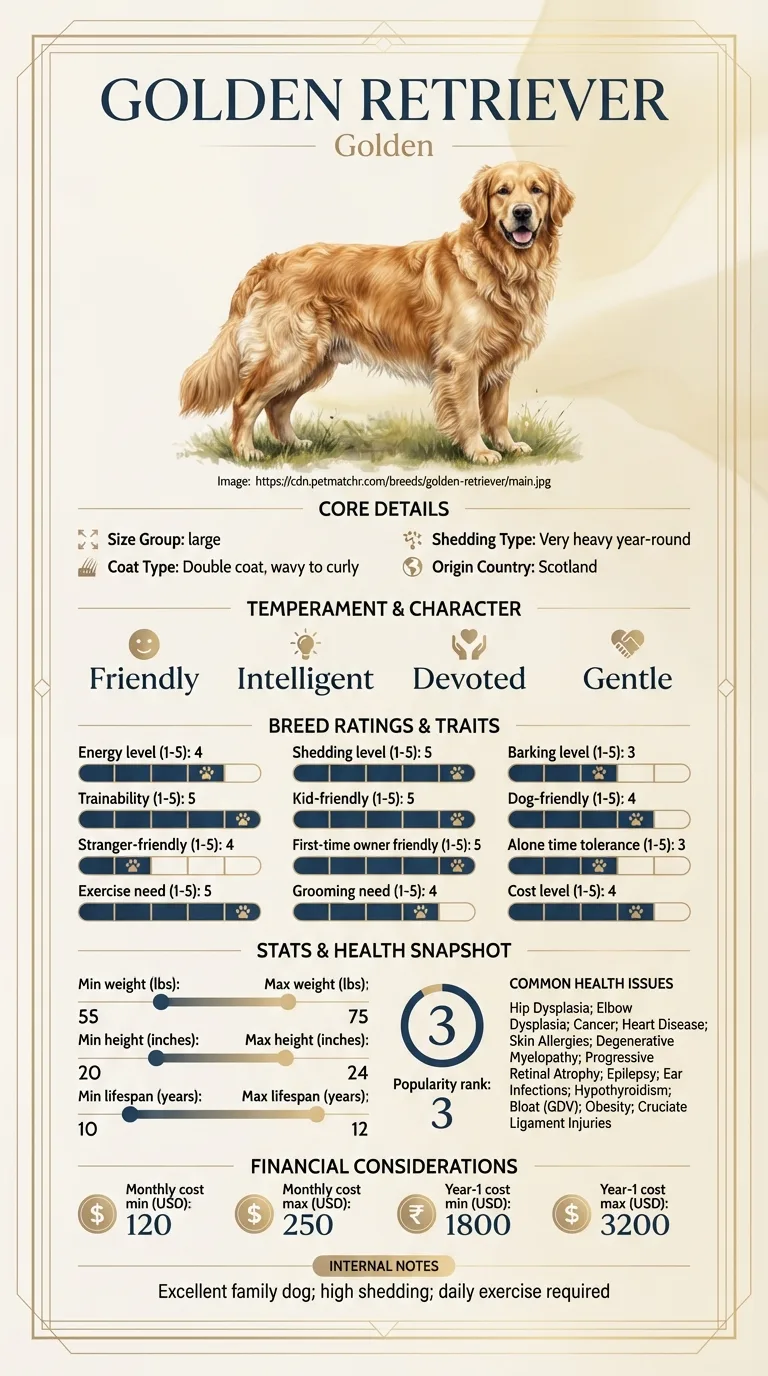
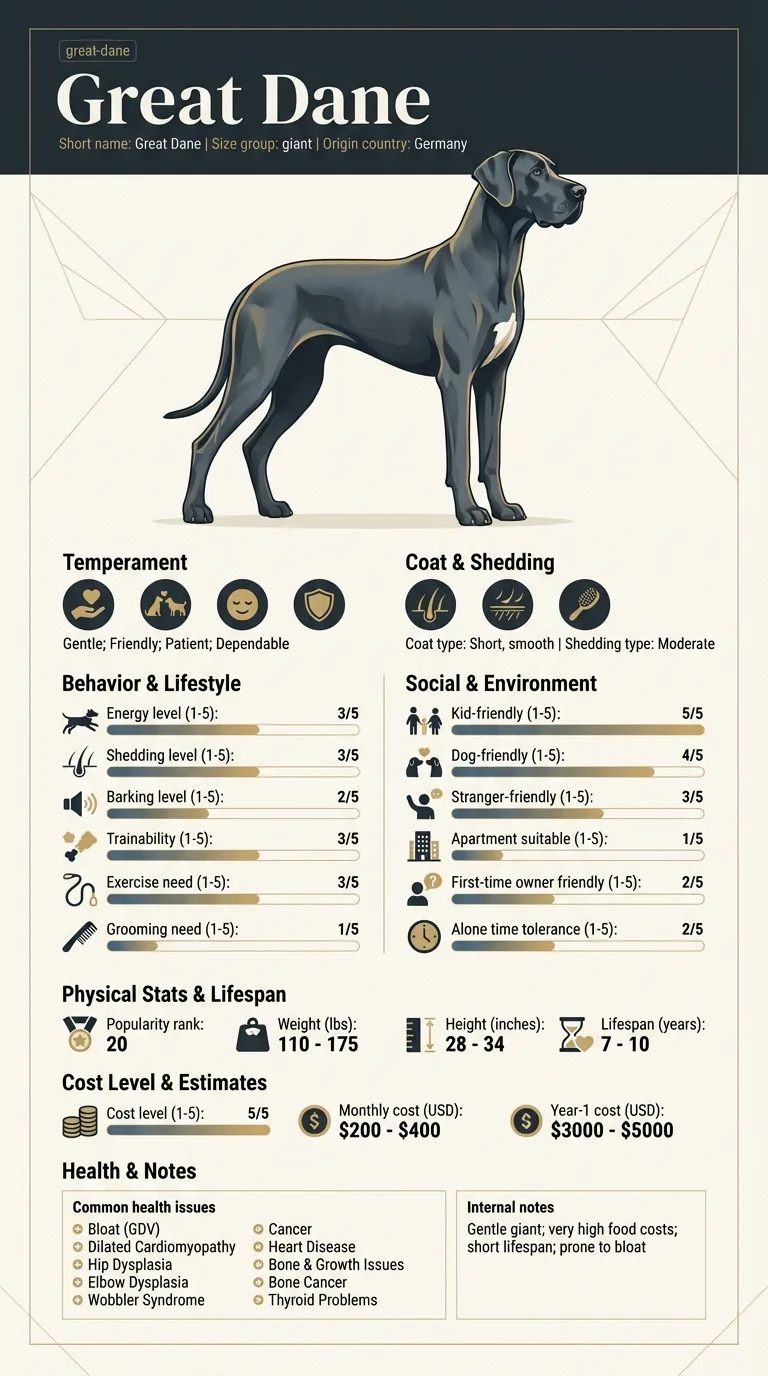
This is for someone already down to Golden Retriever and Great Dane and deciding between them. For this pair the decision usually turns on grooming need and good for first-time owners, so those are covered first and in most detail. Anyone choosing from a flat has a clear answer here: Golden Retriever rates 2/5 against 1/5. The focus throughout is on daily consequences rather than breed background.
Between Golden Retriever and Great Dane, grooming need is what separates them; neither is the lower-effort dog overall.
Choose Golden Retriever if this is your first dog, the dog will be alone during the working day and you want a dog that picks up training quickly.
Choose Great Dane if you do not want a standing grooming appointment, shedding is a problem in your house and your walking routine is modest.
| Feature | golden retriever | great dane | Winner |
|---|---|---|---|
| Size class | large | giant | Equal |
| Weight | 55–75 lbs | 110–175 lbs | Equal |
| Height | 20–24 in | 28–34 in | Equal |
| Lifespan | 10–12 years | 7–10 years | golden retriever |
| Exercise need | Very high (5/5) | Moderate (3/5) | great dane |
| Grooming need | High (4/5) | Very low (1/5) | great dane |
| Shedding | Very high (5/5) | Moderate (3/5) | great dane |
| Energy level | High (4/5) | Moderate (3/5) | Equal |
| Barking | Moderate (3/5) | Low (2/5) | great dane |
| Apartment suitability | Low (2/5) | Very low (1/5) | golden retriever |
| Good for first-time owners | Very high (5/5) | Low (2/5) | golden retriever |
| Tolerates being alone | Moderate (3/5) | Low (2/5) | golden retriever |
| Trainability | Very high (5/5) | Moderate (3/5) | golden retriever |
| Good with kids | Very high (5/5) | Very high (5/5) | Equal |
| Good with other dogs | High (4/5) | High (4/5) | Equal |
| Friendly to strangers | High (4/5) | Moderate (3/5) | golden retriever |
| Cost level | High (4/5) | Very high (5/5) | golden retriever |
| Coat | Double coat, wavy to curly | Short, smooth | Equal |
| Origin | Scotland | Germany | Equal |
| Typical monthly cost | $120–$250 | $200–$400 | Equal |
| Typical first-year cost | $1,800–$3,200 | $3,000–$5,000 | Equal |
The gap here is dramatic even by large-breed standards: a 55-75 lb, 20-24 inch Golden Retriever against a 110-175 lb, 28-34 inch Great Dane, a genuine giant that can stand taller than a grown adult's waist. This isn't a coat or temperament choice so much as a decision about living with a dog that may outweigh most adult humans. Counter, table and car considerations all change at Great Dane scale, doorways feel smaller, a wagging tail becomes a real hazard to breakables, and a growing Dane puppy needs careful joint management during its rapid climb toward adult size, something a Golden's steadier growth curve doesn't demand nearly as urgently.
Despite its size, the Great Dane is the calmer dog on paper, Moderate (3/5) exercise need against the Golden's Very High (5/5), and Moderate (3/5) energy against the Golden's High (4/5). Great Danes are famously known as gentle giants who are content with a couple of solid walks rather than hours of retrieving drills, while the Golden's gundog heritage means it genuinely wants that vigorous daily activity. This flips the usual size assumption: the much bigger dog is actually the lower-energy roommate here, making a Great Dane a surprisingly workable choice for owners who want size and presence without a Golden's relentless need to move.
Coat care favors the Dane decisively, Very Low (1/5) grooming need against the Golden's High (4/5), and Moderate (3/5) shedding against the Golden's Very High (5/5). A Great Dane's short, smooth coat is essentially wash-and-go; a Golden's double coat sheds heavily year-round with seasonal blowouts that call for regular brushing to keep loose fur under control. The irony is that the much larger dog is the easier one to keep clean, since Dane hair is short even if there's a lot of surface area to cover. Anyone picturing a giant dog as automatically higher-maintenance should look at this line item specifically before assuming.
Neither breed is an apartment dog, the Dane rates Very Low (1/5) for apartment suitability, even lower than the Golden's already-poor Low (2/5), simply because of the physical space a giant breed occupies. Barking favors the Dane though, Low (2/5) against the Golden's Moderate (3/5), and the Dane's Gentle, Patient nature tends to make for a quieter household presence overall despite its size. Both dogs need a home with real square footage, but a Golden is the marginally more space-flexible of the two, while a Dane simply cannot be comfortable in a cramped apartment regardless of exercise routine.
The Golden is the clear choice for someone newer to dog ownership, rating Very High (5/5) for both trainability and first-time-owner suitability against the Dane's Moderate (3/5) and Low (2/5) respectively. A Great Dane's sheer size means training mistakes carry real physical consequences, an untrained 150 lb dog pulling on a leash is a genuinely different problem than an untrained 65 lb Golden. The Dane's Gentle, Dependable temperament makes it a fundamentally biddable dog once trained, but getting there takes a confident handler who starts leash and impulse-control work early, ideally before the dog's size makes correction physically difficult.
Both breeds tie at Very High (5/5) with kids and High (4/5) with other dogs, reflecting shared gentle, family-oriented reputations. The Golden pulls ahead with strangers, High (4/5) against the Dane's Moderate (3/5), which fits the Dane's more naturally protective, watchful instinct even within its overall calm temperament. Families should still weigh the Dane's physical size around toddlers carefully, a gentle nudge from a 150 lb dog can knock a small child over regardless of intent, something the Golden's more moderate size makes less of a daily concern even with an equally high kid-friendliness rating.
This is where giant-breed reality hits hardest: the Great Dane's 7-10 year lifespan trails the Golden's already-modest 10-12 years by a meaningful margin. The Dane's ten-item health list includes Wobbler Syndrome and Bone & Growth Issues specific to rapid giant-breed growth, plus Bloat (GDV), Dilated Cardiomyopathy, Cancer and Bone Cancer, several of them acute, fast-moving conditions. The Golden's thirteen-item list shares Bloat, Cancer, Heart Disease and Hip Dysplasia but adds Degenerative Myelopathy, Cruciate Ligament Injuries and Obesity risk instead of the Dane's growth-plate concerns. Both lists point toward cardiac screening and bloat vigilance, but a Dane owner should be prepared for a noticeably shorter, more medically eventful life on average.
The Great Dane is meaningfully more expensive to keep, $200-400 monthly and $3,000-5,000 in year one, against the Golden's $120-250 and $1,800-3,200, and it carries the top Very High (5/5) cost rating against the Golden's High (4/5). Food volume alone explains much of the gap, a 150 lb dog eats far more than a 65 lb one, and giant-breed veterinary care, from orthopedic imaging to medication dosing, scales with size too. Anyone budgeting for a Great Dane should plan for costs closer to double a Golden's in some categories, particularly food, and should factor in giant-breed-specific insurance given the shorter, more health-event-prone lifespan.
Golden Retriever weighs 55–75 lbs and lives 10–12 years; Great Dane weighs 110–175 lbs and lives 7–10 years. The two diverge most on grooming need, good for first-time owners and exercise need and 2 other rated axes. They are level on good with other dogs and good with kids, so those cannot decide it. The table below marks a winner only where one breed is genuinely easier for a typical owner; size and origin are facts rather than merits and stay level. Ratings come from one source applied to both breeds, so they are meaningful against each other rather than as absolute scores.
Yes — despite its size, the Dane rates Moderate (3/5) for exercise need against the Golden's Very High (5/5).
The Golden Retriever, at 10-12 years versus the Great Dane's 7-10 years.
The Great Dane, rated Very Low (1/5) for grooming against the Golden's High (4/5).
No — the Dane rates Very Low (1/5) and the Golden Low (2/5) for apartment suitability, so both need real space.
The Great Dane by a wide margin, $200-400 a month versus $120-250 for the Golden.
The Golden Retriever, rating Very High (5/5) for first-time owners against the Dane's Low (2/5).
Yes, Bloat (GDV) appears on both health lists, and deep-chested giant breeds like the Dane are especially vulnerable.
The Golden Retriever.
The Golden Retriever.
The Great Dane.
The Great Dane.
Secure checkout on Stripe. We never see your card.
7-day money-back guarantee. Instant access.

Health information here is general and is not veterinary advice. If your dog shows pain, sudden behaviour change, or worsening symptoms, consult a licensed veterinarian.
Some links on this site are affiliate links. We may earn a commission at no extra cost to you, and we only suggest products we believe are helpful for dog owners.
We research and check what we publish, but we do not warrant that any figure, date, price, or statement is accurate, complete, or current, and we accept no liability for any loss, cost, injury, or other harm arising from the use of this site. Use it as one reference among several. You remain responsible for your own decisions and for your dog's care - confirm anything that matters with a licensed veterinarian or another qualified professional before you act on it. Full disclaimer.
Match your lifestyle to the right dog.
Take quizNot sure which breed is right for you? Take our 2-minute quiz to find out.
Take the quiz