Behavior
Which breed sheds more?
The Golden Retriever.

Quick answer
Which breed sheds more?
The Golden Retriever.
Golden Retriever or Jack Russell Terrier? On paper they differ most on good for first-time owners, and on the scales Golden Retriever is the heavier at 55–75 lbs. Here is how the two compare on everything that shapes an ordinary week.
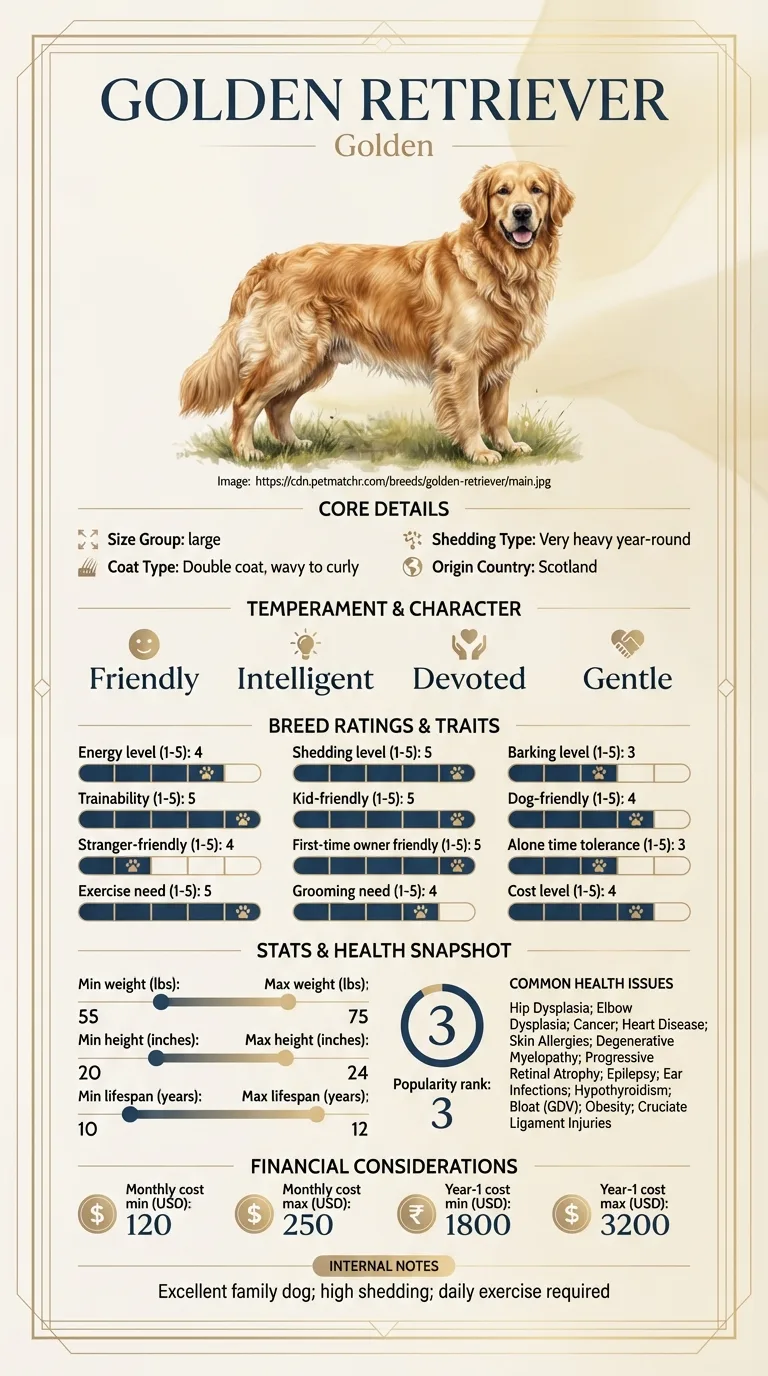
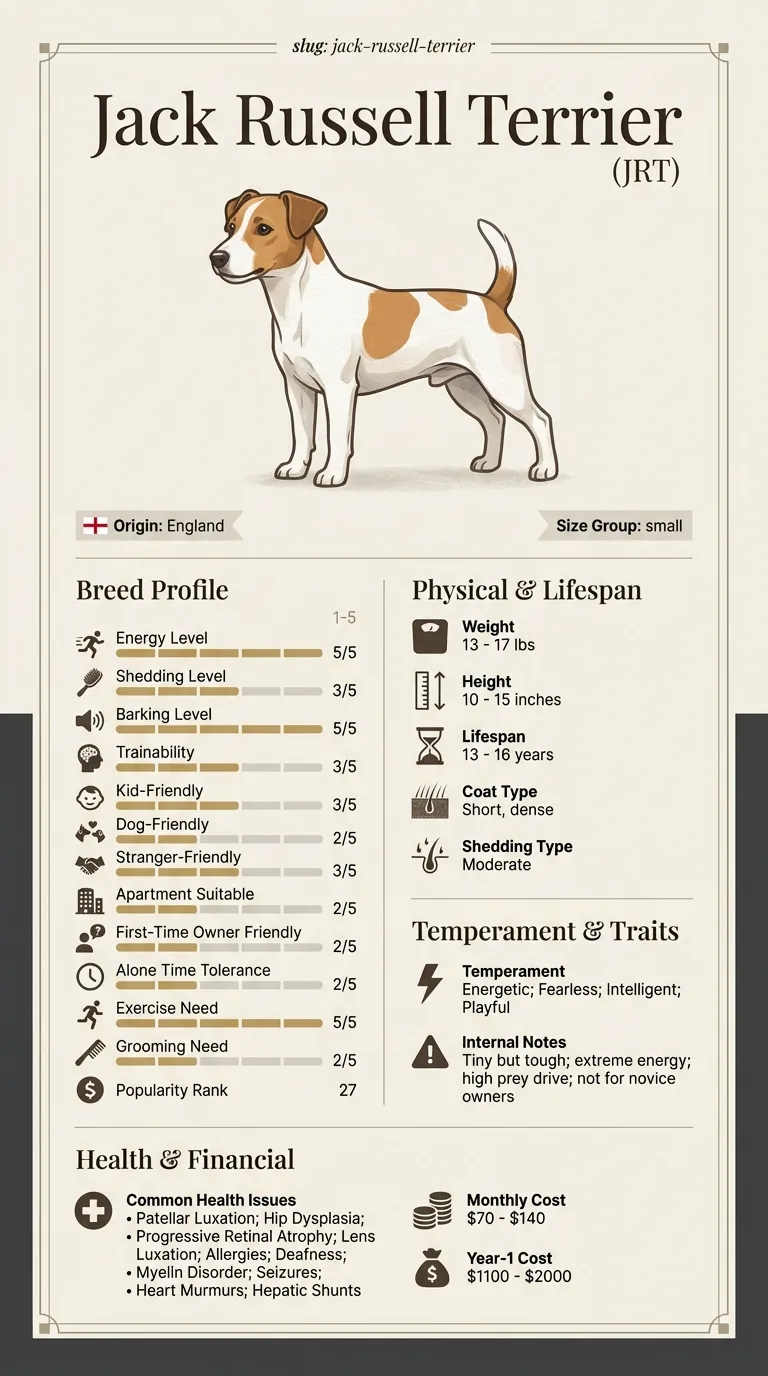
This is for someone already down to Golden Retriever and Jack Russell Terrier and deciding between them. For this pair the decision usually turns on good for first-time owners and grooming need, so those are covered first and in most detail. Both rate 2/5 for flats, so housing does not settle this one. There is no origin story here — only what changes about your week.
Between Golden Retriever and Jack Russell Terrier, good for first-time owners is what separates them, and Golden Retriever is the lower-effort dog of the two to keep.
Choose Golden Retriever if this is your first dog, the dog will be alone during the working day and there are young children at home.
Choose Jack Russell Terrier if you do not want a standing grooming appointment, shedding is a problem in your house and a smaller dog suits your car, your home or your back.
| Feature | golden retriever | jack russell terrier | Winner |
|---|---|---|---|
| Size class | large | small | Equal |
| Weight | 55–75 lbs | 13–17 lbs | Equal |
| Height | 20–24 in | 10–15 in | Equal |
| Lifespan | 10–12 years | 13–16 years | jack russell terrier |
| Exercise need | Very high (5/5) | Very high (5/5) | Equal |
| Grooming need | High (4/5) | Low (2/5) | jack russell terrier |
| Shedding | Very high (5/5) | Moderate (3/5) | jack russell terrier |
| Energy level | High (4/5) | Very high (5/5) | Equal |
| Barking | Moderate (3/5) | Very high (5/5) | golden retriever |
| Apartment suitability | Low (2/5) | Low (2/5) | Equal |
| Good for first-time owners | Very high (5/5) | Low (2/5) | golden retriever |
| Tolerates being alone | Moderate (3/5) | Low (2/5) | golden retriever |
| Trainability | Very high (5/5) | Moderate (3/5) | golden retriever |
| Good with kids | Very high (5/5) | Moderate (3/5) | golden retriever |
| Good with other dogs | High (4/5) | Low (2/5) | golden retriever |
| Friendly to strangers | High (4/5) | Moderate (3/5) | golden retriever |
| Cost level | High (4/5) | Low (2/5) | jack russell terrier |
| Coat | Double coat, wavy to curly | Short, dense | Equal |
| Origin | Scotland | England | Equal |
| Typical monthly cost | $120–$250 | $70–$140 | Equal |
| Typical first-year cost | $1,800–$3,200 | $1,100–$2,000 | Equal |
Fifty-five to seventy-five pounds against thirteen to seventeen, this pairing puts a classic large gundog next to a genuinely small terrier, with the Jack Russell standing just 10-15 inches at the shoulder versus the Golden's 20-24. Don't let the small frame fool you about temperament, though, JRTs were bred to go to ground after quarry and pack outsized confidence and drive into that compact body. Anyone picturing a lapdog because of the Jack Russell's size will be surprised by how much dog is actually inside it. The Golden's larger size at least telegraphs its energy level honestly; the Jack Russell's does not.
Both breeds rate Very High (5/5) for exercise need, a genuine tie that surprises people expecting the small terrier to need less. The Jack Russell actually edges the Golden on raw energy level, Very High (5/5) against High (4/5), reflecting its terrier heritage of relentless, high-intensity drive rather than the Golden's steadier retrieving stamina. Both temperament lists include Energetic, but the Jack Russell's Fearless, Playful pairing suggests a more explosive, less biddable kind of energy than the Golden's more purposeful drive. Owners expecting a small dog to be an easy-exercise option should recalibrate: pound for pound, the Jack Russell may be the more demanding of the two.
Grooming clearly favors the terrier, Low (2/5) against the Golden's High (4/5), and shedding follows the same pattern, Moderate (3/5) versus Very High (5/5). The Jack Russell's short, dense coat needs little beyond occasional brushing, while the Golden's double coat requires regular brushing and produces a genuinely heavy year-round shed with seasonal blowouts. For owners who want a low-fuss coat without sacrificing an active, engaged dog, the Jack Russell delivers on that front even though it demands just as much exercise time as the Golden does. The tradeoff, as always with this breed, is that low grooming needs don't translate to low overall effort.
Apartment suitability ties at Low (2/5) for both, but barking is where the Jack Russell becomes a serious consideration, Very High (5/5) against the Golden's Moderate (3/5), the widest gap in this whole table. A JRT's Fearless, Energetic temperament often expresses itself vocally, at other dogs, at noises, at anything moving past a window, in ways that can strain relationships with close neighbors. Both breeds tolerate being alone poorly, Moderate (3/5) for the Golden versus Low (2/5) for the terrier, so neither is a good match for long solo days, but the terrier adds a noise-complaint risk the Golden simply doesn't carry at the same level.
The Golden is the far more forgiving choice for a first-time owner, Very High (5/5) on both trainability and first-time-owner suitability against the Jack Russell's Moderate (3/5) and Low (2/5). A JRT's Fearless, Intelligent nature means it learns quickly but decides for itself whether following a command is worth the effort, classic terrier independence that can frustrate an inexperienced handler. The Golden's Devoted, eager-to-please disposition makes obedience work feel collaborative rather than a negotiation. Anyone who has trained a strong-willed terrier before will find a Jack Russell manageable and even fun; anyone hoping their first dog trains itself should choose the Golden instead.
The Golden dominates household-fit metrics here: Very High (5/5) with kids against the Jack Russell's Moderate (3/5), High (4/5) with other dogs against Low (2/5), and High (4/5) with strangers against Moderate (3/5). Jack Russells were bred to hunt vermin and small game, and that prey drive can make introductions to smaller pets or unfamiliar dogs genuinely fraught, not just cautious. Families with young kids, multiple pets or a busy stream of visitors will find the Golden the substantially safer, easier default, while the Jack Russell suits a household prepared to manage a feisty, occasionally combative temperament with consistent supervision.
The Jack Russell wins decisively on longevity, 13-16 years against the Golden's 10-12, one of the largest lifespan gaps in this dataset and a real point in the smaller dog's favor. Its ten-item health list, Patellar Luxation, Lens Luxation, Deafness, Seizures and Hepatic Shunts among them, reflects small-breed orthopedic and genetic risks rather than the Golden's cancer-heavy thirteen-item list, which includes Cancer, Heart Disease, Degenerative Myelopathy and Cruciate Ligament Injuries. Progressive Retinal Atrophy and Allergies show up on both lists. Buyers weighing longevity heavily should note the Jack Russell's real advantage here, though its list isn't risk-free, hereditary eye and neurological conditions both appear.
The Jack Russell is meaningfully cheaper to keep, $70-140 monthly and $1,100-2,000 in year one, against the Golden's $120-250 and $1,800-3,200, and it rates Low (2/5) overall cost versus the Golden's High (4/5). Smaller body mass means less food and typically lower medication dosing costs, and the terrier's low grooming needs save on professional coat care too. Over a longer lifespan, that gap compounds, especially given the Jack Russell's extra three to four years of expected life relative to the Golden. Budget-conscious buyers who can handle a high-energy, vocal terrier will find real savings here without sacrificing much in exercise commitment.
Golden Retriever weighs 55–75 lbs and lives 10–12 years; Jack Russell Terrier weighs 13–17 lbs and lives 13–16 years. The two diverge most on good for first-time owners, grooming need and shedding and 5 other rated axes. They are level on apartment suitability and exercise need, so those cannot decide it. Where the table declares a winner it means less work for the owner, nothing more; descriptive rows are left as ties on purpose. The value here is in the differences between the two columns; treat any single score as approximate.

Yes — both rate Very High (5/5) for exercise need, and the JRT actually edges ahead on raw energy level.
The Golden Retriever by a wide margin — Moderate (3/5) barking versus the Jack Russell's Very High (5/5).
The Golden Retriever, rating Very High (5/5) with kids against the Jack Russell's Moderate (3/5).
The Jack Russell Terrier, 13-16 years compared to the Golden's 10-12.
The Jack Russell Terrier, roughly half the Golden's monthly cost.
Not especially — it rates Low (2/5) with other dogs, reflecting its strong terrier prey drive, versus the Golden's High (4/5).
The Golden Retriever, rating Very High (5/5) for both trainability and first-time-owner suitability.
The Golden Retriever.
The Jack Russell Terrier.
The Jack Russell Terrier.
The Golden Retriever.
Secure checkout on Stripe. We never see your card.
7-day money-back guarantee. Instant access.

Health information here is general and is not veterinary advice. If your dog shows pain, sudden behaviour change, or worsening symptoms, consult a licensed veterinarian.
Some links on this site are affiliate links. We may earn a commission at no extra cost to you, and we only suggest products we believe are helpful for dog owners.
We research and check what we publish, but we do not warrant that any figure, date, price, or statement is accurate, complete, or current, and we accept no liability for any loss, cost, injury, or other harm arising from the use of this site. Use it as one reference among several. You remain responsible for your own decisions and for your dog's care - confirm anything that matters with a licensed veterinarian or another qualified professional before you act on it. Full disclaimer.
Match your lifestyle to the right dog.
Take quizNot sure which breed is right for you? Take our 2-minute quiz to find out.
Take the quiz