Behavior
Which one should I actually get?
The Shepherd for a dedicated working or protection role with room and experience to match; the Schnauzer for a lower-maintenance, apartment-friendly dog that still keeps you on your toes.

Quick answer
Which one should I actually get?
The Shepherd for a dedicated working or protection role with room and experience to match; the Schnauzer for a lower-maintenance, apartment-friendly dog that still keeps you on your toes.
Are you torn between choosing a German Shepherd or a Miniature Schnauzer? Each breed has unique traits that fit different lifestyles and preferences. Let's break down their similarities and differences to help you decide.
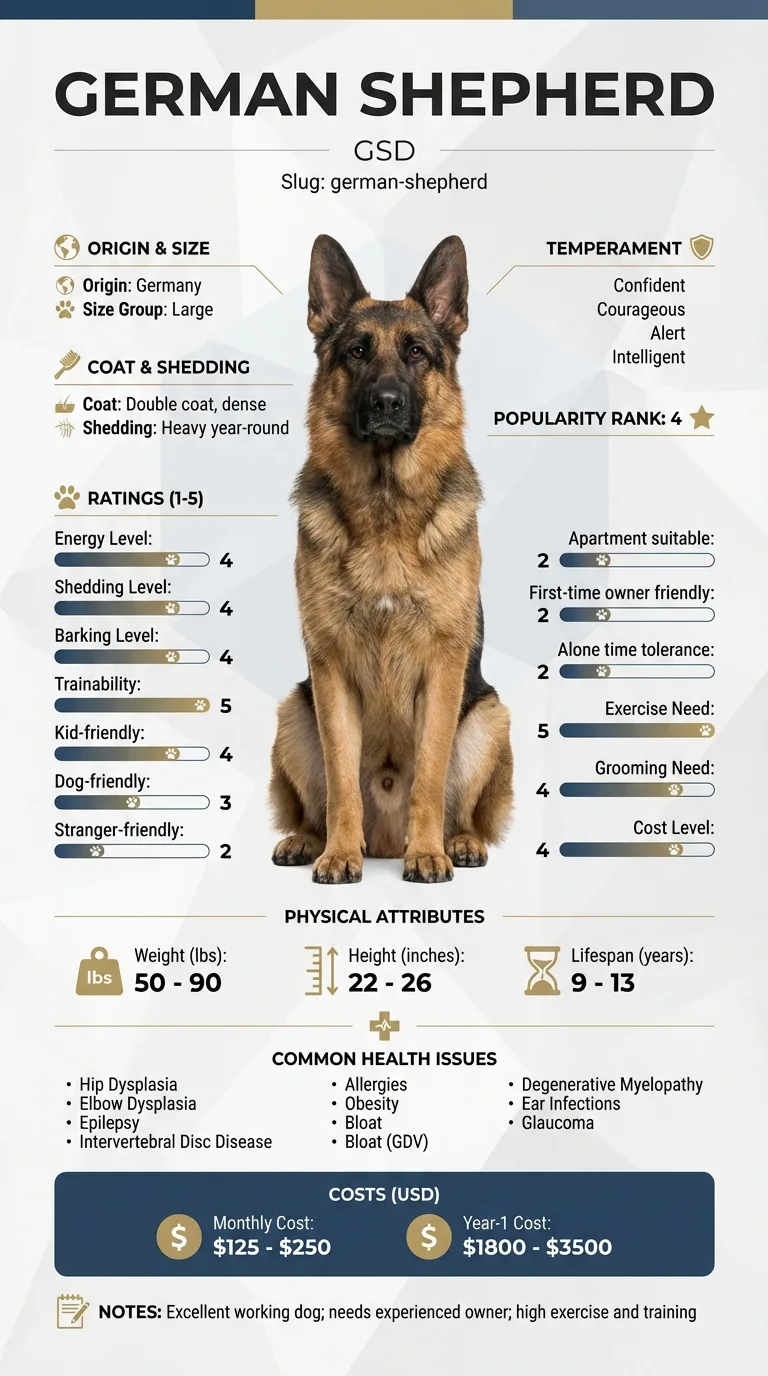
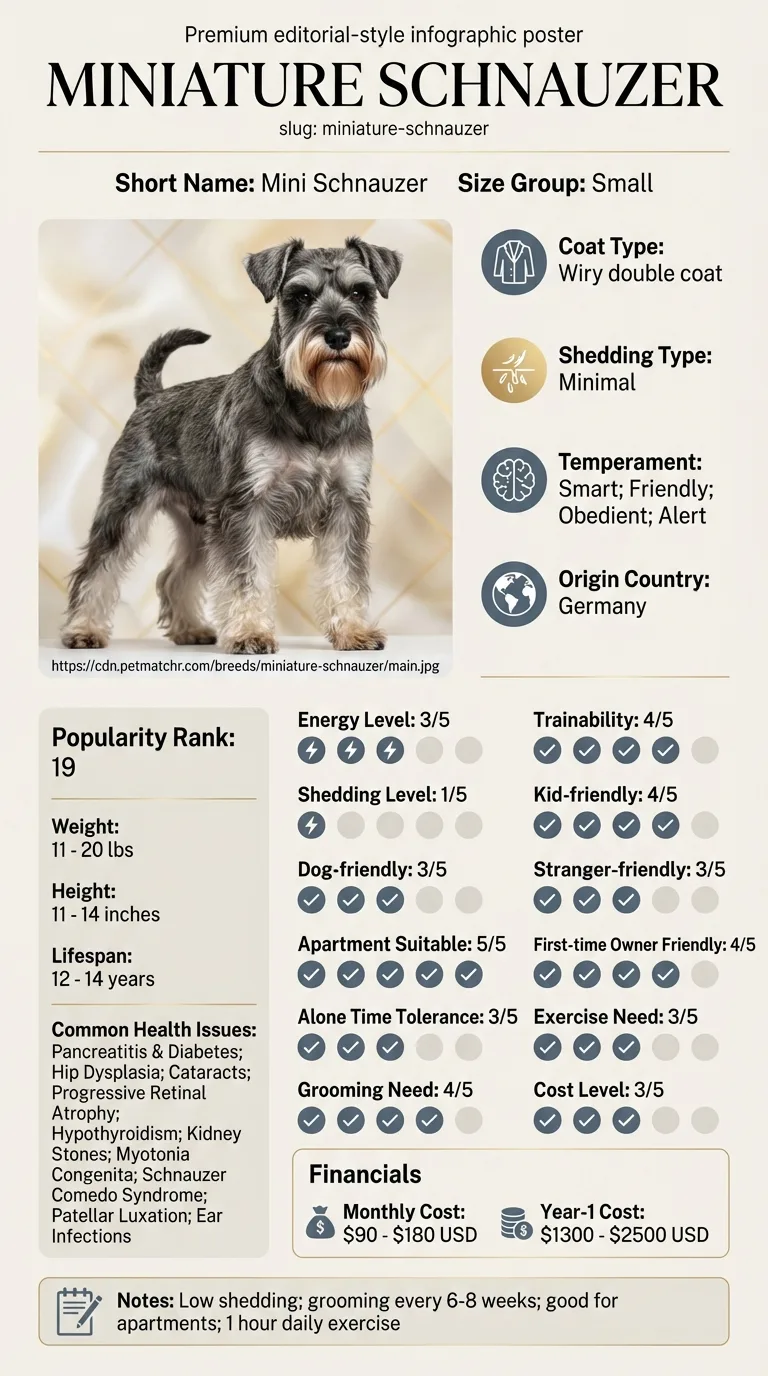
This comparison is perfect for anyone considering these two popular dog breeds. You might be a family looking for a loyal companion, a busy professional in search of a low-maintenance pet, or a first-time dog owner wondering which breed suits your apartment lifestyle. Understanding the key differences, costs, and care needs will help you make a well-informed choice.
If you're looking for a protective, energetic companion, go for the German Shepherd; for a friendly, adaptable pet, choose the Miniature Schnauzer.
Choose a German Shepherd if you have ample space, enjoy outdoor activities, and can commit to training and exercise. This breed is ideal for active families or individuals who value a protective companion.
Opt for a Miniature Schnauzer if you live in an apartment, prefer a smaller dog with lower exercise needs, and want a breed that sheds minimally. This breed is great for first-time owners or those with kids.
| Feature | german shepherd | miniature schnauzer | Winner |
|---|---|---|---|
| Size class | large | small | Equal |
| Weight | 50–90 lbs | 11–20 lbs | Equal |
| Height | 22–26 in | 11–14 in | Equal |
| Lifespan | 9–13 years | 12–14 years | miniature schnauzer |
| Exercise need | Very high (5/5) | Moderate (3/5) | miniature schnauzer |
| Grooming need | High (4/5) | High (4/5) | Equal |
| Shedding | High (4/5) | Very low (1/5) | miniature schnauzer |
| Energy level | High (4/5) | Moderate (3/5) | Equal |
| Barking | High (4/5) | High (4/5) | Equal |
| Apartment suitability | Low (2/5) | Very high (5/5) | miniature schnauzer |
| Good for first-time owners | Low (2/5) | High (4/5) | miniature schnauzer |
| Tolerates being alone | Low (2/5) | Moderate (3/5) | miniature schnauzer |
| Trainability | Very high (5/5) | High (4/5) | german shepherd |
| Good with kids | High (4/5) | High (4/5) | Equal |
| Good with other dogs | Moderate (3/5) | Moderate (3/5) | Equal |
| Friendly to strangers | Low (2/5) | Moderate (3/5) | miniature schnauzer |
| Cost level | High (4/5) | Moderate (3/5) | miniature schnauzer |
| Coat | Double coat, dense | Wiry double coat | Equal |
| Origin | Germany | Germany | Equal |
| Typical monthly cost | $125–$250 | $90–$180 | Equal |
| Typical first-year cost | $1,800–$3,500 | $1,300–$2,500 | Equal |
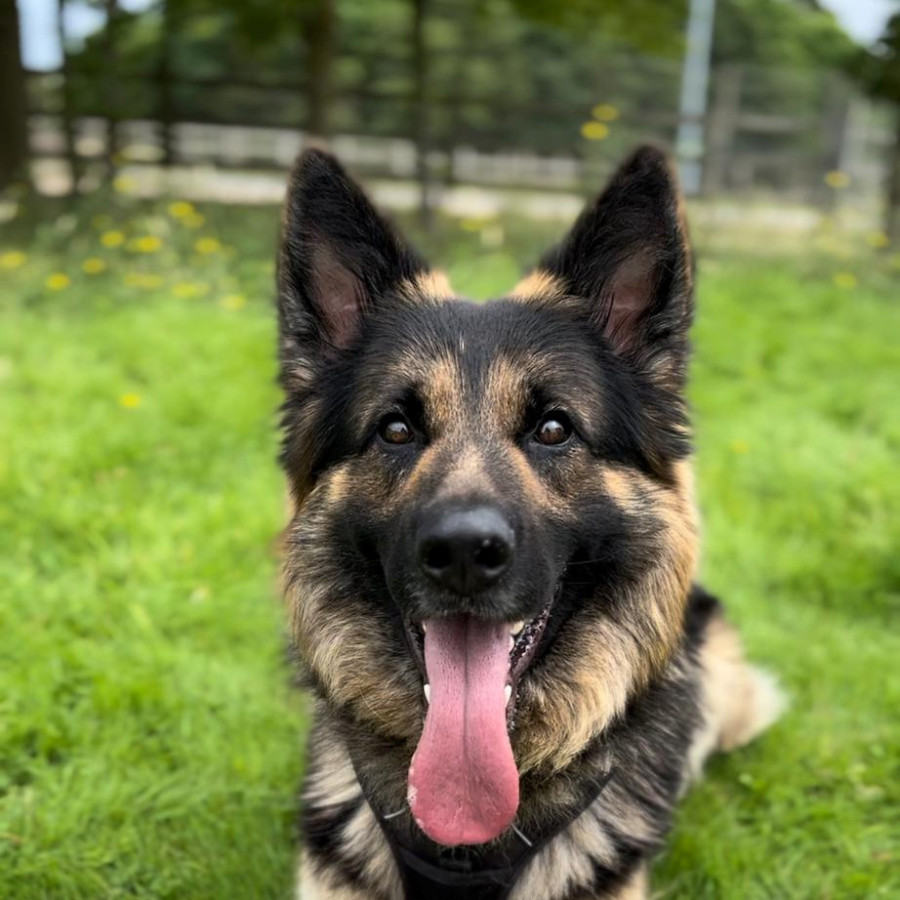
Both breeds trace back to Germany, but that's where the resemblance ends physically. The Shepherd stands 22-26 inches and carries 50-90 lbs of working-dog frame; the Miniature Schnauzer tops out around 14 inches and 20 lbs, built more like a compact terrier than anything resembling its bigger countryman.
Exercise need splits clearly, 5/5 for the Shepherd against 3/5 for the Schnauzer, a moderate daily walk and some yard time satisfies the smaller dog where the Shepherd needs a real job. Energy level tracks the same direction, 4/5 versus 3/5, though the Schnauzer's terrier heritage means it's rarely truly calm, just lower-output than the Shepherd.
Grooming rates 4/5 for both, but again for opposite reasons, the Shepherd because of coat volume and shed load, the Schnauzer because its wiry double coat needs hand-stripping or clipping every six to eight weeks. Where they split hard is shedding: 4/5 for the Shepherd, just 1/5 for the Schnauzer, whose coat holds onto loose hair instead of scattering it around the house.
Barking rates identically at 4/5 for both breeds, so don't expect a quiet apartment either way. Apartment suitability tells a different story though: 5/5 for the Schnauzer against 2/5 for the Shepherd, and the Schnauzer also tolerates being left alone better, 3/5 versus the Shepherd's 2/5. Size buys the Schnauzer some slack the noise numbers don't.
Trainability favors the Shepherd, 5/5 against the Schnauzer's still-respectable 4/5, but first-time-owner suitability flips that, 2/5 for the Shepherd, 4/5 for the Schnauzer. Both breeds are smart enough to get bored without mental work; the difference is what happens after. A Shepherd finds destructive outlets, a Schnauzer mostly just gets yappier.
Kids and other-dog compatibility both come out even, at 4/5 and 3/5 respectively, so neither breed has a clear edge in a mixed household. Strangers are where they part ways: the Schnauzer rates 3/5, still watchful but more receptive, against the Shepherd's guarded 2/5. Expect the Schnauzer to bark at the doorbell and then warm up; the Shepherd may not warm up at all.
The Schnauzer's 12-14 year lifespan beats the Shepherd's 9-13 by a modest but real margin. Health risks barely overlap, only hip dysplasia and ear infections appear on both lists. The Schnauzer's own list runs toward metabolic conditions unique to the breed: pancreatitis, diabetes, and Schnauzer comedo syndrome, none of which show up in the Shepherd's profile at all.
Cost level sits at 4/5 for the Shepherd and 3/5 for the Schnauzer, and the dollar ranges follow suit, $125-$250 monthly for the Shepherd against $90-$180 for the Schnauzer, with first-year costs of $1,800-$3,500 versus $1,300-$2,500. Hand-stripping coat maintenance for the Schnauzer, done professionally, can push the lower end of that range up if you're not doing it yourself.






Not directly, but both were developed in Germany, which is as close as this pairing gets to a shared origin. Beyond that, their size, build, and coat type have little in common.
Neither has an edge here, both rate 4/5 for barking. If a quiet household matters to you, this comparison won't help you decide on noise alone.
The Miniature Schnauzer, rated 4/5 for first-time owners against the Shepherd's 2/5. Its lower exercise need and smaller size make early mistakes less consequential.
Only two show up on both lists, hip dysplasia and ear infections. The Schnauzer carries its own set of metabolic risks, including pancreatitis and diabetes, that the Shepherd's list doesn't include.
The Schnauzer, at $90-$180 versus the Shepherd's $125-$250. Smaller body size generally means smaller food and medication costs.
The Miniature Schnauzer, typically 12-14 years against the Shepherd's 9-13.
Moderately, it rates 3/5, more receptive than the Shepherd's 2/5, but it's still going to announce visitors before deciding whether to like them.
The Shepherd for a dedicated working or protection role with room and experience to match; the Schnauzer for a lower-maintenance, apartment-friendly dog that still keeps you on your toes.
$125-$250 for the Shepherd against $90-$180 for the Schnauzer.
5/5 for the Shepherd versus 3/5 for the Schnauzer, the Shepherd needs substantially more.
The Schnauzer, at 12-14 years versus the Shepherd's 9-13.
Secure checkout on Stripe. We never see your card.
7-day money-back guarantee. Instant access.
This guide is not medical advice. If your dog shows pain, sudden behavior change, or worsening symptoms, consult a licensed veterinarian.
Some links may be affiliate links. We may earn a commission at no extra cost to you. We only suggest products we believe are helpful for dog owners.
We research and check what we publish, but we do not warrant that any figure, date, price, or statement is accurate, complete, or current, and we accept no liability for any loss, cost, injury, or other harm arising from the use of this site. Use it as one reference among several. You remain responsible for your own decisions and for your dog's care - confirm anything that matters with a licensed veterinarian or another qualified professional before you act on it. Full disclaimer.
Match your lifestyle to the right dog.
Take quizNot sure which breed is right for you? Take our 2-minute quiz to find out.
Take the quiz