DogBreedCompass

Malamute or Welsh Springer: A Reserved Spaniel With an Eye Test

The Welsh Springer Spaniel lists reserved with strangers among its own temperament keywords. For a spaniel that is unusual, and it is the single most useful thing to know before choosing one.

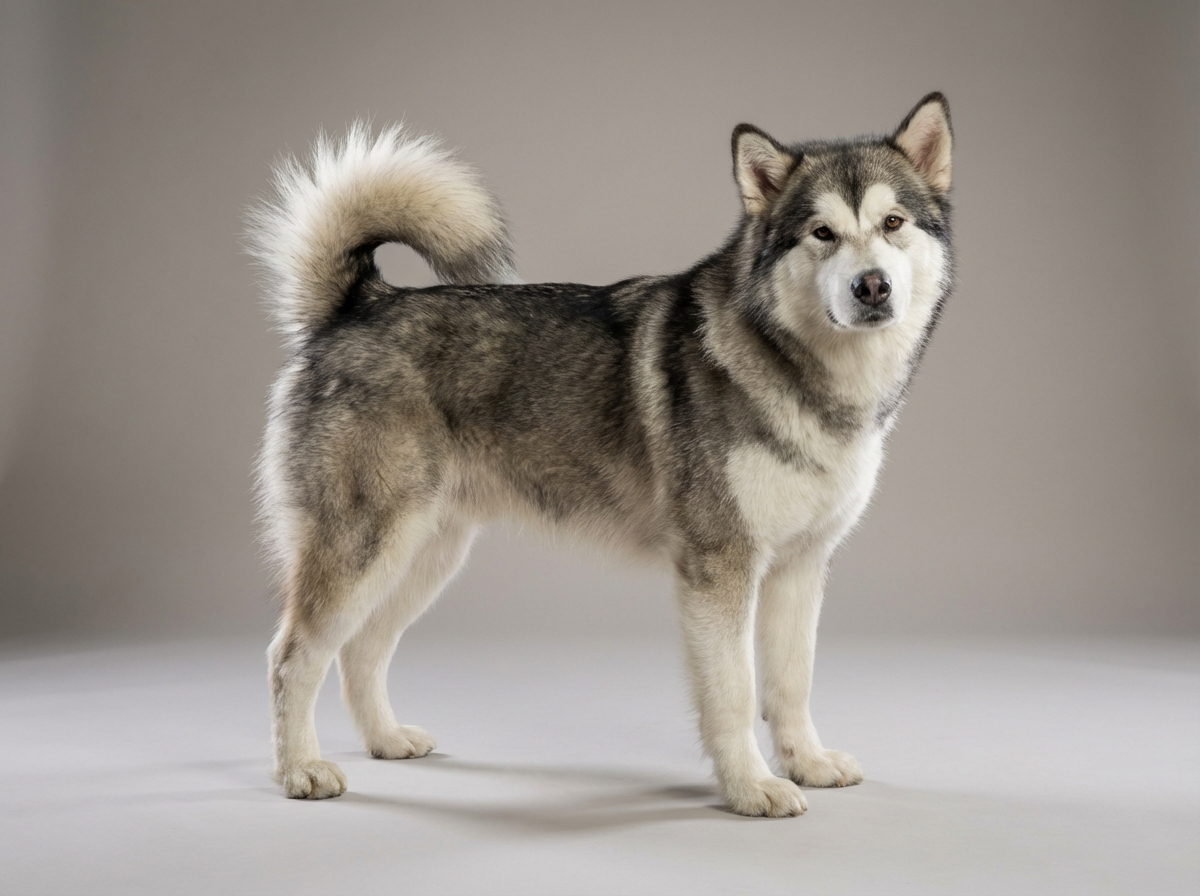
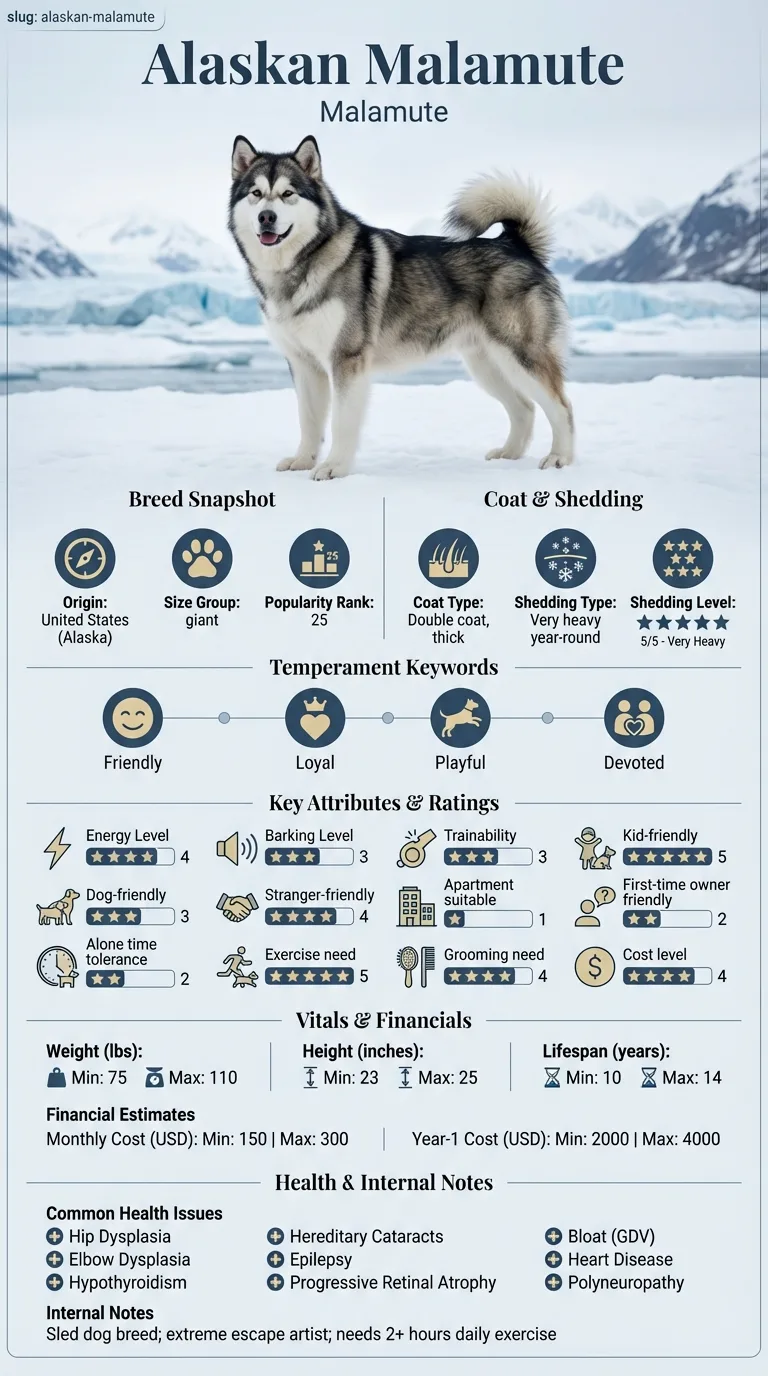
alaskan malamute infographic
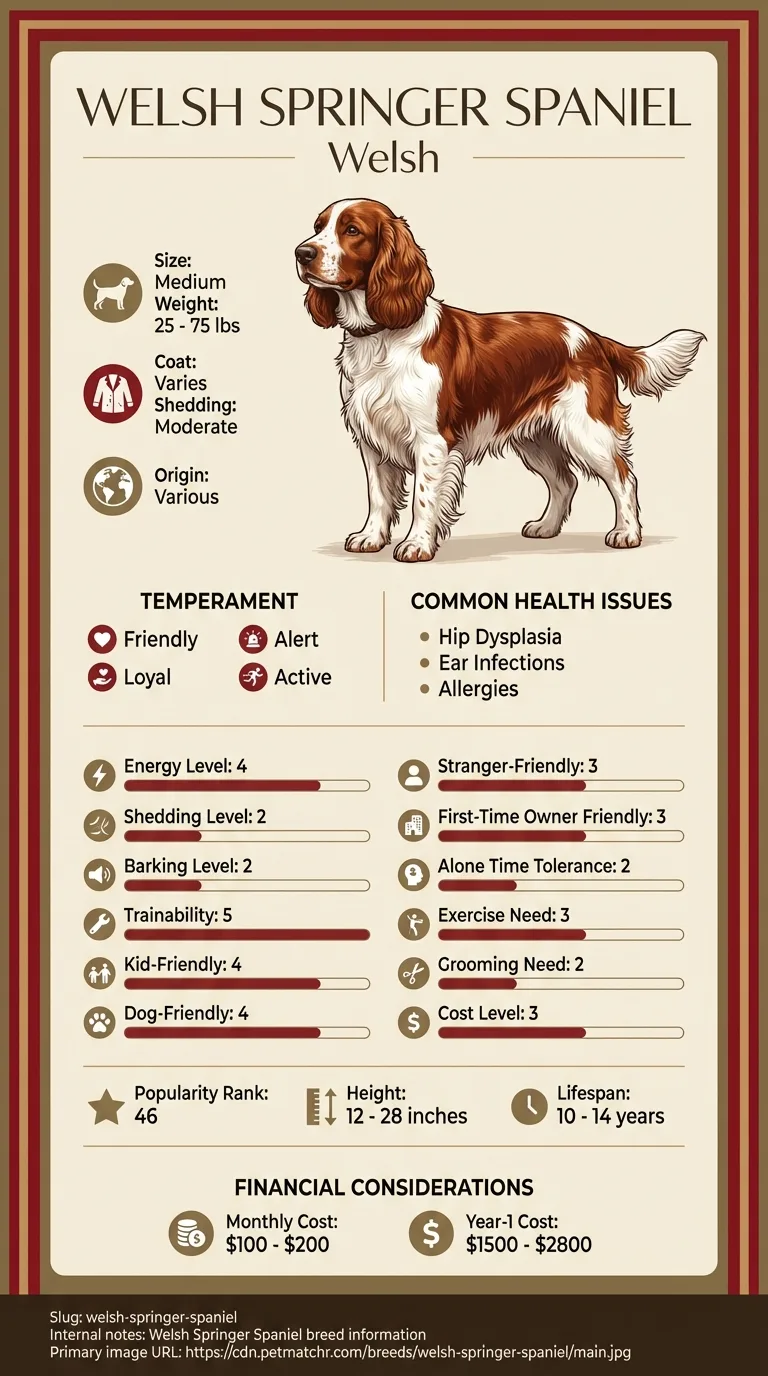
welsh springer spaniel infographic

This page is for someone who wants a mid-sized working gundog for an active household and is weighing it against a large northern breed — and for anyone who has assumed the Welsh and English Springers are the same dog.

Quick verdict

The Welsh Springer is the more practical dog for most active families — smaller, cheaper, longer-lived, more trainable and easier to groom — and its main quirks are a reserve that needs socialising and an eye condition worth screening for.

Choose alaskan malamute if...

Choose the Alaskan Malamute if you want a large cold-weather dog for load-bearing outdoor work, you have secure fencing and two hours a day, and you want a breed that greets everyone warmly.

Choose welsh springer spaniel if...

Choose the Welsh Springer Spaniel if you want a mid-sized, biddable, water-loving gundog for an hour or more of daily activity, you will socialise it properly through the first year, and you can find a breeder.

Head-to-head comparison

Featurealaskan malamutewelsh springer spanielWinner
Weight75–110 lbs35–55 lbsEqual
Height23–25 in17–19 inEqual
Lifespan10–14 years12–15 yearswelsh springer spaniel
CoatThick double coatMedium, water-resistantwelsh springer spaniel
Grooming need4/53/5welsh springer spaniel
Shedding5/5 — very heavy year-round3/5 — moderatewelsh springer spaniel
Energy level4/54/5Equal
Exercise need5/54/5welsh springer spaniel
Trainability3/54/5welsh springer spaniel
Barking3/53/5Equal
Good with kids5/54/5alaskan malamute
Good with other dogs3/54/5welsh springer spaniel
Friendly to strangers4/53/5alaskan malamute
Apartment suitability1/52/5welsh springer spaniel
Good for first-time owners2/53/5welsh springer spaniel
Tolerates being alone2/52/5Equal
Typical monthly cost$150–300$100–200welsh springer spaniel
Typical first-year cost$2,000–4,000$1,400–2,900welsh springer spaniel

Deep dive

A different breed from the English Springer, not a variety of it

The shared name causes more confusion than almost any other in the gundog world, and the differences are practical rather than cosmetic.

The Welsh Springer is the older of the two and developed separately in Wales. It is always red and white — never black and white, never liver and white — with a slightly smaller, more compact build at 35 to 55 pounds and 17 to 19 inches, shorter ears set lower on the head, and a straight, flat, weather-resistant coat with modest feathering rather than heavy furnishings.

The temperament differs more than the appearance. Where the English Springer is typically effusive with everybody, the Welsh Springer's own temperament keywords are loyal, reserved with strangers, energetic and even-tempered. That reserve is a defining trait: a Welsh Springer greets its own people enthusiastically and takes its time with visitors. It is not fearfulness in a well-socialised dog — it is a dog that assesses before engaging.

There is also no split between show and field lines of the kind that makes English Springer temperament so variable. The Welsh Springer is one type, which means a puppy from any decent breeder is fairly predictable.

The breed is uncommon. Waiting lists are normal and breeders are few in most regions, which is worth knowing before you set your heart on one. The upside is that low numbers and a small, conscientious breeder base have kept the health list short.

The Malamute has no comparable identity confusion, though it is regularly mistaken for a Siberian Husky. It is the heavier, slower, stronger of those two, built for freight rather than speed.

3/5 with strangers: socialising a reserved gundog

A 3/5 stranger rating is moderate rather than alarming, but in a breed whose own description leads with reserved it deserves deliberate handling.

The distinction that matters is between reserve and fear. A well-socialised Welsh Springer notices a visitor, holds back briefly, and then decides to engage on its own terms. An under-socialised one skips the assessment and goes straight to avoidance — backing away, hiding behind an owner, or barking from a distance. That second version is preventable and hard to reverse.

The work is unremarkable and needs doing anyway: through the first year, expose the puppy calmly and repeatedly to new people, places, surfaces, vehicles and noises, always with the option to retreat and never with forced greetings. Ask visitors to ignore the dog and let it approach. Reward voluntary engagement rather than luring it.

The payoff is a settled adult that is polite with strangers, excellent with its own family at 4/5 with children, and easy with other dogs at 4/5 — a genuinely straightforward dog in public.

The Malamute's 4/5 needs none of this. It is indiscriminately warm, greets everyone, and is useless as a deterrent — a difference that cuts both ways depending on what you want.

One shared trait: both rate 2/5 for time alone. The Welsh Springer is a close-working gundog that likes company, and a full working day in an empty house is not a good fit. Its version of the problem tends toward vocalising and restlessness rather than the Malamute's digging and escaping.

Glaucoma and the screening test worth asking about

The Welsh Springer's health list is short — hip dysplasia, ear infections, epilepsy, glaucoma and hypothyroidism — and glaucoma is the entry that separates a well-bred dog from a lucky one.

Glaucoma is raised pressure inside the eye. In its primary form it arises from the anatomy of the drainage angle rather than from injury or another disease, and the Welsh Springer is among the breeds with a recognised predisposition. It is painful, and an acute attack can destroy vision within a day or two if pressure is not reduced quickly.

What makes this actionable rather than merely worrying is that the drainage angle can be examined before any problem develops. Gonioscopy is a straightforward ophthalmic examination that assesses whether the angle is abnormally narrow, and responsible breeders in the breed have their stock examined and can tell you the result. Some schemes recommend repeating it as the dog matures, since the angle can change.

Ask a Welsh Springer breeder directly whether both parents have been gonioscopy-tested and what the findings were. Alongside that, ask for hip scores and any history of epilepsy in the line.

As an owner, know the acute signs regardless: a suddenly painful eye, squinting, a cloudy or bluish cornea, redness, a dilated pupil that does not respond to light, and a dog that is subdued or rubbing at its face. That is a same-day emergency.

Ear infections are the routine maintenance issue — drop ears on a dog that swims and pushes through cover trap moisture, so weekly checks and drying after swimming are part of ownership.

The Malamute's list is longer and heavier: hip and elbow dysplasia, bloat, hypothyroidism, epilepsy, progressive retinal atrophy, hereditary cataracts, zinc-responsive dermatosis and inherited polyneuropathy.

4/5 against 5/5, and a coat that handles the weather

The Welsh Springer needs a genuine hour to ninety minutes a day, and it wants that time to have content. This is a hunting spaniel — it quarters ground, uses its nose, flushes and retrieves, and it works happily in water. Scent games, retrieving with rules, gundog training, hiking and canicross all suit it, and at 4/5 trainability it takes instruction readily and enjoys the process.

The practical advantage over the Malamute is flexibility. Mental work counts, so a filthy February evening can be handled with twenty minutes of nose work and a shorter walk without the dog being unsatisfied. The Malamute's 5/5 admits no such substitution: two hours minimum, with physical resistance, in whatever weather there is, and pushed to dawn and dusk for months in a warm climate because of the Arctic coat.

The Welsh Springer's coat is one of the breed's quiet strengths. Straight, flat and genuinely water-resistant, with modest feathering on the legs, ears and belly. At 3/5 grooming and 3/5 shedding it needs a brush two or three times a week, with a comb through the feathering and the ears, plus checking for grass seeds after working in long vegetation. It dries fast, it sheds moderately, and there is no professional appointment required. Compared with heavily furnished show-line spaniels it is a low-fuss coat.

The Malamute's 4/5 and 5/5 is a bigger, though simpler, job: an undercoat rake to the skin two or three times a week and two annual blows that fill the house with wool for a fortnight each. Never clipped.

On cost the Welsh Springer is cheaper across the board: $100–200 a month against $150–300, cost level 3/5 against 4/5, and a first year of $1,400–2,900 against $2,000–4,000.

Which household each breed actually suits

The Welsh Springer's 3/5 for first-time owners is fair and slightly generous. It is biddable, mid-sized, physically manageable and forgiving of ordinary mistakes, and the two things that catch beginners out are under-socialising the reserve and under-estimating the exercise requirement. Neither is difficult if you know about them in advance.

It suits an active family with a garden, older children or well-briefed younger ones, and a routine where the dog is not alone all day. It travels well, fits a normal car, and is small enough that a teenager can walk it safely — which is genuinely not true of a 95 pound Malamute.

At 12 to 15 years it is also the longer commitment, and one that stays active well into old age. Spaniels of this type tend to age gradually rather than sharply.

The Malamute suits a different life altogether: cold weather, a securely fenced garden, and someone who genuinely wants to spend two hours outside every day doing something physical. In exchange it is warmer with strangers, better with children at 5/5, and one of the most striking dogs there is.

The deciding question is rarely temperament, because both are pleasant, sound dogs. It is whether your week can absorb a working breed's requirement in the form it comes in — hauling and distance for one, fieldwork and scent for the other. The Welsh Springer's version is achievable for far more households, which is most of why it is the more sensible recommendation for anyone whose shortlist genuinely contains both.

The caveat, again, is availability. Expect to wait, expect to travel, and treat a breeder who has puppies immediately available in a rare breed as a reason to ask more questions rather than fewer.

Alaskan Malamute vs Welsh Springer Spaniel at a glance

The Welsh Springer Spaniel lists reserved with strangers among its own temperament keywords. For a spaniel that is unusual, and it is the single most useful thing to know before choosing one over the more outgoing breeds in its family.

The Welsh Springer is the more practical dog for most active families — smaller, cheaper, longer-lived, more trainable, and easier to groom than the Malamute. Its main quirks are a natural reserve that needs deliberate socialising, and an eye condition worth screening for before you buy.

Choose the Malamute if you want a large cold-weather dog for load-bearing outdoor work, you have secure fencing and two hours a day, and you want a breed that greets everyone warmly. Choose the Welsh Springer Spaniel if you want a mid-sized, biddable, water-loving gundog for an hour or more of daily activity and will socialise it properly through the first year.

Frequently asked questions

Is a Welsh Springer just a red English Springer?

No. It is a separate, older breed developed in Wales, always red and white, more compact, with shorter lower-set ears and a flatter weather-resistant coat. Its temperament is also more reserved, and it has no show and field line split.

What does reserved with strangers mean in practice?

A well-socialised Welsh Springer holds back briefly, assesses a visitor and then engages on its own terms. An under-socialised one skips that and goes to avoidance instead, so calm repeated exposure through the first year matters.

What is gonioscopy and why does it matter?

An ophthalmic examination of the eye's drainage angle. The breed has a recognised glaucoma predisposition, and a narrow angle can be identified before any problem develops. Ask a breeder whether both parents were tested and what the result was.

How much exercise does a Welsh Springer need?

An hour to ninety minutes a day with content in it — scent work, retrieving, gundog training or hiking. Mental work counts toward the total, unlike the Malamute's 5/5 requirement, which needs two hours of physical resistance.

Is the coat hard work?

Less than most spaniels. It is straight, flat and water-resistant with modest feathering, rating 3/5 for grooming and 3/5 for shedding. A brush two or three times a week plus a comb through the feathering and ear checks covers it.

Which lives longer?

The Welsh Springer at 12 to 15 years against the Malamute's 10 to 14, on a short health list, and it tends to stay active well into old age.

Are Welsh Springers hard to find?

In most regions yes — the breed is uncommon and waiting lists are normal. Treat immediate availability in a rare breed as a prompt to ask more questions about the breeder rather than fewer.

Quick answers

View more answers
Living

Malamute or Welsh Springer Spaniel: which should I choose?

The Welsh Springer for most active households — mid-sized, biddable, cheaper, longer-lived and manageable on a lead. The Malamute if you want a large cold-weather dog for load-bearing work and can supply two hours a day.

Costs

Which is cheaper to keep?

The Welsh Springer at $100–200 a month against $150–300, and $1,400–2,900 in the first year against $2,000–4,000. Cost level 3/5 against 4/5.

Health

What eye signs are urgent?

A suddenly painful eye — squinting, cloudy or bluish cornea, redness, a dilated pupil that does not respond — is a glaucoma emergency. Vision can be lost within a day or two without treatment.

Training

Which is easier to train?

The Welsh Springer at 4/5 against 3/5. It is a gundog bred to take direction at a distance and it enjoys the work. The Malamute evaluates instructions and complies selectively.

Related DogBreedCompass guides

  • Alaskan Malamute breed guideThe Malamute profile covers exercise load, coat raking and the containment the breed requires.
  • Welsh Springer Spaniel breed guideThe Welsh Springer profile covers coat care, fieldwork and the breed's reserved temperament.
  • common genetic disorders in Welsh Springer SpanielsThe breed's inherited risks are few, and one of them has a screening test worth asking about.
  • hypothyroidism in Alaskan MalamutesHypothyroidism sits on both lists and is easy to miss as gradual coat and weight change.
  • hip dysplasia in Alaskan MalamutesHip dysplasia is shared by both breeds and is the first screening question for either breeder.
  • Alaskan Malamute vs English Springer SpanielReaders confusing the two Springers should see how the English version compares on the same measures.

Related guides

Important reminder

Health information here is general and is not veterinary advice. Eye screening, emergencies and individual risk should be discussed with your own veterinarian.

Some links on this site are affiliate links. We may earn a commission if you buy through them, at no additional cost to you.

Find Your Perfect Breed

Match your lifestyle to the right dog.

Take quiz

Find your match

Not sure which breed is right for you? Take our 2-minute quiz to find out.

Take the quiz