DogBreedCompass

Malamute or Golden Retriever: Why One Is a First Dog and One Is Not

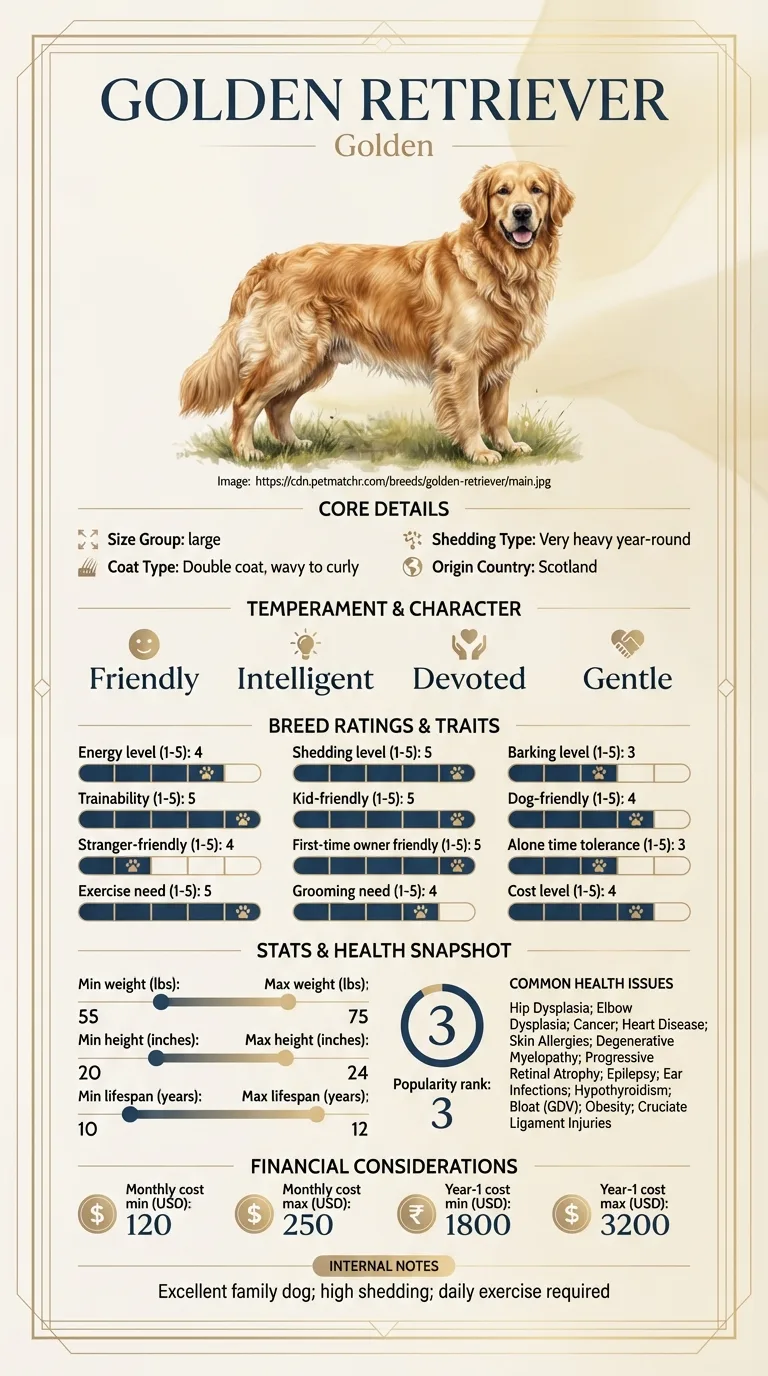
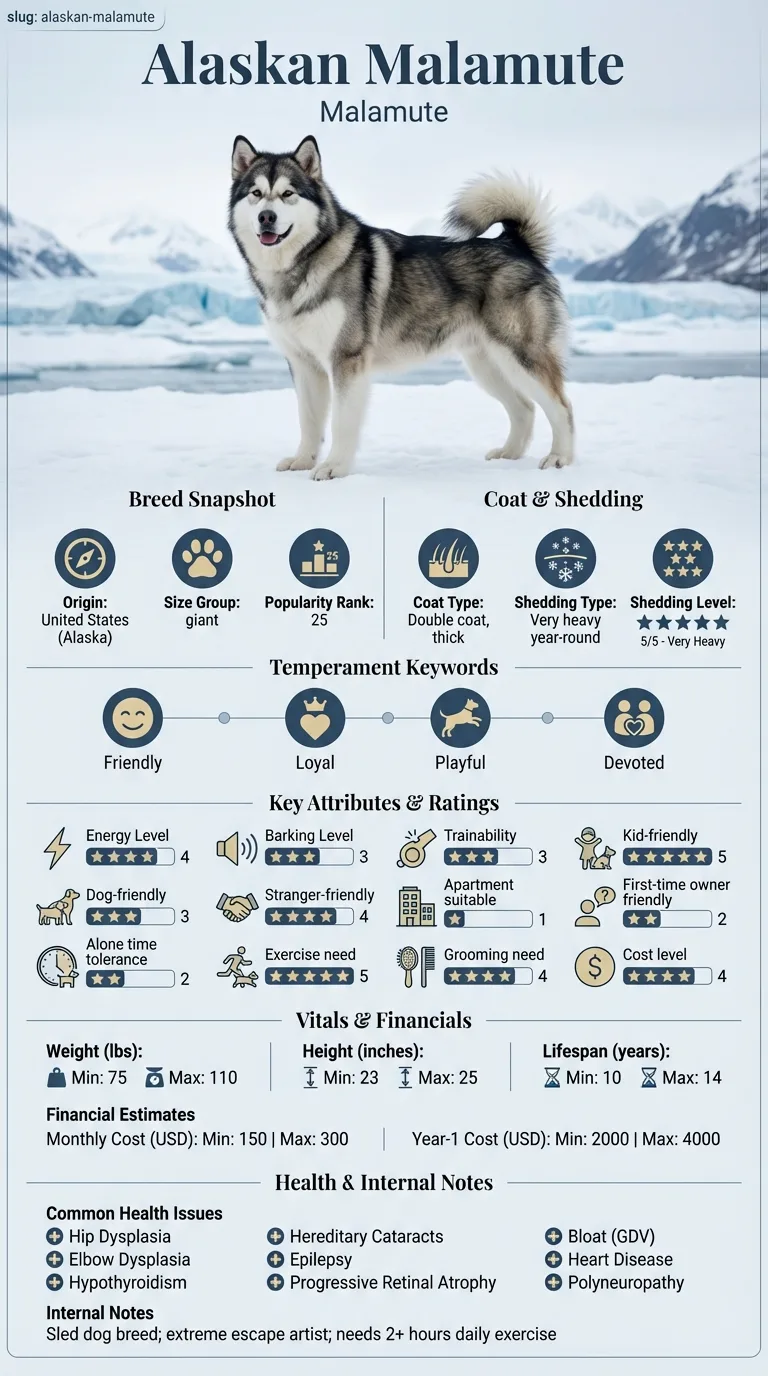
These two share more ratings than almost any other pair on this site — shedding 5/5, exercise 5/5, grooming 4/5, energy 4/5, kids 5/5, strangers 4/5, barking 3/5, cost 4/5 — and the three numbers that differ decide everything.

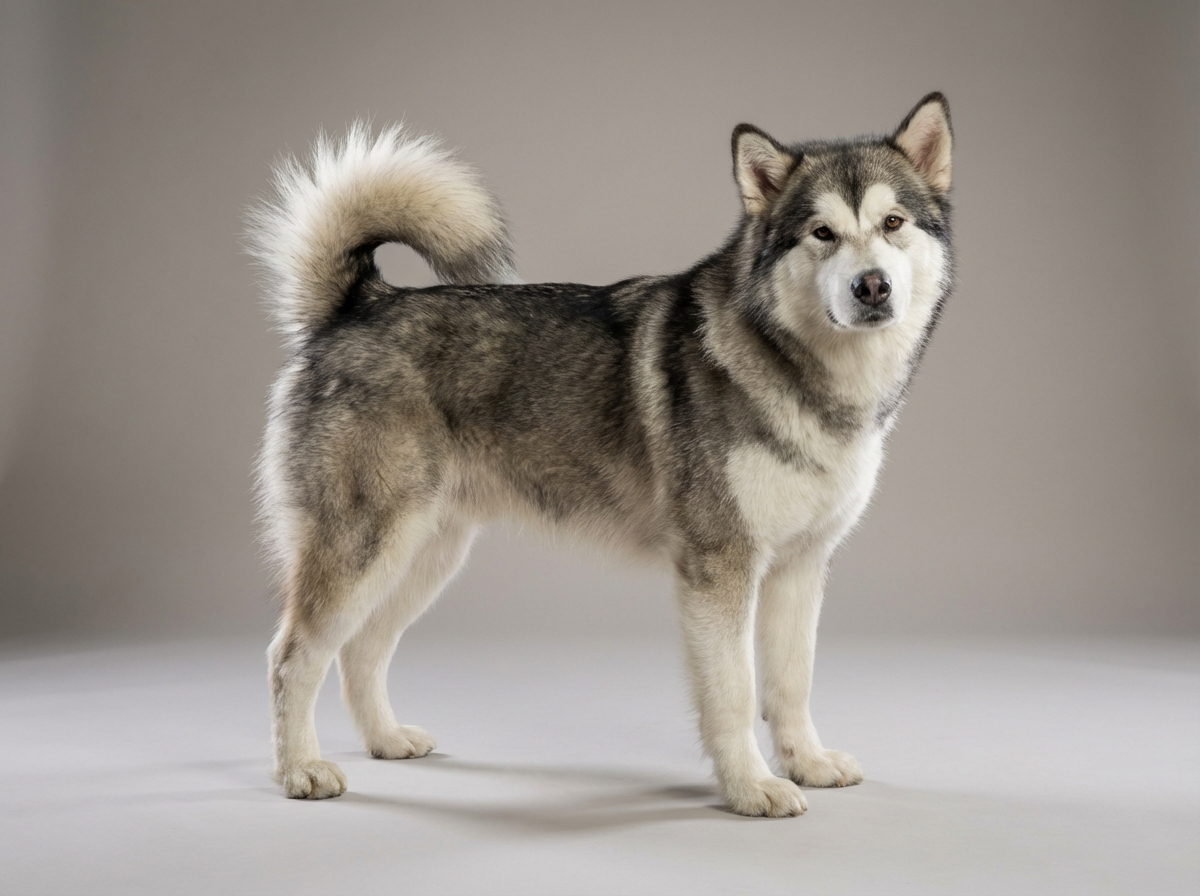
alaskan malamute infographic
golden retriever infographic

This page is for a family that wants a big friendly dog and is weighing the safest possible choice against a more striking and far more demanding one — and for anyone who assumes the two are interchangeable because both are furry, large and good with kids.

Quick verdict

The Golden Retriever is the better dog for almost every ordinary household, and the Malamute earns its place only where the owner can supply serious physical work and airtight containment.

Choose alaskan malamute if...

Choose the Alaskan Malamute if you have cold weather, a properly secured garden, load-bearing activity to offer, and prior experience with an independent breed that treats recall as optional.

Choose golden retriever if...

Choose the Golden Retriever if this is your first big dog, you want something that trains easily and tolerates a few hours alone, and you can accept the breed's substantial cancer burden and shorter life.

Head-to-head comparison

Featurealaskan malamutegolden retrieverWinner
Weight75–110 lbs55–75 lbsEqual
Height23–25 in20–24 inEqual
Lifespan10–14 years10–12 yearsalaskan malamute
CoatThick double coatDouble coat, wavyEqual
Grooming need4/54/5Equal
Shedding5/5 — very heavy year-round5/5 — very heavy year-roundEqual
Energy level4/54/5Equal
Exercise need5/55/5Equal
Trainability3/55/5golden retriever
Barking3/53/5Equal
Good with kids5/55/5Equal
Good with other dogs3/54/5golden retriever
Friendly to strangers4/54/5Equal
Apartment suitability1/52/5golden retriever
Good for first-time owners2/55/5golden retriever
Tolerates being alone2/53/5golden retriever
Typical monthly cost$150–300$120–250golden retriever
Typical first-year cost$2,000–4,000$1,800–3,200golden retriever

Deep dive

5/5 against 2/5 for first-time owners: what that gap costs

A first-time owner rating is really a measure of how much a breed punishes ordinary mistakes, and the three-point gap here is the widest on the page.

The Golden Retriever is forgiving in specific, describable ways. It wants to be near you, which makes recall easy to build. It offers behaviour freely, which makes reward-based training productive from the first week. It is soft enough that a badly timed correction does not create lasting damage, and social enough that a missed socialisation window is usually recoverable. When a Golden owner gets something wrong, the dog tends to wait for them to work it out.

The Malamute charges for the same errors. A missed recall becomes a dog half a mile away following a scent, because the breed was selected to keep going without checking in. A weak boundary becomes a hole under the fence. Inconsistency at the door becomes an eighty-pound dog that has learned bolting works. None of this is aggression or stupidity — the breed is rated 5/5 with children and 4/5 with strangers and is described as friendly, loyal, playful and devoted. It is simply a dog whose default answer to an instruction is to consider it.

The practical consequence is the shape of the first two years. A Golden puppy raised with a decent class and reasonable consistency usually turns into a straightforward adult. A Malamute puppy raised the same way turns into a strong, cheerful adolescent with its own opinions, and the owner spends that period on management — long lines, gates, fence audits, harness work — rather than on obedience polish. Both are perfectly rewarding. Only one is a reasonable first dog.

Both rated 5/5 for shedding, and the hair behaves differently

This is the rare pairing where the shedding rating ties at the maximum. Both breeds carry double coats described as very heavy year-round, and both rate 4/5 for grooming. Anyone imagining the Golden is the tidier option because it looks sleeker in photographs is in for a surprise.

The difference is texture and distribution. Malamute undercoat is dense wool. It comes out in clumps, gathers into drifts along skirting boards and under furniture, and lifts off surfaces in one piece — genuinely easy to sweep once you accept the volume. Golden hair is longer, finer and slightly wavy, and it goes everywhere: it floats, it settles on water bowls and worktops, it works into upholstery weave and it wraps around vacuum brush rolls. Golden owners tend to describe a permanent thin layer over the whole house; Malamute owners describe periodic tumbleweeds.

The seasonal pattern differs too. The Malamute blows coat twice a year in a compressed, dramatic two to three week event that ends. The Golden's heavy shed is less concentrated and more constant, with spring and autumn peaks that are noticeable rather than shocking.

Both need an undercoat rake and a slicker, two or three sessions a week. The Golden adds feathering — on the tail, the back of the legs, the ears and the chest — which mats where the Malamute's coat simply thickens, so a comb through the feathering is a separate small job. And the same rule applies to both: do not shave a double coat. It removes the insulation that works in both directions and the regrowth is frequently permanently altered.

The cancer question, and why lifespan favours the bigger dog

It is unusual for the giant breed to be the longer-lived one, and here it is: 10 to 14 years for the Malamute against 10 to 12 for the Golden. The reason is on the Golden's health list, which is the longest of any breed on this site.

Cancer sits near the top of that list and it is the honest headline of Golden Retriever ownership. The breed carries a well-documented predisposition to haemangiosarcoma and lymphoma in particular, and it is the reason the breed's life expectancy has not moved much despite it being one of the most popular and most carefully bred dogs in the world. Anyone choosing a Golden should go in knowing this, ask a breeder about longevity and cause of death in the line going back three generations, and treat any unexplained lethargy, pale gums or abdominal swelling in a middle-aged dog as an urgent appointment rather than a wait-and-see.

The rest of the Golden's list is long but more ordinary: hip and elbow dysplasia, heart disease, skin allergies, hypothyroidism, ear infections, obesity, cruciate ligament injuries, degenerative myelopathy and progressive retinal atrophy. Cruciate injuries deserve a mention because they are common, expensive, and strongly associated with letting a Golden get heavy.

The Malamute's list is shorter and shares the orthopaedic core — hip dysplasia, elbow dysplasia, hypothyroidism, epilepsy, bloat, progressive retinal atrophy — and adds three northern-breed specifics: zinc-responsive dermatosis, inherited polyneuropathy and hereditary cataracts.

Both are deep-chested and both list bloat, so split meals and a known route to an emergency clinic apply either way. On cost the Golden is slightly cheaper month to month at $120–250 against $150–300, but insurance quotes often narrow or reverse that gap because of the cancer history.

Time alone, other pets and how each fits a normal week

The Golden rates 3/5 for tolerating time alone and the Malamute 2/5. Neither is a dog for a household that is empty ten hours a day, but a 3/5 means a Golden can usually handle a normal working day with a midday break, decent exercise either side and something to chew. A 2/5 Malamute left the same way tends to convert boredom into landscaping.

With other dogs the Golden leads 4/5 to 3/5. Goldens are genuinely easy in group settings, at daycare and on shared walks. Malamutes are variable, and the specific pressure point is same-sex adult pairings, where tolerance can fall away in adolescence even between dogs that grew up together.

With cats and small pets the gap is larger than the ratings suggest. The Golden's retrieving background produces a soft mouth and a low kill drive, and Goldens living peacefully with cats and rabbits are unremarkable. The Malamute retains a real hunting drive from a breed that fed itself between hauling seasons, and small fast animals are not reliably safe with one regardless of how long they have shared a house.

On space, the Golden's 2/5 for apartments against the Malamute's 1/5 is a small edge that becomes a real one in a hot climate, where the Malamute needs indoor cooling and dawn and dusk exercise for months at a time. Both are 5/5 with kids and both are genuinely reliable family dogs. The difference is not affection. It is the amount of infrastructure the household has to supply.

Two 5/5 exercise ratings that ask for different afternoons

The exercise need matches at 5/5 and the energy level matches at 4/5, so the hours are comparable — but the content that actually satisfies each dog is not interchangeable.

The Golden wants retrieving and water. It is a gundog by construction, and the activity that empties a Golden's tank combines movement with a task: fetch with rules, water work, dummy retrieves, scent games, obedience with real criteria, agility. Twenty minutes of structured retrieving does more for a Golden than an hour of loose walking. The breed also trains into canine sports easily at 5/5 trainability, and the availability of that outlet is part of why Goldens fit ordinary households so well — you can satisfy the dog in the garden on a bad-weather day.

The Malamute wants resistance, distance and cold. Its breed notes specify two or more hours daily, and the activity that counts involves load: a weighted pack on a hike, a pulling harness, a scooter or rig, deep snow, steep ground. Fetch does not work — most Malamutes will retrieve twice and then decline. There is no garden-based substitute, which means bad weather does not excuse the walk, and hot weather forces it to the edges of the day.

If you want a dog you can tire out without leaving the property, that is the Golden. If you want a dog that will haul a loaded pack up a mountain and still want more, that is the Malamute — and there is no version of the Malamute that is satisfied with less.

Alaskan Malamute vs Golden Retriever at a glance

These two share more ratings than almost any other pair on this site: shedding 5/5, exercise 5/5, grooming 4/5, energy 4/5, kids 5/5, strangers 4/5, barking 3/5, cost 4/5. On paper they look like the same dog. In practice three numbers decide everything.

The Golden Retriever trains far more easily, tolerates a workday better, and suits a first-time owner in a way the Malamute does not. What it does not solve is health: the breed carries a substantial cancer burden and a shorter expected life than the Malamute's sturdier, longer-lived body.

Choose the Malamute if you have cold weather, a properly secured garden, load-bearing activity to offer, and prior experience with an independent breed that treats recall as optional. Choose the Golden Retriever if this is your first big dog, you want something that trains easily, and you can accept its shorter life and health risks.

Frequently asked questions

Which of these is the better family dog?

Both rate 5/5 with children, but the Golden Retriever is the better fit for most families because it also rates 5/5 for first-time owners and 3/5 for time alone. The Malamute is equally affectionate and needs far more infrastructure to be a good household dog.

Which sheds more?

Neither — both rate 5/5, described as very heavy year-round. The difference is behaviour: Malamute wool comes out in clumps you can sweep, while finer Golden hair works into fabric and settles as a permanent layer across the house.

Why does the Malamute live longer than the Golden?

10 to 14 years against 10 to 12, and the reason is cancer. The Golden Retriever carries a well-documented predisposition to haemangiosarcoma and lymphoma that holds the breed's life expectancy down despite otherwise careful breeding.

Can either be left alone during a workday?

The Golden usually manages it at 3/5, given exercise either side and ideally a midday break. The Malamute at 2/5 generally does not, and converts the time into digging, chewing and attempts on the fence.

Which is safer around cats?

The Golden, comfortably. A retrieving background produces a soft mouth and low kill drive. The Malamute retains genuine hunting drive and small fast animals are not reliably safe with one, however long they have shared a home.

Is the Golden actually cheaper?

On paper yes — $120–250 a month against $150–300, and $1,800–3,200 in the first year against $2,000–4,000. Insurance often narrows or reverses that, because premiums for Goldens reflect the breed's cancer and cruciate history.

Which is easier to train?

The Golden at 5/5 against 3/5. It offers behaviour, stays close and wants to work with you. The Malamute understands what you are asking and then decides, which is why off-lead reliability is a goal most Malamute owners never fully reach.

Quick answers

View more answers
Living

Malamute or Golden Retriever: which should I choose?

The Golden for almost any ordinary household — it is easier to train, tolerates a workday better and is safe with other pets. The Malamute only if you have cold weather, secure fencing, load-bearing activity and prior experience with an independent breed.

Costs

Which costs more to keep?

The Malamute at $150–300 a month against $120–250, though both sit at cost level 4/5 and insurance pricing can close the gap because of the Golden's cancer risk.

Health

What is the single biggest health concern for each?

Cancer for the Golden Retriever — haemangiosarcoma and lymphoma in particular. Hip and elbow dysplasia for the Malamute, with zinc-responsive dermatosis as its distinctive northern-breed issue.

Training

Which one is easier to tire out at home?

The Golden. Structured retrieving and scent games in a garden genuinely satisfy it. The Malamute needs distance and load, and there is no indoor or garden substitute for that.

Related DogBreedCompass guides

  • Alaskan Malamute breed guideThe Malamute profile covers containment, coat raking and the two-hour daily exercise expectation.
  • Golden Retriever breed guideThe Golden profile covers grooming, trainability and the breed's long health list.
  • cancer in Golden RetrieversCancer is the defining health question for the breed and the reason its lifespan lags.
  • hip dysplasia in Golden RetrieversHip dysplasia appears on both lists and is the first thing to ask either breeder about.
  • adopting a Golden RetrieverGoldens appear in rescue in numbers, and an adult arrives with its temperament already visible.
  • Alaskan Malamute vs German ShepherdReaders weighing the Malamute against a trainable working breed often look at this pairing next.

Related guides

Important reminder

Health information here is general and is not veterinary advice. Breed risk, screening availability and individual cases vary — discuss any specific concern with your own veterinarian.

Some links on this site are affiliate links. We may earn a commission if you buy through them, at no additional cost to you.

Find Your Perfect Breed

Match your lifestyle to the right dog.

Take quiz

Find your match

Not sure which breed is right for you? Take our 2-minute quiz to find out.

Take the quiz