Living
Malamute vs Brussels Griffon: which should I choose?
The Griffon if you live in a flat and want a small, funny, attached companion. The Malamute if you are athletic, have space and a properly secured garden, and want a physically robust dog.

Quick answer
Malamute vs Brussels Griffon: which should I choose?
The Griffon if you live in a flat and want a small, funny, attached companion. The Malamute if you are athletic, have space and a properly secured garden, and want a physically robust dog.
An Alaskan Malamute weighs roughly ten times what a Brussels Griffon weighs, and four of their temperament ratings match exactly: barking, trainability, dog tolerance and time alone. The personalities are closer than the packaging suggests. The logistics are not close at all.
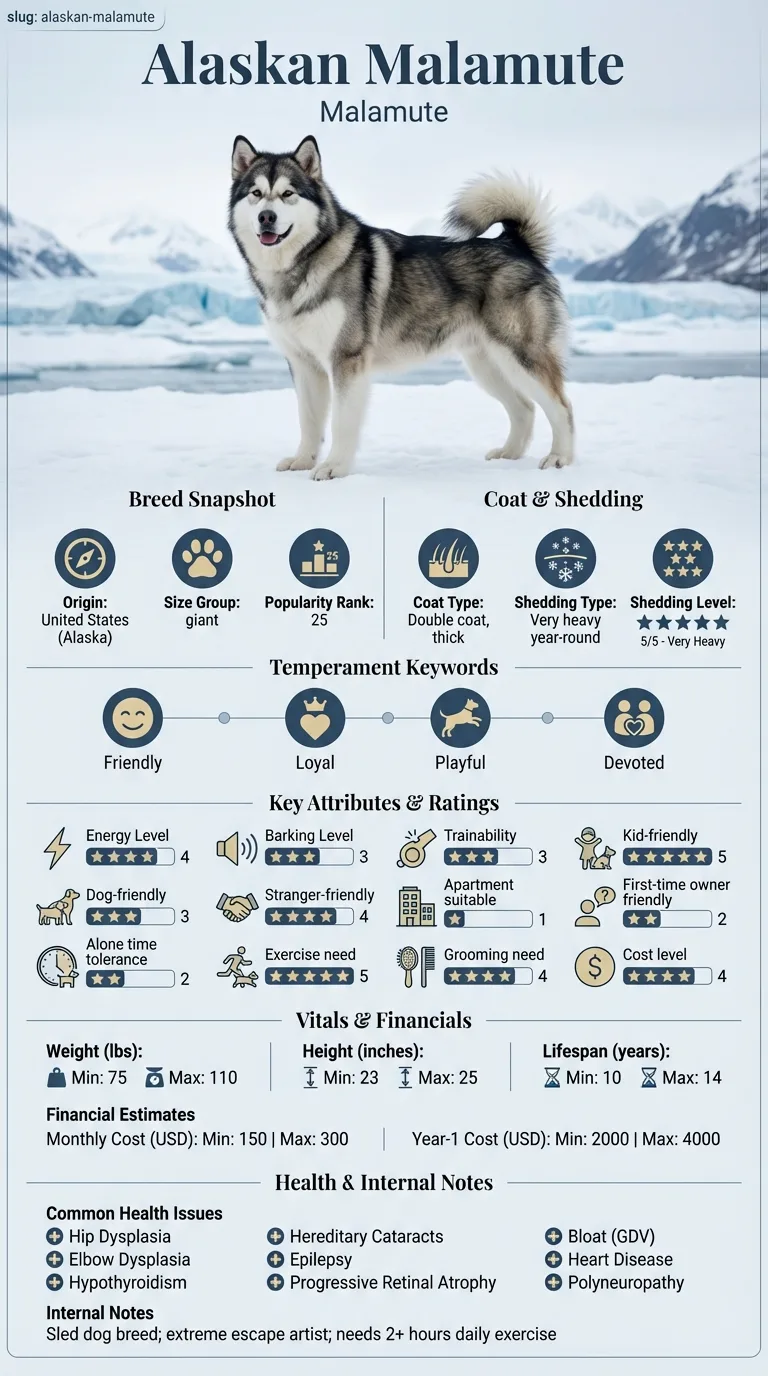
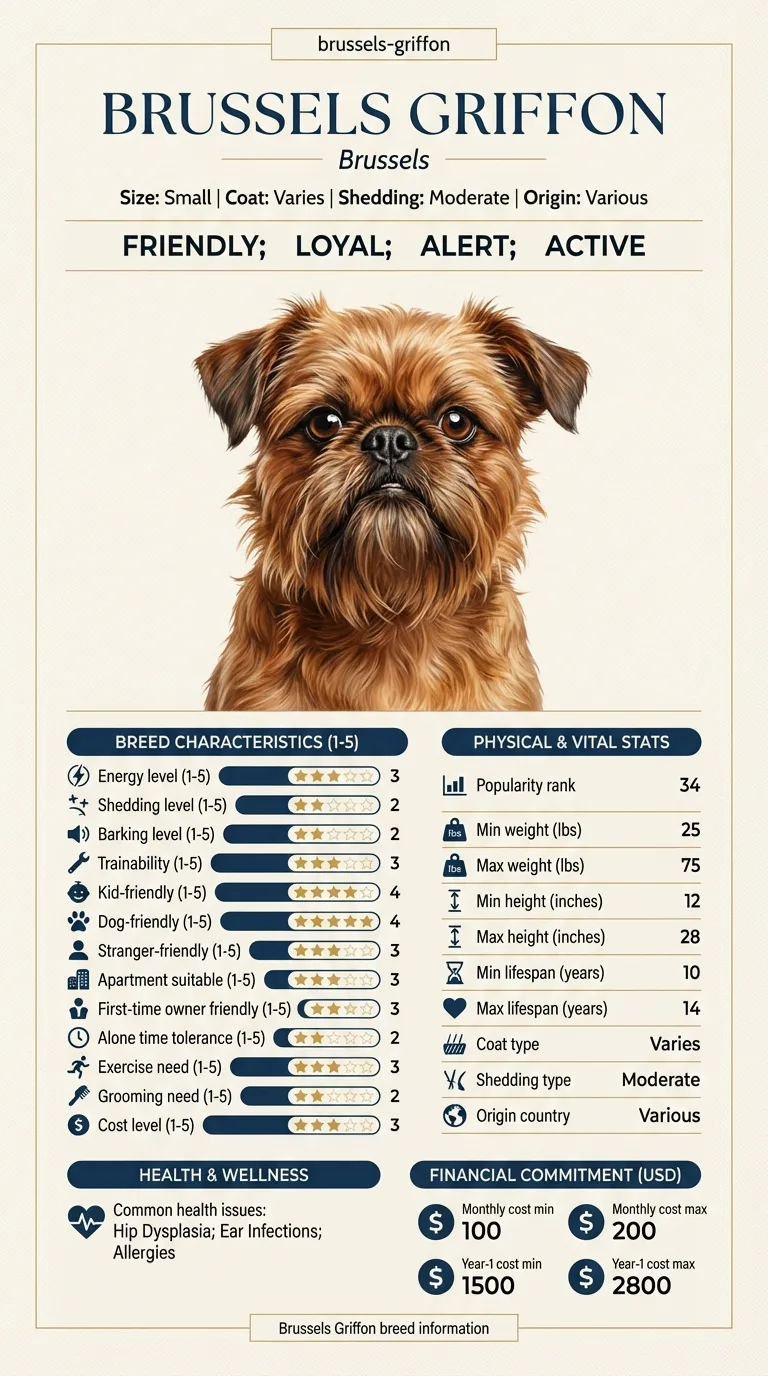
This page is for someone comparing the two ends of the size range. It covers what the matching ratings actually mean at each scale, the exercise and housing gap, the Griffon's breathing, eye and spinal risks, and cost.
The Griffon fits anywhere and is medically fragile; the Malamute is structurally sound and needs a landscape, a fence and twice the budget.
Choose the Alaskan Malamute if you are athletic, have space and want a physically robust dog. It has no breathing limitation, no eye fragility and no spinal risk, and it rates 5/5 with children against the Griffon's 3/5. You are accepting $150–$300 a month against $80–$150, 5/5 exercise and 5/5 shedding.
Choose the Brussels Griffon if you live in a flat and want a small, funny, intensely attached companion. It rates 5/5 for apartments against 1/5, needs only 2/5 exercise against 5/5, sheds at 2/5 against 5/5 and costs half as much. You are accepting a short face, prominent eyes and a fragile frame.
| Feature | alaskan malamute | brussels griffon | Winner |
|---|---|---|---|
| Weight | 75–110 lbs | 8–12 lbs | Equal |
| Height | 23–25 in | 7–10 in | Equal |
| Lifespan | 10–14 years | 12–15 years | brussels griffon |
| Coat | Thick double coat | Rough or smooth | Equal |
| Grooming need | High (4/5) | Moderate (3/5) | brussels griffon |
| Shedding | Very high (5/5) | Low (2/5) | brussels griffon |
| Energy level | High (4/5) | Moderate (3/5) | Equal |
| Exercise need | Very high (5/5) | Low (2/5) | brussels griffon |
| Trainability | Moderate (3/5) | Moderate (3/5) | Equal |
| Barking | Moderate (3/5) | Moderate (3/5) | Equal |
| Good with kids | Very high (5/5) | Moderate (3/5) | alaskan malamute |
| Good with other dogs | Moderate (3/5) | Moderate (3/5) | Equal |
| Friendly to strangers | High (4/5) | Moderate (3/5) | alaskan malamute |
| Apartment suitability | Very low (1/5) | Very high (5/5) | brussels griffon |
| Good for first-time owners | Low (2/5) | Moderate (3/5) | brussels griffon |
| Tolerates being alone | Low (2/5) | Low (2/5) | Equal |
| Typical monthly cost | $150–$300 | $80–$150 | brussels griffon |
| Typical first-year cost | $2,000–$4,000 | $1,100–$2,300 | brussels griffon |
The Malamute needs around two hours a day and it needs resistance. Carting, scootering, canicross, loaded hikes — anything where the dog is moving something. Walking beside you barely registers. Heat limits it, so summer sessions move to the cool ends of the day, and long work becomes seasonal.
The Griffon needs two short walks and some indoor play. It rates 3/5 for energy and is busy rather than sedentary, but the requirement is met in twenty minutes and in almost any weather short of real heat.
That difference produces the apartment ratings — 1/5 against 5/5 — and it also produces the containment difference.
The Malamute's own breed notes call it an extreme escape artist. It digs, climbs, works at latches and travels once loose, so a fence dug in at the base, secured gates and a microchip with current details are the baseline. Its recall should never be relied on as a safety measure.
A Griffon has no comparable instinct. Its outdoor risks are traffic, larger dogs and heat rather than distance.
Brachycephalic airway syndrome heads the Brussels Griffon's condition list. A shortened skull with a normal amount of soft tissue in it means narrowed nostrils and often an elongated soft palate.
The practical rules follow from that: no exercise in the heat of the day from spring onward, a harness rather than a collar, strict weight control since every extra pound loads a compromised airway, and a conversation with any airline before travel, because most refuse short-faced breeds in the hold.
The eyes are the everyday risk and they are the reason to keep a vet's number handy. Griffon eyes are large and prominent, and eye injuries appear on the list explicitly. A scratched or ulcerated cornea in this breed is a same-day problem — there is very little tissue between the surface and the inside of the eye, and an untreated ulcer can perforate.
Ask a breeder how the parents breathe under exertion rather than at rest, and how open their nostrils are.
The Malamute has neither limitation. Its climate problem is a coat that holds heat, which is managed by timing rather than by anatomy.
Syringomyelia appears on the Griffon's condition list and it is worth understanding because the sign that gives it away looks like nothing.
It occurs when the back of the skull is too small for the brain behind it, which disturbs the flow of cerebrospinal fluid and allows fluid-filled cavities to form within the spinal cord. Small, domed-skulled breeds are the ones affected.
The classic sign is phantom scratching — a hind leg lifting toward the neck or shoulder without ever making contact with the skin. Others are yelping when picked up or when a collar goes on, sensitivity around the head and neck, and a reluctance to be touched there.
It is diagnosed by MRI and managed rather than cured, and it responds better to early treatment than late.
The useful thing for a prospective owner is simply to know the name, because scratching that never touches the skin is frequently treated as a skin problem for months before anyone says the word.
Patellar luxation and hip dysplasia complete the list, both common in small breeds and both often mild.
Both rate above average for grooming and the work is unrelated. The Malamute at 4/5 sheds constantly at 5/5 and blows its undercoat in sheets twice a year, needing a rake and several long sessions. It never mats and never needs a groomer, and its coat should never be clipped.
The Griffon at 3/5 depends on variety. A rough-coated Griffon needs hand-stripping or clipping plus a tidy of the beard and facial furnishings, which for most owners means a groomer every couple of months. A smooth-coated one needs almost nothing. Shedding is 2/5 either way.
On money the Griffon runs $80–$150 a month against $150–$300, and $1,100–$2,300 against $2,000–$4,000 in the first year — roughly half.
The number to be careful with is veterinary. Airway surgery, an MRI for suspected syringomyelia and repeated corneal treatment are all realistic in a Griffon's life, and any one of them erases several years of the difference in food.
The Malamute's expensive risks are orthopaedic surgery and a bloat emergency, both four-figure events at this size.
On lifespan the Griffon is slightly ahead at 12 to 15 years against 10 to 14.
Barking ties at 3/5, trainability at 3/5, dog tolerance at 3/5 and time alone at 2/5.
Those four say something real. Neither breed is eager to please in a retriever sense — both understand a request and weigh it. Neither is silent, and neither is a nuisance barker. Both are moderately sociable with other dogs rather than effusive or hostile. And neither copes well with an empty house, because a stable ratter and a team sled dog were both bred to be around others.
What does not translate is scale. 5/5 exercise against 2/5. 1/5 for apartments against 5/5. 5/5 shedding against 2/5. Twice the monthly cost.
The children rating also separates them, 5/5 against 3/5, and the Griffon's figure is about fragility rather than temperament — an 8 to 12 pound dog with fine bones and prominent eyes is genuinely at risk from a toddler.
So the personalities are cousins and the logistics are unrelated.

On four ratings, yes — barking, trainability, dog tolerance and time alone all match. Neither is eager to please in a retriever sense, neither is silent, both are moderately sociable with other dogs, and neither copes with an empty house. What does not translate is anything to do with size.
The Malamute at 5/5 against the Griffon's 3/5, and the Griffon's rating is about fragility rather than temperament. An 8 to 12 pound dog with fine bones and prominent eyes is genuinely at risk from a toddler, and dogs handled roughly learn to defend themselves.
A hind leg lifting toward the neck or shoulder without ever touching the skin. In a small domed-skulled breed it is a classic sign of syringomyelia, in which fluid-filled cavities form in the spinal cord. It is frequently treated as a skin problem for months, so it is worth naming the condition to a vet directly.
2/5 — two short walks and some indoor play, against the Malamute's 5/5 and two hours of pulling work. It rates 3/5 for energy and is busy rather than sedentary, but the requirement is met in twenty minutes and in almost any weather short of real heat.
The Griffon, at $80–$150 a month against the Malamute's $150–$300, and $1,100–$2,300 against $2,000–$4,000 in the first year. The caveat is veterinary: airway surgery, an MRI or repeated corneal treatment are realistic and each erases several years of the food difference.
The Malamute, overwhelmingly — 5/5 against the Griffon's 2/5. It sheds year-round and blows its undercoat in sheets twice a year, needing a rake and several long sessions. The rough-coated Griffon's grooming is a groomer's job rather than a shedding problem.
The Malamute, by a wide margin. Its own breed notes call it an extreme escape artist — it digs, climbs, works at latches and travels once loose. A Griffon has no comparable instinct; its outdoor risks are traffic, larger dogs and heat rather than distance.
The Griffon if you live in a flat and want a small, funny, attached companion. The Malamute if you are athletic, have space and a properly secured garden, and want a physically robust dog.
The Malamute runs $150–$300 a month and the Brussels Griffon $80–$150, with first-year totals of $2,000–$4,000 and $1,100–$2,300 — roughly half.
A squinting, weeping or closed eye. Prominent eyes mean corneal injuries are common and there is very little tissue between the surface and the inside of the eye, so an untreated ulcer can perforate within a day or two.
Yes — both rate 2/5. The Griffon attaches intensely to one or two people; the Malamute was bred to work in a team. Neither suits a full working day without cover.
Secure checkout on Stripe. We never see your card.
7-day money-back guarantee. Instant access.
Health information here is general and is not veterinary advice. If your dog shows pain, sudden behaviour change, or worsening symptoms, consult a licensed veterinarian.
Some links on this site are affiliate links. We may earn a commission at no extra cost to you, and we only suggest products we believe are helpful for dog owners.
We research and check what we publish, but we do not warrant that any figure, date, price, or statement is accurate, complete, or current, and we accept no liability for any loss, cost, injury, or other harm arising from the use of this site. Use it as one reference among several. You remain responsible for your own decisions and for your dog's care - confirm anything that matters with a licensed veterinarian or another qualified professional before you act on it. Full disclaimer.
Match your lifestyle to the right dog.
Take quizNot sure which breed is right for you? Take our 2-minute quiz to find out.
Take the quiz