DogBreedCompass

Malamute or Border Collie: Load-Bearing Against Problem-Solving

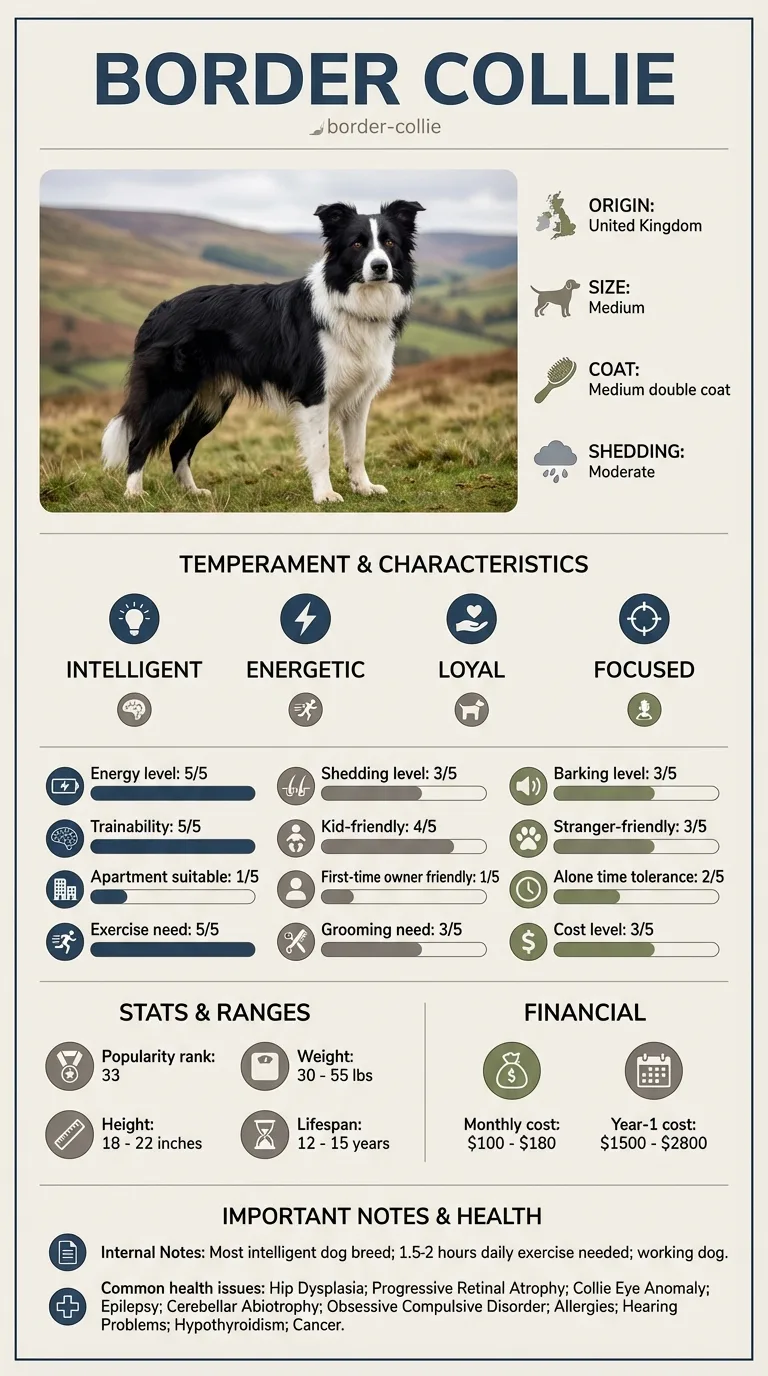
Both rate 5/5 for exercise, 1/5 for apartments and 2/5 for time alone. On the headline numbers they are the same dog. In practice one of them is tired by weight and distance and the other is tired by difficulty, and giving the wrong kind of work to either produces a different flavour of disaster.

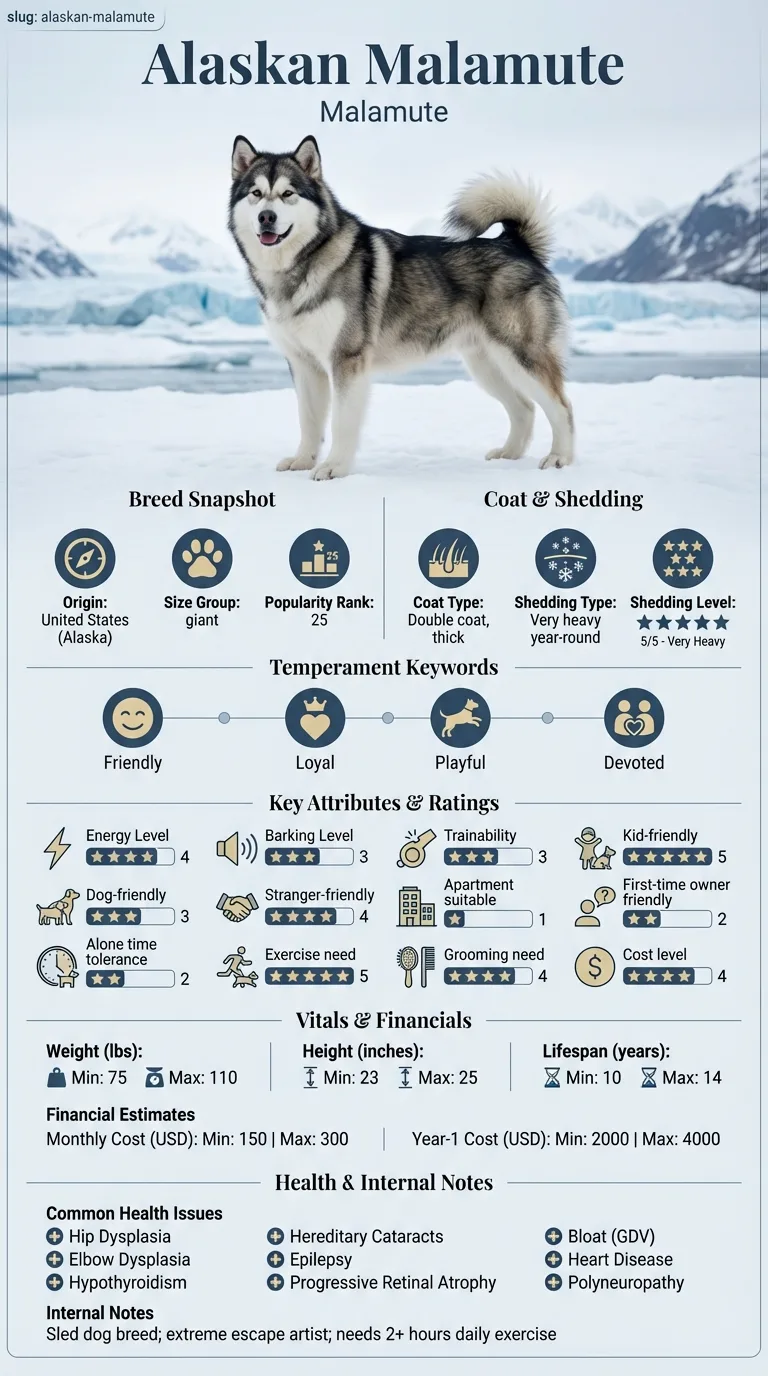
alaskan malamute infographic
border collie infographic

This page is for someone who has accepted a high-output dog and needs to know which kind of output. It covers muscular against cognitive work, trainability, noise sensitivity, two genetic tests for the Collie, containment and cost.

Quick verdict

The Border Collie is cheaper, smaller, far more trainable and much harder to satisfy; the Malamute is stronger, hairier, more expensive and content with pure physical work.

Choose alaskan malamute if...

Choose the Alaskan Malamute if the work you can offer is physical rather than structured. It rates 5/5 with children against the Collie's 4/5 and 4/5 with strangers against 3/5, and it will not develop compulsive behaviour if under-occupied — it will simply dig and leave. You are accepting $150–$300 a month and 5/5 shedding.

Choose border collie if...

Choose the Border Collie if you will train a dog every day and want the most responsive breed available. It rates 5/5 for trainability, grooms at 3/5, sheds at 3/5, lives 12 to 15 years and costs $100–$180 a month. You are accepting 1/5 for first-time owners, noise sensitivity, and a breed that turns inward without work.

Head-to-head comparison

Featurealaskan malamuteborder collieWinner
Weight75–110 lbs30–55 lbsEqual
Height23–25 in18–22 inEqual
Lifespan10–14 years12–15 yearsborder collie
CoatThick double coatMedium double coatEqual
Grooming needHigh (4/5)Moderate (3/5)border collie
SheddingVery high (5/5)Moderate (3/5)border collie
Energy levelHigh (4/5)Very high (5/5)Equal
Exercise needVery high (5/5)Very high (5/5)Equal
TrainabilityModerate (3/5)Very high (5/5)border collie
BarkingModerate (3/5)Moderate (3/5)Equal
Good with kidsVery high (5/5)High (4/5)alaskan malamute
Good with other dogsModerate (3/5)High (4/5)border collie
Friendly to strangersHigh (4/5)Moderate (3/5)alaskan malamute
Apartment suitabilityVery low (1/5)Very low (1/5)Equal
Good for first-time ownersLow (2/5)Very low (1/5)alaskan malamute
Tolerates being aloneLow (2/5)Low (2/5)Equal
Typical monthly cost$150–$300$100–$180border collie
Typical first-year cost$2,000–$4,000$1,500–$2,800border collie

Deep dive

How to actually tire each of them

A Malamute is tired by resistance. Weight-pulling, carting, scootering, canicross, loaded hikes — anything where the dog is moving something. Two hours of that produces a Malamute that lies down and stays down. Two hours of walking beside you does not, because there is nothing to push against.

Heat is the constraint, and a serious one: a thick Arctic coat means summer work moves to the cool ends of the day and long sessions become seasonal.

A Border Collie is tired by criteria. Herding where available, but also agility, competitive obedience, flyball, scent work, or serious daily training with real standards. Forty minutes of that beats two hours of running, and running alone produces an extremely fit dog with the same untouched need.

The failure modes differ accordingly and this is the part worth planning around. An under-worked Malamute digs up the garden and escapes. An under-worked Collie turns inward — obsessive compulsive disorder appears on its condition list, which is unusual for a health list, because the breed genuinely develops it. Shadow chasing, light chasing, spinning and fixation on wheels or water start as boredom and become compulsive.

One problem is fixed with fencing. The other sometimes needs medication.

Noise sensitivity and the household around it

The Border Collie is a soft, sound-sensitive breed and this is under-discussed relative to how much it affects daily life.

Thunderstorm and firework fear are common. So is startling at household noise, reactivity to sudden movement, and a general tendency to find chaos aversive. A Collie in a loud, busy, unpredictable household is not merely unsettled — it can become genuinely anxious, and anxiety in a 5/5 trainable dog gets learned thoroughly.

Sharp correction has the same effect. This breed shuts down under it and gains nothing.

The Malamute is not sensitive in that way at all. It is boisterous, noisy in its own right, indifferent to household chaos and largely unbothered by weather.

Herding behaviour is the other management job in a Collie. Circling and heel-nipping at running children, joggers and cyclists is normal for the breed and needs interrupting early rather than being found charming — a 4/5 rating with children assumes that work has been done.

The Malamute's social complication is same-sex intolerance with other dogs, which surfaces at social maturity rather than in puppyhood.

Two tests every Border Collie buyer should ask for

Collie eye anomaly appears on the Border Collie's condition list. It is an inherited developmental abnormality of the eye, present from birth, ranging from mild and stable to causing retinal detachment and blindness. Puppies can be examined by an ophthalmologist at six to eight weeks and there is a DNA test — ask to see the results.

MDR1 drug sensitivity is the second and it will matter in an emergency rather than at purchase. Many herding-breed dogs carry a mutation affecting a protein that keeps certain drugs out of the brain, and affected dogs can react severely to normal doses of some common medications including particular wormers and sedatives. The test is cheap and done once — put the result on your vet's file and volunteer it at every new practice.

Cerebellar abiotrophy is the third, a progressive inherited condition affecting coordination that presents in young dogs and has a test available.

Hip dysplasia, progressive retinal atrophy, epilepsy, hearing problems, allergies, hypothyroidism and cancer complete the list.

The Malamute's own list runs to hip and elbow dysplasia, hypothyroidism, hereditary cataracts, progressive retinal atrophy, epilepsy, heart disease, bloat, inherited polyneuropathy and zinc-responsive skin disease — and polyneuropathy also has a DNA test.

Fences, coats and money

The Malamute is the harder dog to contain by a wide margin. Its own breed notes call it an extreme escape artist: it digs, climbs, works at latches and travels once loose. A fence dug in at the base, secured gates and a microchip with current details are the baseline, and its recall should never be treated as a safety measure.

A Border Collie generally stays where its people are. Its containment issue is movement rather than wanderlust — a Collie that has decided to gather passing cars is a road-safety problem, and a boundary that lets it see the road makes that worse.

On coat, both are double-coated and neither should ever be clipped. The Malamute sheds year-round at 5/5 and blows its undercoat in sheets twice a year, needing a rake and several sessions. The Collie at 3/5 is far more manageable, with feathering on the legs and tail that needs brushing through.

On money the Collie runs $100–$180 a month against $150–$300, and $1,500–$2,800 against $2,000–$4,000 in the first year.

And it lives longer, 12 to 15 years against 10 to 14.

Alaskan Malamute vs Border Collie: same rating, different fuel

Exercise ties at 5/5, apartments tie at 1/5, barking ties at 3/5 and time alone ties at 2/5. Four of the rows people use to filter breeds are identical.

The divergence is trainability: 5/5 against 3/5, which is the widest gap on the page. A Border Collie is the most responsive breed in dogs and a Malamute is not remotely trying to be.

That single difference determines what the two hours a day has to contain. Load-bearing work satisfies a Malamute completely. It does almost nothing for a Collie, which needs to be told what to do and to do it well.

The Malamute is the more sociable of the two — 5/5 with children against 4/5, 4/5 with strangers against 3/5 — and the Collie is better with other dogs at 4/5 against 3/5.

And the Collie is cheaper, smaller, lives longer and sheds considerably less: 3/5 against 5/5, with grooming at 3/5 against 4/5.

Frequently asked questions

Do both breeds need the same amount of exercise?

Both rate 5/5 and the content is completely different. A Malamute is tired by resistance — pulling, carting, loaded hikes. A Border Collie is tired by criteria — herding, agility, obedience or scent work. Two hours of running satisfies the Malamute and leaves the Collie extremely fit and entirely unsatisfied.

What happens to an under-worked Border Collie?

It turns inward. Obsessive compulsive disorder appears on the breed's condition list, which is unusual for a health list, because Collies genuinely develop it — shadow chasing, light chasing, spinning and fixation on wheels or water. These start as boredom and become compulsive, sometimes needing medication alongside behaviour work.

What happens to an under-worked Malamute?

It digs and it leaves. Its own breed notes describe an extreme escape artist, and a bored Malamute will excavate a garden and test every inch of the boundary. That is a fencing problem rather than a psychological one, which is a meaningful difference from the Collie's failure mode.

Is the Border Collie really that sensitive?

Yes, and it is under-discussed. Thunderstorm and firework fear are common, as is startling at household noise and finding chaos aversive. A Collie in a loud unpredictable household can become genuinely anxious, and sharp correction shuts the breed down. The Malamute is largely indifferent to all of it.

What is MDR1 and why does it matter?

A mutation common in herding breeds affecting a protein that keeps certain drugs out of the brain. Affected dogs can react severely to normal doses of some common medications, including particular wormers and sedatives. The test is cheap and done once — keep the result on your vet's file and volunteer it at every new practice.

Which is better for a first-time owner?

The Malamute marginally, at 2/5 against the Collie's 1/5, though neither is a sensible first dog. The Malamute's difficulty is physical and logistical; the Collie's is that a novice rarely provides the cognitive work it needs, and the consequences of not providing it are harder to undo.

Which is cheaper to keep?

The Border Collie, at $100–$180 a month against the Malamute's $150–$300, and $1,500–$2,800 against $2,000–$4,000 in the first year. It also sheds far less at 3/5 against 5/5, grooms at 3/5 against 4/5, and lives two to three years longer.

Quick answers

View more answers
Living

Malamute vs Border Collie: which should I choose?

The Border Collie if you will train a dog daily and want the most responsive breed available. The Malamute if the work you can offer is physical rather than structured — it is satisfied by pulling and distance alone.

Costs

How much does each cost per month?

The Malamute runs $150–$300 a month and the Border Collie $100–$180, with first-year totals of $2,000–$4,000 and $1,500–$2,800. Grooming is 4/5 against 3/5.

Living

Can either live in an apartment?

Neither — both rate 1/5. The Malamute's problem is size and output together; the Collie's is that a flat offers nothing to think about, and an under-occupied Collie develops compulsive behaviour rather than simply being bored.

Behavior

Which is harder to contain?

The Malamute, clearly. It digs, climbs and travels once loose. A Border Collie generally stays where its people are, though a boundary that lets it watch passing cars creates a herding problem of its own.

Related DogBreedCompass guides

  • Alaskan Malamute breed guideThe Malamute profile covers exercise, containment and the breed's coat.
  • Border Collie breed guideThe Border Collie profile covers working outlets, sensitivity and genetic testing.
  • Malamute vs Australian ShepherdThe Australian Shepherd is the slightly less intense herding breed in the same bracket.
  • Akita vs Alaskan MalamuteThe Akita comparison sets out how the Malamute differs from a Japanese guardian breed.
  • Border Collie anesthesia sensitivityAnaesthesia and drug sensitivity is a specific concern in herding breeds.
  • Malamute bloat and GDVBloat is a genuine emergency in the Malamute and every owner should know the signs.

Related guides

Important reminder

Health information here is general and is not veterinary advice. If your dog shows pain, sudden behaviour change, or worsening symptoms, consult a licensed veterinarian.

Some links on this site are affiliate links. We may earn a commission at no extra cost to you, and we only suggest products we believe are helpful for dog owners.

Find Your Perfect Breed

Match your lifestyle to the right dog.

Take quiz

Find your match

Not sure which breed is right for you? Take our 2-minute quiz to find out.

Take the quiz