DogBreedCompass

Akita or Standard Schnauzer: A Working Farm Dog or a Guardian

The Standard Schnauzer rates 5/5 for trainability, 4/5 for exercise, 1/5 for shedding and lives 13 to 16 years. It is the original of the three Schnauzers — the farm dog the Miniature was bred down from and the Giant bred up from — and it is a considerably more serious animal than its small cousin.

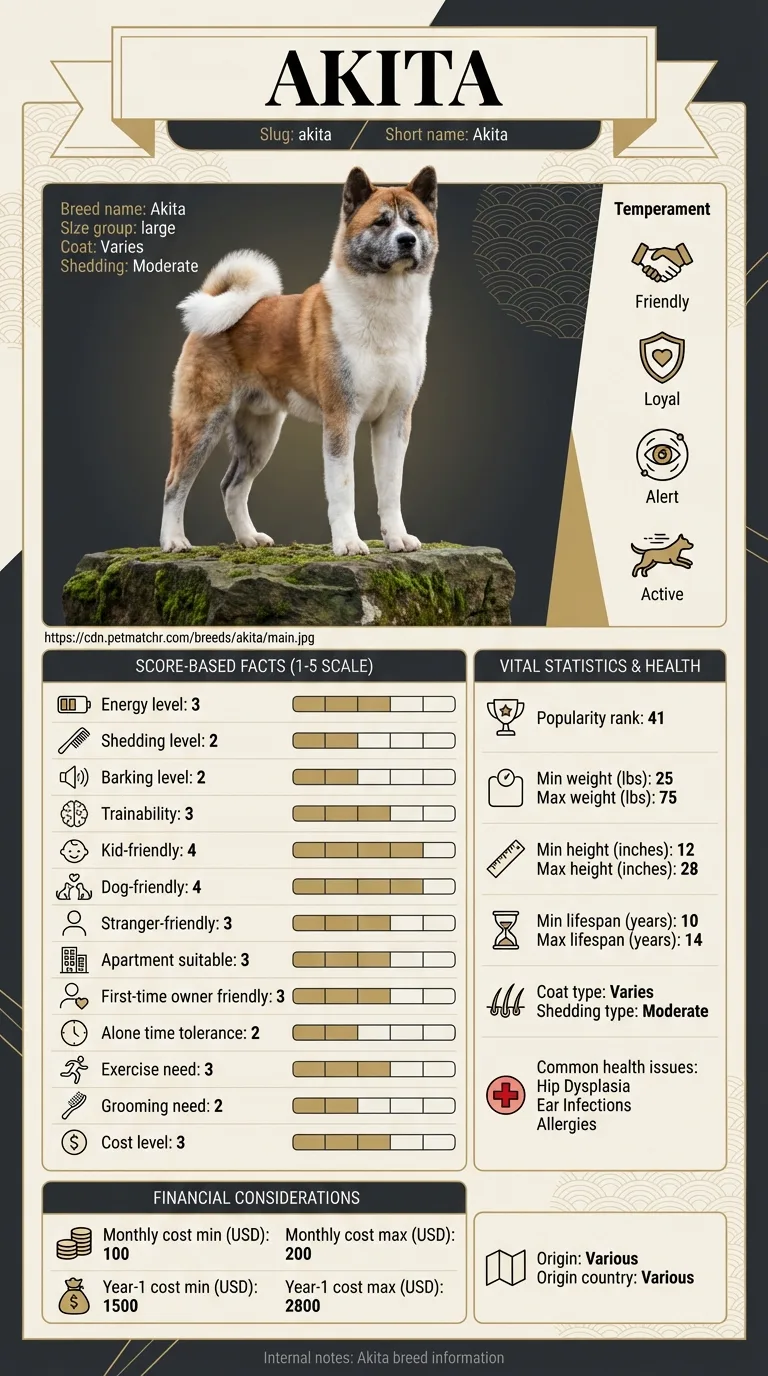
akita infographic
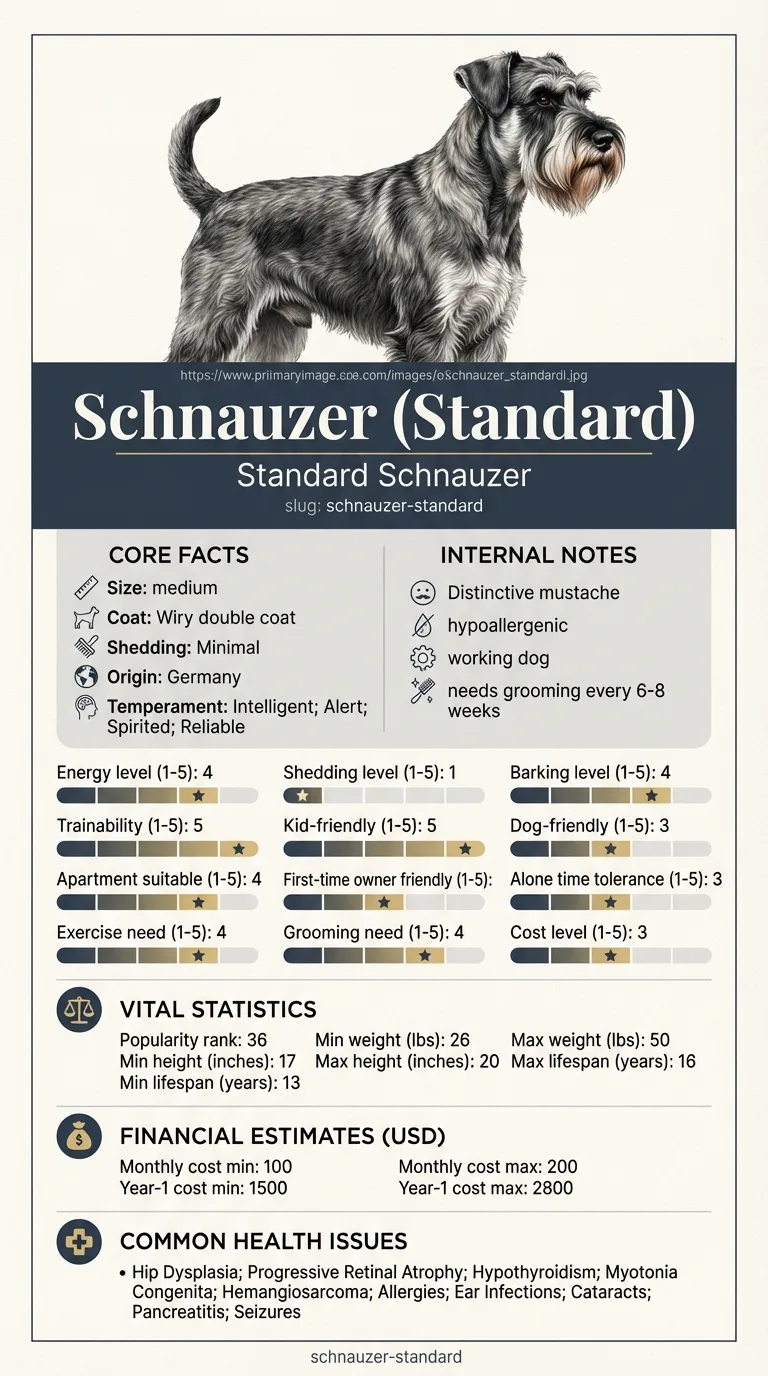
schnauzer standard infographic

This page is for someone weighing a mid-sized, low-shedding working breed against a large guardian. It covers the training and exercise requirement, wire coat maintenance, an inherited muscle disorder with a DNA test, and cost.

Quick verdict

The Standard Schnauzer is a capable, long-lived, low-shedding working dog that needs a job and a groomer; the Akita needs neither and gives you far less in return.

Choose akita if...

Choose the Akita if you want quiet and no grooming appointments. It barks at 2/5 against the Schnauzer's 4/5, grooms at 3/5 against 4/5, and needs 3/5 exercise against 4/5. You are accepting 5/5 shedding against 1/5, 1/5 for first-time owners, 2/5 with other dogs and strangers, and a much shorter life.

Choose schnauzer standard if...

Choose the Standard Schnauzer if you want a mid-sized dog you can genuinely train and will work it daily. It rates 5/5 for trainability and with children, sheds at 1/5, lives 13 to 16 years, tolerates being alone at 3/5 and costs $100–$200 a month. You are accepting 4/5 barking, 4/5 exercise and a coat that needs stripping.

Head-to-head comparison

Featureakitaschnauzer standardWinner
Weight70–130 lbs26–50 lbsEqual
Height24–28 in17–20 inEqual
Lifespan10–13 years13–16 yearsschnauzer standard
CoatDense double coatWiry double coatEqual
Grooming needModerate (3/5)High (4/5)akita
SheddingVery high (5/5)Very low (1/5)schnauzer standard
Energy levelModerate (3/5)High (4/5)Equal
Exercise needModerate (3/5)High (4/5)akita
TrainabilityModerate (3/5)Very high (5/5)schnauzer standard
BarkingLow (2/5)High (4/5)akita
Good with kidsModerate (3/5)Very high (5/5)schnauzer standard
Good with other dogsLow (2/5)Moderate (3/5)schnauzer standard
Friendly to strangersLow (2/5)Moderate (3/5)schnauzer standard
Apartment suitabilityLow (2/5)High (4/5)schnauzer standard
Good for first-time ownersVery low (1/5)Moderate (3/5)schnauzer standard
Tolerates being aloneModerate (3/5)Moderate (3/5)Equal
Typical monthly cost$110–$240$100–$200schnauzer standard
Typical first-year cost$1,700–$3,200$1,500–$2,800schnauzer standard

Deep dive

5/5 trainability with a terrier's opinion attached

The Standard Schnauzer learns quickly and works well — it has been used as a military and police dog, and it competes in obedience, agility, scent work and tracking.

What the rating does not convey is the flavour. This is not a retriever's biddability. A Schnauzer forms opinions, tests boundaries, and finds repetitive drilling insulting. It works best in short, varied, interesting sessions with someone who is consistent and does not nag.

The exercise requirement at 4/5 is around ninety minutes a day plus mental work. An under-employed Standard Schnauzer becomes vocal — the 4/5 barking rating is closely tied to occupation — and inclined to appoint itself as the household's security consultant.

With strangers at 3/5 it is watchful rather than effusive, which is a farm-guard trait, and broad socialisation from eight weeks keeps that watchfulness proportionate.

The Akita at 3/5 is independent rather than opinionated. It needs no mental work, will not invent a job, and gives you influence rather than direction in return.

Stripping, clipping and a 1/5 shedding coat

The Schnauzer's wiry double coat sheds almost nothing at 1/5, which is why the breed suits households that could not tolerate an Akita's 5/5.

A correct coat is hand-stripped — dead hair plucked out by the root — rather than clipped. Clipping cuts the harsh guard hairs and leaves the roots, so over years the coat softens, loses its texture and dirt-shedding quality, and the pepper-and-salt colouring pales. Most pet Schnauzers are clipped and come to no harm; if the classic coat matters, find a groomer who strips.

Either way it is an appointment every six to eight weeks for thirteen to sixteen years, plus brushing between visits.

The beard and leg furnishings are the daily part. The beard holds water after every drink and food after every meal, and it needs combing and wiping or it mats and smells. Leg furnishings pick up mud.

The Akita's coat needs no professional attention at all — a weekly brush for ten months, then two or three weeks of raking twice a year — and it should never be clipped, for the same structural reasons.

Myotonia congenita and the rest of the list

Myotonia congenita is the entry most owners have never encountered and it is specific enough to be worth naming.

It is an inherited disorder of muscle membranes in which muscles are slow to relax after contracting. Affected puppies are stiff, have difficulty rising, may bunny-hop with the hind legs, and often have an enlarged, overdeveloped-looking musculature and a stiff gait that eases as they move. It appears in the first months of life.

There is a DNA test, and it is the single most useful specific question to ask a Standard Schnauzer breeder. A puppy that is oddly stiff getting up should be investigated rather than watched.

Haemangiosarcoma — a cancer of blood vessel walls that is often silent until a tumour bleeds — appears on the list, so sudden collapse with pale gums in an adult is an emergency.

Hip dysplasia, progressive retinal atrophy, cataracts, hypothyroidism, pancreatitis, allergies, ear infections and seizures complete it. As with the Miniature, a low-fat diet is a sensible precaution given the pancreatitis risk.

The Akita's burden is autoimmune and endocrine, with hip dysplasia and bloat.

What each costs across a long life

The Standard Schnauzer runs $100–$200 a month against the Akita's $110–$240, and $1,500–$2,800 against $1,700–$3,200 in the first year.

Grooming is the line that closes the gap and then some. Every six to eight weeks for up to sixteen years is over a hundred appointments, and unless you learn to strip or clip the dog yourself it is unavoidable. Budget it explicitly.

Dental care and a fat-conscious diet are the other routine items, and both are cheap preventives against expensive problems.

The Akita's spending is food-dominated and flat, with autoimmune disease and bloat as the large uncertain risks.

On housing the Schnauzer rates 4/5 for apartments against 2/5 — small enough, low-shedding and content in a flat provided the exercise happens and the barking is managed from the first week.

And it lives three to five years longer, which is worth weighing in both directions: more companionship, and more years of grooming bills.

Akita vs Standard Schnauzer: a farm dog with three jobs

The Standard is the middle Schnauzer and the original one. Where the Miniature is a small alert companion and the Giant is a working guardian, the Standard is a genuine multi-purpose farm dog — ratter, drover and watchdog — and it wants all three parts of that used.

Against the Akita it is more trainable at 5/5 against 3/5, more sociable at 5/5 with children and 3/5 with other dogs and strangers, and it sheds almost nothing at 1/5 against 5/5.

What it costs is engagement and noise: 4/5 exercise against 3/5, and 4/5 barking against 2/5.

Time alone ties at 3/5, which is worth flagging. A low-shedding dog with a working brain that still copes with an ordinary working day is an unusual combination, and it is one of the Standard Schnauzer's genuine strengths.

It also lives 13 to 16 years, three to five more than an Akita.

Frequently asked questions

How does a Standard Schnauzer differ from a Miniature?

It is bigger at 26 to 50 pounds, more driven at 4/5 exercise against 3/5, and more trainable at 5/5 against 4/5. The Standard is the original farm dog — ratter, drover and watchdog — while the Miniature is a small alert companion. Both share the wire coat, the 1/5 shedding and the grooming schedule.

How much exercise does a Standard Schnauzer need?

Around ninety minutes a day at 4/5 exercise, plus mental work — obedience, scent games or agility all suit its 5/5 trainability. An under-employed one becomes vocal and appoints itself as the household's security consultant, which is where most complaints about the breed come from.

Should the coat be stripped or clipped?

A correct wire coat is hand-stripped, with dead hair plucked out by the root. Clipping cuts the guard hairs and leaves the roots, so the coat softens and pales over the years. Most pet Schnauzers are clipped and come to no harm — if the classic texture matters to you, find a groomer who strips.

What is myotonia congenita?

An inherited disorder in which muscles are slow to relax after contracting. Affected puppies are stiff, struggle to rise, may bunny-hop behind and look oddly over-muscled, with a stiffness that eases as they move. It appears in the first months. There is a DNA test — ask a Standard Schnauzer breeder for it by name.

Do Standard Schnauzers bark a lot?

Yes — 4/5, against the Akita's 2/5. It is a farm watchdog trait and it is closely tied to occupation: a well-worked Schnauzer is considerably quieter than the rating suggests, and an under-exercised one is the loudest thing on the street.

Which lives longer?

The Standard Schnauzer, at 13 to 16 years against the Akita's 10 to 13 — a long life for a dog of this size. It cuts both ways: more years of companionship and more years of grooming appointments, which is worth costing before you buy.

Which copes better with a working day?

They tie at 3/5, which is a genuine strength of the Schnauzer. A low-shedding dog with a working brain that still manages an ordinary working day is an unusual combination — provided the exercise happens before you leave rather than after you get back.

Quick answers

View more answers
Living

Akita vs Standard Schnauzer: which should I choose?

The Standard Schnauzer if you want a mid-sized low-shedding dog you can genuinely train, and will work it daily and fund grooming. The Akita if you want quiet, no grooming appointments and a dog that needs no occupation.

Costs

How much does each cost per month?

The Standard Schnauzer runs $100–$200 a month and the Akita $110–$240, with first-year totals of $1,500–$2,800 and $1,700–$3,200. Add grooming every six to eight weeks for up to sixteen years.

Living

Which sheds less?

The Schnauzer, at 1/5 against the Akita's 5/5 — the full width of the scale. The trade is a 4/5 grooming requirement and a beard that needs combing and wiping daily.

Health

What should I ask a Standard Schnauzer breeder?

The myotonia congenita DNA result for both parents, hip scores, eye certification and thyroid results. Ask about pancreatitis and seizures in the line as well.

Related DogBreedCompass guides

  • Akita breed guideThe Akita profile covers guardian temperament and the long socialisation window the breed needs.
  • Standard Schnauzer breed guideThe Standard Schnauzer profile covers coat work, working outlets and health testing.
  • Akita vs Miniature SchnauzerThe Miniature Schnauzer is the smaller version with the same coat and less drive.
  • Akita vs German Wirehaired PointerThe German Wirehaired Pointer is the other wire-coated working breed worth comparing.
  • Standard Schnauzer skin allergiesSkin problems are common in wire-coated breeds and worth recognising early.
  • Akita autoimmune diseasesAutoimmune disease is the Akita's most distinctive burden and the first question for a breeder.

Related guides

Important reminder

Health information here is general and is not veterinary advice. If your dog shows pain, sudden behaviour change, or worsening symptoms, consult a licensed veterinarian.

Some links on this site are affiliate links. We may earn a commission at no extra cost to you, and we only suggest products we believe are helpful for dog owners.

Find Your Perfect Breed

Match your lifestyle to the right dog.

Take quiz

Find your match

Not sure which breed is right for you? Take our 2-minute quiz to find out.

Take the quiz