Akita or Rottweiler Mix: A Known Quantity or an Estimate
Quick answer
Akita vs Rottweiler Mix: which should I choose?
The mix if you are meeting an actual adult dog and can judge it directly — that is better information than any breed average. The Akita if you want a puppy whose adult size, coat and temperament are known in advance.
Six rows on this comparison tie exactly, and both cost figures are identical. On paper the Rottweiler Mix is the closest thing to an Akita in this batch — same barking, same reserve with strangers, same intolerance of other dogs, same apartment rating, same monthly bill. The difference is that one of these is a description and the other is an average.
This page is for someone considering a Rottweiler-type crossbreed, often from a rescue, and weighing it against a purebred guardian. It covers what a mix can and cannot predict, the exercise gap, health risks inherited from the Rottweiler side, and cost.
Quick verdict
The two dogs ask for a similar life and similar money; the Akita tells you in advance what you are getting and the mix does not, which cuts both ways.
Choose akita if...
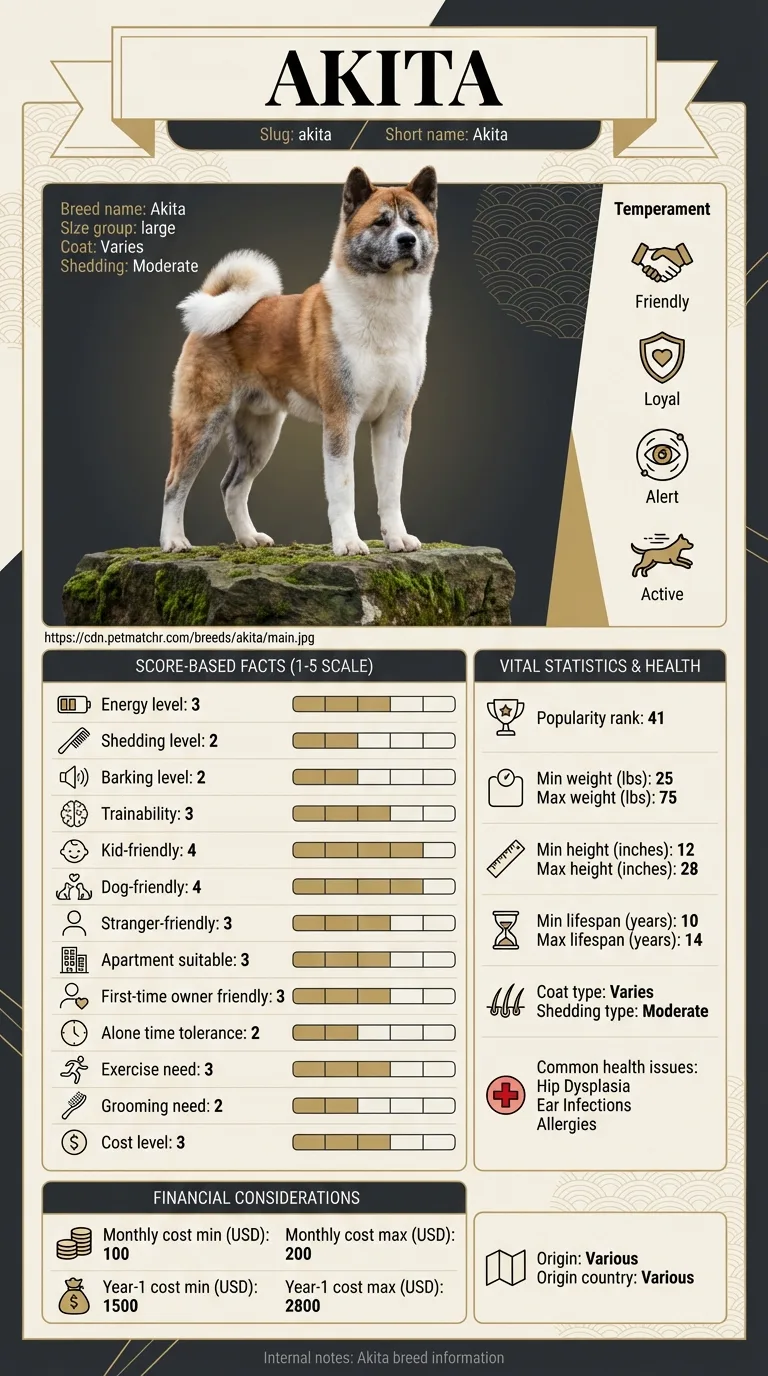
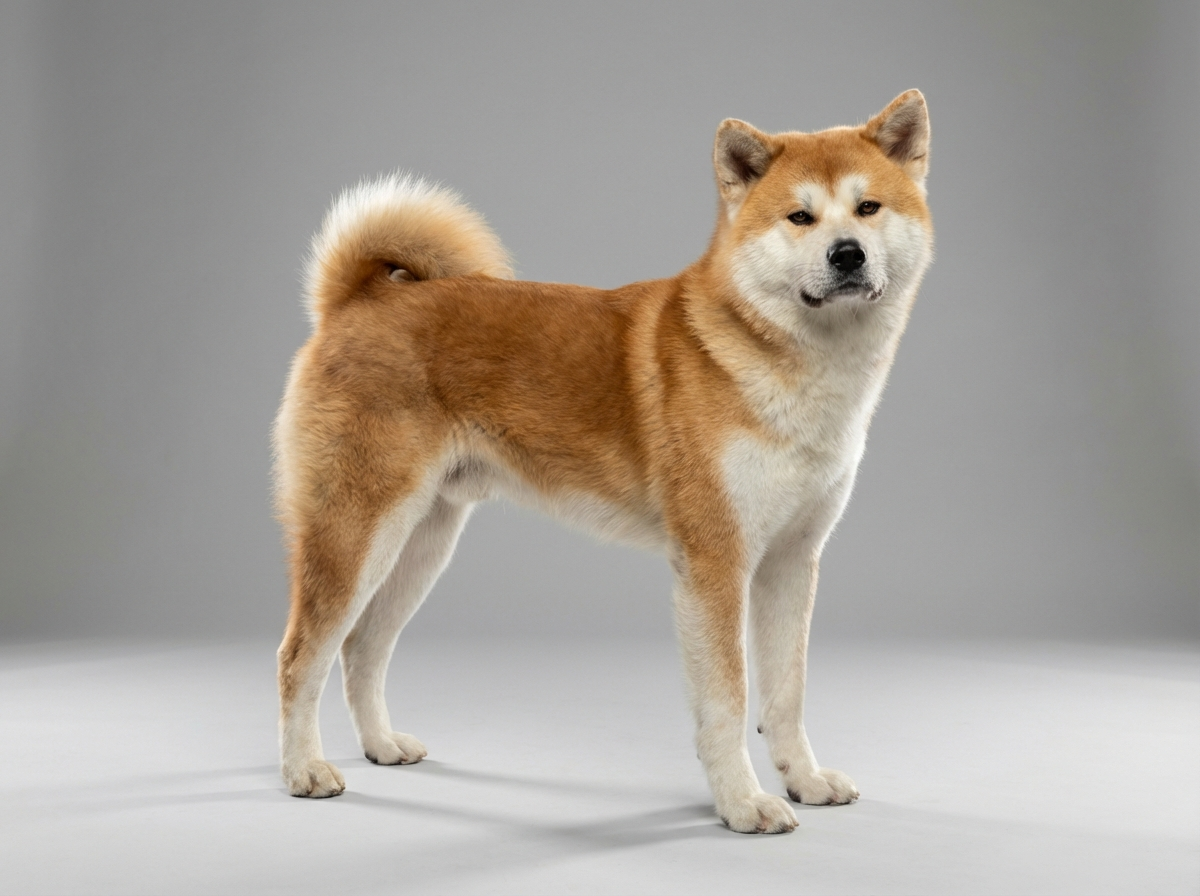
Choose the Akita if predictability matters. Its ratings describe every Akita — size, coat, temperament and the timing of its social maturity are all known before you buy. It needs 3/5 exercise against the mix's 4/5. You are accepting 5/5 shedding against 3/5 and 1/5 for first-time owners against 2/5.
Choose rottweiler secondary if...
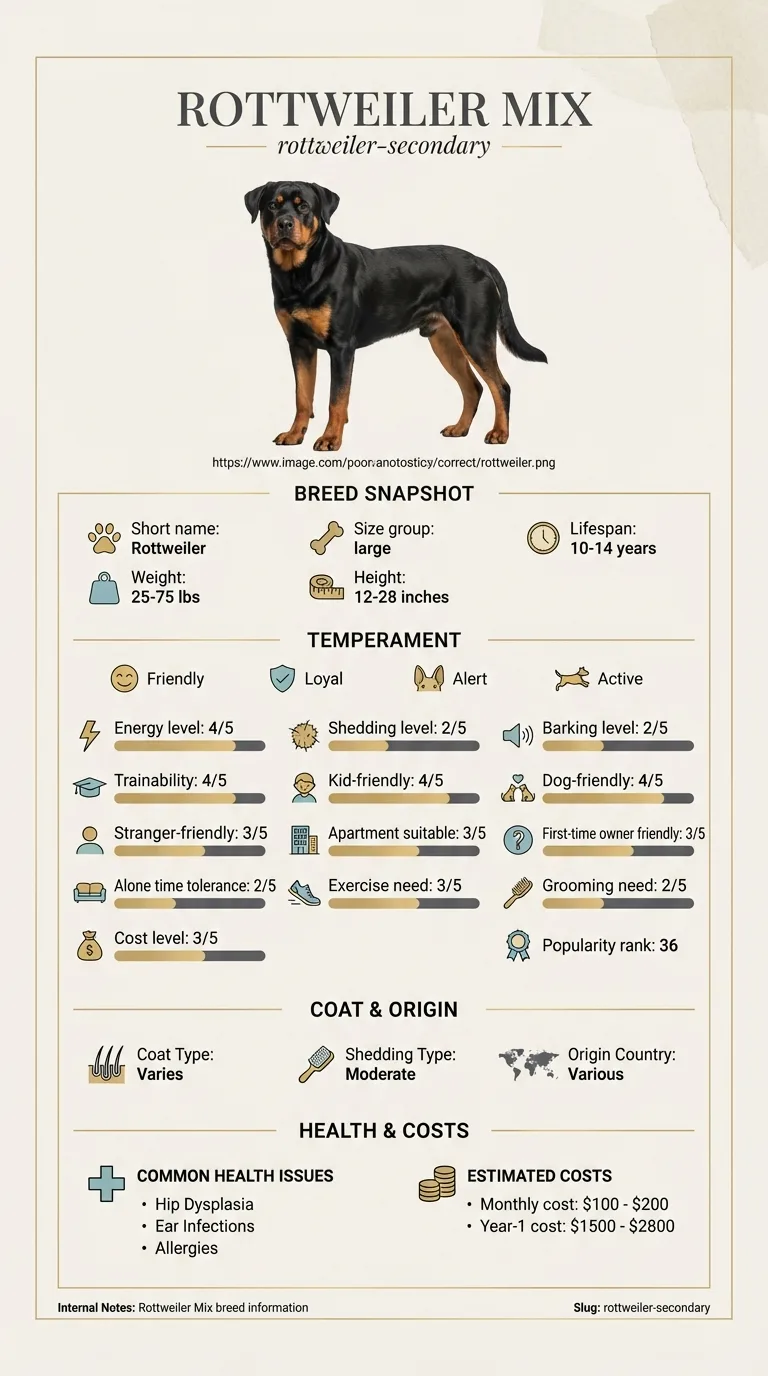
Choose a Rottweiler Mix if you are meeting the actual adult dog and can judge it directly, which is the great advantage of adopting one. It trains at 4/5 against 3/5, grooms at 2/5 against 3/5 and sheds at 3/5 against 5/5. You are accepting an unknown genetic background and a 9 to 10 year lifespan.
Head-to-head comparison
Feature
akita
rottweiler secondary
Winner
Weight
70–130 lbs
80–135 lbs
Equal
Height
24–28 in
22–27 in
Equal
Lifespan
10–13 years
9–10 years
akita
Coat
Dense double coat
Short dense double coat
Equal
Grooming need
Moderate (3/5)
Low (2/5)
rottweiler secondary
Shedding
Very high (5/5)
Moderate (3/5)
rottweiler secondary
Energy level
Moderate (3/5)
Moderate (3/5)
Equal
Exercise need
Moderate (3/5)
High (4/5)
akita
Trainability
Moderate (3/5)
High (4/5)
rottweiler secondary
Barking
Low (2/5)
Low (2/5)
Equal
Good with kids
Moderate (3/5)
Moderate (3/5)
Equal
Good with other dogs
Low (2/5)
Low (2/5)
Equal
Friendly to strangers
Low (2/5)
Low (2/5)
Equal
Apartment suitability
Low (2/5)
Low (2/5)
Equal
Good for first-time owners
Very low (1/5)
Low (2/5)
rottweiler secondary
Tolerates being alone
Moderate (3/5)
Moderate (3/5)
Equal
Typical monthly cost
$110–$240
$110–$240
Equal
Typical first-year cost
$1,700–$3,200
$1,700–$3,200
Equal
Deep dive
What a mix can and cannot tell you
There is a persistent idea that crossbred dogs are automatically healthier and easier. It is worth being precise about what is true in it.
A cross does dilute the risk of recessive conditions concentrated in one breed's gene pool, and that is a genuine advantage. What it does not do is remove risk. A mix can inherit hip dysplasia from both sides, and a Rottweiler cross carries the Rottweiler's cancer and joint risks whatever the other parent contributed.
On temperament, an unknown cross is genuinely unpredictable in a puppy. What the other half contributes — herding drive, terrier reactivity, sighthound flight response — will not be obvious at eight weeks, and it will matter enormously at two years.
The great advantage of a mix, and it is a real one, is that most come through rescue as adults. An adult dog is not an estimate. You can meet it, watch it with other dogs, see how it handles a stranger at the door, and know its actual size. That is better information than any breed average, including this page.
The Akita's ratings are a description rather than an estimate — but you are reading them about a puppy whose adult opinions have not formed yet.
Two guardians, two working styles
Rottweilers were bred to drive cattle and guard the drover's money, working closely with a person throughout. That handler orientation survives in most crosses and is what the 4/5 trainability reflects — a Rottweiler-type dog generally wants direction and takes it well.
The Akita's 3/5 is independence rather than limitation. It was selected to act without instruction and it does, which means training gives you influence rather than control.
Both rate 2/5 with strangers and 2/5 with other dogs, and in both cases the adult position tends to arrive at social maturity rather than in puppyhood. Socialisation from eight weeks, continued past two years, is the requirement for either — calm exposure to people, surfaces, noises and settled adult dogs rather than enthusiastic free-for-alls.
With children both rate 3/5, and for both the issue is size, strength and supervision around visitors rather than any hostility toward their own household.
Neither should be walked on a flexi lead, and both need an owner who reads a street ahead.
What the Rottweiler side brings
The condition list here is short and heavy: hip dysplasia, elbow dysplasia, osteosarcoma, subaortic stenosis and cruciate ligament tears.
Osteosarcoma is the one that shortens the lifespan to 9 to 10 years. It is a bone cancer of large and heavy breeds, Rottweilers are among the most affected, and it typically presents as a limp that does not resolve. In a dog of this type, persistent lameness with no obvious injury means an X-ray rather than rest — early detection genuinely changes the options.
Subaortic stenosis is a congenital narrowing below the aortic valve that makes the heart work harder and can cause fainting or sudden death in a young dog. It is detected by a veterinary cardiologist with an echocardiogram, not by a stethoscope in a busy consulting room.
Cruciate ligament tears are the common orthopaedic injury, and keeping the dog lean is the main thing an owner controls.
The Akita's burden is different — autoimmune disorders, hypothyroidism, progressive retinal atrophy — with hip dysplasia and bloat shared, and it lives one to three years longer.
Identical budgets, different exposure
$110–$240 a month and $1,700–$3,200 in the first year, for both. Food and routine care are the same for two large dogs of the same weight.
Where they differ is exposure. The mix's grooming is easier — 2/5 against 3/5, with 3/5 shedding against 5/5 — so no undercoat rake and no two-week clearing operation twice a year, though a short dense coat sheds steadily and the hairs are stiff.
The mix's veterinary exposure is skewed toward orthopaedics and oncology: cruciate repair, hip disease and bone cancer are all realistic four-figure events. The Akita's is skewed toward autoimmune disease, which is expensive to diagnose and often lifelong to manage, and bloat.
Insurance for a large guardian type is not cheap either way, and in some regions and rental agreements a Rottweiler-type dog is harder to insure or house — a real cost that never appears in a food budget and is worth checking before committing.
On exercise the mix asks for more: around ninety minutes a day against forty-five to sixty.
Akita vs Rottweiler Mix: nine ties and one real difference
Energy, barking, children, other dogs, strangers, apartments, time alone and both cost figures all tie. That is the highest number of matching rows in this batch.
What it tells you is that these two dogs make almost the same demand on a household. Both are large guardians rated 2/5 with unfamiliar dogs and 2/5 with strangers, both are quiet, both cope with a working day, and both cost the same to feed.
The practical differences are three. The mix needs more exercise — 4/5 against 3/5. It trains more readily at 4/5 against 3/5, because Rottweilers are handler-oriented in a way spitz guardians are not. And it sheds much less: 3/5 against 5/5, with 2/5 grooming against 3/5.
The difference that is not on the table is certainty. Every row here describes a typical mix, and a mix is by definition a range.
Akita or Rottweiler Mix: A Known Quantity or an Estimate - Akita vs Rottweiler Mix: nine ties and one real difference
Frequently asked questions
Are mixed breeds healthier than purebreds?
Partly. A cross dilutes the risk of recessive conditions concentrated in one gene pool, which is a genuine advantage. It does not remove risk — a Rottweiler cross still carries the Rottweiler's cancer and joint risks, and can inherit hip dysplasia from both sides. Hybrid vigour is a real effect, not a guarantee.
Can I predict what a Rottweiler mix puppy will be like?
Not reliably. What the other half contributes — herding drive, terrier reactivity, a flight response — will not be obvious at eight weeks and matters enormously at two years. The great advantage of these dogs is that most come through rescue as adults, and an adult dog is not an estimate.
How similar are these two breeds really?
Unusually similar on paper. Energy, barking, children, other dogs, strangers, apartment suitability, time alone and both cost figures all tie. The practical differences are exercise at 4/5 against 3/5, trainability at 4/5 against 3/5, and shedding at 3/5 against 5/5.
What is osteosarcoma and why does it matter here?
A bone cancer of large heavy breeds, and Rottweilers are among the most affected — it is the main reason the lifespan sits at 9 to 10 years. It typically shows as a limp that does not resolve, so persistent lameness with no obvious injury means an X-ray rather than rest and a recheck.
What is subaortic stenosis?
A congenital narrowing below the aortic valve that makes the heart work harder and can cause exercise intolerance, fainting or sudden death in a young dog. It is detected by a veterinary cardiologist using an echocardiogram — a general stethoscope check is not the same test.
Which is easier to train?
The Rottweiler Mix at 4/5 against the Akita's 3/5. Rottweilers were bred to work closely with a drover and that handler orientation usually survives in a cross, so the dog wants direction and takes it. The Akita was selected to act without instruction and gives you influence rather than control.
Do they cost the same?
Yes — both run $110–$240 a month and $1,700–$3,200 in the first year. The mix is cheaper to groom and its veterinary exposure skews toward orthopaedics and oncology; the Akita's skews toward autoimmune disease. Check insurance and any rental restrictions for a Rottweiler-type dog before committing.
The mix if you are meeting an actual adult dog and can judge it directly — that is better information than any breed average. The Akita if you want a puppy whose adult size, coat and temperament are known in advance.
Costs
How much does each cost per month?
Both run $110–$240 a month with first-year totals of $1,700–$3,200. The mix is cheaper to groom; the Akita has no cardiac screening line and a longer expected life.
Living
Which needs more exercise?
The Rottweiler Mix at 4/5 against the Akita's 3/5 — around ninety minutes a day against forty-five to sixty, with structured work suiting its 4/5 trainability.
Behavior
When does dog intolerance appear in these dogs?
Usually at social maturity, around two years old, in a dog that was fine as a puppy. Both rate 2/5, which is why socialisation has to continue well past the first year rather than ending with a puppy class.
Related DogBreedCompass guides
Akita breed guide – The Akita profile covers guardian temperament and the long socialisation window the breed needs.
Rottweiler Mix breed guide – The Rottweiler Mix profile covers what to expect from a crossbred guardian.
Akita vs Rottweiler – The purebred Rottweiler comparison sets out the breed standard version of this dog.
Akita vs Cane Corso – The Cane Corso is the other large guardian in the same behavioural bracket.
Rottweiler Mix cancer risk – Bone cancer is the risk that most shortens life in Rottweiler-type dogs.
Akita autoimmune diseases – Autoimmune disease is the Akita's most distinctive burden and the first question for a breeder.
Health information here is general and is not veterinary advice. If your dog shows pain, sudden behaviour change, or worsening symptoms, consult a licensed veterinarian.
Some links on this site are affiliate links. We may earn a commission at no extra cost to you, and we only suggest products we believe are helpful for dog owners.
We research and check what we publish, but we do not warrant that any figure, date, price, or statement is accurate, complete, or current, and we accept no liability for any loss, cost, injury, or other harm arising from the use of this site. Use it as one reference among several. You remain responsible for your own decisions and for your dog's care - confirm anything that matters with a licensed veterinarian or another qualified professional before you act on it. Full disclaimer.