DogBreedCompass

Akita or Cane Corso: The Independent Guardian or the Handler's One

Quick answer

Akita vs Cane Corso: which should I choose?

The Cane Corso if you will train and work a dog daily and want one that looks to you for direction. The Akita if you want a guardian that fits around an ordinary week and you accept having less influence over it.

Both rate 1/5 for first-time owners, 2/5 with other dogs and 2/5 with strangers. This is the rare comparison on this site where the two breeds are genuinely alternatives to each other, and the choice turns on one difference: the Corso wants a job from you, and the Akita does not.

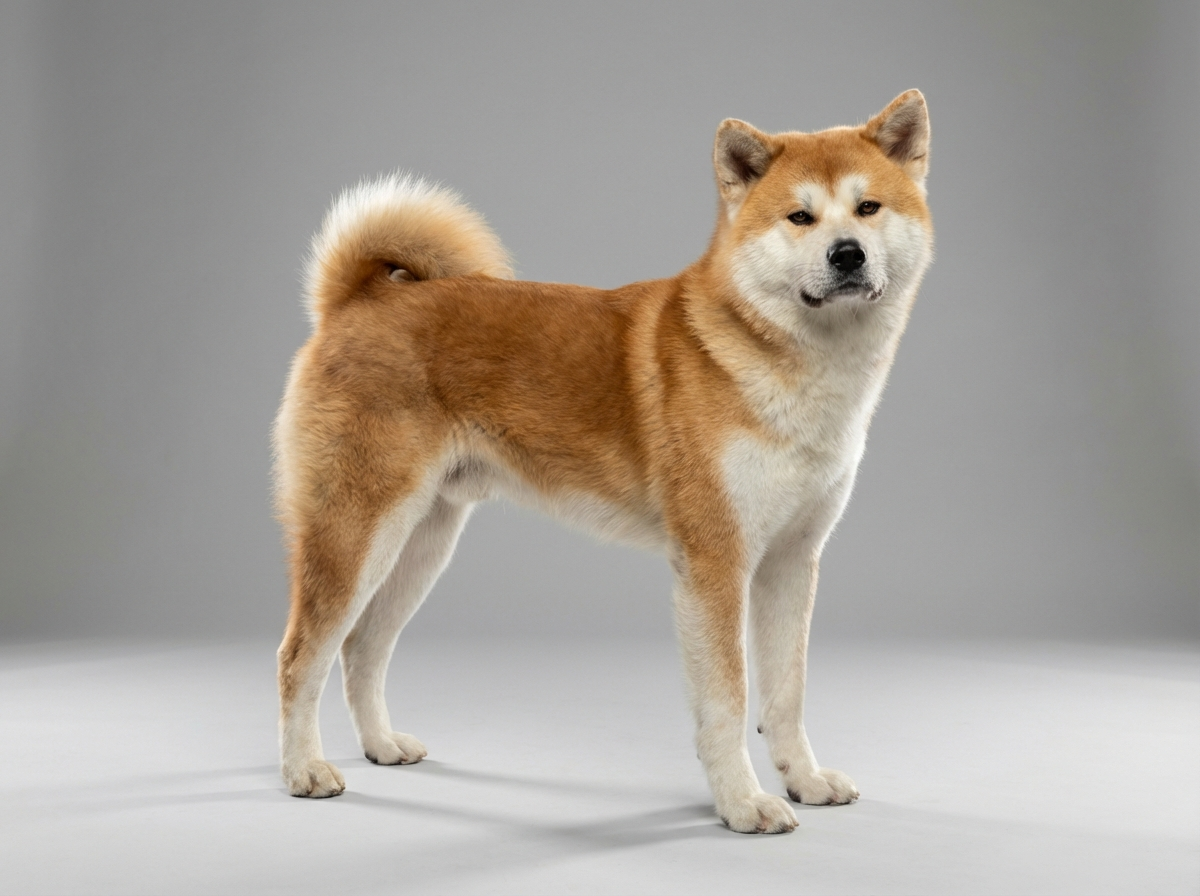
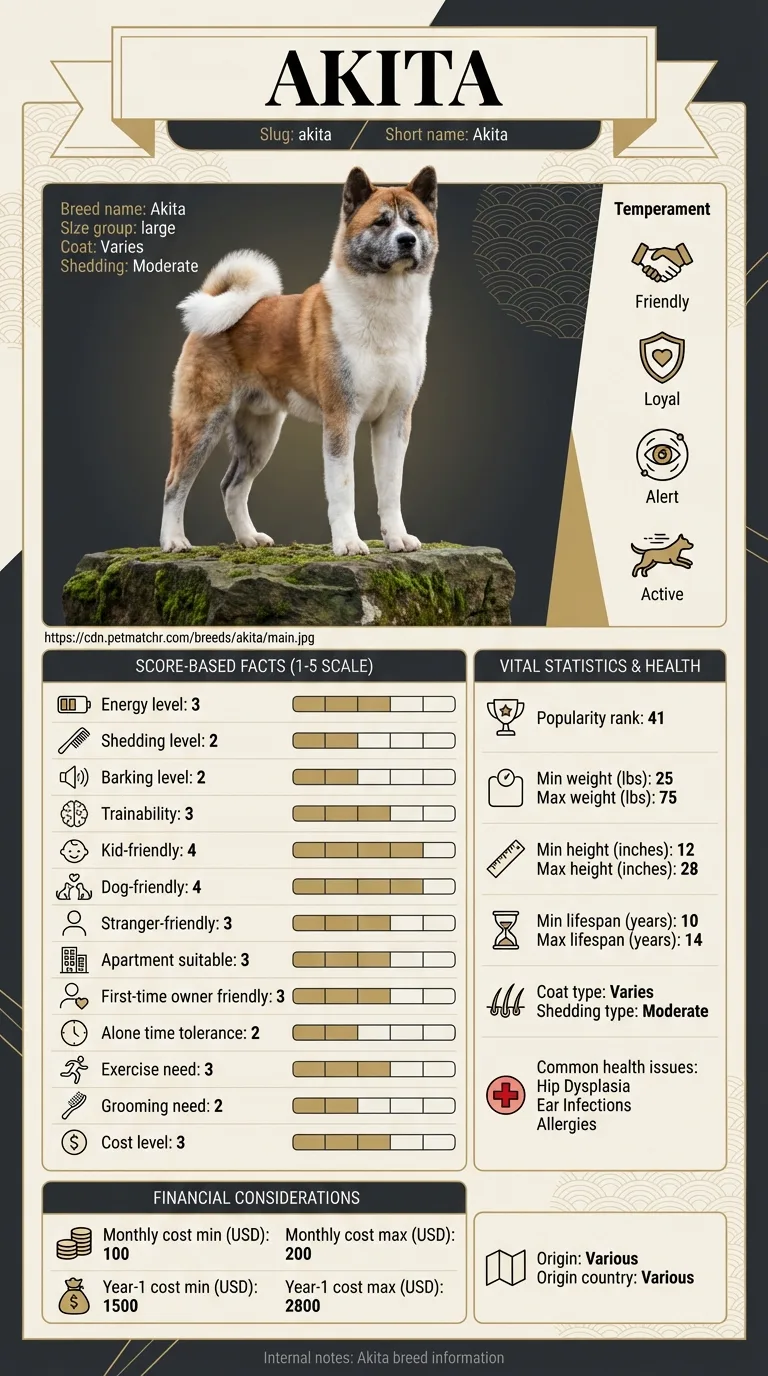
akita infographic
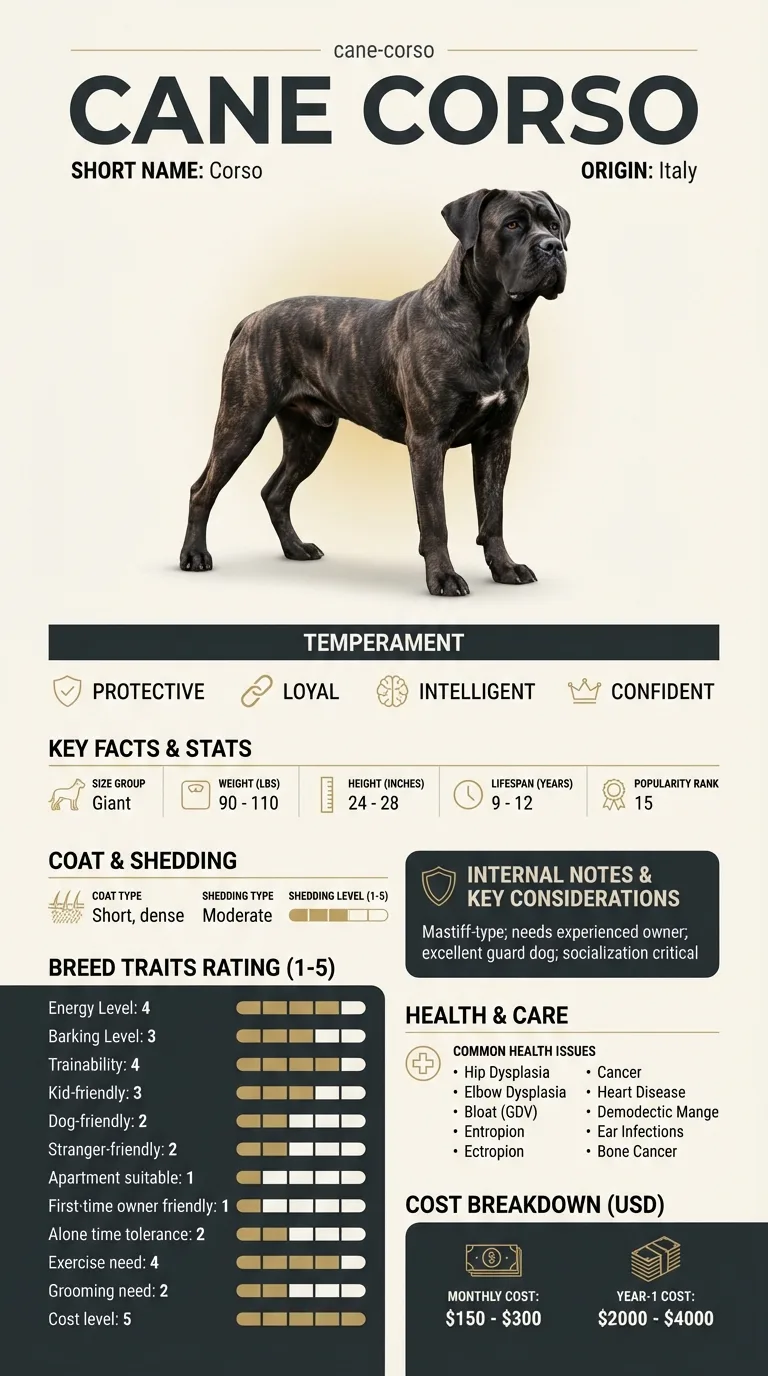
cane corso infographic

This page is for someone who has already decided they want a serious guardian breed and is choosing between two of them. It covers handler orientation and training, the exercise gap, dog tolerance and socialisation windows, health burdens including bone cancer, and what each costs to run.

Quick verdict

The Cane Corso is the more trainable and more demanding dog and needs an owner who will direct it daily; the Akita asks for far less involvement and gives you far less influence in return.

Choose akita if...

Choose the Akita if you want a guardian that fits around an ordinary week. It needs 3/5 exercise against the Corso's 4/5, tolerates being alone at 3/5 against 2/5, lives 10 to 13 years against 9 to 12, and costs $110–$240 a month against $150–$300. You are accepting 3/5 trainability, 5/5 shedding and a dog that forms its own views.

Choose cane corso if...

Choose the Cane Corso if you will train and work a dog every day and want one that looks to you for direction. It rates 4/5 for trainability against 3/5 and sheds at 3/5 against 5/5. You are accepting 4/5 exercise, 1/5 for apartments, up to 110 pounds of highly responsive guarding instinct, and a shorter life with a notable bone cancer risk.

Head-to-head comparison

Featureakitacane corsoWinner
Weight70–130 lbs90–110 lbsEqual
Height24–28 in24–28 inEqual
Lifespan10–13 years9–12 yearsakita
CoatDense double coatShort and denseEqual
Grooming needModerate (3/5)Low (2/5)cane corso
SheddingVery high (5/5)Moderate (3/5)cane corso
Energy levelModerate (3/5)High (4/5)Equal
Exercise needModerate (3/5)High (4/5)akita
TrainabilityModerate (3/5)High (4/5)cane corso
BarkingLow (2/5)Moderate (3/5)akita
Good with kidsModerate (3/5)Moderate (3/5)Equal
Good with other dogsLow (2/5)Low (2/5)Equal
Friendly to strangersLow (2/5)Low (2/5)Equal
Apartment suitabilityLow (2/5)Very low (1/5)akita
Good for first-time ownersVery low (1/5)Very low (1/5)Equal
Tolerates being aloneModerate (3/5)Low (2/5)akita
Typical monthly cost$110–$240$150–$300akita
Typical first-year cost$1,700–$3,200$2,000–$4,000akita

Deep dive

4/5 against 3/5, and what that buys you

The Corso's 4/5 is genuinely useful. Corsos take obedience work well, learn quickly, and want a role — protection sport, tracking, cart work, or simply structured daily training. A Corso given a job is a settled dog.

The corollary is that it is not optional. A hundred-pound mastiff with 4/5 energy and no direction fills the vacuum with its own opinions about the postman, the fence line and the visitor at the door, and it is responsive enough to escalate quickly.

The Akita's independence cuts the other way. It needs less from you daily, and gives you less leverage in a crisis. Recall should be treated as conditional at all times, and secure fencing is a requirement rather than a preference.

What both need in identical measure is socialisation, and both need it far longer than most breeds. Introduce them to people, surfaces, noises and calm dogs from eight weeks, and keep doing it past two years, because in both breeds the adult opinion arrives at social maturity rather than in puppyhood.

The week each one costs you

The Corso rates 4/5 for exercise and 4/5 for energy against the Akita's 3/5 and 3/5. In practice that is around ninety minutes of purposeful activity a day, at least some of it mental, against forty-five to sixty minutes of walking.

On apartments the Corso rates 1/5 — the lowest rating available — against the Akita's 2/5. Neither should be a flat dog, but the Corso is worse: it needs more space, more output, and it is a more reactive presence in a shared corridor.

Alone-tolerance separates them again, 2/5 against 3/5. A Corso left for long days becomes a frustrated guardian, and frustration in a breed this responsive shows up as intensity at the door and the window.

Both need a securely fenced garden with a fence that a determined dog cannot see a reason to go through. For the Corso, the reason is usually something moving on the other side. For the Akita, it is usually another dog.

Two 2/5 ratings that behave differently

Both rate 2/5 with other dogs, and in both cases the trouble tends to arrive at maturity rather than in puppyhood — but the shape differs.

Akita dog-intolerance is frequently same-sex and quite categorical. Many Akitas are entirely settled around a familiar opposite-sex housemate and unmanageable with a same-sex dog they have just met. It is not usually noisy escalation; it is a decision.

Corso reactivity is more often about territory and movement. A Corso is likelier to be fine at a distance in neutral space and difficult at its own gate, and likelier to respond to a dog that runs than to one that stands still.

The practical consequences overlap heavily. Neither is a dog park breed. Neither should be walked on a flexi lead. Both need an owner who reads a street ahead and crosses it early, and both benefit enormously from a good muzzle habit taught as a neutral thing long before it is ever needed.

With children both sit at 3/5, and for both the issue is size, weight and supervision around visitors rather than hostility to their own family.

Bone cancer, joints and the bloat question

The Corso's condition list is long and heavy: hip and elbow dysplasia, bloat, entropion and ectropion, cancer including bone cancer, heart disease, demodectic mange and ear infections.

Bone cancer deserves the emphasis. Osteosarcoma is a disease of large and giant breeds, it typically presents as a limp that does not resolve, and it is aggressive. A persistent lameness in a young adult Corso is an X-ray conversation, not a rest-and-see one.

The eyelid conditions are more mundane and more common than people expect. Entropion rolls the lid inward so lashes abrade the cornea; ectropion rolls it outward and leaves the eye exposed. Both are surgical fixes and both are worth asking a breeder about directly.

The Akita's burden is immune and endocrine instead: autoimmune disorders of skin, eyes and blood, hypothyroidism, progressive retinal atrophy, plus hip dysplasia.

Both are deep-chested and both carry a real gastric dilatation-volvulus risk, so both households should know the signs — unproductive retching, a distending abdomen, restlessness — and know where the nearest out-of-hours surgery is before they need it. Both breeds also have known anaesthetic sensitivities worth flagging.

What each costs to run

The Corso runs $150–$300 a month against the Akita's $110–$240, with first-year totals of $2,000–$4,000 and $1,700–$3,200.

Food explains part of it and the rest is risk-priced. Insurance for a giant guardian breed is expensive, and in some regions and some rental agreements a Corso is harder to insure or house than an Akita — a practical cost that never appears in a food budget.

Orthopaedic risk is the largest single line item on either side. Hip and elbow dysplasia are on both lists, and corrective surgery in a hundred-pound dog is a four-figure sum. Bloat surgery is the same order of magnitude and can happen without warning.

Grooming is cheaper for the Corso, 2/5 against 3/5, and it sheds at 3/5 against 5/5 — though a short dense coat sheds constantly rather than seasonally, and the hairs are stiff and work into upholstery.

Neither of these is a budget dog, and neither should be taken on without either insurance or a genuine emergency fund.

Akita vs Cane Corso: guarding with and without a handler

Five rows on this table are exact ties, which almost never happens here: height, children, other dogs, strangers, and the first-time owner rating. Both are 1/5, 2/5 and 2/5 where it counts.

The difference is orientation. The Corso is a mastiff that worked with a person — driving cattle, guarding a farm alongside a farmer, holding game until the hunter arrived. It watches its handler and takes cues. That is why its trainability is 4/5.

The Akita worked at a distance from human instruction. It rates 3/5 not because it is slow but because it decides. Ask an Akita to do something and it will consider whether it agrees.

This produces two completely different failure modes. A badly raised Corso is a dog that has been given no direction by someone it was waiting on. A badly raised Akita is a dog that has concluded it is in charge of a situation and acted.

Frequently asked questions

Which is harder to own, an Akita or a Cane Corso?

Both rate 1/5 for first-time owners, so neither is easy — but they are hard in different ways. The Corso demands more from your week: 4/5 exercise, 4/5 energy, 2/5 alone tolerance and a genuine need for daily direction. The Akita demands more judgement: it is independent, its recall is conditional, and it forms its own view of strangers and other dogs.

Which is easier to train?

The Cane Corso at 4/5 against the Akita's 3/5. Corsos were bred to work alongside a person and they watch their handler for cues, so obedience, protection sport and structured training all land well. The Akita is not slow — it was selected to make decisions without a handler present, and it will consider a request before agreeing to it.

Can either live with another dog?

Both rate 2/5, and both usually become difficult at social maturity rather than as puppies. Akita intolerance is frequently same-sex and quite categorical. Corso reactivity is more often territorial and triggered by movement. Neither is a dog park breed, and both need an owner who reads a street ahead.

What is the biggest health risk in a Cane Corso?

Bone cancer and joint disease. Osteosarcoma is a large and giant breed disease and typically shows up as a limp that does not resolve, so persistent lameness in a young adult warrants an X-ray rather than rest. Hip and elbow dysplasia, bloat, entropion and ectropion, and heart disease are also on the list.

Which needs more exercise?

The Cane Corso, at 4/5 against the Akita's 3/5, and it needs mental work as well as physical — around ninety minutes of purposeful activity a day. The Akita is satisfied with forty-five to sixty minutes of walking. For a household with a full-time job, that gap is usually the deciding factor.

Which costs more to keep?

The Cane Corso, at $150–$300 a month against the Akita's $110–$240, and $2,000–$4,000 against $1,700–$3,200 in the first year. Food accounts for part of it; insurance and orthopaedic risk account for the rest. Both breeds carry a real bloat risk, and emergency surgery for it is a four-figure sum.

Which sheds more?

The Akita at 5/5 against the Corso's 3/5. The Akita blows a dense double coat in clumps twice a year and needs an undercoat rake through those weeks, and its coat should never be clipped. The Corso's short dense coat sheds steadily all year in stiff hairs that work into fabric.

Quick answers

View more answers
Living

Akita vs Cane Corso: which should I choose?

The Cane Corso if you will train and work a dog daily and want one that looks to you for direction. The Akita if you want a guardian that fits around an ordinary week and you accept having less influence over it.

Costs

How much does each cost per month?

The Akita runs $110–$240 a month and the Cane Corso $150–$300, with first-year totals of $1,700–$3,200 and $2,000–$4,000. Insurance for a giant guardian breed is a meaningful part of the gap.

Living

Are either of these suitable for a flat?

No. The Corso rates 1/5 and the Akita 2/5. The Corso needs more space and output and is a more reactive presence in shared corridors; the Akita's issue is size, shedding and a guarding instinct at communal entrances.

Behavior

When does dog intolerance appear in these breeds?

Usually at social maturity, around two years old, in a dog that was fine as a puppy. That is why socialisation in both breeds has to continue well past the first year rather than being treated as a course you finish.

Related DogBreedCompass guides

  • Akita breed guideThe Akita profile covers guardian temperament and the long socialisation window the breed needs.
  • Cane Corso breed guideThe Cane Corso profile covers handler focus, exercise and the breed's guarding drive.
  • Akita vs RottweilerThe Rottweiler is the third guardian breed most people weigh against these two.
  • Akita vs MastiffThe Mastiff is the calmer, lower-drive giant guardian alternative to the Corso.
  • Cane Corso bloat and GDVBloat is a genuine emergency in both breeds and every owner should know the signs.
  • Akita autoimmune diseasesAutoimmune disease is the Akita's most distinctive burden and the first question for a breeder.

Related guides

Important reminder

Health information here is general and is not veterinary advice. If your dog shows pain, sudden behaviour change, or worsening symptoms, consult a licensed veterinarian.

Some links on this site are affiliate links. We may earn a commission at no extra cost to you, and we only suggest products we believe are helpful for dog owners.

Find Your Perfect Breed

Match your lifestyle to the right dog.

Take quiz

Find your match

Not sure which breed is right for you? Take our 2-minute quiz to find out.

Take the quiz