Living
Havanese or Rottweiler Mix -- which fits your life?
The Havanese suits apartments, first-time owners, and multi-dog households; the Rottweiler Mix needs an experienced owner, space, and a firm exercise routine.

Quick answer
Havanese or Rottweiler Mix -- which fits your life?
The Havanese suits apartments, first-time owners, and multi-dog households; the Rottweiler Mix needs an experienced owner, space, and a firm exercise routine.
Havanese or Rottweiler Mix? On paper they differ most on apartment suitability, and on the scales Rottweiler Mix is the heavier at 80–135 lbs. Here is how the two compare on everything that shapes an ordinary week.
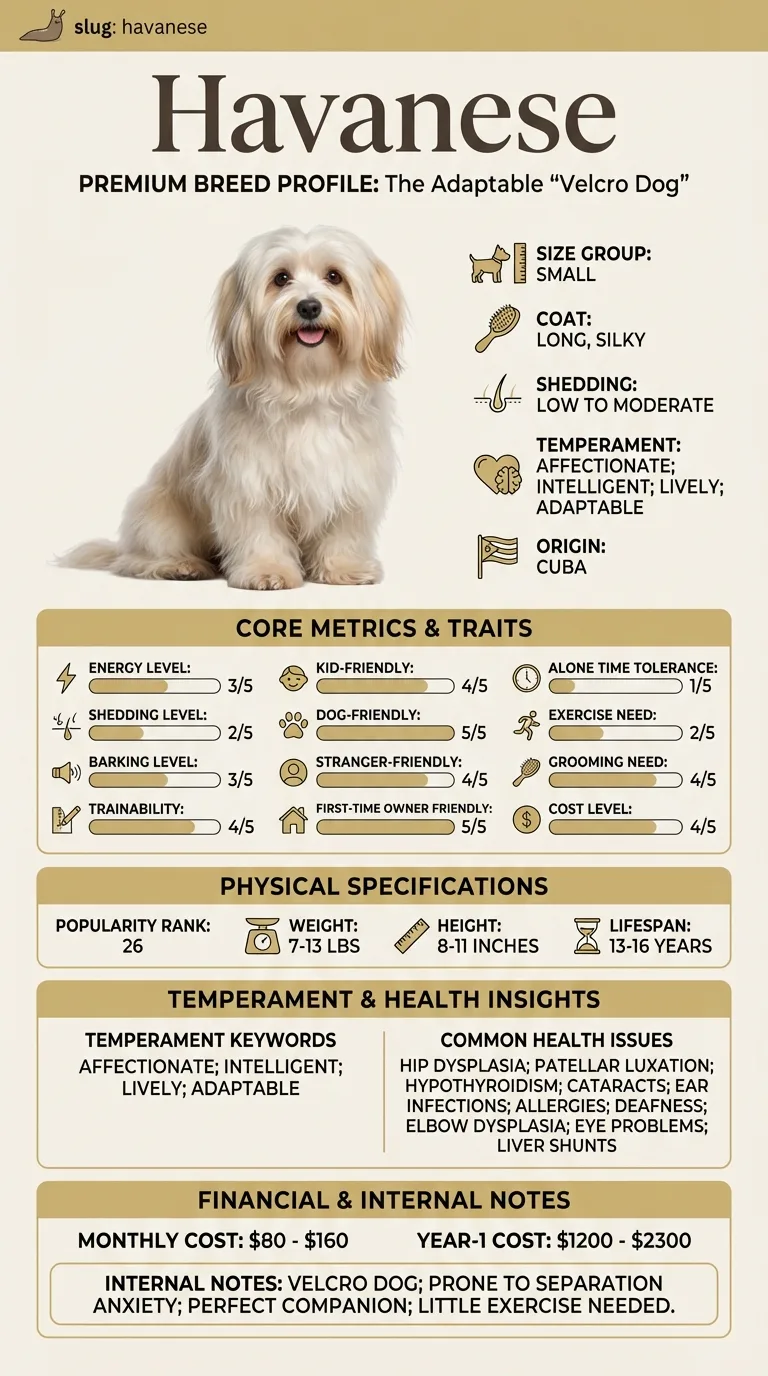
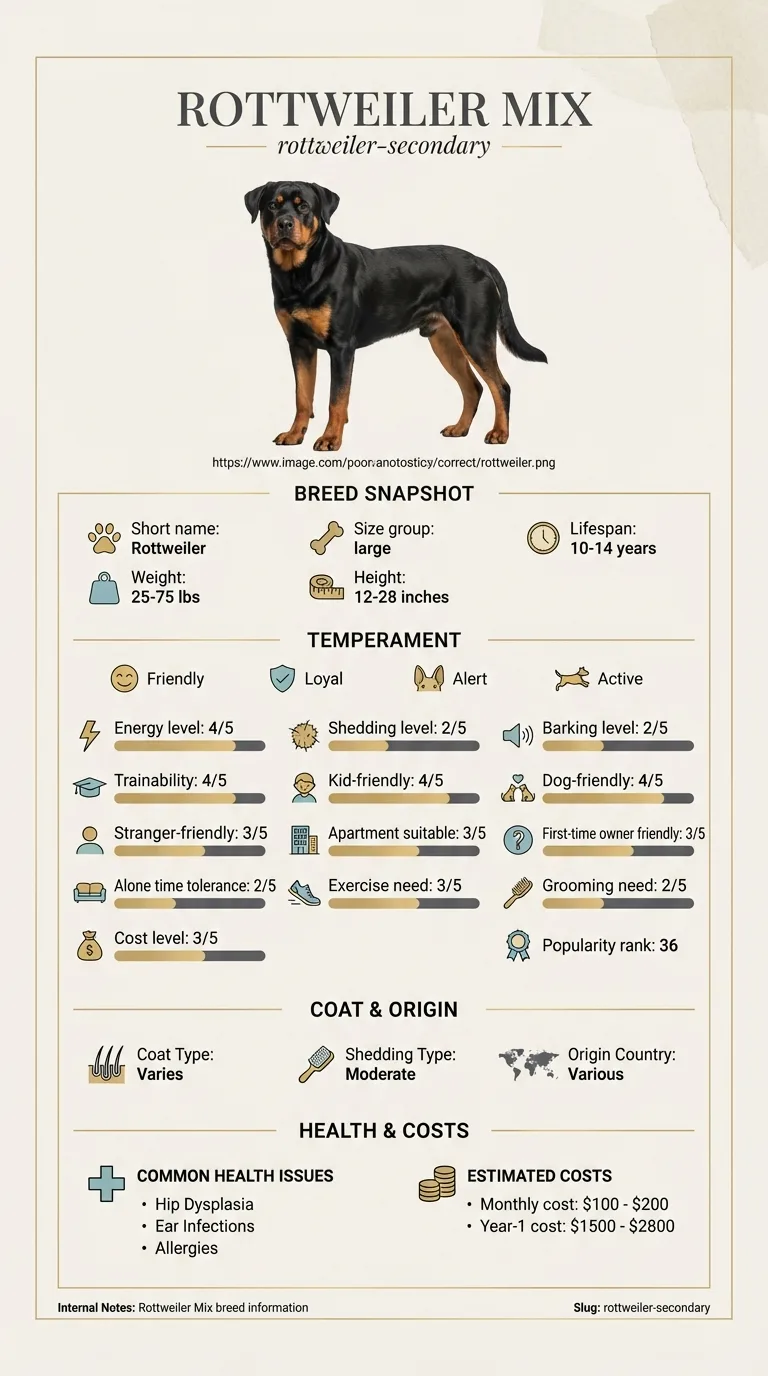
This is for someone already down to Havanese and Rottweiler Mix and deciding between them. For this pair the decision usually turns on apartment suitability and good for first-time owners, so those are covered first and in most detail. Anyone choosing from a flat has a clear answer here: Havanese rates 5/5 against 2/5. It is written for the decision rather than the breed history.
Between Havanese and Rottweiler Mix, apartment suitability is what separates them, and Havanese is the lower-effort dog of the two to keep.
Choose Havanese if you are in a flat or a smaller home, this is your first dog and shedding is a problem in your house.
Choose Rottweiler Mix if you do not want a standing grooming appointment, the dog will be alone during the working day and you want a dog that can keep up with an active routine.
| Feature | havanese | rottweiler secondary | Winner |
|---|---|---|---|
| Size class | small | large | Equal |
| Weight | 7–13 lbs | 80–135 lbs | Equal |
| Height | 8–11 in | 22–27 in | Equal |
| Lifespan | 13–16 years | 9–10 years | havanese |
| Exercise need | Low (2/5) | High (4/5) | havanese |
| Grooming need | High (4/5) | Low (2/5) | rottweiler secondary |
| Shedding | Low (2/5) | Moderate (3/5) | havanese |
| Energy level | Moderate (3/5) | Moderate (3/5) | Equal |
| Barking | Moderate (3/5) | Low (2/5) | rottweiler secondary |
| Apartment suitability | Very high (5/5) | Low (2/5) | havanese |
| Good for first-time owners | Very high (5/5) | Low (2/5) | havanese |
| Tolerates being alone | Very low (1/5) | Moderate (3/5) | rottweiler secondary |
| Trainability | High (4/5) | High (4/5) | Equal |
| Good with kids | High (4/5) | Moderate (3/5) | havanese |
| Good with other dogs | Very high (5/5) | Low (2/5) | havanese |
| Friendly to strangers | High (4/5) | Low (2/5) | havanese |
| Cost level | High (4/5) | High (4/5) | Equal |
| Coat | Long, silky | Short, dense double coat | Equal |
| Origin | Cuba | Various | Equal |
| Typical monthly cost | $80–$160 | $110–$240 | Equal |
| Typical first-year cost | $1,200–$2,300 | $1,700–$3,200 | Equal |
The Rottweiler Mix is logged at the same 80-135 lb, 22-27 inch range as a purebred Rottweiler in this dataset, dwarfing the 7-13 lb, 8-11 inch Havanese. Mixed-breed size can vary more in practice than a single breed standard would suggest, since a shelter estimate is often a best guess until a dog is fully grown, but the numbers here point to a large dog either way you look at it. Plan your space accordingly rather than assuming a mix will run smaller.
Exercise need still favors the Havanese, 2/5 against 4/5 for the mix, but energy level itself is rated the same for both at 3/5 -- a moderate-energy large dog that nonetheless needs real daily exercise to stay balanced, not a couch companion despite the calmer energy rating. The "Steady" temperament tag on this mix suggests a dog that settles well once its exercise needs are actually met, rather than one that stays keyed up regardless of activity level.
Havanese needs more brushing (4/5) than the mix (2/5), and the mix sheds moderately (3/5) rather than heavily, a step down from the high (4/5) shedding logged for a purebred Rottweiler in this dataset. That tracks with mixed coats often running less dense than a purebred double coat. Either way, the Havanese remains the higher-maintenance breed to groom, while the mix leaves more visible hair behind on furniture and clothing.
The Havanese rates 5/5 for apartments, the mix 2/5. Barking runs low for the mix (2/5) against moderate for the Havanese (3/5), quieter, but its size and exercise needs still make a small apartment a poor fit regardless of noise level. A "Watchful" temperament also means this dog may alert to activity outside even without much actual barking, worth knowing before assuming quiet automatically means unobtrusive.
Trainability is equal at 4/5 for both, but first-time-owner suitability again favors the Havanese heavily, 5/5 versus 2/5. A mixed-breed large dog with an unclear early history can add unpredictability that a novice owner isn't well-positioned to manage, even when the dog itself trains well once you're working with it consistently. Rescue organizations placing large mixes often recommend at least some prior dog-handling experience for exactly this reason.
This is where the mix and the purebred Rottweiler data diverge -- the mix rates lower with kids (3/5 vs the purebred's 4/5), other dogs (2/5 vs 3/5), and strangers (2/5, matching the purebred). The Havanese outscores it across the board: 4/5 with kids, 5/5 with other dogs, 4/5 with strangers. If you're weighing this specific mix against a Havanese for a busy household with kids, visitors, or an existing dog, the Havanese's scores are meaningfully higher on every single measure.
Lifespan sits at 9-10 years for the mix, still far short of the Havanese's 13-16. The mix's listed health risks are narrower than a purebred Rottweiler's -- hip and elbow dysplasia, osteosarcoma, subaortic stenosis, and cruciate ligament tears -- but osteosarcoma (bone cancer) and joint disease remain serious large-breed concerns worth budgeting screening for early. A shorter list doesn't necessarily mean a lower-risk dog, just a narrower set of documented issues for this particular mix.
Monthly costs land at $110-240 for the mix against $80-160 for the Havanese, with first-year costs of $1,700-3,200 versus $1,200-2,300. Both share the "high" cost tier rating, but a large mixed-breed dog's food and potential joint-care costs still run well above a small breed's across the board. That gap tends to widen further if osteosarcoma or cruciate injuries require surgery later in life, both of which carry substantial large-breed veterinary bills.
Havanese weighs 7–13 lbs and lives 13–16 years; Rottweiler Mix weighs 80–135 lbs and lives 9–10 years. The two diverge most on apartment suitability, good for first-time owners and good with other dogs and 4 other rated axes. They are level on cost level, energy level and trainability, so those cannot decide it. In the table, a "winner" means easier for an ordinary household — not better. Size, coat and origin are recorded without a verdict. Because both breeds are scored the same way, the gaps are reliable even where the absolute numbers are rough.

The mix in this data sheds less (moderate, 3/5, versus high, 4/5), barks less (2/5 vs 3/5), and tolerates being alone slightly better (3/5 vs 2/5) -- but it also scores lower with kids and other dogs, and its lifespan tops out a year short at 9-10 years.
Rated 2/5, the same low score as a purebred Rottweiler -- size and handling experience matter more than exact breed composition here.
A lot -- 4/5, same as a purebred Rottweiler, despite a slightly calmer moderate energy rating. This isn't a low-activity dog.
Rated only 2/5, lower than both the Havanese (5/5) and even a purebred Rottweiler (3/5) in this dataset -- worth factoring in if you already have other dogs at home.
$110-240 a month and $1,700-3,200 in the first year -- more than the Havanese but somewhat less than the purebred Rottweiler figures in this comparison set.
Hip and elbow dysplasia, osteosarcoma, subaortic stenosis, and cruciate ligament tears -- a shorter list than the purebred Rottweiler's, but still centered on the joint and cardiac risks common to large dogs.
9-10 years, several years short of the Havanese's 13-16.
The Havanese suits apartments, first-time owners, and multi-dog households; the Rottweiler Mix needs an experienced owner, space, and a firm exercise routine.
$80-160 for the Havanese versus $110-240 for the mix.
The mix needs substantial daily exercise (4/5); the Havanese needs much less (2/5).
Havanese 13-16 years, Rottweiler Mix 9-10 years.
Secure checkout on Stripe. We never see your card.
7-day money-back guarantee. Instant access.

Health information here is general and is not veterinary advice. If your dog shows pain, sudden behaviour change, or worsening symptoms, consult a licensed veterinarian.
Some links on this site are affiliate links. We may earn a commission at no extra cost to you, and we only suggest products we believe are helpful for dog owners.
We research and check what we publish, but we do not warrant that any figure, date, price, or statement is accurate, complete, or current, and we accept no liability for any loss, cost, injury, or other harm arising from the use of this site. Use it as one reference among several. You remain responsible for your own decisions and for your dog's care - confirm anything that matters with a licensed veterinarian or another qualified professional before you act on it. Full disclaimer.
Match your lifestyle to the right dog.
Take quizNot sure which breed is right for you? Take our 2-minute quiz to find out.
Take the quiz