Labradoodle vs Pembroke Welsh Corgi: Which Suits Your Home?
Quick answer
Which one should I get?
If a smaller apartment-friendly footprint matters most, the Corgi's 4/5 apartment score fits better, just budget for barking and heavy seasonal shedding. If you want the quieter dog and slightly better trainability, the Labradoodle's 2/5 barking score is the difference-maker.
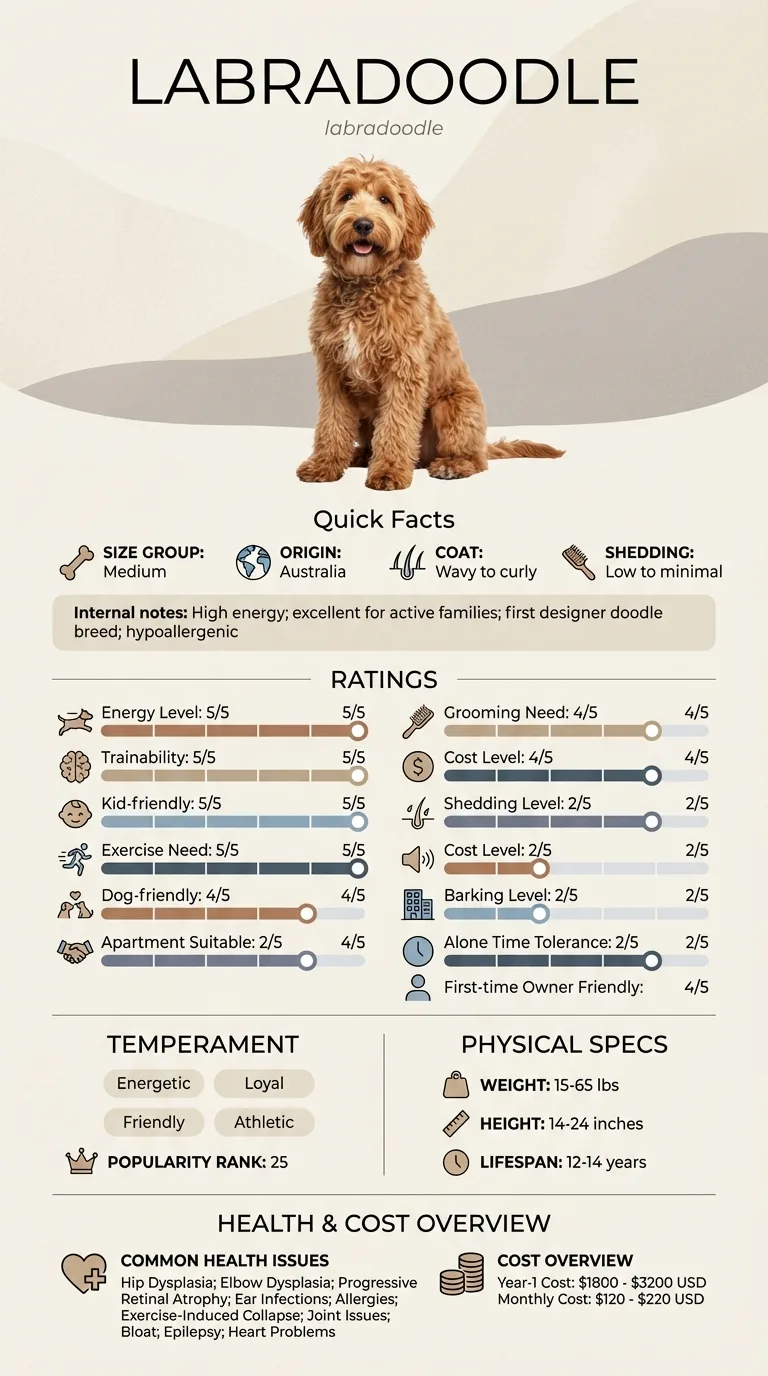
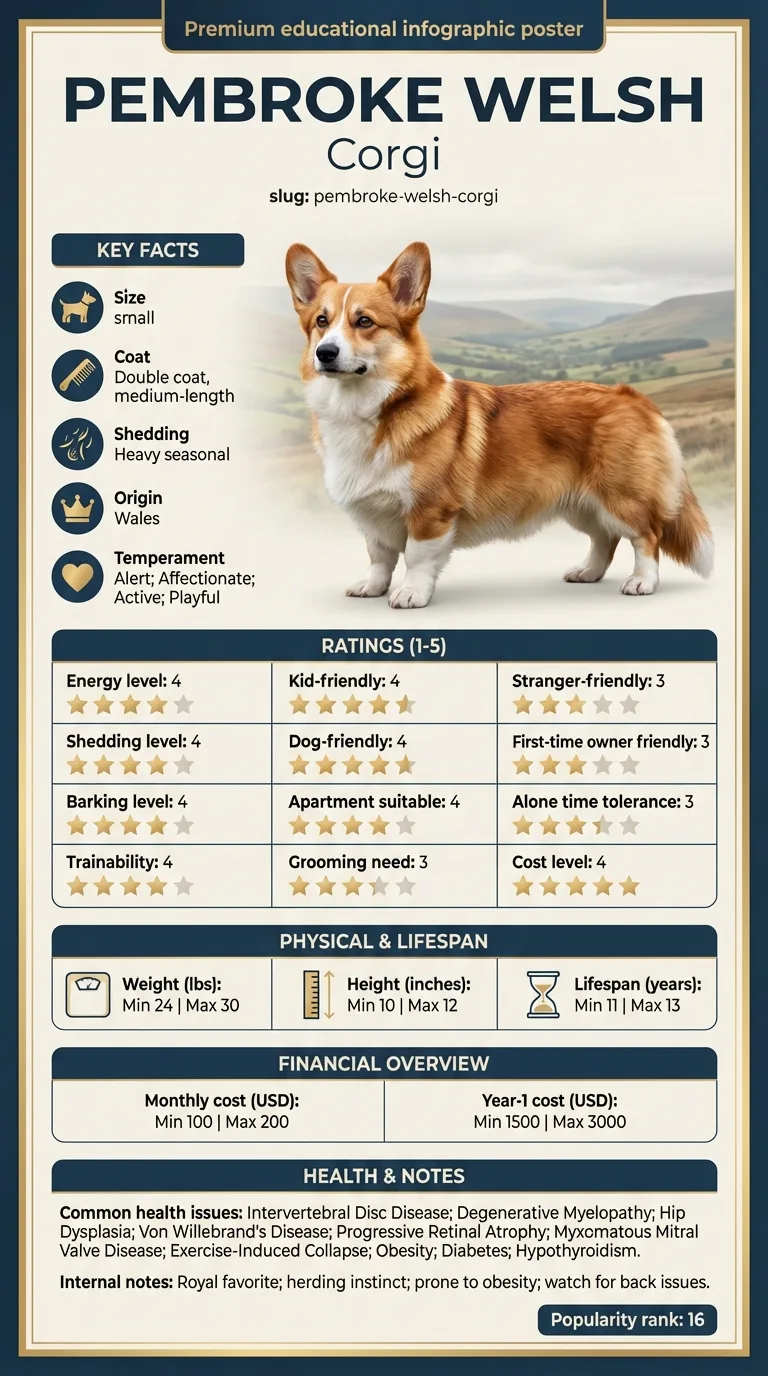
Labradoodle or Pembroke Welsh Corgi? On paper they differ most on apartment suitability, and on the scales Labradoodle is the heavier at 15–65 lbs. Here is how the two compare on everything that shapes an ordinary week.
This is for someone already down to Labradoodle and Pembroke Welsh Corgi and deciding between them. For this pair the decision usually turns on apartment suitability and shedding, so those are covered first and in most detail. Anyone choosing from a flat has a clear answer here: Pembroke Welsh Corgi rates 4/5 against 2/5. It is written for the decision rather than the breed history.
Quick verdict
Between Labradoodle and Pembroke Welsh Corgi, apartment suitability is what separates them, and Pembroke Welsh Corgi is the lower-effort dog of the two to keep.
Choose labradoodle if...
Choose Labradoodle if this is your first dog, shedding is a problem in your house and there are young children at home.
Choose pembroke welsh corgi if...
Choose Pembroke Welsh Corgi if you are in a flat or a smaller home, you do not want a standing grooming appointment and your walking routine is modest.
Head-to-head comparison
Feature
labradoodle
pembroke welsh corgi
Winner
Size class
medium
small
Equal
Weight
15–65 lbs
24–30 lbs
Equal
Height
14–24 in
10–12 in
Equal
Lifespan
12–14 years
11–13 years
labradoodle
Exercise need
Very high (5/5)
High (4/5)
pembroke welsh corgi
Grooming need
High (4/5)
Moderate (3/5)
pembroke welsh corgi
Shedding
Low (2/5)
High (4/5)
labradoodle
Energy level
Very high (5/5)
High (4/5)
Equal
Barking
Low (2/5)
High (4/5)
labradoodle
Apartment suitability
Low (2/5)
High (4/5)
pembroke welsh corgi
Good for first-time owners
High (4/5)
Moderate (3/5)
labradoodle
Tolerates being alone
Low (2/5)
Moderate (3/5)
pembroke welsh corgi
Trainability
Very high (5/5)
High (4/5)
labradoodle
Good with kids
Very high (5/5)
High (4/5)
labradoodle
Good with other dogs
High (4/5)
High (4/5)
Equal
Friendly to strangers
High (4/5)
Moderate (3/5)
labradoodle
Cost level
High (4/5)
High (4/5)
Equal
Coat
Wavy to curly
Double coat, medium-length
Equal
Origin
Australia
Wales
Equal
Typical monthly cost
$120–$220
$100–$200
Equal
Typical first-year cost
$1,800–$3,200
$1,500–$3,000
Equal
Deep dive
Size and build
The Pembroke Welsh Corgi is deceptively heavy for its height, 24-30 lbs packed onto a 10-12 inch frame, the long-backed, short-legged build the breed is known for. The Labradoodle's 15-65 lb range starts below the Corgi's weight and climbs well past it, so the overlap here is real only at the low end of the Labradoodle's spread, meaning most Labradoodles will still outweigh a Corgi.
Energy and exercise
This is the closest exercise match in the whole batch: the Labradoodle rates 5/5 against the Corgi's 4/5, high. Corgis are working herding dogs at heart, and it shows. If you were expecting a low-key small dog because of its short legs, the Corgi's exercise need should adjust that expectation quickly, especially once its herding instincts kick in on a walk.
Grooming and shedding
The Corgi needs less brushing overall, 3/5 grooming against the Labradoodle's 4/5, but sheds considerably more, 4/5 versus 2/5. That double coat blows out seasonally regardless of how often you brush it, so budget for a lot of loose hair around the house even with less hands-on coat maintenance than the Labradoodle requires day to day, especially during the spring and fall coat blow.
Apartment living, noise and time alone
The Corgi is the better apartment fit, 4/5 against the Labradoodle's 2/5, but it's also the louder housemate, 4/5 barking versus the Labradoodle's 2/5. Corgis were bred to vocalize while herding livestock, and that instinct doesn't switch off indoors. The Corgi also tolerates alone time slightly better, 3/5 against 2/5, a modest edge worth noting for busy households with long workdays.
Training and owner experience
The Labradoodle edges ahead for first-time owners, 4/5 versus the Corgi's 3/5, and is slightly more trainable, 5/5 against 4/5. The Corgi is still a smart, biddable breed; the gap here is modest rather than a genuine mismatch, and either dog should progress well with consistent, reward-based training from day one, though the Corgi's herding instincts sometimes need extra redirection around moving objects.
Kids, other dogs and visitors
The Labradoodle rates a bit higher with kids (5/5 vs. 4/5) and strangers (4/5 vs. 3/5), while both tie at 4/5 with other dogs. The differences are small enough that temperament alone probably shouldn't decide between these two; the health and build differences below likely carry more weight for most households weighing this specific pairing carefully before deciding which dog to bring home.
Health and lifespan
The Labradoodle lives slightly longer, 12-14 years against the Corgi's 11-13. The more important difference is in the health list itself: the Corgi's includes intervertebral disc disease and degenerative myelopathy, spine conditions directly tied to its long-backed build, alongside hip dysplasia and progressive retinal atrophy, which it shares with the Labradoodle's own longer, ten-item list of risks to watch for.
Cost to keep
Cost level ties at 4/5 for both breeds. Monthly costs run close, $120-220 for the Labradoodle against $100-200 for the Corgi, and first-year costs land at $1,800-3,200 versus $1,500-3,000. The Corgi's smaller size keeps its costs modestly lower despite the tied cost rating, mostly through smaller food portions and lower medication amounts across a typical calendar year of routine care.
Labradoodle vs Pembroke Welsh Corgi at a glance
Labradoodle weighs 15–65 lbs and lives 12–14 years; Pembroke Welsh Corgi weighs 24–30 lbs and lives 11–13 years. The two diverge most on apartment suitability, shedding and barking. They are level on cost level and good with other dogs, so those cannot decide it. In the table, a "winner" means easier for an ordinary household — not better. Size, coat and origin are recorded without a verdict. Because both breeds are scored the same way, the gaps are reliable even where the absolute numbers are rough.
Labradoodle vs Pembroke Welsh Corgi: Which Suits Your Home? - Labradoodle vs Pembroke Welsh Corgi at a glance
Frequently asked questions
Do Corgis need a lot of exercise?
Yes, more than most people expect, rating 4/5, high, only one point below the Labradoodle's 5/5. As working herding dogs, Corgis need real daily activity, not just a stroll around the block.
What health issue is unique to the Corgi's build?
Spine-related conditions, specifically intervertebral disc disease and degenerative myelopathy, both tied to the Corgi's long back and short legs. Neither appears on the Labradoodle's health list, which skews more toward joint and orthopedic issues instead.
Which sheds more?
The Corgi, considerably, 4/5 against the Labradoodle's 2/5. Its double coat blows out seasonally regardless of how much you brush it, so expect ongoing vacuuming even with less overall grooming effort than the Labradoodle needs.
Which barks more?
The Corgi, 4/5 versus the Labradoodle's 2/5. Herding instincts translate to a vocal dog indoors, something to weigh if noise is a concern in your living situation.
Which is better for a first-time owner?
The Labradoodle, modestly, 4/5 against the Corgi's 3/5. It's not a large gap; both breeds are reasonably approachable for someone without prior dog experience.
How much does each cost to keep?
They're close: $120-220 monthly for the Labradoodle versus $100-200 for the Corgi, and $1,800-3,200 in year one against $1,500-3,000. The Corgi's smaller size trims costs slightly despite an identical cost-level rating.
Which lives longer?
The Labradoodle, slightly, 12-14 years against the Corgi's 11-13. The lifespan gap is modest compared to the difference in their respective health risk profiles.
If a smaller apartment-friendly footprint matters most, the Corgi's 4/5 apartment score fits better, just budget for barking and heavy seasonal shedding. If you want the quieter dog and slightly better trainability, the Labradoodle's 2/5 barking score is the difference-maker.
Costs
What's the monthly cost?
$120-220 for a Labradoodle versus $100-200 for a Corgi, a modest gap tied mostly to size.
Behavior
How much exercise does each need?
Both need a lot: 5/5 for the Labradoodle and 4/5, high, for the Corgi. This is the closest exercise match of any pairing on this site.
Health
Which lives longer?
The Labradoodle, slightly, 12-14 years against the Corgi's 11-13.
Related DogBreedCompass guides
Labradoodle breed guide – Readers comparing the two usually want the full profile of Labradoodle before deciding.
Labradoodle vs Bernedoodle – Bernedoodle is the closest breed to Labradoodle on the measured axes, so it is the natural next comparison.
Pembroke Welsh Corgi vs Welsh Springer Spaniel – Welsh Springer Spaniel sits closest to Pembroke Welsh Corgi, which makes it the alternative worth ruling out.
What Labradoodle costs to keep – Anyone weighing these two is usually also pricing them, and the cost pages carry city-level figures.
Pembroke Welsh Corgi health problems – The health pages set out what each breed is actually screened for.
Health information here is general and is not veterinary advice. If your dog shows pain, sudden behaviour change, or worsening symptoms, consult a licensed veterinarian.
Some links on this site are affiliate links. We may earn a commission at no extra cost to you, and we only suggest products we believe are helpful for dog owners.
We research and check what we publish, but we do not warrant that any figure, date, price, or statement is accurate, complete, or current, and we accept no liability for any loss, cost, injury, or other harm arising from the use of this site. Use it as one reference among several. You remain responsible for your own decisions and for your dog's care - confirm anything that matters with a licensed veterinarian or another qualified professional before you act on it. Full disclaimer.