DogBreedCompass

Akita or French Bulldog: The Cheapest Week or the Cheapest Vet Bill

The French Bulldog is the most popular breed in the world and one of the most expensive dogs on this site to keep — $150 to $300 a month for a 25-pound animal, against $110 to $240 for an Akita that can weigh five times as much. Nothing about that gap is food.

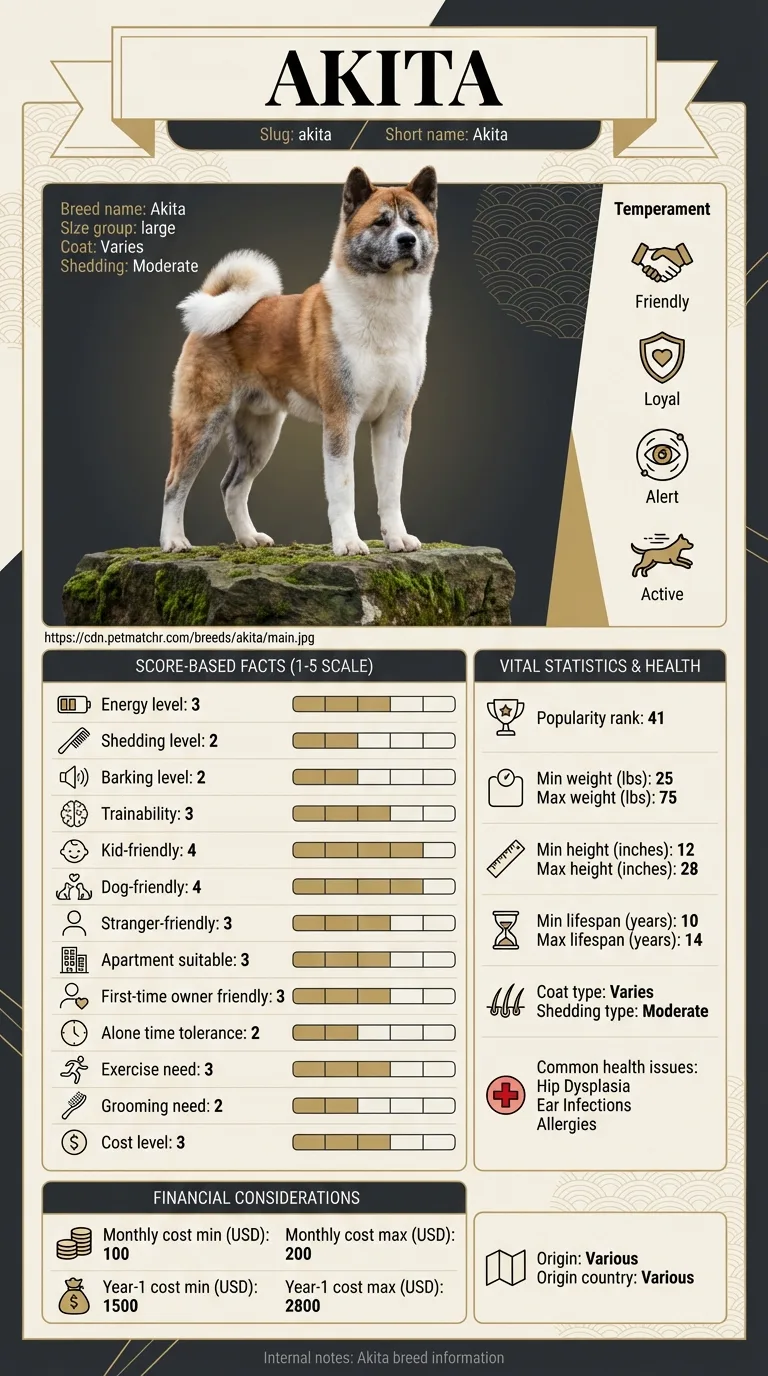
akita infographic
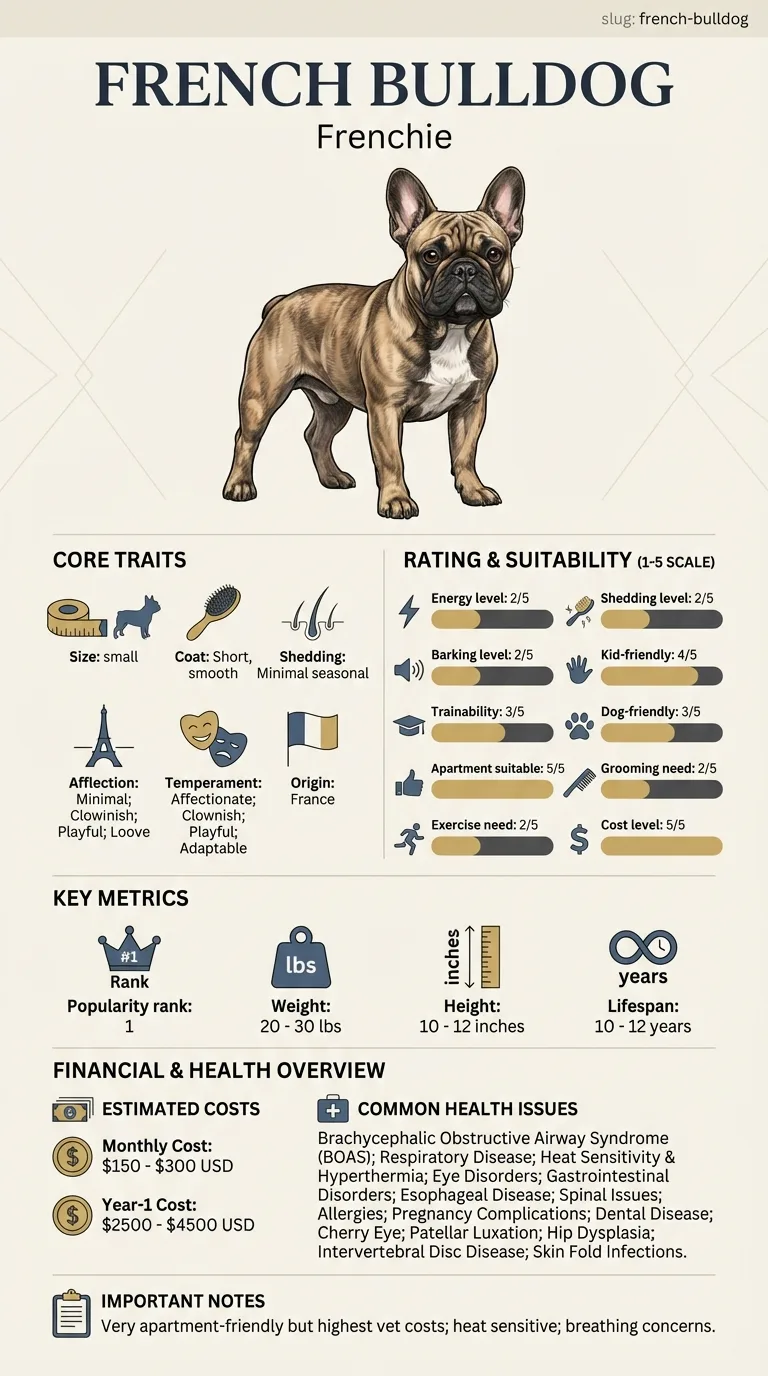
french bulldog infographic

This page is for someone weighing the easiest flat dog available against a large guardian, and who needs the health and cost picture stated plainly. It covers breathing and heat, spinal problems, the Frenchie's unusual tolerance for being left alone, and what each really costs.

Quick verdict

The French Bulldog fits a modern life better than almost any breed and carries a health burden that no amount of good ownership removes; the Akita is the opposite trade in every respect.

Choose akita if...

Choose the Akita if you want a structurally sound dog and have the space for it. It costs $110–$240 a month against $150–$300, needs no heat management, can exercise freely and swim, and lives 10 to 13 years. You are accepting 1/5 for first-time owners, 2/5 with other dogs and strangers, 5/5 shedding and up to 130 pounds.

Choose french bulldog if...

Choose the French Bulldog if you live in a flat, work full time and want a low-effort companion. It rates 5/5 for apartments, first-time owners and — unusually — tolerating time alone, needs only 2/5 exercise and sheds at 2/5. You are accepting brachycephalic airway disease, heat danger, spinal risk and the highest vet costs here.

Head-to-head comparison

Featureakitafrench bulldogWinner
Weight70–130 lbs20–30 lbsEqual
Height24–28 in10–12 inEqual
Lifespan10–13 years10–12 yearsakita
CoatDense double coatShort and smoothEqual
Grooming needModerate (3/5)Low (2/5)french bulldog
SheddingVery high (5/5)Low (2/5)french bulldog
Energy levelModerate (3/5)Low (2/5)Equal
Exercise needModerate (3/5)Low (2/5)french bulldog
TrainabilityModerate (3/5)Moderate (3/5)Equal
BarkingLow (2/5)Low (2/5)Equal
Good with kidsModerate (3/5)High (4/5)french bulldog
Good with other dogsLow (2/5)Moderate (3/5)french bulldog
Friendly to strangersLow (2/5)Moderate (3/5)french bulldog
Apartment suitabilityLow (2/5)Very high (5/5)french bulldog
Good for first-time ownersVery low (1/5)Very high (5/5)french bulldog
Tolerates being aloneModerate (3/5)Very high (5/5)french bulldog
Typical monthly cost$110–$240$150–$300akita
Typical first-year cost$1,700–$3,200$2,500–$4,500akita

Deep dive

Air, heat and what the short face costs

Brachycephalic obstructive airway syndrome heads the French Bulldog's list, with respiratory disease and heat sensitivity immediately behind it. Three of the first four entries are the same underlying problem.

The skull is shortened but the soft tissue is not, producing narrowed nostrils, an elongated soft palate, and frequently a narrow windpipe. A dog cools itself by moving air, so an airway that restricts airflow also restricts cooling.

The consequences are firm rules rather than suggestions. No exercise in the heat of the day from spring onward. A harness, never a collar. Strict weight control, because every extra pound loads the airway. Air conditioning or fans in summer. Most airlines refuse the breed entirely.

And one that surprises new owners: most French Bulldogs cannot swim. A heavy front end, a short muzzle at the waterline and limited endurance make water genuinely dangerous, and unfenced pools are a real hazard.

The Akita's constraint is the mirror image and far milder — a dense double coat that makes it comfortable in cold and means summer walks move to the cooler ends of the day. It should never be clipped.

The screw tail and what sits behind it

Spinal issues and intervertebral disc disease both appear on the French Bulldog's list, and they are connected to something that looks purely cosmetic.

The breed's short screw tail is produced by malformed vertebrae. The same developmental process can affect vertebrae further up the spine, producing hemivertebrae — wedge-shaped bones that can destabilise the spinal column and, in some dogs, compress the spinal cord.

Most affected dogs are fine. A proportion develop hind limb weakness, incoordination, or incontinence, usually appearing in the first year, and surgery is sometimes needed.

Practically this means treating a young Frenchie's back with the same care a Dachshund's gets: discourage jumping off furniture, use ramps, keep the dog lean, and take any unexplained hind limb weakness seriously and quickly.

The rest of the list is long — eye disorders and cherry eye, skin fold infections, allergies, gastrointestinal and oesophageal disease, dental disease, patellar luxation and hip dysplasia. Most of it is anatomical rather than bad luck, which is why breeder choice matters so much here.

The Akita carries hip dysplasia and no comparable structural liability.

A companion breed that can be left alone

The 5/5 for time alone deserves emphasis because it is genuinely unusual. Most small companion breeds rate 1/5 or 2/5 — the Cavalier, the Havanese, the Dachshund all do. The French Bulldog is content to sleep through a working day, and that is a large part of why it suits modern city households.

It is otherwise a straightforward temperament: 4/5 with children, 3/5 with other dogs and strangers, 2/5 barking, and a strong tendency to be wherever the people are when the people are home.

Trainability is 3/5, and the honest description is stubborn rather than slow. Frenchies learn quickly and comply when it suits them. House-training is often slower than owners expect.

The Akita's 3/5 for time alone is also self-contained but for a different reason — it is an independent breed rather than a placid one. Its 2/5 with strangers and 2/5 with other dogs need active socialisation from eight weeks and continued past two years, because that is when the adult opinion arrives.

Where $150 to $300 a month goes

The Frenchie costs $150–$300 a month and $2,500–$4,500 in the first year, against the Akita's $110–$240 and $1,700–$3,200. For a dog a fifth the weight, that needs explaining.

Almost none of it is food. It is skin fold cleaning products and treatment for the infections that follow, ear and eye treatment, allergy management, and the strong likelihood of at least one surgical procedure — airway correction, cherry eye, or a luxating patella.

Purchase price is high too, and the reason is production: most French Bulldogs are conceived by artificial insemination and delivered by caesarean, because the breed's proportions make natural mating and whelping difficult. That cost is priced into every puppy.

Insurance is quoted near the top of the market, and airway and skin fold conditions are among the most commonly excluded as breed-related — which is exactly the cover you want.

The Akita's expensive risks are autoimmune disease and bloat: less likely, larger when they arrive, and not close to certainties in the way the Frenchie's are.

Lifespan runs 10 to 13 years against 10 to 12.

Akita vs French Bulldog: the convenience is real and so is the bill

The Frenchie's ratings explain its popularity better than any marketing does. 5/5 for apartments. 5/5 for first-time owners. 5/5 for tolerating time alone — which is rare, and rarer still in a small companion breed. 2/5 exercise, 2/5 shedding, 2/5 barking.

That is a dog engineered, deliberately or not, for a small flat and a full-time job. Nothing else on this page competes with it on that.

The Akita's counter-offer is a body that works. It can be exercised in July. It can swim. It can fly. It does not need its face wiped. Its costs are lower despite being up to five times heavier.

Both bark at 2/5, which is a genuine tie and one of the Frenchie's underrated flat-living virtues.

The decision is unusually clean: you are choosing between a dog that fits your life and a dog that fits its own.

Frequently asked questions

Why is a French Bulldog more expensive than an Akita?

Because almost none of a Frenchie's cost is food. It runs $150–$300 a month against the Akita's $110–$240 despite weighing a fifth as much, and the difference is skin fold care and infections, eye and ear treatment, allergy management, and a high likelihood of surgery for the airway, a cherry eye or a knee.

Can French Bulldogs swim?

Most cannot. A heavy front end, a short muzzle sitting close to the waterline and limited endurance make water genuinely dangerous for the breed. Unfenced pools are a real hazard, and a Frenchie should never be left unsupervised near open water even briefly.

How long can a French Bulldog be left alone?

It rates 5/5 for tolerating solitude, which is unusual for a companion breed — most small companions rate 1/5 or 2/5. A Frenchie will generally sleep through a working day. That single rating explains much of its popularity with people in flats who work full time.

What are hemivertebrae?

Wedge-shaped malformed vertebrae, produced by the same developmental process that creates the breed's short screw tail. Most affected dogs are fine, but some develop hind limb weakness, incoordination or incontinence in the first year, and surgery is occasionally needed. Any unexplained hind limb weakness deserves prompt investigation.

Which is better for an apartment?

The French Bulldog at 5/5 against the Akita's 2/5. It needs only 2/5 exercise, barks at 2/5, sheds at 2/5 and tolerates being alone at 5/5. The Akita's problems in a flat are size in shared corridors, heavy shedding and a guarding instinct at communal entrances.

What should I ask a French Bulldog breeder?

How the parents breathe under exertion rather than at rest, whether either has had airway surgery, and how open the nostrils are. Ask about spinal screening and hemivertebrae, about eye and patella testing, and whether the line has any history of hind limb problems in young dogs.

Which lives longer?

The Akita marginally, at 10 to 13 years against the French Bulldog's 10 to 12 — unusual, since the Akita is far the heavier breed and size normally shortens lifespan. The Frenchie's figure reflects respiratory, spinal and dermatological consequences of its build rather than its size.

Quick answers

View more answers
Living

Akita vs French Bulldog: which should I choose?

The French Bulldog if you live in a flat, work full time and want the lowest-effort companion available. The Akita if you want a structurally sound dog that can exercise in summer and swim, and you have the space for it.

Costs

How much does each cost per month?

The French Bulldog runs $150–$300 a month and the Akita $110–$240, with first-year totals of $2,500–$4,500 and $1,700–$3,200. The smaller breed is the more expensive one at every point.

Living

Can a French Bulldog fly?

Usually not. Most airlines refuse short-faced breeds in the hold and several restrict them in cabin, because stress and heat combined with a compromised airway have proved dangerous. Plan around this before committing to the breed.

Living

Which needs less exercise?

The French Bulldog at 2/5 against the Akita's 3/5, with the important caveat that a short-faced dog should not be exercised in the heat of the day at all from spring onward.

Related DogBreedCompass guides

  • Akita breed guideThe Akita profile covers guardian temperament and the long socialisation window the breed needs.
  • French Bulldog breed guideThe French Bulldog profile covers airway care, heat management and the breed's cost profile.
  • Akita vs BulldogThe English Bulldog is the larger short-faced breed with an even higher veterinary spend.
  • Akita vs Boston TerrierThe Boston Terrier is the lighter, more athletic short-faced alternative worth considering.
  • French Bulldog back problemsSpinal problems are the risk most often missed in a young French Bulldog.
  • Akita autoimmune diseasesAutoimmune disease is the Akita's most distinctive burden and the first question for a breeder.

Related guides

Important reminder

Health information here is general and is not veterinary advice. If your dog shows pain, sudden behaviour change, or worsening symptoms, consult a licensed veterinarian.

Some links on this site are affiliate links. We may earn a commission at no extra cost to you, and we only suggest products we believe are helpful for dog owners.

Find Your Perfect Breed

Match your lifestyle to the right dog.

Take quiz

Find your match

Not sure which breed is right for you? Take our 2-minute quiz to find out.

Take the quiz