Akita or Doberman Pinscher: Watcher or Working Partner
Quick answer
Akita vs Doberman Pinscher: which should I choose?
The Doberman if you want a working partner and will train and exercise it daily, and can commit to annual cardiac screening. The Akita if your week has no room for that and you want a self-contained guardian.
Both rate 2/5 with strangers and both were bred to guard, but they do the job in opposite ways. The Doberman rates 5/5 for trainability and 5/5 for exercise — it is a working dog that needs a handler and a purpose. The Akita rates 3/5 and 3/5, and needs neither.
This page is for someone who has decided on a guardian breed and is choosing between a highly trainable athlete and a self-contained one. It covers the training and exercise gap, the Doberman's very serious cardiac burden, bleeding and spinal disorders, grooming, and cost.
Quick verdict
The Doberman is the more capable dog and the more demanding one in both time and health risk; the Akita asks far less of your week and gives you far less control.
Choose akita if...
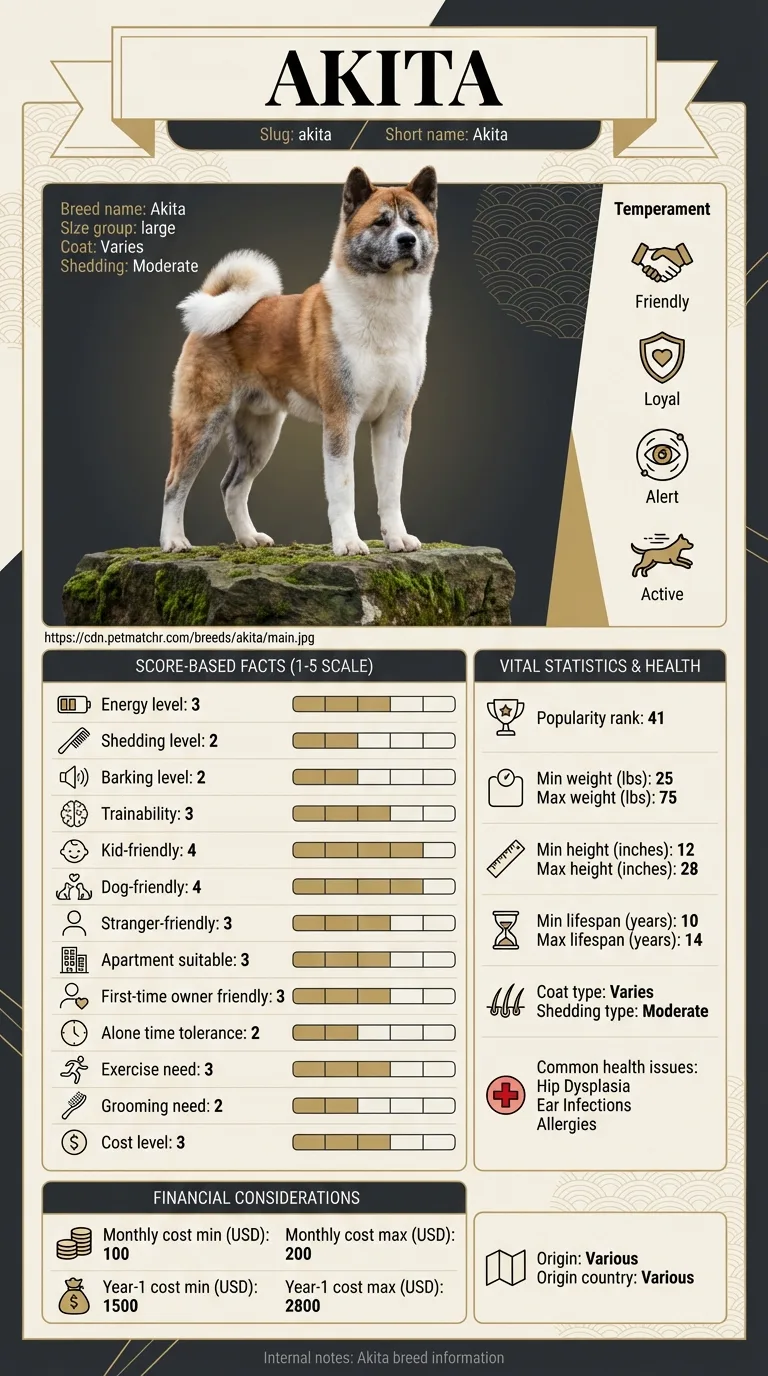
Choose the Akita if your week has no room for daily training and hard exercise. It needs 3/5 exercise against the Doberman's 5/5, tolerates being alone at 3/5 against 2/5, and carries nothing like the Doberman's cardiac risk. You are accepting 3/5 trainability, 5/5 shedding, 2/5 with other dogs and $110–$240 a month.
Choose doberman pinscher if...
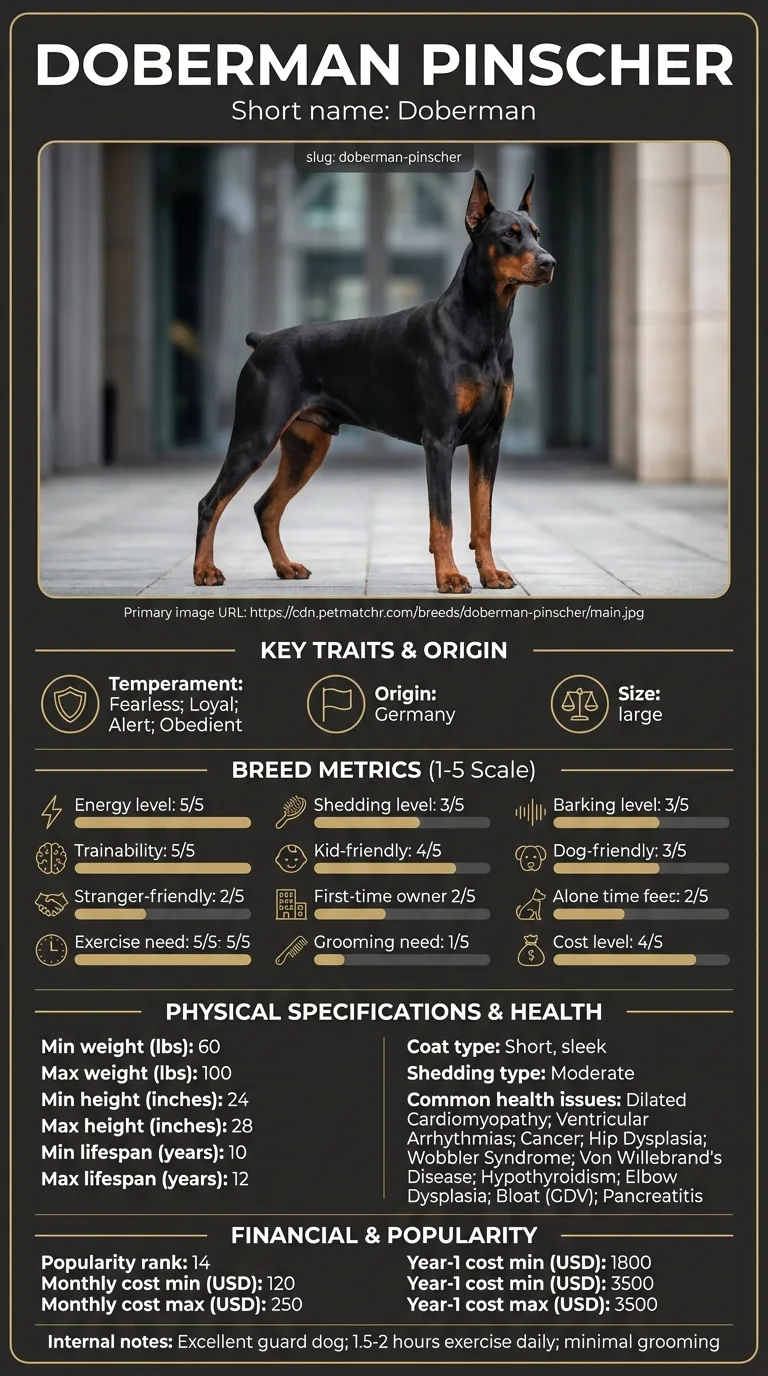
Choose the Doberman if you want a genuine working partner and will train it daily. It rates 5/5 for trainability, 5/5 for energy, 4/5 with children, and grooms at 1/5. You are accepting 5/5 exercise, a 2/5 tolerance for being left, $120–$250 a month, and dilated cardiomyopathy — the most serious breed-specific health risk on this page.
Head-to-head comparison
Feature
akita
doberman pinscher
Winner
Weight
70–130 lbs
60–100 lbs
Equal
Height
24–28 in
24–28 in
Equal
Lifespan
10–13 years
10–12 years
akita
Coat
Dense double coat
Short and sleek
Equal
Grooming need
Moderate (3/5)
Very low (1/5)
doberman pinscher
Shedding
Very high (5/5)
Moderate (3/5)
doberman pinscher
Energy level
Moderate (3/5)
Very high (5/5)
Equal
Exercise need
Moderate (3/5)
Very high (5/5)
akita
Trainability
Moderate (3/5)
Very high (5/5)
doberman pinscher
Barking
Low (2/5)
Moderate (3/5)
akita
Good with kids
Moderate (3/5)
High (4/5)
doberman pinscher
Good with other dogs
Low (2/5)
Moderate (3/5)
doberman pinscher
Friendly to strangers
Low (2/5)
Low (2/5)
Equal
Apartment suitability
Low (2/5)
Low (2/5)
Equal
Good for first-time owners
Very low (1/5)
Low (2/5)
doberman pinscher
Tolerates being alone
Moderate (3/5)
Low (2/5)
akita
Typical monthly cost
$110–$240
$120–$250
akita
Typical first-year cost
$1,700–$3,200
$1,800–$3,500
akita
Deep dive
What a 5/5 working dog actually needs
The Doberman's ratings describe a dog that was built for a job and still expects one. Ninety minutes to two hours of daily activity is the realistic figure, and a meaningful part of it has to be mental — obedience, tracking, protection sport, agility or serious structured training at home.
Without that, the failure mode is not a naughty dog. It is an anxious one. Dobermans are unusually sensitive for their reputation, they attach very closely to their people, and an under-employed Doberman becomes restless, clingy and destructive at doors.
That sensitivity is also why the training works. Dobermans learn fast, want the interaction and are ruined by heavy-handedness. They are frequently described as velcro dogs and the description is accurate — this is not an aloof breed at home despite the 2/5 with strangers.
The Akita's independence is the opposite proposition. It needs less from you, does not experience an empty afternoon as abandonment, and gives you correspondingly less influence. Its recall should be treated as conditional at all times, and secure fencing is a requirement rather than a preference for both breeds.
Dilated cardiomyopathy is the Doberman's defining risk
Dilated cardiomyopathy heads the Doberman's condition list, and ventricular arrhythmias sit immediately below it. No other breed on this site carries a cardiac risk of comparable scale.
In DCM the heart muscle weakens and the chambers enlarge, so the heart pumps progressively less effectively. In Dobermans there is usually a long occult phase in which the dog looks entirely healthy while the disease is already established, and the first outward sign can be collapse or sudden death from an arrhythmia.
This is why screening is different in this breed. Annual Holter monitoring and echocardiography from around three years old are the standard recommendation, because catching the occult phase allows medication that meaningfully delays the onset of heart failure. A stethoscope check will not find it.
Ask a breeder for Holter and echo results on the parents, and for the age and cause of death of grandparents. A breeder who volunteers this is telling you they take the problem seriously.
The Akita's burden is autoimmune and endocrine — immune-mediated disease of skin, eyes and blood, hypothyroidism, progressive retinal atrophy — plus hip dysplasia and bloat.
Bleeding disorders, wobbler syndrome and bloat
Von Willebrand's disease is the second Doberman item worth naming. It is an inherited clotting disorder, it has a DNA test, and the reason it matters is timing: the first time most owners find out is during surgery. Test before any elective procedure, including neutering.
Wobbler syndrome — cervical spondylomyelopathy — is compression of the spinal cord in the neck, producing a wobbly, uncoordinated hind end and neck pain. It appears in large breeds generally and Dobermans specifically, and an unsteady gait in a young adult is worth investigating rather than watching.
Hypothyroidism, pancreatitis, hip and elbow dysplasia and cancer complete the list.
Both breeds are deep-chested and both carry a real bloat risk. Every household with either dog should recognise unproductive retching, a distending abdomen and restlessness as an emergency, and should know where the nearest out-of-hours surgery is before it is needed.
Both also have known anaesthetic sensitivities worth raising with a vet in advance — a point that matters more in a breed that may also have an undiagnosed clotting disorder.
Daily life, climate and money
The Doberman's short sleek coat is the lowest-maintenance on this site at 1/5 grooming, and it sheds moderately at 3/5 in fine hairs that stick to everything.
It also provides almost no insulation. Dobermans genuinely need a coat in cold weather and should not be left outside in it. The Akita is the reverse — entirely comfortable in cold that keeps other breeds indoors, and needing summer walks moved to the cooler ends of the day.
On money the two are close, with the Doberman slightly ahead: $120–$250 a month against $110–$240, and $1,800–$3,500 against $1,700–$3,200 in the first year.
The figure that separates them is cardiac screening. Annual Holter monitoring and echocardiography from three years old is a recurring cost of several hundred a year, and it is not optional in this breed if you want the diagnosis while it is still useful. Insurance is also priced with DCM in mind.
Lifespan runs 10 to 13 years against 10 to 12, and both are at the shorter end for their size.
Akita vs Doberman Pinscher: same job, opposite method
Height ties at 24 to 28 inches. Strangers ties at 2/5. Apartments ties at 2/5. On paper these are two dogs of the same size doing the same job.
The method is entirely different. The Doberman guards by responding — it is fast, alert, extremely trainable at 5/5, and it looks to its handler for the decision. A well-trained Doberman is arguably the most controllable protection dog available.
The Akita guards by deciding. At 3/5 trainability it is not slow, but it was selected to act without instruction, and it will resolve a situation on its own terms.
The practical consequence is what each demands. The Doberman's 5/5 exercise and 5/5 energy mean an hour and a half of real work every day, and a Doberman that does not get it becomes anxious and destructive rather than merely bored. The Akita's 3/5 means a walk.
Grooming reverses the picture entirely: 1/5 against 3/5, and 3/5 shedding against 5/5.
Akita or Doberman Pinscher: Watcher or Working Partner - Akita vs Doberman Pinscher: same job, opposite method
Frequently asked questions
Which is easier to train, an Akita or a Doberman?
The Doberman decisively, at 5/5 against the Akita's 3/5. It learns fast, works well under direction and is one of the most controllable protection breeds available. The catch is that its training is not optional — a Doberman with 5/5 energy and no job becomes anxious and destructive rather than simply bored.
How much exercise does a Doberman need?
Ninety minutes to two hours a day at 5/5 exercise and 5/5 energy, and a meaningful part of it has to be mental rather than just physical. Obedience, tracking, protection sport or agility all work. The Akita at 3/5 is satisfied with forty-five to sixty minutes of walking and no structured work at all.
What is dilated cardiomyopathy and how common is it in Dobermans?
It is a disease in which the heart muscle weakens and the chambers enlarge, and no breed on this site carries a comparable cardiac risk. There is usually a long phase where the dog looks healthy while the disease is established, and the first sign can be sudden collapse. Annual Holter monitoring and echocardiography from around three years old are the standard response.
What should I ask a Doberman breeder?
Holter monitor and echocardiogram results for both parents, and the age and cause of death of the grandparents. Then von Willebrand's DNA status, hip and elbow scores, and thyroid results. A breeder who volunteers cardiac data before you ask is the one worth talking to.
Why does von Willebrand's disease matter?
Because it is an inherited clotting disorder and the first time most owners discover it is during surgery. There is a DNA test, so an affected dog can be identified in advance and the procedure planned accordingly. Test before any elective operation, including neutering.
Which copes better with being left alone?
The Akita at 3/5 against the Doberman's 2/5. Dobermans attach very closely to their people and are far less aloof at home than their reputation suggests — an under-exercised one left for long days becomes clingy and destructive. The Akita is self-contained and does not experience an empty house as a loss.
Which handles cold better?
The Akita, easily. Its dense double coat handles temperatures that keep most breeds indoors, and it should never be clipped since it insulates in both directions. The Doberman's sleek coat gives almost no insulation — it needs a coat in winter and should not be left outside in cold weather.
Akita vs Doberman Pinscher: which should I choose?
The Doberman if you want a working partner and will train and exercise it daily, and can commit to annual cardiac screening. The Akita if your week has no room for that and you want a self-contained guardian.
Costs
How much does each cost per month?
The Doberman runs $120–$250 a month and the Akita $110–$240, with first-year totals of $1,800–$3,500 and $1,700–$3,200. Budget separately for annual Holter and echo screening on a Doberman.
Living
Which sheds more?
The Akita at 5/5 against the Doberman's 3/5, blowing a dense double coat twice a year. On grooming effort the Doberman is the easiest breed here at 1/5, needing little more than a weekly wipe over.
Health
Are both breeds prone to bloat?
Yes — both are deep-chested and gastric dilatation-volvulus is a genuine emergency risk in each. Learn the signs: unproductive retching, a distending abdomen and restlessness. Know where your nearest out-of-hours surgery is in advance.
Related DogBreedCompass guides
Akita breed guide – The Akita profile covers guardian temperament and the long socialisation window the breed needs.
Doberman Pinscher breed guide – The Doberman profile covers working drive, cardiac screening and the breed's sensitivity.
Akita vs Rottweiler – The Rottweiler is the heavier guardian most often weighed against the Doberman.
Akita vs Belgian Malinois – The Belgian Malinois is the other high-drive working breed in the same bracket.
Doberman heart disease – Heart disease is the defining health question for anyone considering a Doberman.
Akita autoimmune diseases – Autoimmune disease is the Akita's most distinctive burden and the first question for a breeder.
Health information here is general and is not veterinary advice. If your dog shows pain, sudden behaviour change, or worsening symptoms, consult a licensed veterinarian.
Some links on this site are affiliate links. We may earn a commission at no extra cost to you, and we only suggest products we believe are helpful for dog owners.
We research and check what we publish, but we do not warrant that any figure, date, price, or statement is accurate, complete, or current, and we accept no liability for any loss, cost, injury, or other harm arising from the use of this site. Use it as one reference among several. You remain responsible for your own decisions and for your dog's care - confirm anything that matters with a licensed veterinarian or another qualified professional before you act on it. Full disclaimer.