Behavior
Which breed is easier to groom, the Doberman or the Cocker Spaniel?
The Doberman, by a wide margin — very low (1/5) grooming need versus the Cocker's high (4/5).

Quick answer
Which breed is easier to groom, the Doberman or the Cocker Spaniel?
The Doberman, by a wide margin — very low (1/5) grooming need versus the Cocker's high (4/5).
Doberman Pinscher or English Cocker Spaniel? On paper they differ most on grooming need, and on the scales Doberman Pinscher is the heavier at 60–100 lbs. Here is how the two compare on everything that shapes an ordinary week.
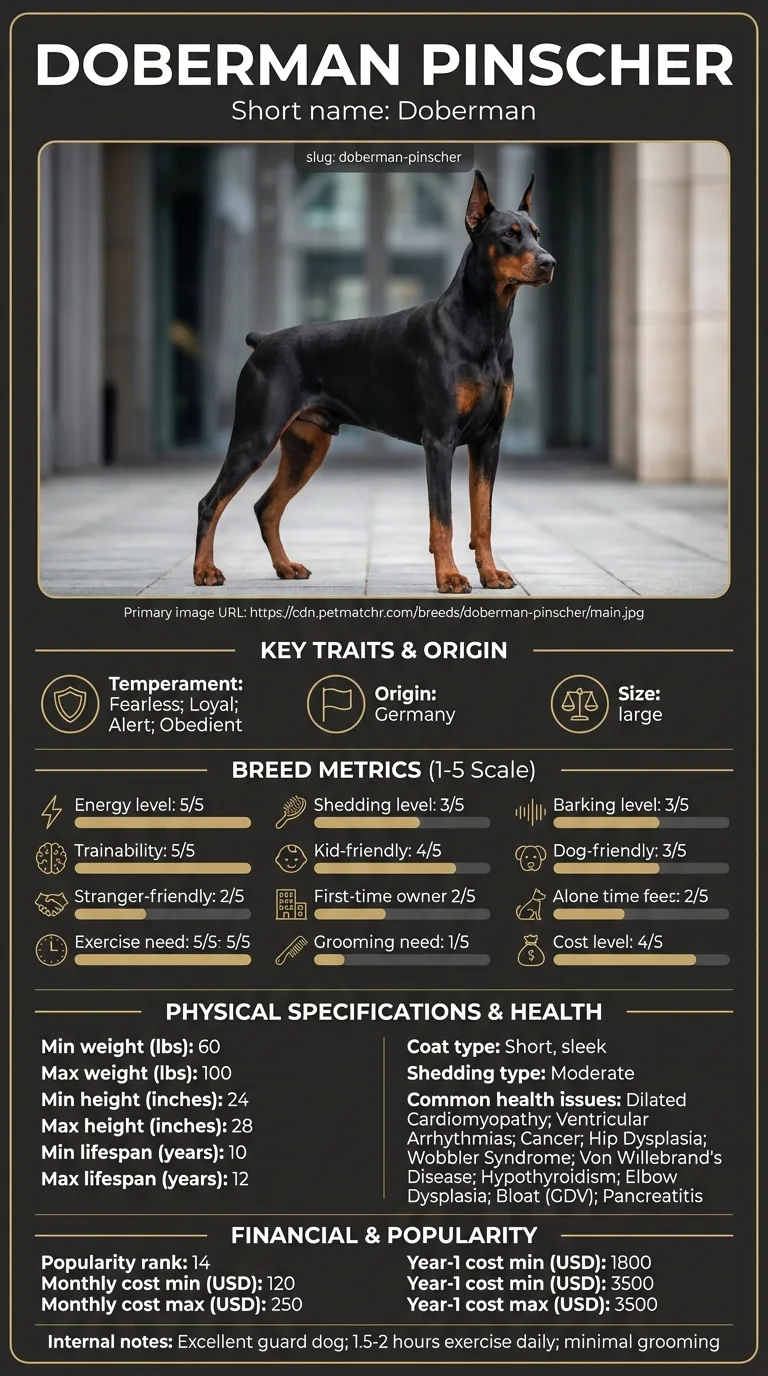
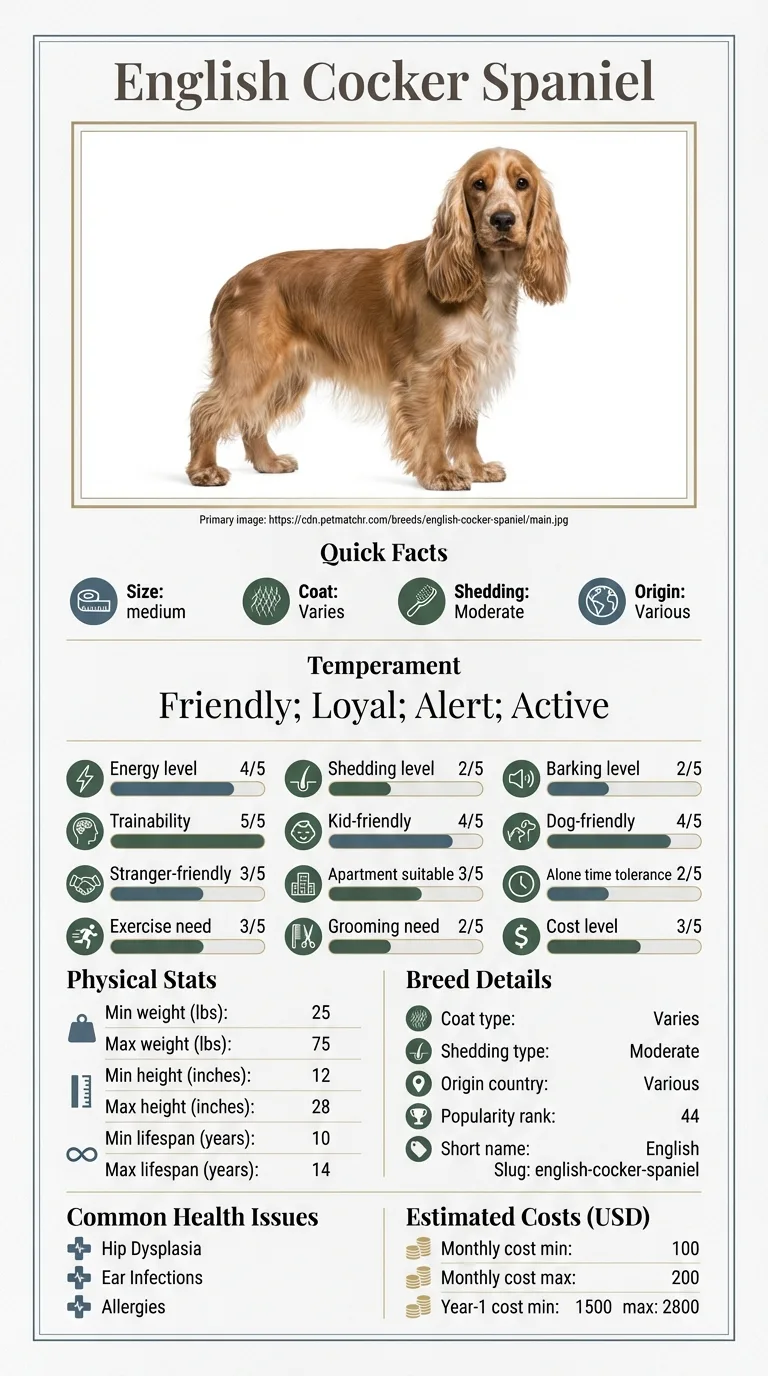
This is for someone already down to Doberman Pinscher and English Cocker Spaniel and deciding between them. For this pair the decision usually turns on grooming need and apartment suitability, so those are covered first and in most detail. Anyone choosing from a flat has a clear answer here: English Cocker Spaniel rates 4/5 against 2/5. The focus throughout is on daily consequences rather than breed background.
Between Doberman Pinscher and English Cocker Spaniel, grooming need is what separates them, and English Cocker Spaniel is the lower-effort dog of the two to keep.
Choose Doberman Pinscher if you do not want a standing grooming appointment, you want a dog that picks up training quickly and you want a dog that can keep up with an active routine.
Choose English Cocker Spaniel if you are in a flat or a smaller home, this is your first dog and your walking routine is modest.
| Feature | doberman pinscher | english cocker spaniel | Winner |
|---|---|---|---|
| Size class | large | medium | Equal |
| Weight | 60–100 lbs | 26–34 lbs | Equal |
| Height | 24–28 in | 15–17 in | Equal |
| Lifespan | 10–12 years | 12–14 years | english cocker spaniel |
| Exercise need | Very high (5/5) | High (4/5) | english cocker spaniel |
| Grooming need | Very low (1/5) | High (4/5) | doberman pinscher |
| Shedding | Moderate (3/5) | Moderate (3/5) | Equal |
| Energy level | Very high (5/5) | High (4/5) | Equal |
| Barking | Moderate (3/5) | Moderate (3/5) | Equal |
| Apartment suitability | Low (2/5) | High (4/5) | english cocker spaniel |
| Good for first-time owners | Low (2/5) | High (4/5) | english cocker spaniel |
| Tolerates being alone | Low (2/5) | Low (2/5) | Equal |
| Trainability | Very high (5/5) | High (4/5) | doberman pinscher |
| Good with kids | High (4/5) | Very high (5/5) | english cocker spaniel |
| Good with other dogs | Moderate (3/5) | High (4/5) | english cocker spaniel |
| Friendly to strangers | Low (2/5) | High (4/5) | english cocker spaniel |
| Cost level | High (4/5) | Moderate (3/5) | english cocker spaniel |
| Coat | Short, sleek | Medium, silky and feathered | Equal |
| Origin | Germany | Various | Equal |
| Typical monthly cost | $120–$250 | $100–$200 | Equal |
| Typical first-year cost | $1,800–$3,500 | $1,400–$2,900 | Equal |
Picture the two side by side in a vet's waiting room: a 24-to-28-inch Doberman weighing up to 100 pounds beside a Cocker Spaniel that tops out around 34 pounds and stands barely 17 inches at the shoulder. The Doberman's build is lean, square, and muscular — engineered for speed and guarding work — while the Cocker carries a compact, sturdy sporting-dog frame with feathered legs and long, low-set ears that need their own maintenance routine. Despite the size gap, both breeds are classified with strong alertness and drive in their working history. A Doberman's silhouette reads as athletic power; a Cocker's reads as approachable and rounded, and that visual difference shapes first impressions long before either dog does anything at all.
Exercise need rates very high (5/5) for the Doberman and high (4/5) for the Cocker Spaniel — both are working-line dogs that expect real daily activity, not a stroll around the block. The Doberman was developed for protection work requiring stamina and speed, so it does best with running, structured training sessions, or a job to focus on; an under-exercised Doberman tends toward destructive or anxious behavior. The Cocker's energy channels more into flushing and retrieving instincts, so scent games, fetch, and swimming suit it as well as straight mileage does. Energy level itself sits at very high for the Doberman versus high for the Cocker, a small gap that matters less than how each breed prefers to burn it off.
Very low (1/5) against high (4/5) is the grooming gap between these two, and it flips the usual size assumption — the bigger dog is the easier one to maintain. A Doberman's short, sleek coat needs little beyond an occasional wipe-down and nail trims. The Cocker's medium, silky, feathered coat mats easily around the ears and legs, and its shedding rating of moderate (3/5) matches the Doberman's own moderate score, so neither is a hypoallergenic option, but the Cocker demands scissors, a slicker brush, and regular professional grooming appointments the Doberman never will. Owners choosing a Cocker Spaniel for its soft-eyed good looks should budget for that upkeep from day one.
Apartment suitability lands at low (2/5) for the Doberman and high (4/5) for the Cocker Spaniel, a gap driven less by size than by the Doberman's need for space to move and a job to occupy its alert, fearless mind. Barking is a rare tie here — moderate (3/5) for both — so neither breed is notably quiet nor notably loud by default. Tolerating time alone is also tied, low (2/5) for both, meaning neither dog handles long solo stretches well; the Doberman bonds intensely with its household and the merry, affectionate Cocker simply enjoys company too much to be left for a full workday without complaint.
Trainability tips toward the Doberman, very high (5/5) against the Cocker's still-respectable high (4/5), and the word 'obedient' appears directly in the Doberman's temperament profile alongside fearless and alert. That capability comes with a catch: suitability for first-time owners rates low (2/5) for the Doberman and high (4/5) for the Cocker, because a Doberman's intelligence and protective instincts need an experienced, consistent handler to channel properly, whereas the Cocker's biddable, energetic nature responds well to gentler, less experienced training approaches. A new owner drawn to the Doberman's obedience potential should weigh that against the discipline required to earn it.
Good with kids scores high (4/5) for the Doberman and very high (5/5) for the Cocker, both solid numbers, though friendliness to strangers separates them sharply: low (2/5) versus high (4/5). A Doberman's loyalty and alertness translate into watchfulness around unfamiliar visitors, a trait that suits guarding roles but requires early socialization work in a house that entertains often. The Cocker's merry, affectionate temperament extends more readily to guests and to other dogs, where it also edges ahead, high (4/5) against the Doberman's moderate (3/5). Neither breed is aggressive by nature, but the household that wants an instantly welcoming dog around a steady stream of visitors will find the Cocker the lower-effort choice.
Lifespan favors the Cocker Spaniel, 12 to 14 years against the Doberman's 10 to 12, and the health lists explain part of that gap. The Doberman carries a heavier cardiac burden — dilated cardiomyopathy and ventricular arrhythmias both appear on its list, alongside Wobbler Syndrome, a cervical spine condition, and Von Willebrand's Disease, a clotting disorder that complicates any surgery. Cancer and bloat (GDV) round out a genuinely demanding health profile. The Cocker's risks run gentler but still real: ear infections from those long, low-hanging ears, progressive retinal atrophy, and two less common conditions, familial nephropathy and adult-onset neuropathy, both worth screening for in breeding lines. Hip dysplasia is the one condition both breeds share outright.
First-year costs run $1,800 to $3,500 for a Doberman and $1,400 to $2,900 for a Cocker Spaniel, with monthly upkeep following the same pattern at $120-$250 versus $100-$200. Cost level itself rates high for the Doberman and moderate for the Cocker, and cardiac screening is a real driver on the Doberman side — echocardiograms and Holter monitoring for a breed prone to dilated cardiomyopathy aren't cheap, and Wobbler Syndrome can mean imaging and possibly surgery. The Cocker's costs skew toward grooming rather than veterinary specialists, with regular professional trims and ear cleaning supplies adding a recurring line item the low-maintenance Doberman coat simply doesn't generate.
Doberman Pinscher weighs 60–100 lbs and lives 10–12 years; English Cocker Spaniel weighs 26–34 lbs and lives 12–14 years. The two diverge most on grooming need, apartment suitability and good for first-time owners and 1 other rated axes. They are level on tolerates being alone, barking and shedding, so those cannot decide it. The table below marks a winner only where one breed is genuinely easier for a typical owner; size and origin are facts rather than merits and stay level. Ratings come from one source applied to both breeds, so they are meaningful against each other rather than as absolute scores.

Not typically — it rates low (2/5) for first-time-owner suitability, needing an experienced handler to manage its size, drive, and protective instincts.
The Cocker, averaging 12 to 14 years against the Doberman's 10 to 12, partly reflecting the Doberman's higher cardiac disease risk.
Considerably more — high (4/5) grooming need versus the Doberman's very low (1/5), because of the Cocker's feathered coat and long ears.
The Cocker Spaniel, rated high (4/5), compared to the Doberman's low (2/5) — the Doberman's alert, protective nature makes it more reserved with unfamiliar people.
It's one of the breed's best-documented health risks, appearing alongside ventricular arrhythmias on the Doberman's health list, and it's a leading reason for cardiac screening in the breed.
Neither does particularly well — both rate low (2/5) for tolerating solitude, so long workdays are a challenge with either breed.
Ear infections top the breed's health list, a direct consequence of its long, low-set, feathered ears trapping moisture and debris.
The Doberman, by a wide margin — very low (1/5) grooming need versus the Cocker's high (4/5).
The Doberman, rated very high (5/5), against the Cocker's high (4/5).
The Cocker Spaniel, at roughly $1,400-$2,900 versus the Doberman's $1,800-$3,500.
The Cocker Spaniel, rated high (4/5), compared to the Doberman's low (2/5).
Secure checkout on Stripe. We never see your card.
7-day money-back guarantee. Instant access.
Health information here is general and is not veterinary advice. If your dog shows pain, sudden behaviour change, or worsening symptoms, consult a licensed veterinarian.
Some links on this site are affiliate links. We may earn a commission at no extra cost to you, and we only suggest products we believe are helpful for dog owners.
We research and check what we publish, but we do not warrant that any figure, date, price, or statement is accurate, complete, or current, and we accept no liability for any loss, cost, injury, or other harm arising from the use of this site. Use it as one reference among several. You remain responsible for your own decisions and for your dog's care - confirm anything that matters with a licensed veterinarian or another qualified professional before you act on it. Full disclaimer.
Match your lifestyle to the right dog.
Take quizNot sure which breed is right for you? Take our 2-minute quiz to find out.
Take the quiz