Akita or Boxer: A Quiet Guardian or a Clown With a Short Clock
Quick answer
Akita vs Boxer: which should I choose?
The Boxer if you have children and can commit to hard daily exercise, accepting a 7 to 10 year lifespan. The Akita if you want a quiet guardian and only have a walk in your day, accepting a 1/5 first-time rating.
The single number that should decide this comparison is lifespan. The Boxer lives 7 to 10 years against the Akita's 10 to 13, and it is one of the shortest-lived breeds of its size anywhere. That is not a footnote to the health section — it is the health section.
This is for someone who wants a large dog with presence and is weighing a guardian against an athlete. It covers the exercise gap, what the Boxer's cancer and cardiac burden means in practice, heat sensitivity in both, coat and shedding, and running costs.
Quick verdict
The Boxer is the better family dog and the worse bet on longevity; the Akita asks far less of your week but far more of your handling.
Choose akita if...
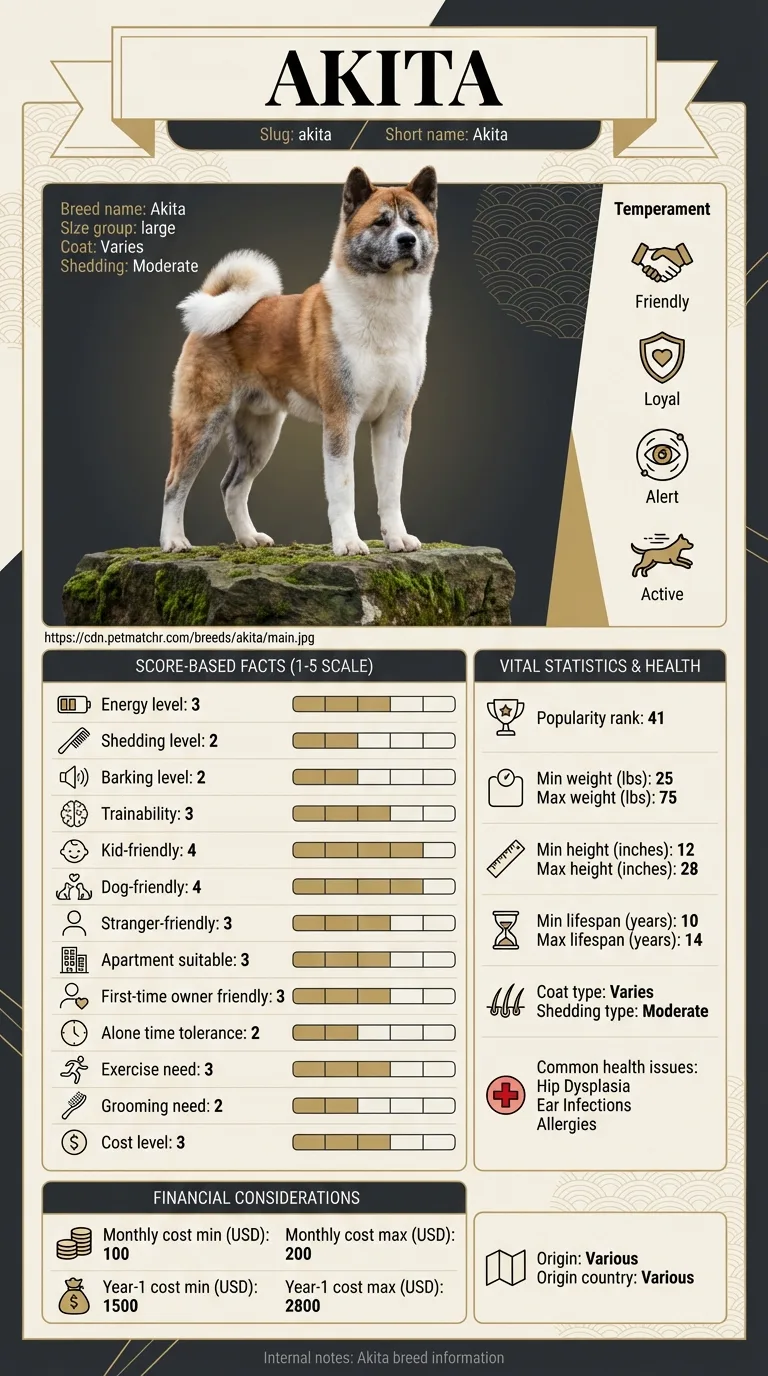
Choose the Akita if you want a calm guardian and your week does not have an hour of hard exercise in it. It rates 3/5 for exercise against the Boxer's 5/5, barks at 2/5, and lives 10 to 13 years. You are accepting 1/5 for first-time owners, 2/5 with other dogs and strangers, 5/5 shedding and up to 130 pounds.
Choose boxer if...
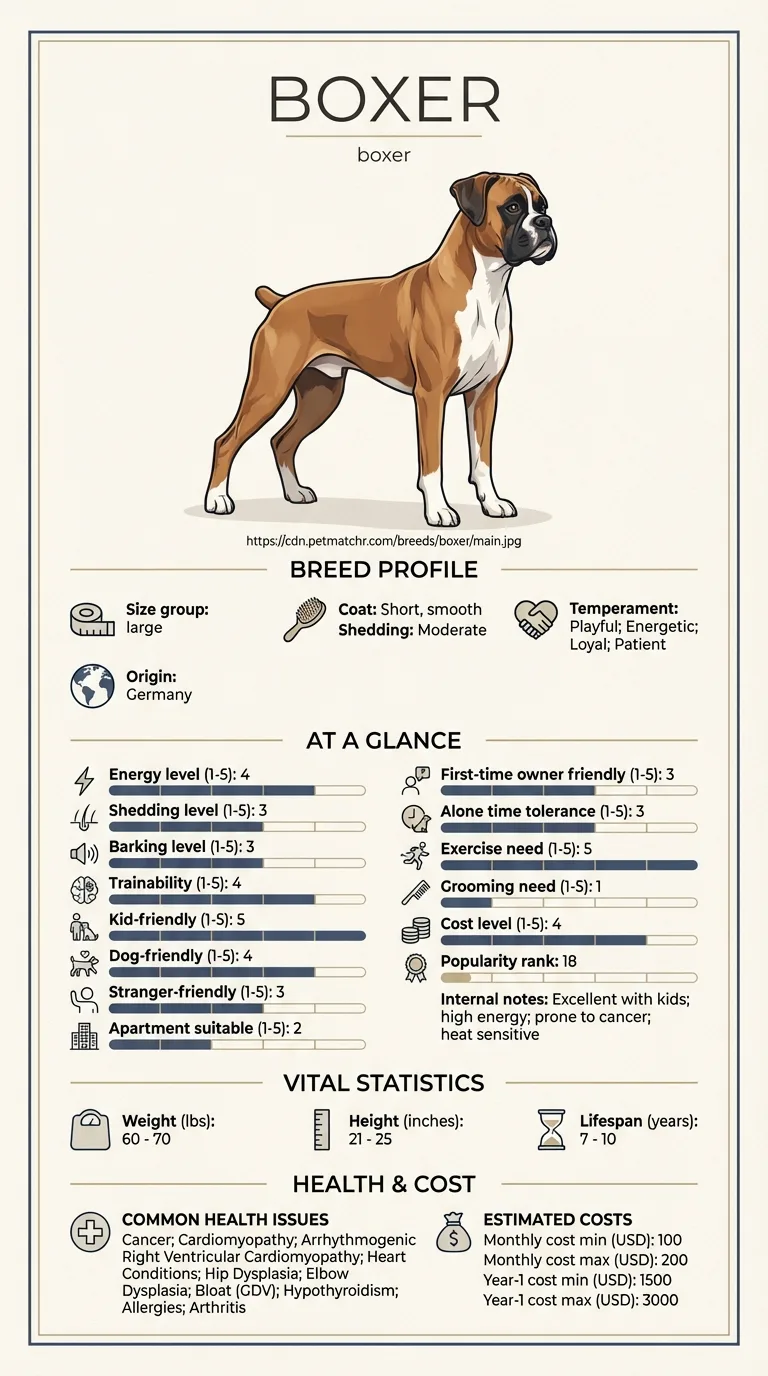
Choose the Boxer if you want a demonstrative family dog and will run it properly. It rates 5/5 with children, 4/5 with other dogs, 4/5 for trainability and grooms at 1/5. You are accepting 5/5 exercise, a 7 to 10 year lifespan, and one of the heaviest cancer and cardiac burdens of any breed on this site.
Head-to-head comparison
Feature
akita
boxer
Winner
Weight
70–130 lbs
60–70 lbs
Equal
Height
24–28 in
21–25 in
Equal
Lifespan
10–13 years
7–10 years
akita
Coat
Dense double coat
Short and smooth
Equal
Grooming need
Moderate (3/5)
Very low (1/5)
boxer
Shedding
Very high (5/5)
Moderate (3/5)
boxer
Energy level
Moderate (3/5)
High (4/5)
Equal
Exercise need
Moderate (3/5)
Very high (5/5)
akita
Trainability
Moderate (3/5)
High (4/5)
boxer
Barking
Low (2/5)
Moderate (3/5)
akita
Good with kids
Moderate (3/5)
Very high (5/5)
boxer
Good with other dogs
Low (2/5)
High (4/5)
boxer
Friendly to strangers
Low (2/5)
Moderate (3/5)
boxer
Apartment suitability
Low (2/5)
Low (2/5)
Equal
Good for first-time owners
Very low (1/5)
Moderate (3/5)
boxer
Tolerates being alone
Moderate (3/5)
Moderate (3/5)
Equal
Typical monthly cost
$110–$240
$100–$200
boxer
Typical first-year cost
$1,700–$3,200
$1,500–$3,000
boxer
Deep dive
5/5 exercise in a dog that stays adolescent
Boxers mature slowly and act like puppies for the first three years, which is charming in a forty-pound dog and considerably less so in a seventy-pound one that jumps.
The 5/5 exercise rating is not satisfied by a walk. A Boxer wants to sprint, wrestle and play hard, and an under-exercised one becomes a bouncing, mouthy, furniture-clearing nuisance rather than a destructive one. The good news is that it is straightforward to satisfy: two proper sessions of running and play a day covers most of it.
The complication is heat. Boxers have a moderately shortened muzzle and are genuinely heat sensitive, so summer exercise moves to early morning and late evening. Combining 5/5 exercise need with poor heat tolerance is one of the more awkward constraints in this breed.
The Akita at 3/5 wants a decent walk and then lies down. For a household with a full-time job, that single row may outweigh everything else on this page.
The most tolerant large breed against the most reserved
The Boxer's 5/5 with children is well earned. It is patient, physically robust, and genuinely enjoys the noise and unpredictability of a household with young children — the main risk is a boisterous dog knocking a toddler over rather than anything worse.
It rates 4/5 with other dogs and 3/5 with strangers. Boxers greet enthusiastically and at volume; they are not subtle, and a Boxer that has decided a visitor is wonderful is difficult to persuade otherwise.
The Akita's 3/5 and 2/5 and 2/5 describe a different animal. It assesses rather than greets, its reserve is territorial rather than nervous, and its intolerance of other dogs — often same-sex — commonly appears at social maturity around two years, catching owners who had an easy puppy.
On training, 4/5 against 3/5 understates the gap in practice. The Boxer is willing but silly and needs repetition. The Akita is neither: it understands and then decides.
Cancer and the Boxer heart
The Boxer's health list is unusual for how specific and how serious it is. Cancer sits at the top — mast cell tumours, lymphoma and brain tumours all appear at elevated rates in the breed, and cancer is the leading cause of death in Boxers by a clear margin.
The cardiac entries matter just as much. Arrhythmogenic right ventricular cardiomyopathy, often called Boxer cardiomyopathy, is a breed-specific disease of the heart muscle that produces arrhythmias, fainting and sudden death, sometimes in an apparently healthy young adult. Dilated cardiomyopathy and aortic stenosis also appear.
Ask a Boxer breeder about Holter monitoring in the parents, echocardiogram results, and cardiac history in the wider line. This is not an optional question in this breed.
The Akita's burden is different: autoimmune disorders affecting skin, eyes and blood, hypothyroidism, progressive retinal atrophy, hip dysplasia and bloat. Both breeds are deep-chested and both should be assessed for bloat risk, and both carry known anaesthetic sensitivities worth flagging to a vet.
Coat, climate and what each costs
Grooming is 1/5 for the Boxer against 3/5 for the Akita, and shedding 3/5 against 5/5. The Boxer needs a rubber curry once a week and nothing else; the Akita needs an undercoat rake and bin bags twice a year.
But the Boxer's short coat is not an advantage in every climate. It has almost no insulation, so a Boxer needs a coat in a cold winter, while an Akita is entirely comfortable at temperatures that keep most breeds indoors. In hot weather the position reverses, and the Akita's coat — which should never be clipped, because it insulates both ways — still handles heat better than a shortened muzzle does.
On money the two are close: $110–$240 a month against $100–$200, and $1,700–$3,200 against $1,500–$3,000 in the first year.
The honest caveat is that the Boxer's lifetime veterinary spend tends to run well above the monthly figure, because cardiac monitoring and oncology are both expensive and both are realistic.
Akita vs Boxer: the lifespan gap comes first
Seven to ten years against ten to thirteen. At the pessimistic end that is a difference of six years, on breeds of broadly similar weight.
Size normally explains lifespan gaps. Here it does not — the Akita is the heavier dog and lives longer. The Boxer's number is driven by disease burden rather than mass, and specifically by cancer, which is the first entry on its condition list for good reason.
On everything else the Boxer is the more agreeable dog: 5/5 with children against 3/5, 4/5 with other dogs against 2/5, 4/5 trainability against 3/5, and 1/5 grooming against 3/5 with a fraction of the shedding.
What the Akita offers is a much smaller claim on your time. 3/5 exercise against 5/5 is the difference between a dog you walk and a dog you have to run.
Akita or Boxer: A Quiet Guardian or a Clown With a Short Clock - Akita vs Boxer: the lifespan gap comes first
Frequently asked questions
Which lives longer, an Akita or a Boxer?
The Akita, at 10 to 13 years against the Boxer's 7 to 10 — despite being the heavier breed, which normally works the other way. The Boxer's short lifespan is driven by disease rather than size, principally cancer, which is the leading cause of death in the breed, and cardiac disease including arrhythmogenic right ventricular cardiomyopathy.
Which needs more exercise?
The Boxer, at 5/5 against the Akita's 3/5. A walk does not satisfy a Boxer; it wants to sprint and play hard, twice a day, and stays adolescent for around three years. The complication is heat sensitivity, so summer sessions move to early morning and late evening. The Akita wants a decent walk and then settles.
Which is better with children?
The Boxer at 5/5 against the Akita's 3/5, and it is one of the more genuinely child-tolerant large breeds. The main risk is a boisterous seventy-pound dog knocking a toddler over. The Akita's rating reflects size, tolerance for handling and the need to supervise a guardian breed around visiting children.
What should I ask a Boxer breeder?
Cardiac questions first: Holter monitor results and echocardiograms on the parents, and the cardiac history of the wider line. Then hip and elbow scores, thyroid testing, and how long the dogs in that line have lived. Arrhythmogenic right ventricular cardiomyopathy can cause sudden death in a young adult, so this is not a formality.
Which sheds more?
The Akita at 5/5 against the Boxer's 3/5. The Akita blows a dense double coat in clumps twice a year. The Boxer sheds a short stiff hair steadily all year that works its way into upholstery. Grooming effort is 3/5 against 1/5 — the Boxer needs a rubber curry once a week and nothing more.
Can either live in an apartment?
Both rate 2/5, for different reasons. The Boxer's problem is 5/5 exercise and a habit of running indoors; the Akita's is size, 5/5 shedding and a guarding instinct in shared corridors. Neither is impossible with a committed owner, but neither is a sensible default choice for a flat.
Which is the better first dog?
The Boxer at 3/5 against the Akita's 1/5, though neither is easy. The Boxer's difficulty is physical — a strong, slow-maturing dog that needs a lot of exercise. The Akita's is judgemental: an independent guardian whose dog-intolerance often surfaces at around two years old.
The Boxer if you have children and can commit to hard daily exercise, accepting a 7 to 10 year lifespan. The Akita if you want a quiet guardian and only have a walk in your day, accepting a 1/5 first-time rating.
Costs
How much does each cost per month?
The Akita runs $110–$240 a month and the Boxer $100–$200, with first-year totals of $1,700–$3,200 and $1,500–$3,000. The Boxer's lifetime veterinary spend usually exceeds what its monthly figure suggests.
Health
Is the Boxer really that prone to cancer?
Yes. Cancer is the leading cause of death in the breed, with mast cell tumours, lymphoma and brain tumours all elevated. Combined with breed-specific cardiomyopathy, it is what produces the 7 to 10 year lifespan.
Living
Which handles cold better?
The Akita, comfortably. Its dense double coat handles temperatures that keep most breeds indoors. The Boxer's short coat has almost no insulation and it needs a coat in a cold winter. Both struggle in real heat.
Related DogBreedCompass guides
Akita breed guide – The Akita profile covers guardian temperament and the socialisation window the breed needs.
Boxer breed guide – The Boxer profile covers exercise requirements and the breed's cardiac screening.
Akita vs Rottweiler – The Rottweiler is the other large guardian most often weighed against both of these.
Akita vs Alaskan Malamute – The Malamute is the large northern alternative to the Akita and is far more sociable.
Boxer cancer risk – Cancer risk is the defining health question for anyone considering a Boxer.
Boxer heart disease – Heart disease screening should happen before you commit to a Boxer puppy.
Health information here is general and is not veterinary advice. If your dog shows pain, sudden behaviour change, or worsening symptoms, consult a licensed veterinarian.
Some links on this site are affiliate links. We may earn a commission at no extra cost to you, and we only suggest products we believe are helpful for dog owners.
We research and check what we publish, but we do not warrant that any figure, date, price, or statement is accurate, complete, or current, and we accept no liability for any loss, cost, injury, or other harm arising from the use of this site. Use it as one reference among several. You remain responsible for your own decisions and for your dog's care - confirm anything that matters with a licensed veterinarian or another qualified professional before you act on it. Full disclaimer.