Health
Is exercise-induced collapse a real risk for Welsh Springer Spaniels?
No — EIC's DNM1 mutation is documented in Labrador Retrievers and related retriever lines, not in Welsh Springer Spaniels.

Quick answer
Is exercise-induced collapse a real risk for Welsh Springer Spaniels?
No — EIC's DNM1 mutation is documented in Labrador Retrievers and related retriever lines, not in Welsh Springer Spaniels.
EIC sounds like exactly the kind of thing an energetic sporting breed should worry about, but the genetics behind it simply haven't been found outside a specific set of retriever lines.
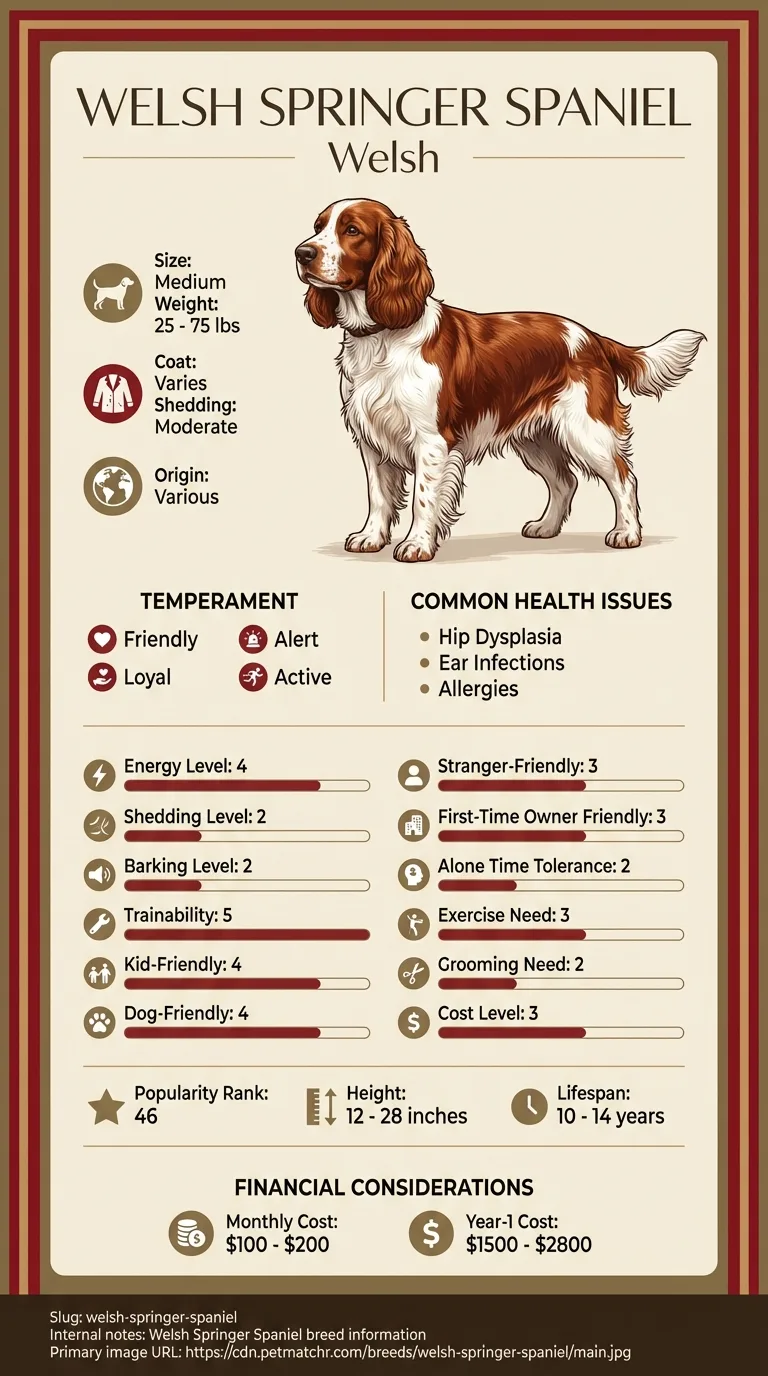
Owners of an energetic, athletic Welsh Springer Spaniel who've come across EIC while researching general canine exercise risks, especially after a scary post-exercise wobble or stumble, are the audience for this page.
This guide is not medical advice. If your dog shows pain, sudden behavior change, or worsening symptoms, consult a licensed veterinarian.
Some links may be affiliate links. We may earn a commission at no extra cost to you. We only suggest products we believe are helpful for dog owners.
Exercise-induced collapse is a well-characterized genetic condition caused by a mutation in the DNM1 gene, documented in Labrador Retrievers and related retriever-type lines such as Chesapeake Bay Retrievers, Curly-Coated Retrievers, and Boykin Spaniels. It has not been identified or established in Welsh Springer Spaniels, so a collapse after hard exercise in this breed warrants investigation into other, genuinely documented causes.
EIC itself is considered uncommon even within the retriever lines where it's genetically confirmed, and it has no documented prevalence in Welsh Springer Spaniels because the breed isn't known to carry the mutation. Collapse-like episodes in this breed are far more often traced to heat, conditioning, hip dysplasia, or epilepsy — all real, documented possibilities worth ruling out first.
The genetic mutation responsible for EIC has been mapped specifically within Labrador Retriever bloodlines and a small number of related retriever-type breeds that share genetic ancestry with Labradors. Welsh Springer Spaniels descend from an older, separate spaniel lineage, and no genetic studies have identified the DNM1 mutation, or the EIC phenotype it causes, in this breed.
Because the underlying mutation isn't present in this breed, there are no meaningful environmental triggers to discuss for EIC specifically. The environmental factors actually worth watching in a Welsh Springer Spaniel are heat and humidity during exercise, which can cause genuine heat stress, and hard or repetitive activity on a dog with early hip dysplasia, which can worsen joint discomfort over time.
See a vet the same day for any collapse involving loss of consciousness, stiff or paddling limbs, disorientation afterward, or a recovery time longer than a few minutes. Also schedule a visit for repeated milder episodes, ongoing stiffness after exercise, or any new reluctance to play or run.
A dramatic-sounding genetic condition documented in other breeds can send an owner down the wrong research path after a scary episode. Here's what to avoid.
See all Welsh Springer Spaniel health problems, which breeds are prone to exercise induced collapse eic, or the full Welsh Springer Spaniel breed guide for temperament, exercise needs and ownership costs.
Because EIC itself isn't a relevant diagnosis for this breed, there's no EIC-specific timeline to track. If a vet is instead evaluating for hip dysplasia or epilepsy after a collapse-like episode, expect an initial exam and bloodwork within days and, if warranted, X-rays or a neurology referral over the following weeks.
Success here looks like redirecting concern toward the breed's actually documented risks rather than a retriever-specific gene mutation. For most owners, that means a clear vet explanation of what really happened during the episode and a sensible exercise and monitoring plan going forward.
A Welsh Springer Spaniel that goes weak, wobbly, or briefly collapses after hard exercise needs same-day veterinary evaluation, regardless of whether EIC is a realistic cause. Heatstroke, an underlying heart abnormality, and a seizure event are all more relevant possibilities in this breed and can look similar in the first few minutes.
A dog that recovers within a few minutes, seems mildly tired, and returns to normal behavior shortly after is more likely dealing with simple over-exertion or mild heat stress. A dog that loses consciousness, has stiff or paddling limbs, seems disoriented afterward, or collapses repeatedly across different outings needs prompt workup for epilepsy or a cardiac cause.
Given that hip dysplasia is a genuinely documented risk in this breed, a vet will also want to rule out joint pain as a reason the dog is reluctant or unable to keep moving. None of this workup involves testing for EIC, since that diagnosis simply doesn't fit the breed's known genetics.

The DNM1 mutation behind EIC arose and has been tracked within Labrador Retriever breeding lines, and researchers have since found it in a handful of closely related retriever-type breeds that share ancestry with Labradors. Welsh Springer Spaniels come from a separate, older spaniel lineage with no documented crossover to those retriever lines, which is why the mutation hasn't turned up in genetic surveys of this breed.
That doesn't mean this breed's exercise capacity is risk-free, just that the risk comes from a different mechanism. Hip dysplasia, which is a real and documented concern here, affects joint mechanics rather than nerve signaling, so it produces stiffness or weight-shifting rather than the sudden hind-limb collapse seen in true EIC cases.
Hypothyroidism, also documented in this breed, can independently lower stamina and exercise tolerance through a slowed metabolism rather than any neuromuscular event. Understanding which mechanism is actually plausible in a Welsh Springer Spaniel points a vet toward the right tests much faster than starting from an EIC assumption.

Dana's four-year-old Welsh Springer Spaniel, Fenwick, went stiff-legged and wobbly in the back end after an unusually long round of fetch on a warm Asheville afternoon. A late-night search for "dog collapse after exercise" turned up page after page about exercise-induced collapse, and Dana spent a sleepless night convinced Fenwick carried the same DNM1 mutation seen in field-bred retrievers. The vet visit told a different story. Fenwick's temperature was elevated but not dangerously so, his gait returned to normal within twenty minutes of rest and water, and a physical exam turned up mild hip laxity consistent with early hip dysplasia rather than any neurological event. The vet's advice was straightforward: shorter, cooler exercise sessions, a weight check, and a hip radiograph down the line if stiffness continued. Dana's takeaway was that the actual documented risk for this breed's joints, not a retriever-specific gene, was the more useful thing to have researched from the start.
Key takeaway: A collapse after hard exercise in a Welsh Springer Spaniel is far more likely to trace back to heat, conditioning, or this breed's documented hip dysplasia risk than to a retriever-line genetic mutation that has never been identified in the breed.
EIC is an inherited condition caused by a mutation in the DNM1 gene that causes affected dogs to lose muscle control and sometimes collapse after five to fifteen minutes of intense, high-excitement exercise. It has been genetically characterized in Labrador Retrievers and is also documented in related retriever-type lines, including Chesapeake Bay Retrievers, Curly-Coated Retrievers, and Boykin Spaniels.
No. The DNM1 mutation and the EIC diagnosis built around it have not been identified or characterized in Welsh Springer Spaniels, which are a distinct spaniel line rather than a retriever line.
It's very unlikely to be EIC specifically, but any collapse during or after exercise is worth a prompt vet visit regardless of the label. Heat stress, poor conditioning, an underlying heart issue, or an epileptic event are all more plausible explanations to investigate in this breed.
It's worth ruling out, since epilepsy is one of this breed's actually documented health issues and seizures can sometimes be mistaken for a collapse if an owner doesn't see the full event. A vet can distinguish a seizure from simple exhaustion or overheating by asking about loss of consciousness, muscle rigidity, and recovery time.
Genetic testing labs typically only recommend the DNM1 test for breeds where the mutation is known to occur, and Welsh Springer Spaniel isn't one of them. Money is better spent on a general veterinary workup for whatever symptom actually prompted the concern.
Hip dysplasia is the most relevant one, since it can cause hind-end weakness, reluctance to continue exercising, or a stiff gait after exertion that can superficially resemble collapse. Hypothyroidism, also documented in this breed, can independently cause low exercise tolerance and sluggishness.
Stop the activity immediately, move the dog to shade or a cool area, offer water, and watch closely for how quickly they recover. Any collapse that involves loss of consciousness, doesn't resolve within a few minutes, or recurs should be seen by a vet the same day.
No — EIC's DNM1 mutation is documented in Labrador Retrievers and related retriever lines, not in Welsh Springer Spaniels.
Hip dysplasia and epilepsy, both genuinely documented in Welsh Springer Spaniels, can each produce symptoms that resemble a collapse.
Most healthy adults do well with sixty to ninety minutes of varied daily activity, built up gradually rather than in one intense burst.
Increase duration and intensity gradually over weeks, and always provide breaks and water during hot-weather activity.
A basic exam plus bloodwork usually runs $150 to $400, with hip X-rays or a neurology referral adding more if hip dysplasia or epilepsy is suspected.
A one-page prep sheet for this condition: the signs, the questions to ask, what to get priced. Unlocks here.
You get: Vet visit prep sheet
No spam. One-click unsubscribe. See our privacy policy.
Preview page 1 before you decide.