Health
What's the earliest sign of a luxating patella?
A brief skip or hop mid-stride, with the dog holding the leg up momentarily before resuming normal walking.

Quick answer
What's the earliest sign of a luxating patella?
A brief skip or hop mid-stride, with the dog holding the leg up momentarily before resuming normal walking.
It's not a limp at first — it's a skip so brief you might convince yourself you imagined it.
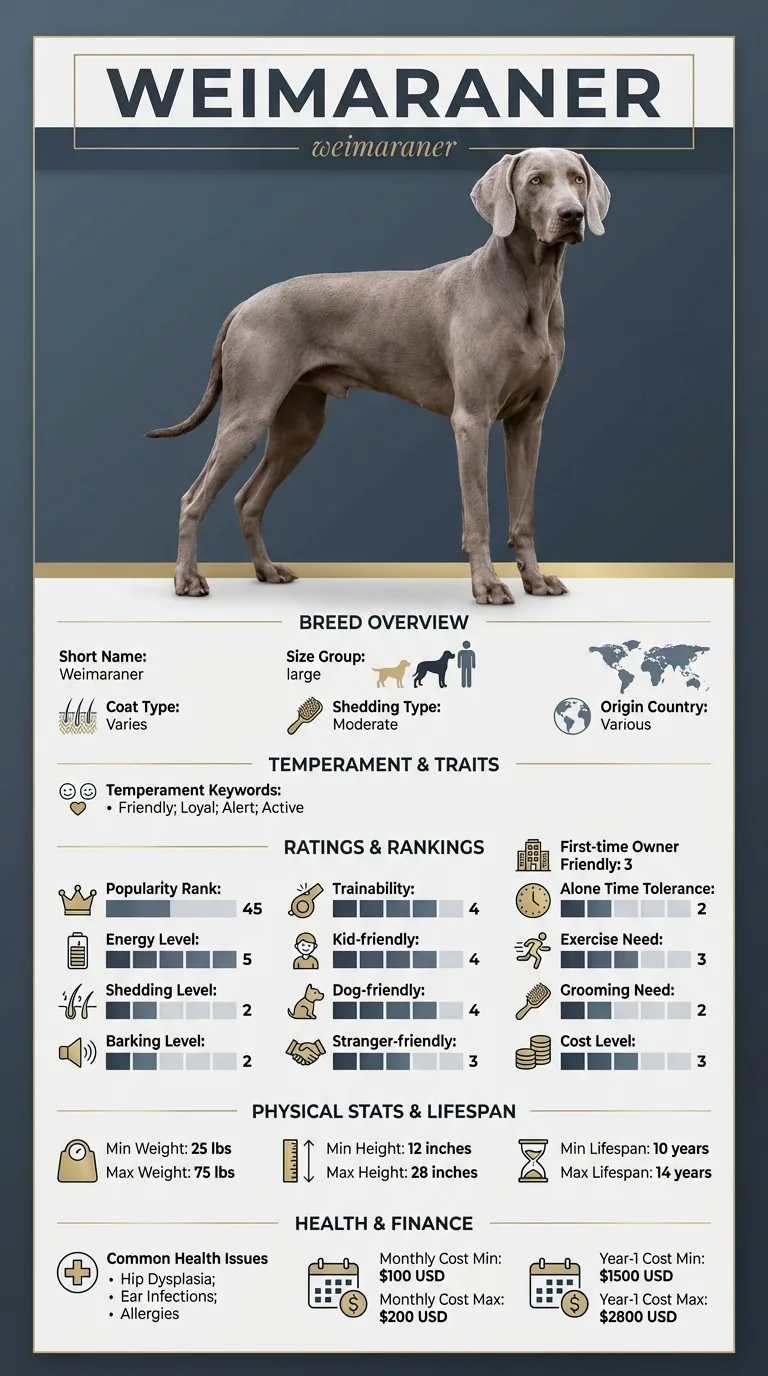
This can affect Weimaraners of any age, though it's often first noticed in younger, more active dogs whose owners are paying close attention to gait during exercise.
This guide is not medical advice. If your dog shows pain, sudden behavior change, or worsening symptoms, consult a licensed veterinarian.
Some links may be affiliate links. We may earn a commission at no extra cost to you. We only suggest products we believe are helpful for dog owners.
We research and check what we publish, but we do not warrant that any figure, date, price, or statement is accurate, complete, or current, and we accept no liability for any loss, cost, injury, or other harm arising from the use of this site. Use it as one reference among several. You remain responsible for your own decisions and for your dog's care - confirm anything that matters with a licensed veterinarian or another qualified professional before you act on it. Full disclaimer.
A luxating patella is a kneecap that slips out of its normal groove and often pops back into place quickly, making early cases easy to mistake for a one-off stumble. Recognizing the repeating pattern, rather than dismissing individual episodes, is what actually leads to an earlier, more effective grading and management plan.
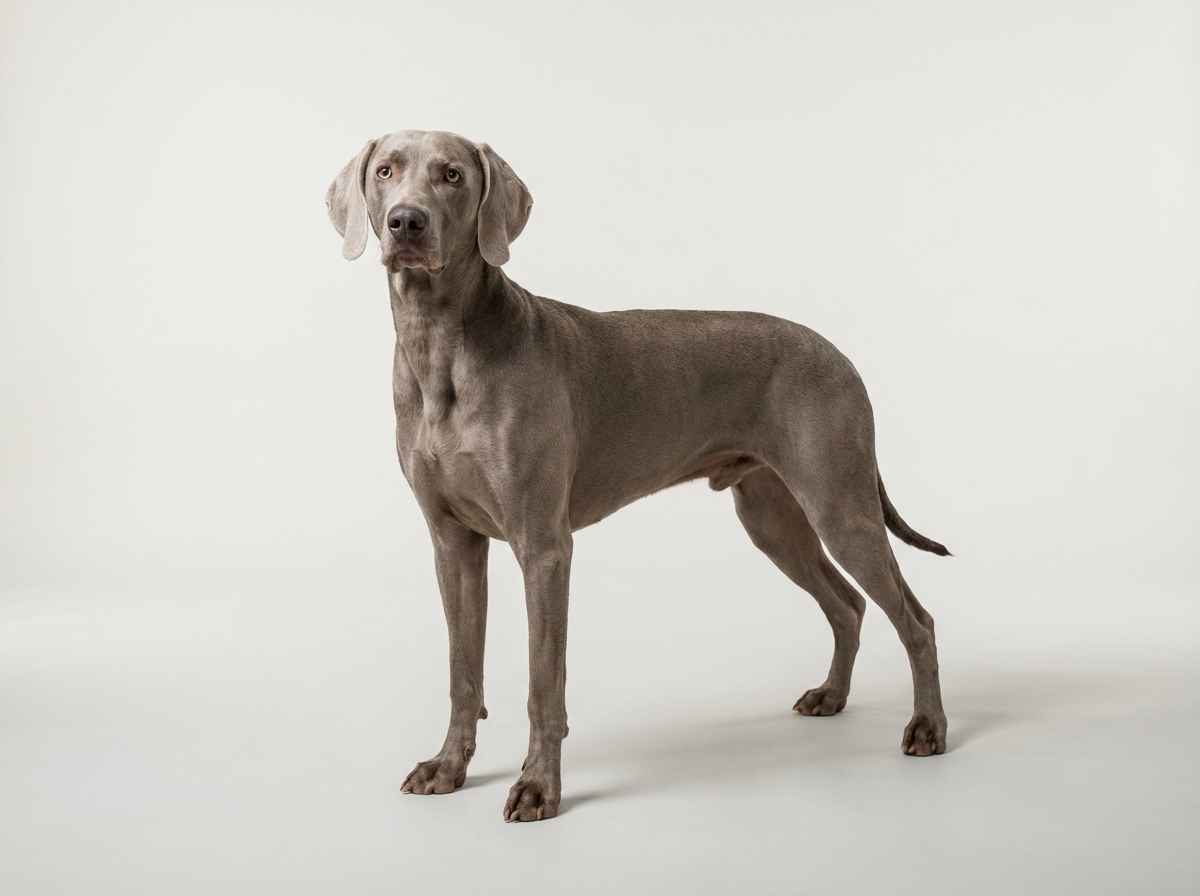
Luxating patellas occur across dog breeds of all sizes, and while it's more classically associated with smaller breeds, it's a recognized orthopedic finding in larger, active dogs as well, including Weimaraners, particularly in dogs with a structural predisposition.
As a large, high-energy breed that spends much of its life running, jumping, and making fast directional changes in the field, a Weimaraner's knee joints experience frequent lateral stress, which can reveal an underlying structural predisposition toward patellar instability more readily than in a lower-activity dog.
Excess body weight, repetitive high-impact activity, and hard surfaces during fast movement all add mechanical stress that can aggravate an existing structural predisposition toward patellar luxation.
Schedule an exam if you notice a repeating skip-and-recover pattern over several weeks, even if your dog seems otherwise unbothered. A leg held up consistently, visible pain, or sudden inability to bear weight warrants prompt veterinary attention rather than waiting.
See all Weimaraner health problems, which breeds are prone to luxating patellas, or the full Weimaraner breed guide for temperament, exercise needs and ownership costs.
Diagnosis and grading typically happen within a single vet visit through physical examination. Conservative management may take a few weeks to show its full effect on comfort; surgical recovery, if pursued, generally spans eight to twelve weeks.
Success looks like a stable, comfortable gait appropriate to the diagnosed grade — for many dogs, that means no progression beyond a mild, low-grade finding managed with weight control, while more affected dogs achieve stability through surgical correction and rehabilitation.
A luxating patella means the kneecap slips out of its normal groove, usually toward the inside of the leg, and then pops back in on its own. In mild cases, this happens briefly and infrequently — a single skip during a run, followed by completely normal movement. Because the dog often isn't in obvious pain and resumes normal walking within seconds, owners frequently dismiss it as a one-off stumble rather than recognizing a pattern.
The clue to watch for is repetition: does this same skip-and-recover happen again, maybe during turns, a fast start, or after resting and then getting up. A single occurrence might genuinely be nothing. A pattern that repeats over weeks is a joint issue worth having evaluated, even if the dog seems otherwise completely unbothered by it.
Vets grade luxating patellas on a scale of one to four based on severity. Grade one means the kneecap can be manually pushed out of place but pops back on its own and rarely causes symptoms. Grade two, the most common presentation matching that early skip pattern, means the kneecap slips out during normal activity but returns to place. Grades three and four involve progressively more persistent displacement, with grade four meaning the kneecap stays out of place most or all of the time.
The grade at diagnosis matters for the treatment conversation. Lower grades are often managed conservatively with weight control and activity modification, sometimes with no intervention needed beyond monitoring. Higher grades, or any grade that's progressing or causing lameness, are more likely to be discussed as surgical candidates, since the mechanical instability tends to worsen over time and contribute to arthritis if left unaddressed.

If you think your Weimaraner has luxating patellas, the plan is three steps: write down what you have seen and when it started, book a veterinary appointment rather than waiting for the next flare, and take video of the behaviour or symptom before you go — the thing you are worried about rarely happens in the consulting room. Screening in the parents covers bloat (gdv), hip dysplasia, hypertrophic osteodystrophy.
What the vet visit should produce is a diagnosis and a written plan, not just reassurance: what is being ruled out, what the monitoring interval is, and which signs mean you come back sooner. Ask what the treatment costs across a year rather than per visit, because that is the number that decides whether you are managing this condition or reacting to it.
Between appointments, keep a short log — dates, what you saw, what changed. It is the single most useful thing an owner brings to a follow-up, and for luxating patellas it is often what separates a clear pattern from a guess.
Nova's owner Vesper first noticed a quick hitch in her stride during a game of fetch, the kind of thing that resolved so fast she wondered if she'd imagined it. It happened again a few weeks later, then again after that, always the same pattern — a skip, a held-up back leg for a step, then normal walking. At Nova's next routine visit, Vesper finally mentioned it almost as an afterthought. Her vet identified a grade two luxating patella on exam. Given the mild grade and lack of persistent lameness, they opted for weight monitoring and activity adjustments rather than surgery, with a plan to recheck in six months and reconsider surgery if it progressed. Two years later, Nova's grade has stayed stable.
Key takeaway: A brief, repeating skip is worth mentioning even when it seems too minor to matter — catching the pattern early gives you and your vet more management options before it potentially progresses.
Often a brief skip or hop during a run or a fast turn, with the dog holding the leg up momentarily before walking normally again. It's easy to mistake for a one-off stumble, especially if it happens rarely.
Lower grades often cause minimal discomfort, especially if the kneecap returns to place quickly. Higher grades, or a joint developing arthritis from chronic instability, are more likely to cause noticeable pain or lameness.
On a one-to-four scale based on how easily and how often the kneecap dislocates and whether it returns to place on its own, with grade four being a kneecap that stays displaced most or all of the time.
No. Lower-grade cases are often managed conservatively with weight control and activity adjustments. Surgery is more commonly discussed for higher grades or for any case that's progressing or causing consistent lameness.
Yes, chronic joint instability can contribute to cartilage wear and arthritis over time, which is part of why a repeating pattern, even a mild one, is worth having evaluated rather than permanently ignored.
It has a hereditary component related to how the knee joint develops structurally, alongside individual anatomical variation, which is why some breeding programs screen for it even though it isn't the most universally tested trait.
Keep a simple mental or written note of when it happens and how often. A single occurrence may not need immediate action, but a repeating pattern over weeks is worth mentioning at your next vet visit.
A brief skip or hop mid-stride, with the dog holding the leg up momentarily before resuming normal walking.
Four grades, ranging from an occasional, self-correcting slip to a kneecap that stays displaced most of the time.
No, lower grades are often managed conservatively with weight control and activity adjustments rather than surgery.
Yes, chronic joint instability can contribute to cartilage wear over time, which is why a repeating pattern is worth evaluating.
Not necessarily — a single occurrence may be nothing, but a pattern that repeats over weeks warrants a vet visit.
A one-page prep sheet for this condition: the signs, the questions to ask, what to get priced. Unlocks here.
You get: Vet visit prep sheet
No spam. One-click unsubscribe. See our privacy policy.
See a sample page before you decide.
Early access list
The free prep sheet covers the same-day warning signs, a symptom log and the questions to ask. We are considering a fuller kit that adds a cost worksheet for the usual tests and treatments (US price ranges with their sources) and a plain-English guide to ways of covering the bill. It is not built yet; this list tells us whether it is worth building.
One email, no spam, unsubscribe anytime. Information only, not veterinary advice.