Health
What is MMVD?
A progressive degeneration of the mitral valve that causes it to leak blood backward with each heartbeat.

Quick answer
What is MMVD?
A progressive degeneration of the mitral valve that causes it to leak blood backward with each heartbeat.
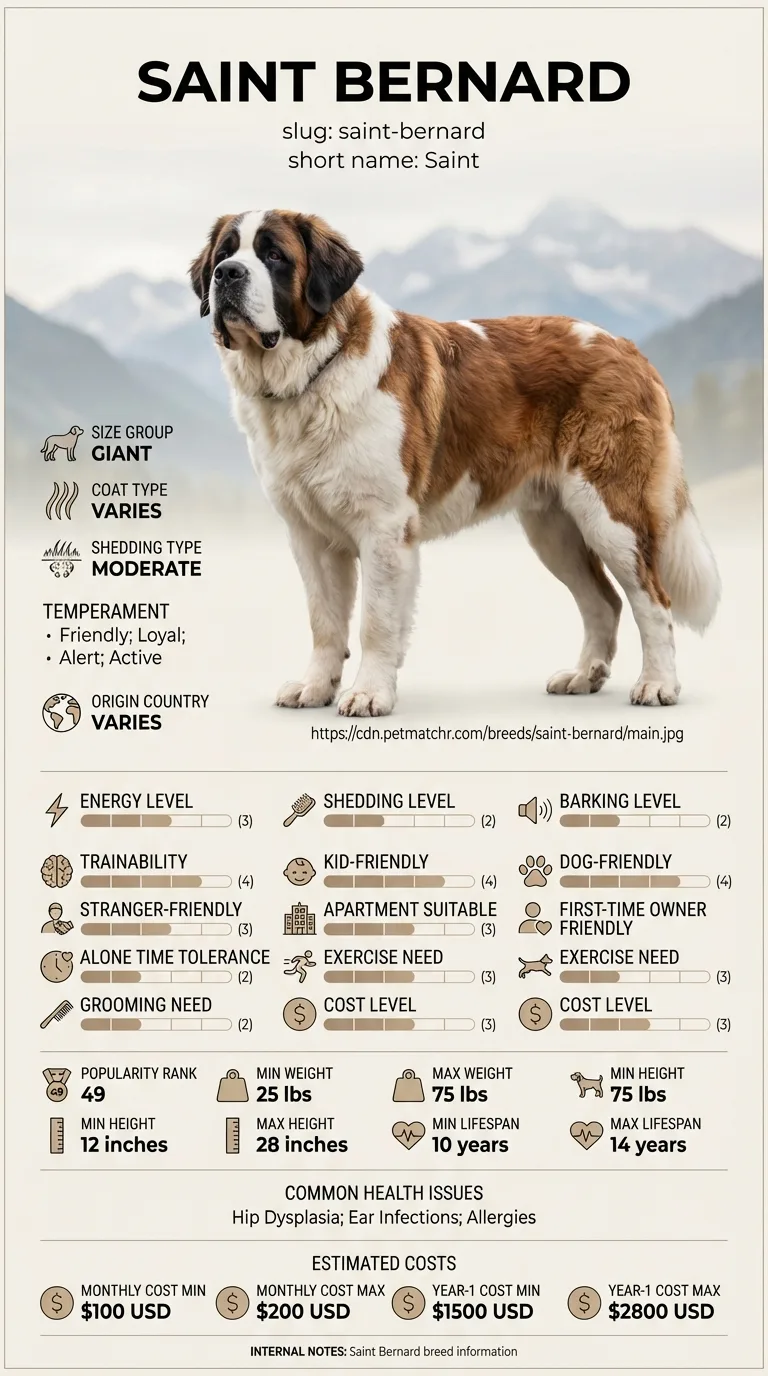
In a Saint Bernard, MMVD can occur, but dilated cardiomyopathy is the more consistently documented cardiac risk for this breed specifically, which makes it worth knowing how the two conditions differ rather than assuming a murmur automatically means one or the other.
This mostly comes up for owners comparing notes with friends who have small-breed dogs, or reading general cardiac information online, and trying to understand which condition actually applies to their own giant breed dog.
This guide is not medical advice. If your dog shows pain, sudden behavior change, or worsening symptoms, consult a licensed veterinarian.
Some links may be affiliate links. We may earn a commission at no extra cost to you. We only suggest products we believe are helpful for dog owners.
We research and check what we publish, but we do not warrant that any figure, date, price, or statement is accurate, complete, or current, and we accept no liability for any loss, cost, injury, or other harm arising from the use of this site. Use it as one reference among several. You remain responsible for your own decisions and for your dog's care - confirm anything that matters with a licensed veterinarian or another qualified professional before you act on it. Full disclaimer.
Check this first
Regardless of which specific cardiac condition is present, congestive heart failure is the shared emergency endpoint: labored breathing at rest, a persistent cough that worsens at night, a swollen abdomen, pale or bluish gums, or collapse all require immediate veterinary care. MMVD and dilated cardiomyopathy can both progress to this point, though through somewhat different mechanisms.
Earlier-stage MMVD, confirmed by echocardiogram to show mild valve leakage without significant heart enlargement, is generally lower urgency and may only need periodic monitoring. This is different from a case already showing chamber enlargement or reduced heart function, which typically needs more active management sooner.
The practical point for a Saint Bernard owner is that the specific diagnosis, MMVD, dilated cardiomyopathy, or both together, changes the expected progression and treatment plan, which is exactly why a cardiologist's imaging-based diagnosis matters more than assuming based on a murmur alone or on what's typical for small breeds.
If any of these apply, call your vet or an emergency clinic now. The rest of this page is for the cases that are not an emergency.
Myxomatous mitral valve disease is a progressive degeneration of the mitral valve leaflets that prevents the valve from sealing properly, letting blood leak backward with each heartbeat. It's one of the most extensively documented heart conditions in dogs generally, but it's classically a small and toy breed problem; in Saint Bernards, dilated cardiomyopathy is the more consistently documented cardiac risk, though MMVD can still occur and sometimes appears alongside other cardiac findings.
MMVD is far more frequently diagnosed in small and toy breeds than in giant breeds, making it a less typical, though still possible, finding in a Saint Bernard compared to dilated cardiomyopathy.
The strongest genetic associations with MMVD are documented in small and toy breeds, and while the exact reasons giant breeds are less frequently affected aren't fully understood, Saint Bernards more consistently show dilated cardiomyopathy as their primary documented cardiac risk, meaning any murmur found in this breed deserves imaging to determine which condition, or combination, is actually present.
General cardiovascular strain from excess body weight, high heat exposure, or reduced overall fitness can accelerate wear on any valve, including one already undergoing early degenerative changes, though these factors apply broadly across cardiac conditions rather than being specific triggers for MMVD alone.
Talk to your vet about any new murmur, reduced exercise tolerance, or coughing, and ask specifically whether echocardiogram findings point to valve disease, chamber enlargement, or both. Labored breathing at rest, blue-tinged gums, a distended abdomen, or collapse are emergencies requiring immediate care.
Confusing which cardiac condition is actually present leads to a few avoidable missteps.
See all Saint Bernard health problems, which breeds are prone to myxomatous mitral valve disease mmvd, or the full Saint Bernard breed guide for temperament, exercise needs and ownership costs.
MMVD, when present, is typically progressive over months to years, similar to dilated cardiomyopathy, and echocardiogram-based staging helps determine how frequently rechecks and medication adjustments are needed.
Success means stable or slowly progressing valve function on periodic rechecks, with medication and lifestyle adjustments keeping the dog comfortable, rather than a return to a fully normal valve, since the underlying degeneration doesn't reverse.
Grace's Saint Bernard, Apollo, had a murmur found at a senior wellness visit, and Grace initially assumed it was likely mitral valve disease based on what she'd read about heart murmurs in dogs generally. An echocardiogram told a more complete story: Apollo had mild mitral valve changes alongside early signs of dilated cardiomyopathy. His cardiologist explained that the combination changed the monitoring plan compared to either condition alone, and Apollo started on a treatment plan addressing both findings, with rechecks scheduled more frequently than either condition would need in isolation.
Key takeaway: The imaging revealed a combination Grace hadn't expected, which is exactly why getting an actual echocardiogram, rather than assuming based on general information about heart murmurs, mattered for Apollo's specific treatment plan.
It's a progressive degeneration of the mitral valve's leaflets, causing them to thicken and no longer close properly, which allows blood to leak backward into the left atrium with each heartbeat.
It's documented far more frequently in small and toy breeds, and it's less consistently associated with Saint Bernards than dilated cardiomyopathy, though it can still occur, sometimes alongside other cardiac findings.
MMVD is a problem with the valve itself failing to seal properly, while dilated cardiomyopathy is a weakening and enlarging of the heart muscle itself. Both can produce murmurs and eventually heart failure, but they progress differently and are managed somewhat differently.
An echocardiogram is the standard tool, showing the valve leaflets directly and measuring how much blood is leaking backward, which also helps distinguish it from chamber enlargement caused by cardiomyopathy.
It can't be cured, but medications can help manage symptoms and slow progression toward heart failure, and treatment is typically adjusted based on the stage of disease found on echocardiogram.
Prognosis depends more on disease severity and any co-occurring cardiac conditions than on breed size alone, though giant breeds carry additional cardiac risk factors, like a higher likelihood of concurrent cardiomyopathy, that a cardiologist will factor into the overall picture.
Similar to other cardiac conditions, initial echocardiogram diagnosis plus ongoing medication and periodic rechecks represent a recurring, moderate to significant lifetime cost.
A progressive degeneration of the mitral valve that causes it to leak blood backward with each heartbeat.
Not necessarily; dilated cardiomyopathy is more consistently documented in this specific breed, though MMVD can still occur.
An echocardiogram directly visualizes the valve and measures how much blood is leaking backward.
No, but medication can help manage symptoms and slow disease progression.
Yes, ongoing cardiac medication and monitoring represent a recurring, meaningful expense.
A one-page prep sheet for this condition: the signs, the questions to ask, what to get priced. Unlocks here.
You get: Vet visit prep sheet
No spam. One-click unsubscribe. See our privacy policy.
Preview page 1 before you decide.