Living
Better with new visitors?
The Saint Bernard, rated high (4/5) versus the Welsh Springer's moderate (3/5).

Quick answer
Better with new visitors?
The Saint Bernard, rated high (4/5) versus the Welsh Springer's moderate (3/5).
Saint Bernard or Welsh Springer Spaniel? On paper they differ most on exercise need, and on the scales Saint Bernard is the heavier at 120–180 lbs. Here is how the two compare on everything that shapes an ordinary week.
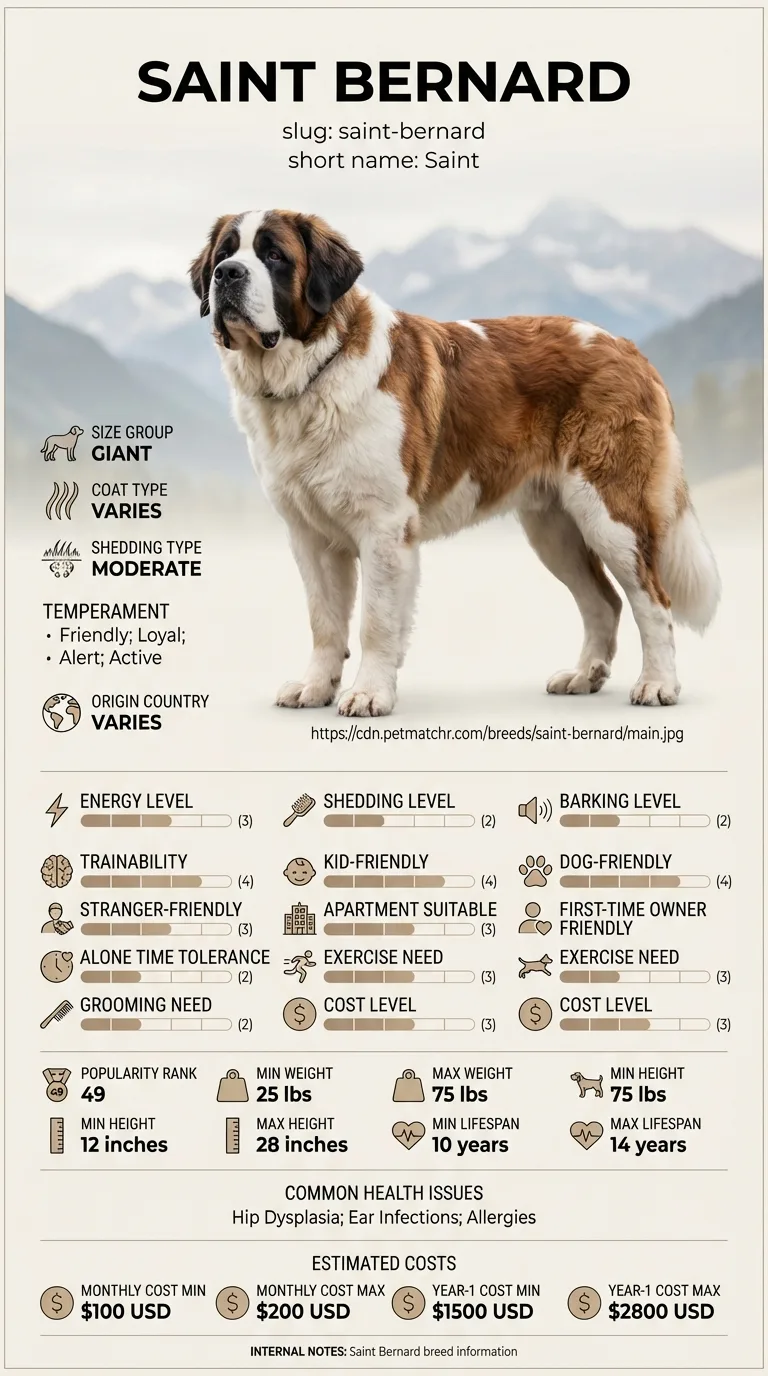
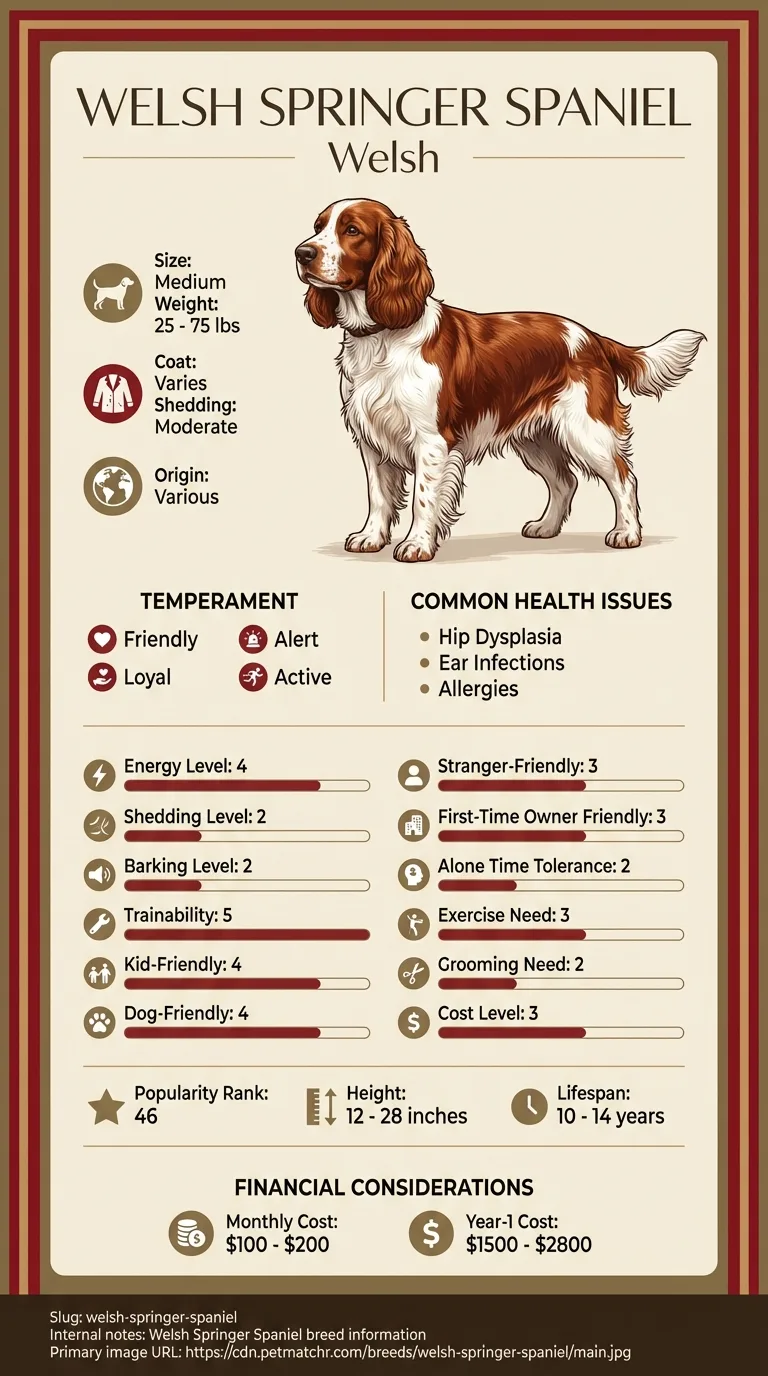
This is for someone already down to Saint Bernard and Welsh Springer Spaniel and deciding between them. For this pair the decision usually turns on exercise need and energy level, so those are covered first and in most detail. Anyone choosing from a flat has a clear answer here: Welsh Springer Spaniel rates 2/5 against 1/5. Breed history is left out; what follows is what you will actually live with.
Between Saint Bernard and Welsh Springer Spaniel, exercise need is what separates them, and Saint Bernard is the lower-effort dog of the two to keep.
Choose Saint Bernard if your walking routine is modest, the dog will be alone during the working day and there are young children at home.
Choose Welsh Springer Spaniel if shedding is a problem in your house, you want a dog that picks up training quickly and a smaller dog suits your car, your home or your back.
| Feature | saint bernard | welsh springer spaniel | Winner |
|---|---|---|---|
| Size class | giant | medium | Equal |
| Weight | 120–180 lbs | 35–55 lbs | Equal |
| Height | 26–30 in | 17–19 in | Equal |
| Lifespan | 8–10 years | 12–15 years | welsh springer spaniel |
| Exercise need | Low (2/5) | High (4/5) | saint bernard |
| Grooming need | Moderate (3/5) | Moderate (3/5) | Equal |
| Shedding | High (4/5) | Moderate (3/5) | welsh springer spaniel |
| Energy level | Low (2/5) | High (4/5) | Equal |
| Barking | Low (2/5) | Moderate (3/5) | saint bernard |
| Apartment suitability | Very low (1/5) | Low (2/5) | welsh springer spaniel |
| Good for first-time owners | Moderate (3/5) | Moderate (3/5) | Equal |
| Tolerates being alone | Moderate (3/5) | Low (2/5) | saint bernard |
| Trainability | Moderate (3/5) | High (4/5) | welsh springer spaniel |
| Good with kids | Very high (5/5) | High (4/5) | saint bernard |
| Good with other dogs | High (4/5) | High (4/5) | Equal |
| Friendly to strangers | High (4/5) | Moderate (3/5) | saint bernard |
| Cost level | Very high (5/5) | Moderate (3/5) | welsh springer spaniel |
| Coat | Short or long double coat | Medium, straight and water-resistant | Equal |
| Origin | Various | Various | Equal |
| Typical monthly cost | $150–$310 | $100–$200 | Equal |
| Typical first-year cost | $2,200–$4,200 | $1,400–$2,900 | Equal |
The Welsh Springer Spaniel's 35–55 lb, 17–19 inch build makes it a solidly medium dog, but the Saint Bernard's 120–180 lbs and 26–30 inches still dwarfs it by three to four times at the high end. Both breeds need adequate room, though the Welsh Springer's compact, sturdy frame — built for flushing game through brush — fits into more modest spaces than the Saint Bernard's bulk ever could. This comparison sits in the middle of this site's size-gap range: not as extreme as toy-versus-giant pairings, but still a meaningful difference in daily handling and equipment.
The Welsh Springer Spaniel rates high (4/5) for exercise need against the Saint Bernard's low (2/5), reflecting its sporting-dog roots and "Energetic" temperament tag. This isn't quite the extreme gap seen with some other Saint Bernard pairings, but it's still substantial — a Welsh Springer wants daily runs, retrieving games, or field time, while the Saint Bernard is satisfied with a short walk. Households drawn to the Saint Bernard's calm size should be honest that a Welsh Springer, despite its friendlier apartment-adjacent size, actually asks for more active daily engagement.
Grooming and shedding both rate moderate (3/5) for the Welsh Springer Spaniel, essentially matching the Saint Bernard's moderate (3/5) grooming need, though the Saint Bernard sheds more heavily at high (4/5). The Welsh Springer's medium, straight, water-resistant coat needs regular brushing and attention to its long ears, which are prone to matting and moisture retention. Neither breed is especially low-maintenance in the coat department, but the Welsh Springer's shedding is noticeably lighter than the Saint Bernard's, a real consideration for households trying to minimize fur around the house.
The Welsh Springer Spaniel rates low (2/5) for apartment suitability against the Saint Bernard's very low (1/5) — both breeds are better suited to houses with yard access, though the Welsh Springer edges out a slightly better fit for smaller spaces if its high exercise needs are met elsewhere. Barking rates moderate (3/5) for the Welsh Springer versus low (2/5) for the Saint Bernard. Alone-time tolerance favors the Saint Bernard, moderate (3/5) against the Welsh Springer's low (2/5), a breed whose "Loyal" and people-oriented nature means it prefers company over solitude.
Trainability rates high (4/5) for the Welsh Springer Spaniel against moderate (3/5) for the Saint Bernard, consistent with its sporting-breed heritage and eagerness to work with a handler. Both breeds rate moderate (3/5) for first-time owners, a rare even match on this metric. The Welsh Springer's "Reserved with strangers" temperament tag is worth noting for training purposes — early, consistent socialization matters more for this breed than its friendly-sounding sporting-dog reputation might suggest, especially compared to the more uniformly outgoing Saint Bernard.
The Saint Bernard edges ahead with kids, very high (5/5) against the Welsh Springer's high (4/5), while both breeds match at high (4/5) with other dogs. Strangers are where the difference is clearest: the Saint Bernard rates high (4/5) friendly to strangers, while the Welsh Springer rates only moderate (3/5) — a gap that lines up directly with its "Reserved with strangers" temperament tag. Households that entertain often or have unpredictable visitor traffic may find the Saint Bernard the more relaxed host, while the Welsh Springer may need more time to warm up to new faces.
The Welsh Springer Spaniel's 12–15 year lifespan comfortably exceeds the Saint Bernard's 8–10 years, and its health list is notably shorter too: Hip Dysplasia, Ear Infections, Epilepsy, Glaucoma, and Hypothyroidism, versus the Saint Bernard's Hip Dysplasia, Elbow Dysplasia, Dilated Cardiomyopathy, Entropion, and Bloat (GDV). The shared Hip Dysplasia risk is worth screening for in either breed, but the Welsh Springer's list skews toward manageable, monitorable conditions like ear infections and hypothyroidism rather than the acute emergency risk of bloat that shadows Saint Bernard ownership.
Cost level rates very high (5/5) for the Saint Bernard against moderate (3/5) for the Welsh Springer Spaniel, with monthly costs of $150–310 versus $100–200 and first-year costs of $2,200–4,200 versus $1,400–2,900. As with most pairings on this page, food volume tied to the Saint Bernard's much greater weight is the primary driver. The Welsh Springer's moderate grooming needs and long, floppy ears do call for regular ear-cleaning attention to prevent infections, a smaller but real recurring cost worth factoring in.
Saint Bernard weighs 120–180 lbs and lives 8–10 years; Welsh Springer Spaniel weighs 35–55 lbs and lives 12–15 years. The two diverge most on exercise need, energy level and cost level. They are level on good with other dogs, good for first-time owners and grooming need, so those cannot decide it. The comparison marks an easier option only where one exists. Facts like weight and country of origin are not scored. Both dogs are rated from the same dataset, which is what makes the numbers comparable with each other even though any individual dog sits somewhere inside its breed's range.

Not especially — it's tagged 'Reserved with strangers' and rates only moderate (3/5) for stranger-friendliness, compared to the Saint Bernard's high (4/5).
The Welsh Springer Spaniel, rated high (4/5) versus the Saint Bernard's low (2/5), reflecting its sporting-dog background.
The Welsh Springer Spaniel, at 12–15 years versus the Saint Bernard's 8–10.
The Welsh Springer Spaniel, rated moderate (3/5) versus the Saint Bernard's high (4/5).
The Welsh Springer Spaniel, rated high (4/5) versus the Saint Bernard's moderate (3/5).
Yes, though the Saint Bernard rates slightly higher — very high (5/5) versus the Welsh Springer's high (4/5).
The Welsh Springer Spaniel, at $100–200 monthly and $1,400–2,900 first-year, both well under the Saint Bernard's figures.
The Saint Bernard, rated high (4/5) versus the Welsh Springer's moderate (3/5).
The Welsh Springer Spaniel, rated high (4/5) versus the Saint Bernard's low (2/5).
The Welsh Springer Spaniel, with a shorter health list and a longer 12–15 year lifespan.
The Welsh Springer Spaniel, on both monthly and first-year cost.
Secure checkout on Stripe. We never see your card.
7-day money-back guarantee. Instant access.
Health information here is general and is not veterinary advice. If your dog shows pain, sudden behaviour change, or worsening symptoms, consult a licensed veterinarian.
Some links on this site are affiliate links. We may earn a commission at no extra cost to you, and we only suggest products we believe are helpful for dog owners.
We research and check what we publish, but we do not warrant that any figure, date, price, or statement is accurate, complete, or current, and we accept no liability for any loss, cost, injury, or other harm arising from the use of this site. Use it as one reference among several. You remain responsible for your own decisions and for your dog's care - confirm anything that matters with a licensed veterinarian or another qualified professional before you act on it. Full disclaimer.
Match your lifestyle to the right dog.
Take quizNot sure which breed is right for you? Take our 2-minute quiz to find out.
Take the quiz