Living
Which should you choose overall?
The Shepherd suits an active owner with space to burn energy; the Saint Bernard suits a calmer household that wants a big, gentle presence without the exercise demands.

Quick answer
Which should you choose overall?
The Shepherd suits an active owner with space to burn energy; the Saint Bernard suits a calmer household that wants a big, gentle presence without the exercise demands.
German Shepherd or Saint Bernard? On paper they differ most on exercise need, and on the scales Saint Bernard is the heavier at 120–180 lbs. Here is how the two compare on everything that shapes an ordinary week.
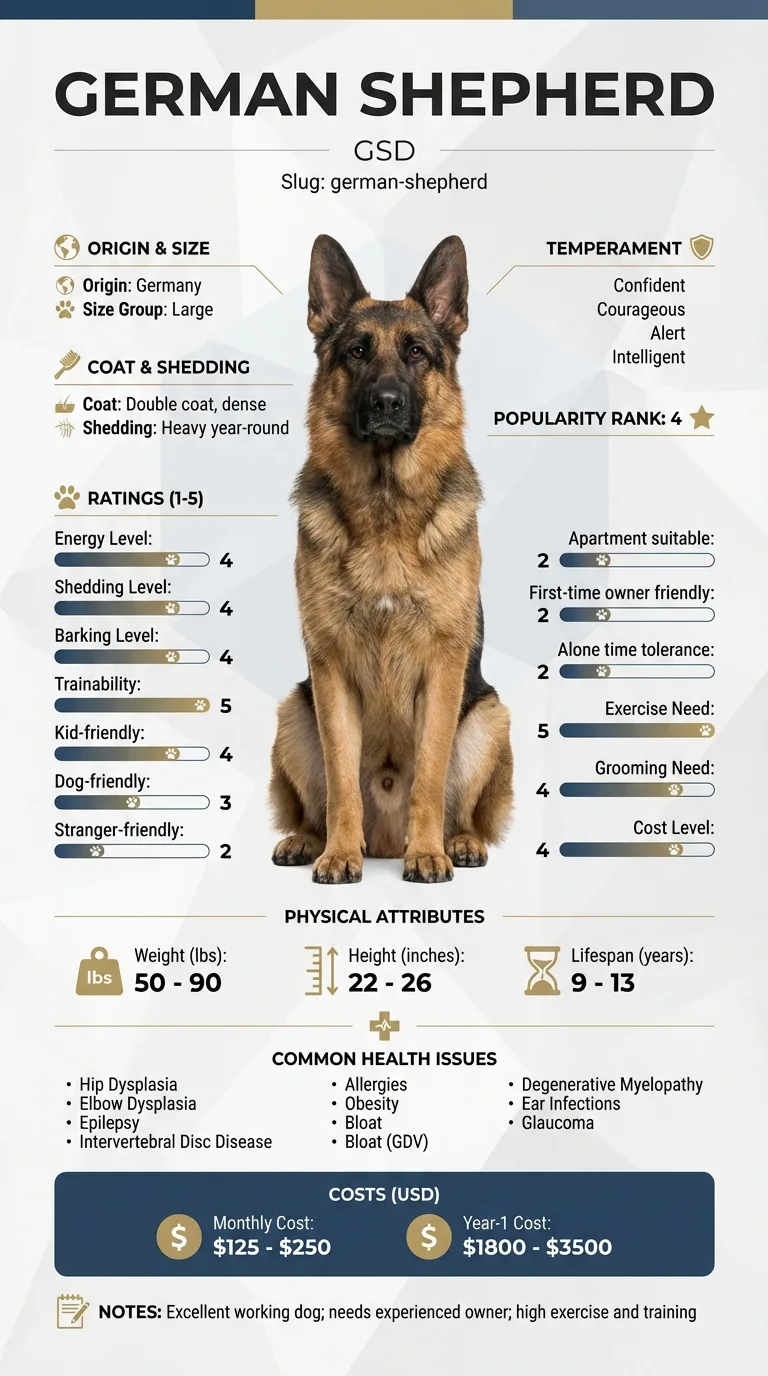
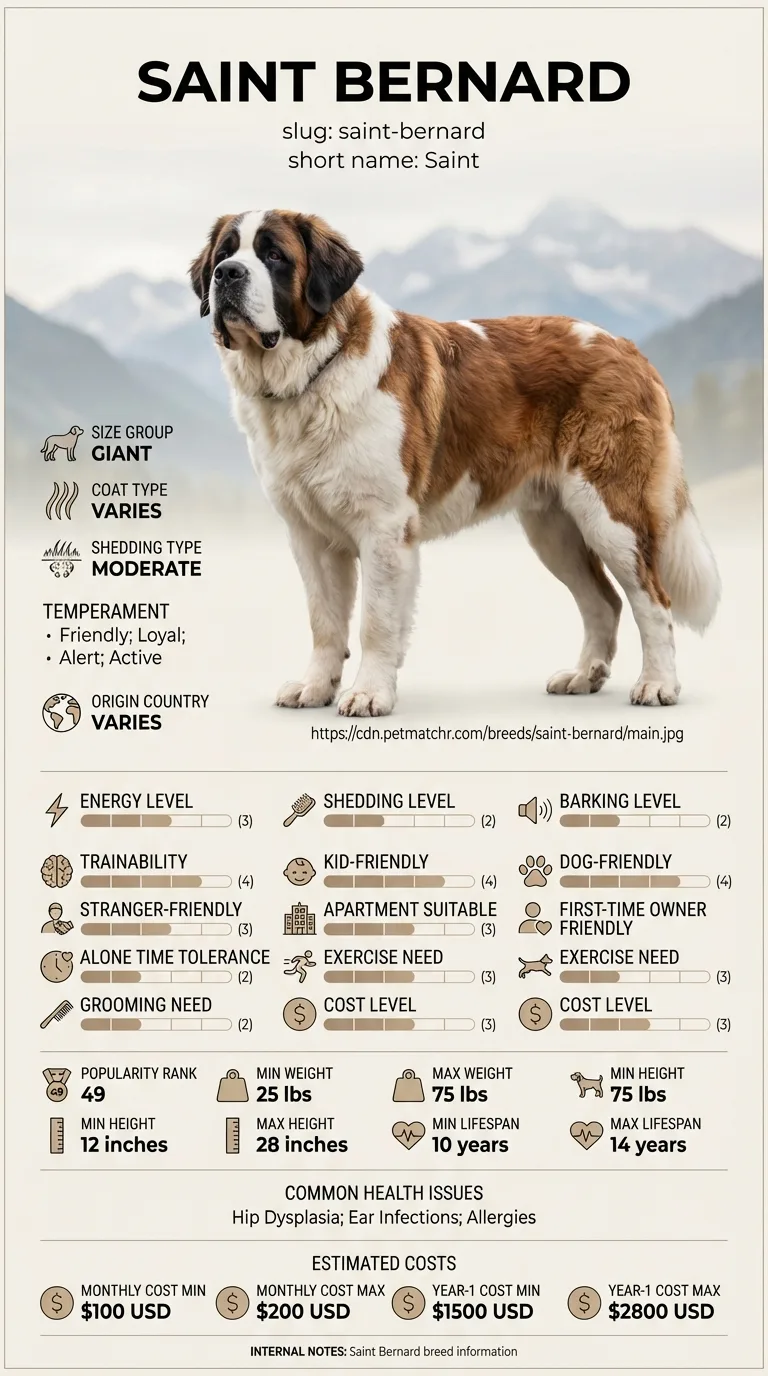
This is for someone already down to German Shepherd and Saint Bernard and deciding between them. For this pair the decision usually turns on exercise need and energy level, so those are covered first and in most detail. Anyone choosing from a flat has a clear answer here: German Shepherd rates 2/5 against 1/5. There is no origin story here — only what changes about your week.
Between German Shepherd and Saint Bernard, exercise need is what separates them, and Saint Bernard is the lower-effort dog of the two to keep.
Choose German Shepherd if you want a dog that picks up training quickly, a smaller dog suits your car, your home or your back and you want a dog that can keep up with an active routine.
Choose Saint Bernard if this is your first dog, you do not want a standing grooming appointment and your walking routine is modest.
| Feature | german shepherd | saint bernard | Winner |
|---|---|---|---|
| Size class | large | giant | Equal |
| Weight | 50–90 lbs | 120–180 lbs | Equal |
| Height | 22–26 in | 26–30 in | Equal |
| Lifespan | 9–13 years | 8–10 years | german shepherd |
| Exercise need | Very high (5/5) | Low (2/5) | saint bernard |
| Grooming need | High (4/5) | Moderate (3/5) | saint bernard |
| Shedding | High (4/5) | High (4/5) | Equal |
| Energy level | High (4/5) | Low (2/5) | Equal |
| Barking | High (4/5) | Low (2/5) | saint bernard |
| Apartment suitability | Low (2/5) | Very low (1/5) | german shepherd |
| Good for first-time owners | Low (2/5) | Moderate (3/5) | saint bernard |
| Tolerates being alone | Low (2/5) | Moderate (3/5) | saint bernard |
| Trainability | Very high (5/5) | Moderate (3/5) | german shepherd |
| Good with kids | High (4/5) | Very high (5/5) | saint bernard |
| Good with other dogs | Moderate (3/5) | High (4/5) | saint bernard |
| Friendly to strangers | Low (2/5) | High (4/5) | saint bernard |
| Cost level | High (4/5) | Very high (5/5) | german shepherd |
| Coat | Double coat, dense | Short or long double coat | Equal |
| Origin | Germany | Various | Equal |
| Typical monthly cost | $125–$250 | $150–$310 | Equal |
| Typical first-year cost | $1,800–$3,500 | $2,200–$4,200 | Equal |
This is a genuine size mismatch. The Shepherd tops out around 90 pounds and 26 inches; the Saint Bernard starts near there and climbs to 180 pounds and 30 inches, squarely in giant-breed territory. A large Saint Bernard can outweigh a large Shepherd by nearly 100 pounds, which changes everything from furniture space to the strength needed to manage the dog on a leash.
The exercise gap here is about as wide as the numbers go: the Shepherd rates a 5 out of 5, the Saint Bernard a 2. That's not a small difference - the Shepherd wants serious daily work, while the Saint Bernard is content with modest activity and can overheat easily given its size and coat. Anyone expecting a giant dog to match a Shepherd's drive will be surprised.
Both dogs shed heavily, tied at 4 out of 5, but grooming effort differs. The Shepherd's dense double coat rates a 4; the Saint Bernard, despite being the bigger shedder in absolute hair volume, rates a 3 for grooming need since its coat - short or long - is less prone to matting. Either way, expect regular vacuuming.
Neither dog suits apartment living, but the Saint Bernard is worse, a 1 out of 5 against the Shepherd's 2 - size alone rules out most small spaces. Barking favors the Saint Bernard, a 2 versus the Shepherd's 4, and it also tolerates being alone slightly better, a 3 compared to a 2. Space, not noise, is the bigger obstacle with the Saint Bernard.
The Shepherd is rated a 5 out of 5 for trainability, the Saint Bernard a 3, a real gap that shows up in how quickly each dog picks up commands. For first-time owners, though, the Saint Bernard actually scores better, a 3 versus the Shepherd's 2 - its slower, more even temperament can be more forgiving of a less experienced handler, even if it doesn't learn as fast.
The Saint Bernard rates higher with kids (5 versus 4), with other dogs (4 versus 3), and with strangers (4 versus 2) - across the board, it's the more socially easygoing of the two. The Shepherd's higher wariness of strangers reflects its guarding instincts, useful for some households but not what you want if you're expecting a dog that greets every visitor warmly.
The Shepherd lives longer, 9 to 13 years against the Saint Bernard's 8 to 10, a difference worth weighing given how attached you'll get. Both breeds risk hip dysplasia, elbow dysplasia, and bloat - three overlapping conditions tied to their size and depth of chest. The Saint Bernard adds dilated cardiomyopathy and entropion to its list, both worth asking a breeder or vet about directly.
The Saint Bernard is the pricier of the two, rated 5 out of 5 for cost against the Shepherd's 4, and the dollar figures confirm it: $150 to $310 a month versus $125 to $250, and a first-year total that can run past $4,200. Food alone for a 150-plus pound dog adds up fast, before vet bills for a giant breed's higher anesthesia and medication doses.
German Shepherd weighs 50–90 lbs and lives 9–13 years; Saint Bernard weighs 120–180 lbs and lives 8–10 years. The two diverge most on exercise need, energy level and barking and 2 other rated axes. Almost every rated axis separates them at least slightly. Where the table declares a winner it means less work for the owner, nothing more; descriptive rows are left as ties on purpose. The value here is in the differences between the two columns; treat any single score as approximate.

Yes - a Saint Bernard can weigh up to 180 pounds against a Shepherd's ceiling of 90, and stands several inches taller at the shoulder. It's a genuine giant breed, not just a large one.
The Saint Bernard, by far - a 2 out of 5 against the Shepherd's 5. It's a much lower-energy dog day to day.
The Saint Bernard, rated 4 out of 5 versus the Shepherd's 2. It's generally an easygoing, welcoming breed rather than a watchful one.
No, the opposite - it costs more, both in its 5-out-of-5 cost rating and in dollar terms, roughly $150 to $310 a month against the Shepherd's $125 to $250.
Yes, hip dysplasia, elbow dysplasia, and bloat all appear on both lists, reflecting risks common to large, deep-chested dogs.
The Shepherd, 9 to 13 years against the Saint Bernard's 8 to 10 - giant breeds typically have shorter lifespans, and this pair follows that pattern.
Slightly - it rates a 3 out of 5 against the Shepherd's 2, thanks to its calmer, more patient temperament, even though it's harder to train.
The Shepherd suits an active owner with space to burn energy; the Saint Bernard suits a calmer household that wants a big, gentle presence without the exercise demands.
The Saint Bernard costs more: $150-$310 a month against the Shepherd's $125-$250, driven largely by its size.
Hugely different - the Shepherd rates a 5 out of 5 on exercise need, the Saint Bernard just a 2. This is one of the widest gaps in the comparison.
The Shepherd lives longer on average, 9 to 13 years versus 8 to 10 for the Saint Bernard, typical of the gap between large and giant breeds.
Secure checkout on Stripe. We never see your card.
7-day money-back guarantee. Instant access.

Health information here is general and is not veterinary advice. If your dog shows pain, sudden behaviour change, or worsening symptoms, consult a licensed veterinarian.
Some links on this site are affiliate links. We may earn a commission at no extra cost to you, and we only suggest products we believe are helpful for dog owners.
We research and check what we publish, but we do not warrant that any figure, date, price, or statement is accurate, complete, or current, and we accept no liability for any loss, cost, injury, or other harm arising from the use of this site. Use it as one reference among several. You remain responsible for your own decisions and for your dog's care - confirm anything that matters with a licensed veterinarian or another qualified professional before you act on it. Full disclaimer.
Match your lifestyle to the right dog.
Take quizNot sure which breed is right for you? Take our 2-minute quiz to find out.
Take the quiz