Behavior
Is barking typical for this breed?
No, Pugs generally rank low for barking tendency compared to many small breeds.

Quick answer
Is barking typical for this breed?
No, Pugs generally rank low for barking tendency compared to many small breeds.
A breed that isn't known for barking a lot gives you a useful baseline; when that baseline shifts, it's worth asking why.
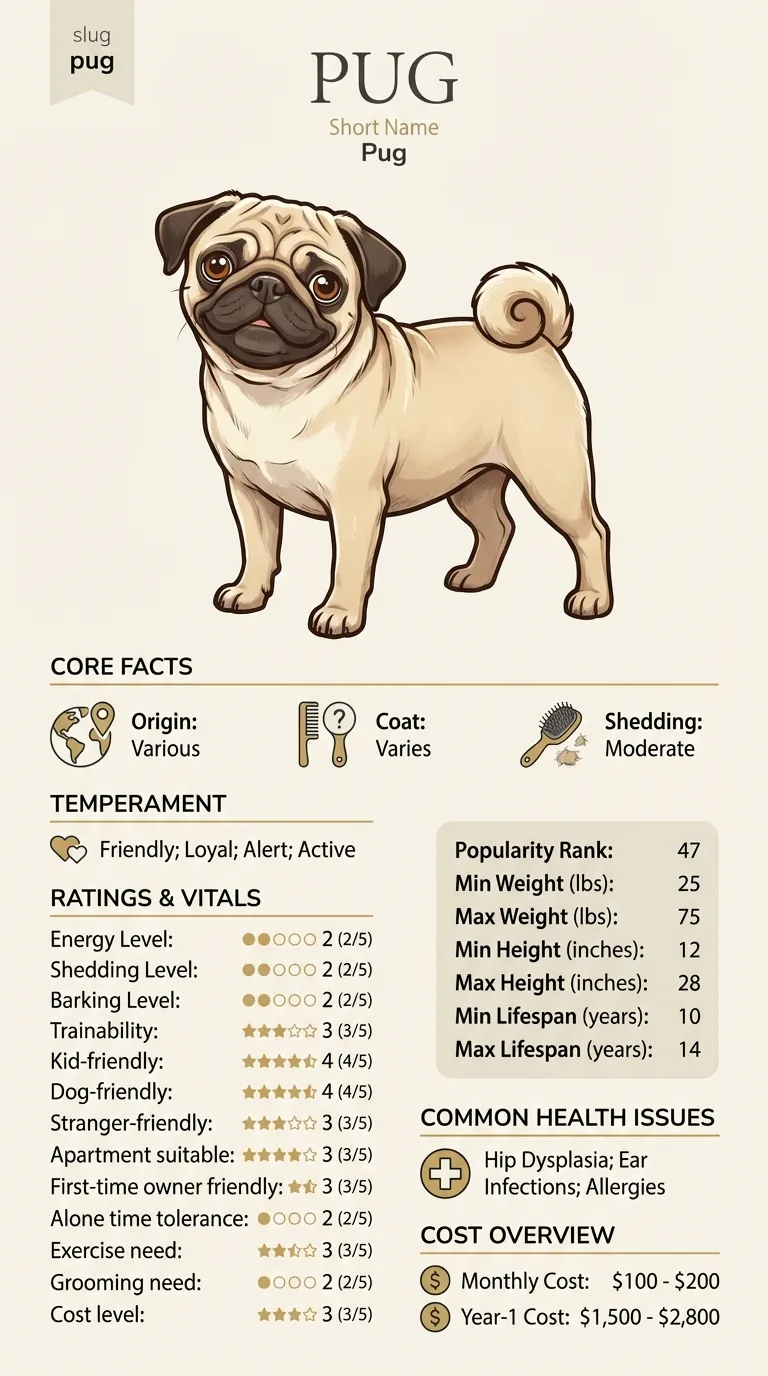
This is relevant for owners whose Pug has developed a barking habit that feels disproportionate to what's typical for the breed, whether that's constant demand barking at home or a newer pattern in an aging dog.
This guide is not medical advice. If your dog shows pain, sudden behavior change, or worsening symptoms, consult a licensed veterinarian.
Some links may be affiliate links. We may earn a commission at no extra cost to you. We only suggest products we believe are helpful for dog owners.
Excessive barking is notable in this breed precisely because Pugs aren't typically a highly vocal breed, making a persistent or new barking pattern a useful signal that something specific, attention-seeking, boredom, anxiety, or occasionally a medical change, is driving it rather than simply individual temperament.
Excessive barking isn't a defining trait of this breed, which is exactly what makes it worth investigating as a specific, addressable behavior pattern rather than accepting it as an unavoidable part of Pug ownership.
This breed's temperament generally trends toward a lower baseline barking tendency, which means persistent barking more often reflects an individual, addressable situation than a strong breed-wide vocal instinct working against training efforts.
A lack of consistent mental stimulation, inadvertent reinforcement of barking through owner attention, and stressful or unpredictable routines are the environmental factors most commonly behind excessive barking in this breed.
A trainer experienced in positive reinforcement can help identify the specific driver behind persistent barking and build a consistent plan, particularly useful if attention-seeking or boredom-driven patterns haven't improved with basic consistency alone.
Talk to your vet if new barking develops in an older dog with no prior history, especially if it happens at night, seems tied to apparent confusion, or comes with other behavior changes, since this can point to a sensory or cognitive cause worth ruling out before assuming it's purely behavioral.
Start here: Pug Most Common Genetic Disorders: What to Screen For
See all PUG health problems, which breeds are prone to excessive barking, or the full PUG breed guide for temperament, exercise needs and ownership costs.
Attention-seeking barking often briefly worsens before improving over two to four weeks of consistent non-response paired with rewarded quiet behavior. Boredom-driven barking typically improves within a couple of weeks of adding consistent enrichment.
Success means barking returning to this breed's typically lower baseline level, not complete silence, since some barking at genuine triggers, like a knock at the door, remains normal and appropriate.
Because this breed isn't defined by a strong instinct to bark the way some breeds are, persistent barking in a Pug is more likely to reflect a specific, addressable cause than simply an unusually vocal individual of an already-vocal breed. Attention-seeking barking, often unintentionally reinforced when an owner responds, even negatively, to every bark, is one of the most common patterns. Boredom-driven barking shows up in dogs without enough mental stimulation, notable in a breed with fairly low exercise needs that can still get understimulated if enrichment isn't intentional. Anxiety-driven barking, often tied to separation or specific triggers, is a third common pattern, each requiring a different response.
In a senior Pug who wasn't previously a big barker, a new pattern of vocalizing, especially at night, when seemingly nothing is happening, or paired with apparent confusion, can point toward vision or hearing decline making the world feel less predictable, or in some cases toward cognitive changes associated with aging. This is a meaningfully different situation from a young dog's attention-seeking barking and calls for a vet visit to rule out a sensory or cognitive cause before assuming it's a purely behavioral issue to train away.

Otis, previously a quiet Pug, developed a habit of barking whenever his owner sat down to work from home, which she initially addressed by picking him up to soothe him each time. A trainer pointed out that this response, meant to calm him, was actually reinforcing the exact behavior she wanted to reduce. Switching to ignoring the barking entirely and instead rewarding Otis when he settled quietly nearby led to noticeably less barking within about three weeks, though the first few days were, as predicted, louder before they got quieter.
Key takeaway: Because this breed isn't naturally prone to a lot of barking, a sudden habit often traces back to an identifiable pattern, like unintentional reinforcement, that responds well to a consistent, deliberate change in response.
No, this breed typically ranks on the lower end for barking tendency compared to many other small breeds, which is part of why persistent or new excessive barking is worth investigating rather than dismissed as normal for the breed.
Attention-seeking barking that's been inadvertently reinforced by an owner responding to it, even with a scolding, is one of the most common patterns, alongside boredom from insufficient mental stimulation.
Consistently not responding to the barking itself while rewarding calm, quiet behavior is the standard approach, though it often gets briefly worse before it improves as the dog tests whether the old pattern still works.
In an older dog with no prior barking history, new vocalizing, especially at night or paired with apparent confusion, can point to vision or hearing decline or cognitive changes, and is worth a vet visit rather than assuming it's purely behavioral.
Yes, a breed with fairly low exercise needs can still become understimulated without intentional mental enrichment, and barking is one common outlet for that pent-up energy and boredom.
These don't address the underlying cause of the barking and can add stress without resolving the actual trigger; addressing the root cause, attention, boredom, anxiety, or a medical issue, tends to be more effective long-term.
If barking is severe, seems anxiety-driven, or hasn't improved despite consistent efforts to address the likely cause, a trainer experienced in behavior modification or a vet behaviorist referral can help identify what's actually driving it.
No, Pugs generally rank low for barking tendency compared to many small breeds.
Attention-seeking that's been unintentionally reinforced, or boredom from insufficient stimulation.
Yes, new barking in a senior dog can point to sensory decline or cognitive changes and warrants a vet check.
Yes, consistently not responding to attention-seeking barking while rewarding quiet behavior is the standard approach.
They don't address the root cause and are generally less effective than identifying and addressing the actual trigger.
Behaviour changes often start with pain. The prep sheet for this page covers what to rule out, and what to ask.
You get: Vet visit prep sheet
No spam. One-click unsubscribe. See our privacy policy.
Preview page 1 before you decide.