Living
Which is the bigger dog?
The Newfoundland, up to 150 pounds versus the Boston's 25-pound maximum.

Quick answer
Which is the bigger dog?
The Newfoundland, up to 150 pounds versus the Boston's 25-pound maximum.
Boston Terrier or Newfoundland? On paper they differ most on apartment suitability, and on the scales Newfoundland is the heavier at 100–150 lbs. Here is how the two compare on everything that shapes an ordinary week.
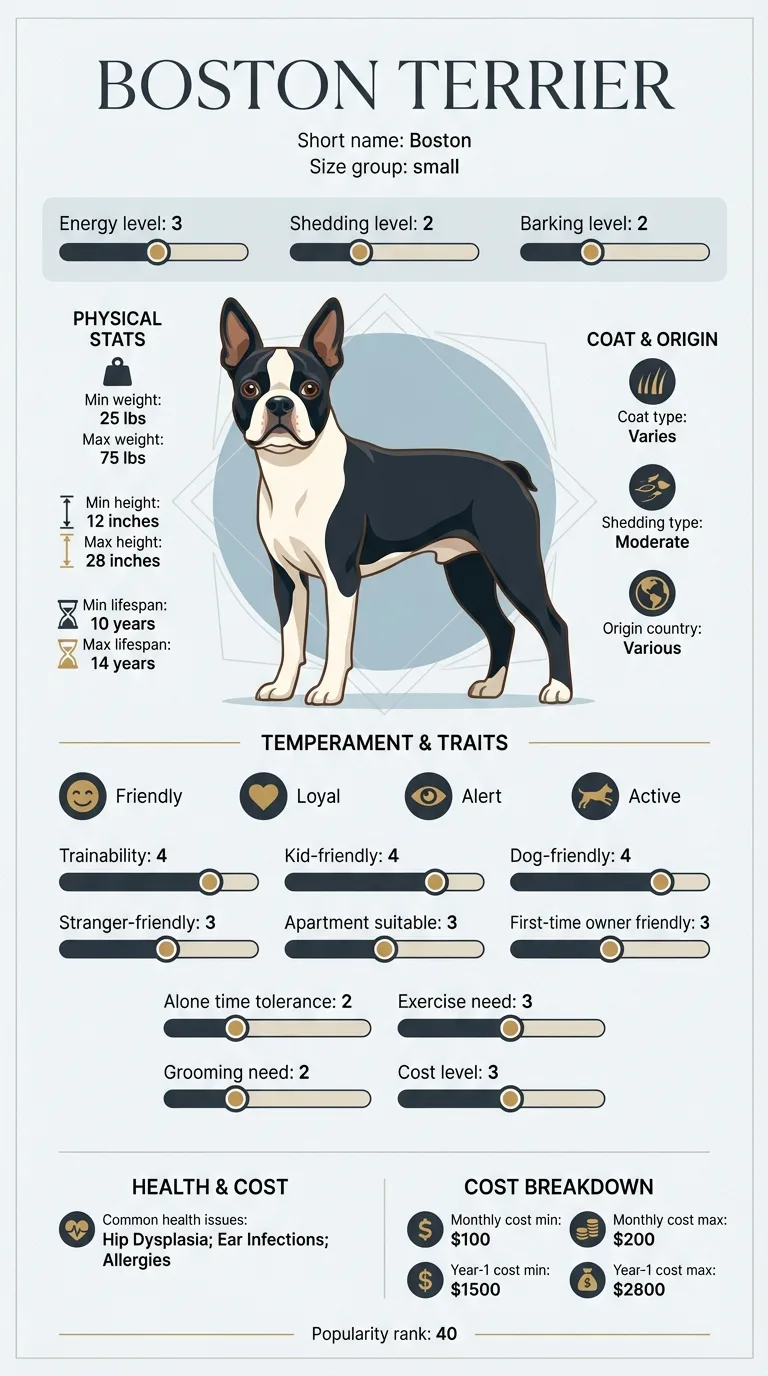
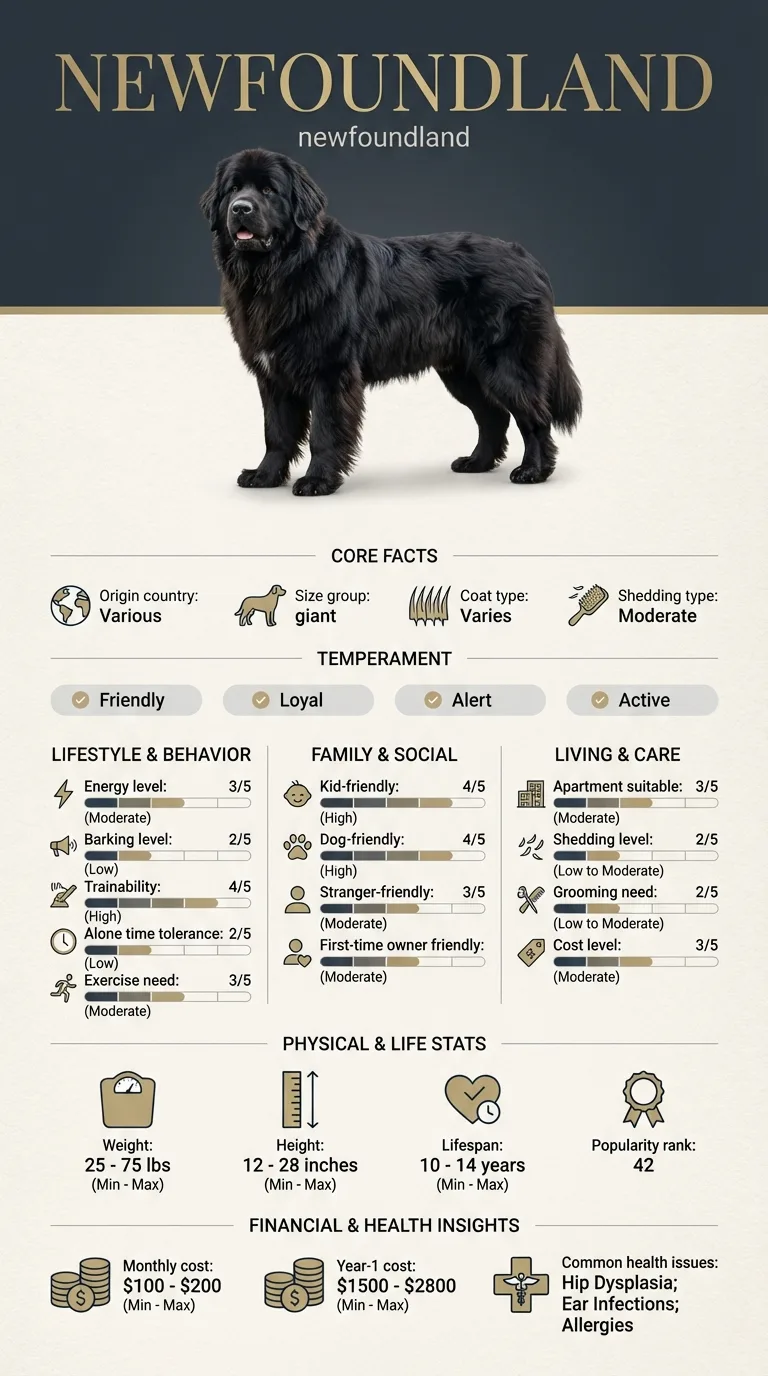
This is for someone already down to Boston Terrier and Newfoundland and deciding between them. For this pair the decision usually turns on apartment suitability and grooming need, so those are covered first and in most detail. Anyone choosing from a flat has a clear answer here: Boston Terrier rates 5/5 against 1/5. There is no origin story here — only what changes about your week.
Between Boston Terrier and Newfoundland, apartment suitability is what separates them, and Boston Terrier is the lower-effort dog of the two to keep.
Choose Boston Terrier if you are in a flat or a smaller home, this is your first dog and you do not want a standing grooming appointment.
Choose Newfoundland if you want a dog that can keep up with an active routine.
| Feature | boston terrier | newfoundland | Winner |
|---|---|---|---|
| Size class | small | giant | Equal |
| Weight | 12–25 lbs | 100–150 lbs | Equal |
| Height | 15–17 in | 26–28 in | Equal |
| Lifespan | 11–13 years | 9–10 years | boston terrier |
| Exercise need | Low (2/5) | Moderate (3/5) | boston terrier |
| Grooming need | Very low (1/5) | High (4/5) | boston terrier |
| Shedding | Low (2/5) | Very high (5/5) | boston terrier |
| Energy level | Moderate (3/5) | Low (2/5) | Equal |
| Barking | Low (2/5) | Low (2/5) | Equal |
| Apartment suitability | Very high (5/5) | Very low (1/5) | boston terrier |
| Good for first-time owners | Very high (5/5) | Moderate (3/5) | boston terrier |
| Tolerates being alone | Moderate (3/5) | Moderate (3/5) | Equal |
| Trainability | High (4/5) | High (4/5) | Equal |
| Good with kids | Very high (5/5) | Very high (5/5) | Equal |
| Good with other dogs | High (4/5) | High (4/5) | Equal |
| Friendly to strangers | High (4/5) | High (4/5) | Equal |
| Cost level | Moderate (3/5) | Very high (5/5) | boston terrier |
| Coat | Short and smooth | Heavy water-resistant double coat | Equal |
| Origin | Various | Various | Equal |
| Typical monthly cost | $80–$150 | $150–$310 | Equal |
| Typical first-year cost | $1,100–$2,300 | $2,200–$4,200 | Equal |
A Newfoundland can weigh up to 150 pounds -- six times the Boston Terrier's 25-pound ceiling -- and stands 26 to 28 inches tall against the Boston's 15 to 17. This is a giant working breed built originally for cold-water rescue, with a heavy bone structure and a massive head, set against a small, compact companion breed. The size gap alone reshapes nearly every practical consideration that follows, from what vehicle can transport the dog to how much floor space it occupies at rest. A Newfoundland's sheer physical presence in a home is something photos rarely convey accurately until an owner has one lying across a doorway.
The Newfoundland rates Moderate (3/5) for exercise need against the Boston's Low (2/5), a modest gap given the size difference, and actually rates lower on overall energy, Low (2/5) against the Boston's Moderate (3/5) -- Newfoundlands are known for a calm, easygoing temperament despite their working heritage. A daily walk plus occasional swimming, a favorite activity for this water-loving breed, generally covers a Newfoundland's needs well. The Boston needs even less. Neither breed will run an owner ragged, which makes this one of the more forgiving comparisons on this list for anyone who isn't especially active themselves but still wants a dog with real presence in the household.
This is where the Newfoundland's size becomes a real daily commitment: High (4/5) grooming need and Very High (5/5) shedding, the highest shedding score in this comparison, against the Boston's Very Low (1/5) grooming and Low (2/5) shedding. A Newfoundland's heavy, water-resistant double coat drops fur constantly and mats without regular brushing, and its size means there's simply more coat to manage than on almost any other breed. The Boston's short, smooth coat takes minutes to maintain. Anyone drawn to the Newfoundland's famously gentle nature should go in clear-eyed about the vacuuming and brushing routine that comes with it -- this isn't a breed where coat care can be an afterthought.
The Boston rates Very High (5/5) for apartment suitability against the Newfoundland's Very Low (1/5), the widest gap of any category in this comparison, driven entirely by the Newfoundland's giant size rather than temperament -- both breeds actually tie at Low (2/5) for barking, since Newfoundlands are famously quiet, gentle dogs. Both also tie at Moderate (3/5) for tolerating time alone. A Newfoundland simply needs more physical space to lie down, turn around, and move through a home than most apartments offer, regardless of how well-behaved or quiet the dog is. This is a breed that genuinely needs a house, ideally with some outdoor space, not a temperament issue that training can solve.
The Boston rates Very High (5/5) for first-time owners against the Newfoundland's Moderate (3/5), though trainability itself ties at High (4/5) -- Newfoundlands are intelligent, willing dogs, true to their Devoted temperament. The gap for novices is about handling a giant breed's size responsibly, not intelligence: leash manners, jumping, and basic impulse control carry more physical weight and consequence in a 100-plus-pound dog than in a small one. A first-time owner who's done real research and committed to early, consistent training can absolutely succeed with a Newfoundland. Someone wanting the lowest-friction first-dog experience will still find the Boston's smaller scale more forgiving of the inevitable early mistakes.
This pair ties across the board -- Very High (5/5) with kids, High (4/5) with other dogs, High (4/5) with strangers -- and the temperament lists back it up: the Newfoundland is Sweet, Patient, and Devoted, traits that have earned it a reputation as one of the most naturally gentle giant breeds around children, sometimes called a "nanny dog." The Boston's Friendly and Comical nature makes it just as suited to family life at a fraction of the size. The real household consideration isn't sociability, which both breeds deliver, but physical scale: a Newfoundland's size means supervising toddler interactions for accidental knock-overs, not temperament concerns.
The Boston Terrier's 11-to-13-year lifespan comfortably outpaces the Newfoundland's 9-to-10, one of the shortest lifespans in this entire dataset, typical for a true giant breed carrying that much body weight for a decade. The Newfoundland's five-item health list includes Subaortic Stenosis and Dilated Cardiomyopathy, both serious heart conditions, plus Hip Dysplasia and Bloat (GDV), risks tied directly to its large, deep-chested frame. The Boston's five conditions instead center on Brachycephalic Airway Syndrome and eye issues like Cataracts and Corneal Ulcers, tied to its flat face. Both lists are equally short in count but point to very different daily vigilance -- cardiac monitoring for the Newfoundland, airway and heat awareness for the Boston.
Keeping a Newfoundland costs substantially more -- $150 to $310 monthly and $2,200 to $4,200 in the first year, against the Boston's $80-$150 and $1,100-$2,300 -- reflected in its Very High (5/5) cost level against the Boston's Moderate (3/5). Food alone for a 100-to-150-pound dog runs many times a Boston's grocery bill, and giant-breed medications, larger-capacity gear, and higher-volume grooming supplies all add up. The Newfoundland's heart-related health conditions can also mean more frequent cardiac screening as a preventive measure, an added recurring cost. A Boston owner's expenses scale down proportionally at every category -- food, medicine, equipment -- making it the meaningfully cheaper dog to keep over a lifetime.
Boston Terrier weighs 12–25 lbs and lives 11–13 years; Newfoundland weighs 100–150 lbs and lives 9–10 years. The two diverge most on apartment suitability, grooming need and shedding and 2 other rated axes. They are level on tolerates being alone, barking and good with other dogs, so those cannot decide it. Where the table declares a winner it means less work for the owner, nothing more; descriptive rows are left as ties on purpose. The value here is in the differences between the two columns; treat any single score as approximate.

A Newfoundland can weigh 100 to 150 pounds, roughly six times the Boston Terrier's 12-to-25-pound range.
No -- they rate Very Low (1/5) for apartment suitability against the Boston Terrier's Very High (5/5), simply due to needing more physical space.
No -- they tie with the Boston Terrier at Low (2/5) for barking, a notably quiet breed for its size.
The Newfoundland, rated Very High (5/5), the highest shedding score of any breed in this comparison, against the Boston's Low (2/5).
The Boston Terrier, 11 to 13 years, against the Newfoundland's 9 to 10 -- typical for a true giant breed.
Yes, exceptionally -- they tie the Boston Terrier at Very High (5/5) and their Sweet, Patient, Devoted temperament has earned them a reputation as natural family dogs.
Subaortic Stenosis and Dilated Cardiomyopathy, both cardiac conditions, alongside Hip Dysplasia and Bloat (GDV) common to large, deep-chested breeds.
The Newfoundland, up to 150 pounds versus the Boston's 25-pound maximum.
The Newfoundland, Very High (5/5) versus the Boston's Low (2/5).
They tie -- both rate Low (2/5) for barking.
The Boston Terrier, 11-13 years versus the Newfoundland's 9-10.
Secure checkout on Stripe. We never see your card.
7-day money-back guarantee. Instant access.

Health information here is general and is not veterinary advice. If your dog shows pain, sudden behaviour change, or worsening symptoms, consult a licensed veterinarian.
Some links on this site are affiliate links. We may earn a commission at no extra cost to you, and we only suggest products we believe are helpful for dog owners.
We research and check what we publish, but we do not warrant that any figure, date, price, or statement is accurate, complete, or current, and we accept no liability for any loss, cost, injury, or other harm arising from the use of this site. Use it as one reference among several. You remain responsible for your own decisions and for your dog's care - confirm anything that matters with a licensed veterinarian or another qualified professional before you act on it. Full disclaimer.
Match your lifestyle to the right dog.
Take quizNot sure which breed is right for you? Take our 2-minute quiz to find out.
Take the quiz