Health
What is the earliest sign of arthritis in a Newfoundland?
A change in how the dog gets up, not how far they walk. Front-end-first rising with a pause before the back end follows is often the first thing owners notice in hindsight.

Quick answer
What is the earliest sign of arthritis in a Newfoundland?
A change in how the dog gets up, not how far they walk. Front-end-first rising with a pause before the back end follows is often the first thing owners notice in hindsight.
A nine-year-old Newfoundland is an old dog. With a lifespan of nine to ten years, arthritis in this breed is not a distant problem for later; for many dogs it is the defining condition of the second half of life.
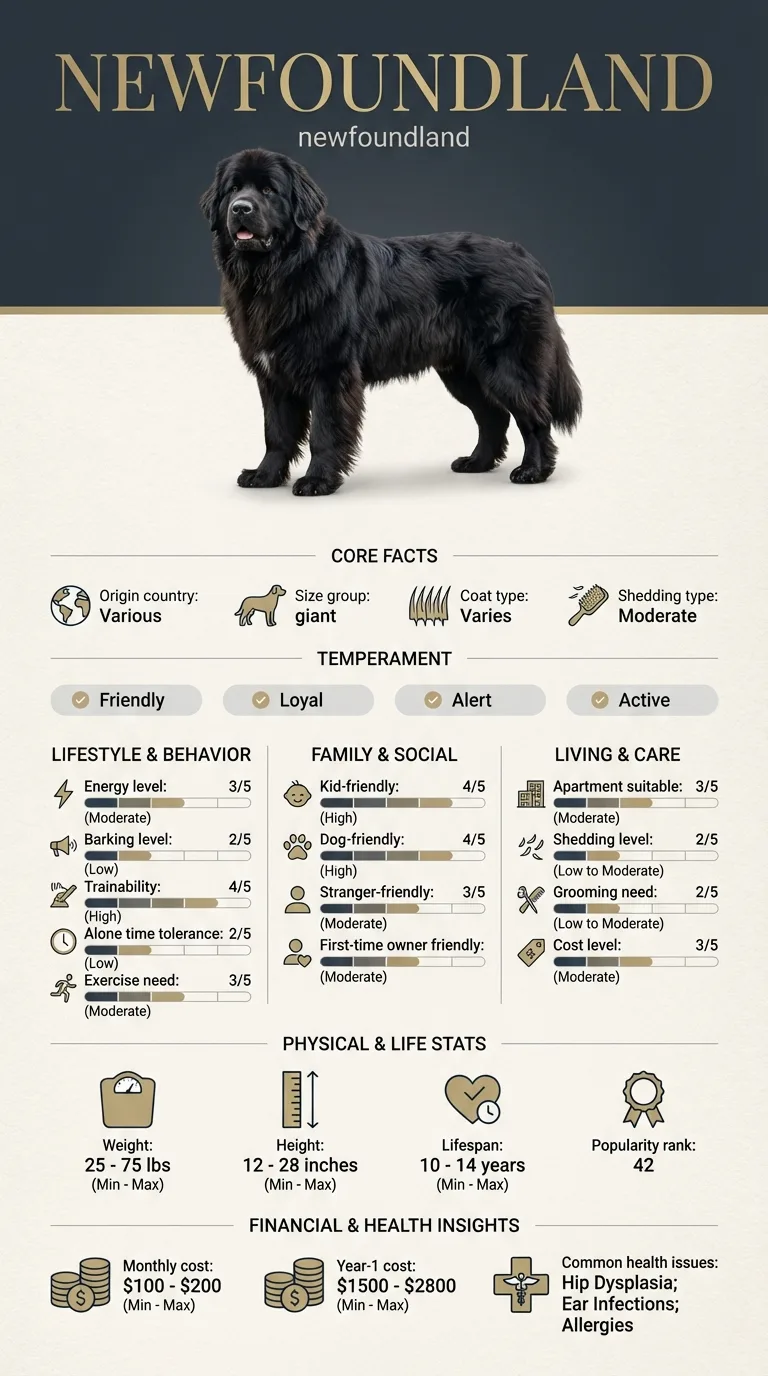
For owners who have noticed their dog now takes a run-up at the stairs, sits down halfway through a walk, or has started sleeping on the cool tile instead of the sofa they used to heave themselves onto.
This guide is not medical advice. If your dog shows pain, sudden behavior change, or worsening symptoms, consult a licensed veterinarian.
Some links may be affiliate links. We may earn a commission at no extra cost to you. We only suggest products we believe are helpful for dog owners.
We research and check what we publish, but we do not warrant that any figure, date, price, or statement is accurate, complete, or current, and we accept no liability for any loss, cost, injury, or other harm arising from the use of this site. Use it as one reference among several. You remain responsible for your own decisions and for your dog's care - confirm anything that matters with a licensed veterinarian or another qualified professional before you act on it. Full disclaimer.
Arthritis in a Newfoundland is a slow loss of joint comfort that usually begins in the hips and elbows and spreads its effects into the whole dog: muscle wastage over the hindquarters, reluctance to move, weight gain from reduced activity, and then more joint load from the weight. It is progressive and it is not curable. It is, however, one of the most controllable conditions in the breed, because the largest levers, body weight, flooring and exercise type, are entirely in the owner's hands.
Degenerative joint disease is extremely common in large and giant breeds, and hip dysplasia sits at the top of the Newfoundland's list of documented health issues. Precise breed prevalence figures for arthritis are not established, but any veterinarian working with giant breeds will tell you that the question is usually when rather than whether, particularly in dogs who reach eight or nine.
Mass and conformation do most of the damage. A dog standing 26 to 28 inches at the shoulder and weighing up to 150 pounds transmits enormous force through each joint with every step, and hip dysplasia, in which the hip socket and femoral head do not fit congruently, concentrates that force onto a small area of cartilage. The joint responds by wearing, inflaming and remodelling. A short lifespan of nine to ten years also means the breed reaches geriatric joint status while owners still think of the dog as middle-aged. The calm, low-energy temperament then hides the early pain.
The home does more harm than the walk. Laminate, tile and polished wood give a heavy dog no grip, and each slip creates a jolt through already-sore joints plus a lasting reluctance to move. Sofas and cars that the dog jumps into and out of deliver repeated impact loading. Cold, damp sleeping areas stiffen joints overnight. And the commonest environmental factor of all is a feeding routine built for a growing dog that never got reduced when the dog stopped growing and slowed down.
Book an assessment as soon as you notice stiffness after rest, difficulty rising, reluctance on stairs, or a change in what your dog volunteers to do; do not wait for a limp. Ask for a pain management plan rather than accepting that the dog is just old. Seek same-day care for a sudden non-weight-bearing lameness on one hind leg, which in a heavy dog often means a ruptured cruciate ligament, for any dog who cannot stand at all, for sudden weakness or dragging of both hind legs, or for a hot, swollen, exquisitely painful joint. Sudden severe pain is a different problem from arthritis and should never be treated as a bad arthritis day.
See all Newfoundland health problems, which breeds are prone to arthritis, or the full Newfoundland breed guide for temperament, exercise needs and ownership costs.
Owners who fix the flooring and start a proper weight reduction plan usually see a visible difference within four to eight weeks, and weight loss on a giant breed should be slow and steady rather than dramatic. A veterinary pain plan often changes comfort within days. What will not happen at any point is reversal: arthritis is managed for the rest of the dog's life, and the plan is revisited every few months as the disease progresses.
Success is a dog who rises without a struggle, chooses to walk to the end of the road again, sleeps through the night without repeatedly repositioning, and keeps the muscle over the hindquarters that arthritis otherwise strips away. It is measured in what the dog volunteers to do, not in how the joints look on a radiograph, because radiographs generally continue to worsen even when the dog is doing well.
The Newfoundland temperament is described as sweet, patient, devoted and calm, and the energy level is low by nature. That combination is a diagnostic problem. A stoic, unenergetic dog who lies down more is very easily read as a dog who is simply getting on a bit.
The signs that actually mean something are changes in how the dog transitions between positions rather than how much they move. Watch the rise from lying down: an arthritic Newfoundland pushes up with the front end first, pauses, and then hauls the back end after it. Watch the sit: a dog with sore hips or stifles rolls onto one hip instead of sitting square. Watch the first thirty seconds of a walk after a long rest, because stiffness that eases as the dog warms up is one of the most reliable indicators there is.
Then look at what your dog has stopped choosing. Refusing a jump into the car they used to make, abandoning a favourite chair, hesitating at the top of stairs rather than the bottom, or licking repeatedly at one specific joint are all decisions, and decisions are more honest than limping. A great many Newfoundlands never limp visibly until the disease is well advanced, because the pain is symmetrical and there is no good leg to favour.

Most arthritic dogs are stuck between two bad options: exercise that hurts and rest that stiffens. The Newfoundland has a third option built into the breed.
This is a working water dog. Swimming removes almost all weight from the joints while still working the muscles that stabilise them, which is precisely what an arthritic hip or stifle needs. It also suits a breed with a modest exercise requirement, because a Newfoundland is not asking for hours of running. Fifteen minutes of easy swimming several times a week does more for a stiff giant breed than an hour of pavement walking, and this is one of the few dogs who will genuinely volunteer for it.
There are conditions. Cold open water and a heavily arthritic dog are a poor combination, and a dog with known cardiac disease needs veterinary clearance before any swimming programme. Getting a wet 130-pound dog out of a lake up a muddy bank is a real problem worth solving before you are in it. Professional canine hydrotherapy, with a heated pool or underwater treadmill and a ramp, solves all three and is worth the cost for a dog this size.
On land, the enemy is the floor. Hard smooth flooring makes an arthritic giant breed brace, slip and lose confidence, and a dog who has slipped badly once will start refusing to cross the kitchen. Runners and non-slip mats along every route the dog uses are the cheapest and most effective change most owners make.
Delta was seven, weighed 141 pounds, and had stopped coming upstairs at bedtime. Her owners, Colin and Ruth, assumed she had simply chosen the cool hallway floor. Their vet asked them to film her getting up, and the video showed something they had never registered: she was hauling her hindquarters up after her front end and pausing each time. Radiographs confirmed arthritic change in both hips. The plan had three parts and none of them was dramatic. Delta came down to 124 pounds over five months on a measured diet with the training treats counted. Runners went down along the hallway, the kitchen and the turn by the back door. And Colin, who kept a boat, started taking her to the slipway twice a week for ten minutes of easy paddling in the shallows, which she had always loved anyway. By the autumn she was climbing the stairs at bedtime again. Her radiographs, retaken the following year, looked slightly worse. Her behaviour looked considerably better, and her vet was clear that the behaviour was the measure that mattered. Delta is now nine and needs help getting into the car. Her owners bought a ramp and taught her to use it over a fortnight, before she needed it.
Key takeaway: The joints will keep degenerating. What you can change is the load on them, the grip under them and the muscle around them, and in this breed the water is the best tool you own.
Earlier than owners expect. Because hip dysplasia is one of the conditions most associated with the breed, dogs with dysplastic joints can show arthritic change while still young, sometimes before three. In dogs with normal joints, the first signs commonly appear from around six or seven, which is already late middle age for a breed living nine to ten years.
No, but dysplasia is the single biggest contributor. Elbow dysplasia, an old cruciate ligament injury, osteochondritis dissecans from puppyhood and simple mechanical wear from carrying 100 to 150 pounds all produce arthritis too. Working out which joints are involved changes the management plan, which is why imaging is worth doing.
It makes more difference than any other single factor you control. Every pound of excess is force multiplied through a joint thousands of times a day, and on a giant frame the absolute numbers are large. Getting an overweight Newfoundland to a lean body condition reliably improves comfort, and it costs nothing.
No. Rest stiffens joints and wastes the muscle that supports them. What changes is the shape of the exercise: shorter and more frequent instead of long weekend outings, on soft ground rather than pavement, with swimming substituted where possible, and stopping before the dog is tired rather than after.
Supplements are a conversation to have with your vet, and expectations should be modest. Nothing available regrows cartilage. Weight control, the right kind of exercise, home modifications and a veterinary pain plan are what actually change a dog's day, and no supplement substitutes for a proper assessment.
Ideally, remove them from the routine. Move the bed and water downstairs, gate the staircase, and use a ramp for the car rather than lifting. A support harness with a handle over the hips lets one person steady a dog on a short flight, but nobody should be carrying a Newfoundland up and down stairs regularly.
A change in how the dog gets up, not how far they walk. Front-end-first rising with a pause before the back end follows is often the first thing owners notice in hindsight.
Very. It is one of the best low-impact options available and this breed usually enjoys it. Get veterinary clearance first if there is any known heart disease, and plan how you will get a heavy wet dog out of the water.
Non-slip flooring along every route the dog uses. Runners and rubber-backed mats stop the bracing and slipping that make an arthritic giant breed lose confidence in moving at all.
Higher than for a medium dog, because most medication is dosed by weight and hydrotherapy sessions and mobility equipment are sized up. Budget for it as a recurring cost from middle age rather than a one-off.
Yes. Teaching a dog to use a ramp calmly, to wait at the top of stairs, and to accept a support harness prevents the falls that cause sudden deterioration.
A one-page prep sheet for this condition: the signs, the questions to ask, what to get priced. Unlocks here.
You get: Vet visit prep sheet
No spam. One-click unsubscribe. See our privacy policy.
Preview page 1 before you decide.