DogBreedCompass
← Back to breed profile

Newfoundland Bone & Growth Issues: The Riskiest Eighteen Months of the Dog's Life

Quick answer

What is the biggest mistake in raising a Newfoundland puppy?

Growing them too fast. Overfeeding and calcium supplementation push growth beyond what the joints can convert in an orderly way, and the consequences show up as joint disease years later.

Most of the orthopaedic problems a Newfoundland has at seven were set up before they were one. The decisions that matter, about food, weight and stairs, are made when the dog is a puppy and their consequences arrive years later.

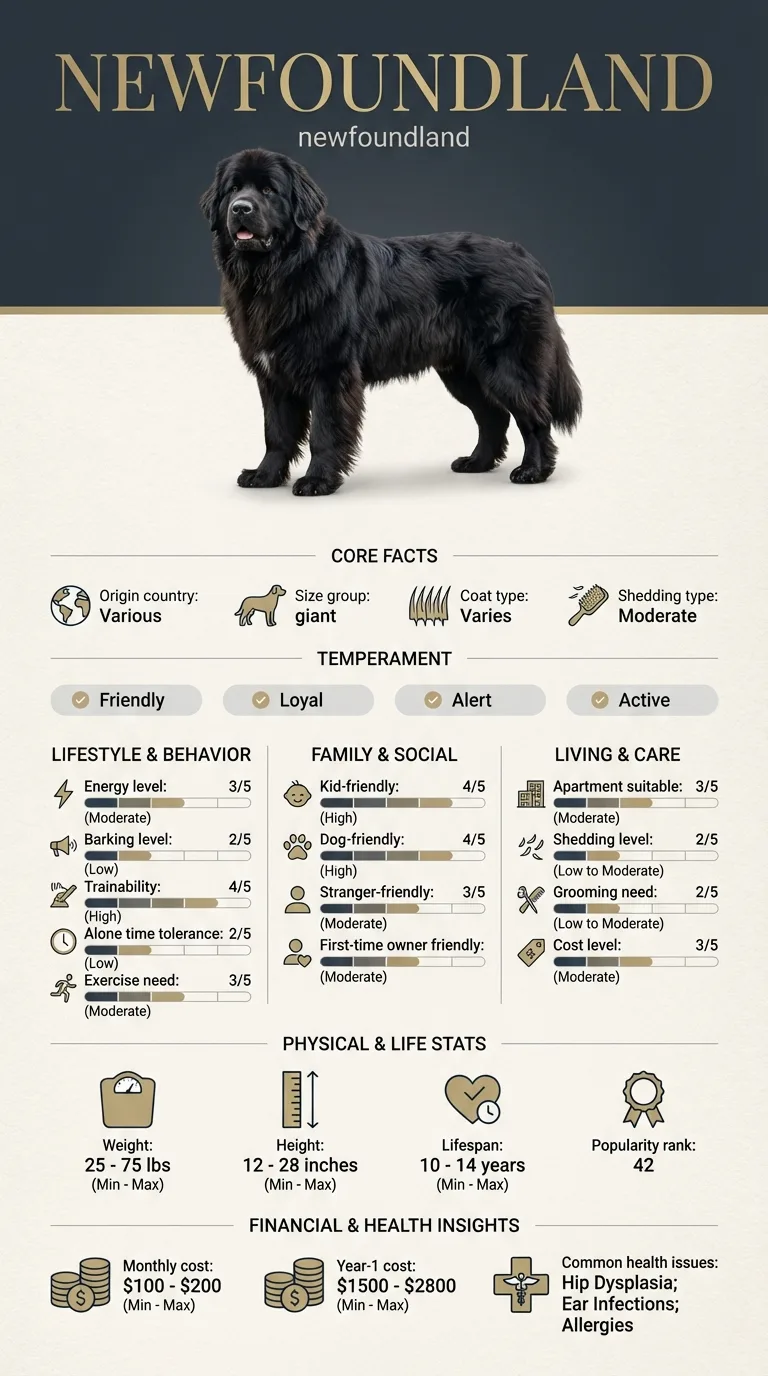
Newfoundland Bone & Growth Issues: The Riskiest Eighteen Months of the Dog's Life infographic

Written for anyone raising a Newfoundland puppy who has been given conflicting advice about calcium, joint supplements, how much walking is safe, and whether a limp that comes and goes needs a vet.

Important reminder

This guide is not medical advice. If your dog shows pain, sudden behavior change, or worsening symptoms, consult a licensed veterinarian.

Some links may be affiliate links. We may earn a commission at no extra cost to you. We only suggest products we believe are helpful for dog owners.

What this problem looks like

Developmental bone and joint problems in this breed cluster into the first eighteen months, while the skeleton is soft and growing at speed. They include growth plate injuries from falls and jumps, osteochondrosis and its painful sequel osteochondritis dissecans, panosteitis, and the developmental joint malformations of the hips and elbows. The common thread is that growth rate, body weight and mechanical loading during this window shape the joints the dog will live in for the rest of its life.

Common triggers

  • Overfeeding and free-feeding a fast-growing giant-breed puppy
  • Calcium or mineral supplementation added to an already balanced growth diet
  • Repeated jumping in and out of vehicles and off furniture before growth finishes
  • Slipping on smooth flooring, which puts sudden twisting force through immature joints
  • Forced repetitive exercise such as jogging or bicycle work in a young dog

Developmental orthopaedic disease is a well-recognised problem across large and giant breeds. Hip dysplasia specifically heads the Newfoundland's documented list of health issues, which tells you the breed's joints are a genuine concern rather than a theoretical one. Not every puppy raised imperfectly will develop disease and not every carefully raised puppy escapes it, since genetics sets the starting point, but rearing is the part of the equation an owner controls.

Why this happens

Breed factors

Everything follows from the size the dog is heading for. Reaching 100 to 150 pounds means the skeleton must build a very large amount of bone over a prolonged growth period, during which the growth plates stay open longer than in smaller breeds and the joints carry increasing weight before they are finished. Hip dysplasia is the breed's most frequently listed health issue, which means many Newfoundlands begin life with hip joints that fit imperfectly, and load applied to an imperfect joint during growth does more damage than the same load applied to a mature one. A calm, biddable temperament is a small mercy here, since these puppies are generally easier to keep quiet than a high-drive breed.

Environment factors

The domestic environment is where most of the avoidable damage happens. Hard smooth flooring, staircases used many times a day, sofas and car boots that a puppy jumps down from, and gardens with steep steps all deliver repetitive or sudden loading. Feeding practice is the other half: bowls topped up freely, treats uncounted, and supplements added on advice from a well-meaning source. Households that meant to build a strong dog by feeding generously and walking far are the ones who most often arrive at a lameness consultation at eight months old.

What you can do at home (once it is not an emergency)

When to talk to your vet

Book an appointment for any limp lasting more than a day or two, any reluctance to bear weight, any swelling around a joint, or a puppy who cries when a leg is handled. Do not adopt a wait-and-see approach with lameness in a growing giant breed, because several of the conditions in this age group have better outcomes when addressed early. Seek same-day care for a puppy who will not put a foot down at all, for an obviously deformed or unstable limb after a fall, for severe pain, or for a swollen, hot and painful joint alongside fever and lethargy. And ask your vet at the outset which diet, how much, and what exercise limits they recommend for your individual dog, rather than assembling advice from breeders and forums.

At home, alongside your vet's plan

  • Measure every meal against your vet's guidance and adjust it as your puppy's weight changes, rather than filling the bowl by eye.
  • Do not add calcium or mineral supplements to a complete large-breed growth diet unless your vet has specifically prescribed them.
  • Ask for a body condition score at every appointment and aim to keep your puppy visibly lean throughout growth.
  • Lay non-slip runners on all hard flooring before the puppy arrives, particularly at doorways, turns and the bottom of stairs.
  • Gate the staircase and rearrange sleeping and feeding areas onto one level for the first year.
  • Teach ramp use for the car from the first week, while the puppy is small enough for the habit to form easily.
  • Favour free play on grass over structured road walking, and stop before your puppy is tired rather than after.
  • Note any limp with the date, the leg and what preceded it, since a pattern across weeks is what distinguishes shifting lameness from a fixed problem.

See all Newfoundland health problems, which breeds are prone to bone growth issues, or the full Newfoundland breed guide for temperament, exercise needs and ownership costs.

What to expect, and how you know it is working

The high-risk growth period runs roughly to twelve to eighteen months, with different growth plates closing at different times. Panosteitis typically comes and goes over several months and then stops for good. Osteochondritis dissecans lesions are usually diagnosed between four and twelve months and often need surgery, followed by weeks of restricted activity. Hip and elbow conformation is assessed formally at maturity. The important framing is that this is a window that closes: decisions made in year one cannot be revisited in year four.

Success is a lean, well-grown eighteen-month-old with no history of lameness, a body condition score in the middle of the range, hips and elbows that a vet is happy with, and a dog who uses a ramp automatically and does not fly off the sofa. It is emphatically not a heavy, impressive-looking yearling. Owners are frequently told their well-reared Newfoundland puppy looks thin, and being able to ignore that comment is part of the job.

Growth Plates, and Why Growing Fast Is the Problem

Long bones lengthen at growth plates, bands of cartilage near each end that harden into bone only when growth finishes. In a giant breed those plates stay open longer than in a small dog, often well past a year, and they are the weakest part of the skeleton for the entire time. This is why a young Newfoundland who takes a bad fall on a slippery floor can injure a growth plate in a way an adult simply cannot.

The deeper problem is speed. Cartilage in a rapidly growing joint has to be converted into bone in an orderly way, and if the cartilage grows thicker than the blood supply can service, patches of it fail to convert properly. That is the origin of osteochondrosis, and when a flap of that abnormal cartilage lifts away it becomes osteochondritis dissecans, a painful lesion inside the shoulder, elbow, stifle or hock of a young large-breed dog.

Overfeeding is the main accelerator. A well-meaning owner who free-feeds a hungry Newfoundland puppy, or who adds calcium supplements to an already complete diet, pushes growth faster than the joints can accommodate. Excess dietary calcium during growth is specifically implicated in developmental orthopaedic disease in large breeds, and it is one of the few areas where doing more is actively harmful.

Panosteitis is the other common cause of puppy lameness in this age group. It produces pain deep in the shaft of a long bone, characteristically shifts from leg to leg over weeks, and it resolves on its own with time. It hurts, it needs a vet to diagnose and manage, and it does not cause lasting damage, which makes it the most reassuring item on this list.

Newfoundland Bone and Growth Issues - Growth Plates and Why Growing Fast Is the Problem

How Much Exercise Is Right for a Giant-Breed Puppy

The honest answer is that there is no validated formula, and the popular five-minutes-per-month-of-age rule is a rough convention rather than a research finding. What follows is the principle behind sensible practice, which your vet can tailor to your individual dog.

  • Free play on soft, level ground with good footing is the safest form of exercise for a growing giant-breed puppy, because the puppy self-regulates and stops when tired.
  • Forced repetitive exercise is the category to limit: long road walks at a fixed pace, running alongside a bicycle, and structured jogging all remove the puppy's ability to stop.
  • Repeated jumping is worth avoiding entirely until growth is finished. That includes in and out of car boots, off decking and onto furniture.
  • Stairs are a daily repetitive load. Carrying is impractical at this size beyond the first few months, so gates and rearranged rooms are the realistic answer.
  • Slippery floors deserve more attention than exercise duration does. A skidding puppy on laminate is a common route to a growth plate injury, and runners are cheap.
  • Swimming is excellent for this breed once your vet is happy, because it builds muscle with almost no joint loading, but the entry and exit need to be gentle rather than a leap off a bank.
  • Watch what happens the day after, not during. A puppy who is stiff or slow the following morning did too much yesterday, and that feedback is more useful than any minutes-per-day rule.

The Puppy Everyone Said Looked Thin: Raising Cormac

Cormac's owners, Beth and Sam, were first-time giant-breed owners and had been told by three separate people at the park that their nine-month-old Newfoundland was underweight. He was not. Their vet had body condition scored him at every visit and he was exactly where he should be. What they had done was unglamorous. They weighed his food. They ignored the calcium supplement his breeder had recommended after checking with the vet, who was direct that adding calcium to a complete large-breed growth diet was a known risk in giant breeds. They put rubber-backed runners down the hallway and across the kitchen before he came home. They gated the stairs and moved his bed downstairs. He learned the car ramp at eleven weeks, when he still weighed eighteen pounds and thought it was a game. At seven months he came up lame on the right foreleg. Two weeks later the same lameness was on the left hind. Their vet examined him, took radiographs, diagnosed panosteitis, managed his pain and told them it would pass. It did, by ten months. Cormac is now three, 132 pounds, and has clear hip and elbow scores. Beth's summary: the hardest part of raising him well was tolerating strangers telling them he looked thin for a year and a half.

Key takeaway: A giant-breed puppy should grow steadily, not fast, and should look lean while doing it. Weigh the food, skip the calcium, fix the floors, and buy the ramp before the dog is too heavy to lift.

Frequently asked questions

Should I give my Newfoundland puppy a calcium supplement?

Not unless your veterinarian specifically prescribes one. Complete large-breed puppy diets are formulated with controlled calcium precisely because excess calcium during growth is implicated in developmental orthopaedic disease in large breeds. Adding more to a balanced diet is one of the clearest examples of well-intentioned harm in giant-breed rearing.

Does a large-breed puppy food actually matter?

Yes, more than most food decisions do. Diets formulated for large-breed growth are designed to control energy density and the calcium and phosphorus balance, which moderates growth rate. Ask your vet to confirm the specific diet is appropriate for a giant breed and how much to feed as your puppy's weight changes.

Is a limp that moves between legs serious?

It needs diagnosing, but shifting lameness in a growing large-breed puppy is a classic description of panosteitis, which is self-limiting and does not cause permanent damage. It is genuinely painful while it lasts and your vet can help with that. Do not assume it is panosteitis without an examination, because elbow and shoulder problems also cause lameness at this age.

How do I know if my puppy is too heavy?

You should be able to feel the ribs easily under a light covering, and there should be a visible waist from above. A growing Newfoundland should look lean, even slightly ribby, which alarms owners who expect a chunky teddy bear. Ask your vet to body condition score at every visit rather than judging it yourself.

When do the growth plates close?

Later than in smaller dogs, commonly around twelve to eighteen months in giant breeds, and different plates close at different times. Your vet can advise for your dog, and the timing is relevant to decisions about neutering, jumping, and any structured exercise programme.

Are joint supplements worth giving during growth?

Discuss it with your vet rather than starting one on a breeder's recommendation. What is reliably beneficial in this period is controlled growth rate, lean body condition, sensible exercise and good footing, and no supplement substitutes for those four things.

Quick answers

View more answers
Health

What is the biggest mistake in raising a Newfoundland puppy?

Growing them too fast. Overfeeding and calcium supplementation push growth beyond what the joints can convert in an orderly way, and the consequences show up as joint disease years later.

Living

How much walking should a giant-breed puppy do?

Favour self-directed play on soft ground over structured walking, and limit forced repetitive exercise. Ask your vet for limits appropriate to your dog rather than relying on any internet formula.

Training

Why should I stop my puppy jumping out of the car?

Landing impact goes through open growth plates and immature joints. Use a ramp from the start, so it becomes a habit before the dog is heavy enough that lifting is impossible.

Living

Does flooring really matter?

More than most owners expect. A puppy skidding on laminate takes sudden twisting forces through soft cartilage, and non-slip runners are one of the cheapest protective measures available.

Costs

How much does raising a giant-breed puppy properly cost?

Expect large volumes of a good large-breed growth diet, more frequent weight checks, and possible imaging if lameness appears. It is front-loaded spending that reduces far larger orthopaedic costs later.

Related DogBreedCompass guides

  • osteochondritis dissecans in NewfoundlandsOsteochondritis dissecans is the specific joint lesion that fast growth produces, and it has its own management.
  • elbow dysplasiaElbow dysplasia is a developmental condition of the growth period with lifelong consequences.
  • Newfoundland hip dysplasiaHip dysplasia is the breed's most commonly listed health issue and is shaped during growth.
  • arthritis in this breedArthritis in middle age is largely the downstream consequence of developmental joint disease.
  • the cost of raising a NewfoundlandFeeding volume during the growth period is a major early cost of owning a giant breed.

Bring the right questions to the vet

A one-page prep sheet for this condition: the signs, the questions to ask, what to get priced. Unlocks here.

You get: Vet visit prep sheet

No spam. One-click unsubscribe. See our privacy policy.

Preview page 1 before you decide.

Related guides