Health
What actually restarts the cycle after treatment?
Untreated underlying allergic itch, which keeps driving licking and scratching even after a secondary infection has cleared.

Quick answer
What actually restarts the cycle after treatment?
Untreated underlying allergic itch, which keeps driving licking and scratching even after a secondary infection has cleared.
Treating the infection without breaking the cycle behind it is like mopping a floor under a leaking pipe. It looks clean for a while, and then it does not.
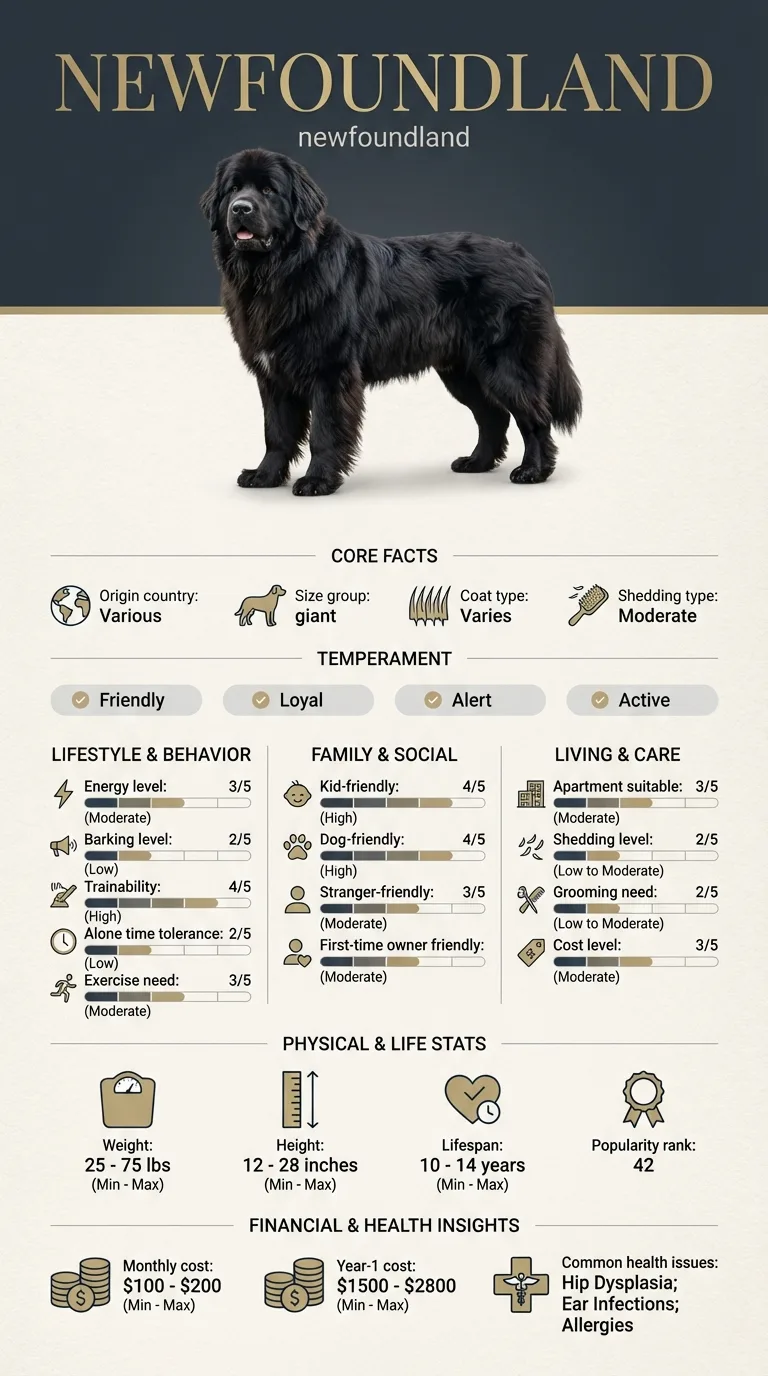
For owners of a Newfoundland who licks its paws raw, has recurring belly or armpit irritation, or has developed a thickened, darkened patch of skin from months of low-grade self-trauma, and who want to understand the mechanism rather than just the next course of treatment.
This guide is not medical advice. If your dog shows pain, sudden behavior change, or worsening symptoms, consult a licensed veterinarian.
Some links may be affiliate links. We may earn a commission at no extra cost to you. We only suggest products we believe are helpful for dog owners.
We research and check what we publish, but we do not warrant that any figure, date, price, or statement is accurate, complete, or current, and we accept no liability for any loss, cost, injury, or other harm arising from the use of this site. Use it as one reference among several. You remain responsible for your own decisions and for your dog's care - confirm anything that matters with a licensed veterinarian or another qualified professional before you act on it. Full disclaimer.
Allergic skin disease in a Newfoundland frequently progresses through a self-reinforcing cycle: itch drives licking or scratching, which damages the skin barrier, which allows secondary bacterial or yeast infection to take hold, which itself causes more itch. Breaking this cycle requires treating the infection, controlling the underlying allergic trigger, and physically preventing ongoing self-trauma all at once, rather than addressing whichever part is most visible at the time.
Allergic skin disease with secondary infection is one of the most common reasons dogs of any breed are seen by a veterinarian, and it is not among the five conditions most consistently documented specifically for the Newfoundland. This breed's dense double coat and heavy shedding do make the itch-scratch-infection cycle more likely to become established and harder to spot early than in a lighter-coated dog, which is a practical rather than a fundamental difference in risk.
The Newfoundland's heavy, water-resistant double coat and dense, constantly shedding undercoat create a warm, humid microclimate at skin level that favours both the initial allergic inflammation staying hidden longer and the secondary infections that follow becoming established more easily. A large body surface area means more skin to monitor for early signs of self-trauma, and a calm, undemanding temperament can mean a dog quietly licks or chews at an itchy spot for a long time before an owner notices a change in behaviour serious enough to prompt a closer look.
Swimming and general dampness are the leading environmental amplifiers, since wet skin under a dense coat takes far longer to dry than on a shorter-coated dog, extending the window in which bacteria and yeast can multiply after any allergic flare begins. Warm indoor environments and thick bedding can have a similar effect on paws and the belly. Households that catch scratching or licking early, before it becomes established at a single spot, and that keep commonly affected areas clean and dry, see far less of the entrenched lichenification and lick granuloma pattern that develops after months of an unaddressed cycle.
Book an appointment for any persistent licking, chewing or scratching at a specific area, any visible thickening, darkening or hair loss, or any patch that has developed a leathery texture. Book promptly for a red, warm, tender or foul-smelling area, since these suggest active secondary infection needing treatment rather than home care alone. Seek same-day care for a rapidly spreading raw patch, a dog that seems distressed or is losing sleep to the itching, or any sign the dog is off food or lethargic alongside the skin problem.
See all Newfoundland health problems, which breeds are prone to skin allergies, or the full Newfoundland breed guide for temperament, exercise needs and ownership costs.
Secondary infection typically improves within two to four weeks of appropriate treatment. Interrupting the mechanical self-trauma with a barrier method shows benefit within days, since it simply stops further damage from accumulating. Identifying and controlling the underlying allergic trigger is the slowest part, often taking a full season to confirm an environmental pattern or three to four months for a complete food trial with rechallenge. Established lichenification can take months to soften even once the cycle is broken, and a mature lick granuloma is often the slowest of all to resolve.
Success is not permanently itch-free skin, since underlying allergy is usually managed rather than cured. It is a dog whose flares are shorter, less frequent and caught earlier, whose skin has a chance to actually heal between episodes rather than being perpetually re-damaged, and whose owner recognises the early signs of the cycle restarting before it reaches infection again.
An allergic reaction in the skin releases inflammatory chemicals that trigger the sensation of itch, and a dog responds to itch the only way it can: licking, chewing or scratching at the affected area. That response feels effective in the short term because mechanical stimulation genuinely does interrupt the itch signal briefly, which is exactly why the behaviour becomes compulsive rather than incidental.
The damage this does is cumulative. Repeated licking keeps the skin surface constantly damp, which softens and weakens its barrier function. Repeated chewing and scratching cause microscopic and eventually visible breaks in that barrier. Bacteria and yeast that live harmlessly on normal skin in small numbers take advantage of both the moisture and the broken barrier to multiply, and a secondary infection develops on top of the original allergic inflammation. That infection itself is intensely itchy, often more so than the allergy alone, which drives more licking and scratching, which causes more damage, and the cycle tightens.
Over months, the skin in a frequently targeted spot, commonly the paws, the groin, the armpits or the flanks, can thicken, darken and develop a leathery texture called lichenification, a visible record of a cycle that has been running for a long time. Some dogs develop a discrete, intensely focused area of self-trauma called a lick granuloma, most often over a lower leg, where compulsive licking has become almost a habit independent of whatever originally triggered it.
This is why treating only the visible infection rarely holds. Antibiotics or antifungal treatment clears the secondary infection, the skin looks better for a period, and then the underlying allergic itch, never actually addressed, restarts the same sequence.

Genuinely interrupting this cycle means addressing every stage of it at once, not just the most visible one.
If you think your Newfoundland has skin allergies, the plan is three steps: write down what you have seen and when it started, book a veterinary appointment rather than waiting for the next flare, and take video of the behaviour or symptom before you go — the thing you are worried about rarely happens in the consulting room. Screening in the parents covers hip dysplasia, subaortic stenosis, dilated cardiomyopathy.
What the vet visit should produce is a diagnosis and a written plan, not just reassurance: what is being ruled out, what the monitoring interval is, and which signs mean you come back sooner. Ask what the treatment costs across a year rather than per visit, because that is the number that decides whether you are managing this condition or reacting to it.
Between appointments, keep a short log — dates, what you saw, what changed. It is the single most useful thing an owner brings to a follow-up, and for skin allergies it is often what separates a clear pattern from a guess.
Bram's owner, Kestrel, had treated two rounds of paw infections over the course of a year, each time with antibiotics that cleared the redness and swelling within a couple of weeks, only for him to be back at the vet a few months later with the same paw looking worse. On the third visit, the vet asked a different question: not what infection was present now, but what had been happening to that paw between the two prior episodes. Kestrel admitted Bram had never really stopped licking it, even when it looked clear, and that she had assumed the behaviour was just a habit unrelated to the skin itself. Examination found the skin on that paw had become notably thickened and darkened, a sign of many months of low-grade, unaddressed self-trauma running underneath two rounds of successfully treated infection. This time, alongside a fresh course of treatment, Bram wore a boot on that paw during the day for three weeks while an environmental allergy was investigated and confirmed. The licking, uninterrupted by the boot for the first time in over a year, finally had a chance to fully stop. The thickened skin took several more months to soften, but the paw has not needed antibiotic treatment again since Kestrel started treating the licking itself as part of the problem rather than a side note to it.
Key takeaway: Clearing an infection is not the same as breaking the cycle behind it. If the licking or scratching never actually stops between flares, the skin never gets a real chance to heal, no matter how well each infection responds to treatment.
Because the infection is a downstream consequence of ongoing allergic itch and self-trauma, not the original problem. Clearing it without addressing the itch and the licking or scratching behaviour that damaged the skin in the first place leaves the cycle ready to restart as soon as treatment stops.
A thickened, darkened, leathery change in the skin that develops after months of repeated inflammation and self-trauma in the same spot. It is a visible sign of a long-running itch-scratch-infection cycle rather than a separate disease, and it can take a long time to soften even once the underlying trigger is controlled.
A firm, raised, often hairless patch, most commonly on a lower leg, created by intense, repetitive licking at one specific spot. It can become partly independent of the original itch trigger over time, functioning almost as a habit, which is why it sometimes needs its own dedicated treatment approach.
Paws, groin, armpits and flanks are common targets for self-trauma, since these areas are thin-skinned, easily reached by the mouth, and prone to holding moisture, particularly in a heavily coated dog.
Yes. Ongoing mechanical trauma keeps damaging the skin barrier regardless of how well the underlying allergy is being managed, and healing genuinely cannot outpace continued licking. A recovery collar or similar barrier during active flares protects the progress the other treatments are making.
It varies, but expect weeks rather than days for a well-established pattern. Secondary infection typically clears within two to four weeks of appropriate treatment, while identifying and controlling the underlying allergic trigger, particularly through a food trial, can take considerably longer.
It sits within the same broader allergic picture but focuses specifically on the mechanical damage-and-infection cycle at the skin level, particularly around the paws and body rather than the ears, which are covered in more general allergy management separately.
The early signs are set out in the sections above, and they are the reason to book a veterinary appointment rather than wait. Skin Allergies in Newfoundlands is diagnosed by a vet, not from a symptom list, and the sooner it is on record the more options remain open.
Untreated underlying allergic itch, which keeps driving licking and scratching even after a secondary infection has cleared.
Paws, groin, armpits and flanks, all thin-skinned areas prone to moisture and easy for the dog to reach with its mouth.
A properly fitted recovery collar or boots, since healing skin cannot outpace continued licking or scratching.
A firm patch created by intensely repetitive licking at one spot, which can become a habit independent of the original trigger.
Weeks for secondary infection to clear, and potentially much longer to properly identify and control the underlying allergic trigger.
A one-page prep sheet for this condition: the signs, the questions to ask, what to get priced. Unlocks here.
You get: Vet visit prep sheet
No spam. One-click unsubscribe. See our privacy policy.
Preview page 1 before you decide.