Health
What is osteochondritis dissecans?
A cartilage flap that fails to attach properly to bone during growth, causing joint pain and potential loose fragments inside the joint.

Quick answer
What is osteochondritis dissecans?
A cartilage flap that fails to attach properly to bone during growth, causing joint pain and potential loose fragments inside the joint.
A large, fast-growing puppy is the textbook OCD case, but the compact, muscular build of a growing French Bulldog puts enough stress through developing joints that it shows up here too.

Owners of large-for-the-breed or rapidly growing puppies notice this most, usually when a limp appears with no clear injury and doesn't follow the typical short-lived pattern of a minor sprain.
This guide is not medical advice. If your dog shows pain, sudden behavior change, or worsening symptoms, consult a licensed veterinarian.
Some links may be affiliate links. We may earn a commission at no extra cost to you. We only suggest products we believe are helpful for dog owners.
We research and check what we publish, but we do not warrant that any figure, date, price, or statement is accurate, complete, or current, and we accept no liability for any loss, cost, injury, or other harm arising from the use of this site. Use it as one reference among several. You remain responsible for your own decisions and for your dog's care - confirm anything that matters with a licensed veterinarian or another qualified professional before you act on it. Full disclaimer.
Osteochondritis dissecans (OCD) is a developmental joint condition where a section of cartilage fails to properly convert to bone and attach during a puppy's growth, leaving a flap that can crack, loosen, or fully detach inside the joint. It most often affects the shoulder, though the elbow, knee, and hock can also be involved, and it typically shows up during the rapid growth period of puppyhood.
OCD is more classically associated with large, fast-growing breeds, but it's documented across a range of breed sizes including compact, muscular ones like the French Bulldog, particularly in puppies that grow quickly or carry excess weight during development.
French Bulldogs are a heavily muscled breed relative to their frame, and that muscle mass develops during the same growth window when joint cartilage is converting to bone. The combination of a compact skeleton and substantial muscle pull across developing joints can concentrate mechanical stress in ways that contribute to an OCD lesion forming.
How a puppy is fed and exercised during the growth period plays a meaningful role: calorie-dense diets that accelerate growth, along with repetitive high-impact activity like jumping, both add mechanical demand on joint surfaces before they've finished developing.
See a vet if a growing puppy develops a limp that persists beyond a few days, worsens with activity, or recurs after apparent improvement — imaging is the only way to identify a developing OCD lesion before it worsens.
Because affected puppies often act otherwise normal, a few assumptions can delay catching this condition early.
See all French Bulldog health problems, which breeds are prone to osteochondritis dissecans ocd, or the full French Bulldog breed guide for temperament, exercise needs and ownership costs.
Diagnosis typically happens within the growth period, often between four and eight months old. If surgery is performed, expect several weeks of restricted activity before a full return to normal exercise.
Success means a comfortable, functional joint with minimal or no lameness in adulthood, even if some mild arthritic change eventually shows up on imaging — full prevention of any long-term joint change isn't always realistic, but good function usually is.
OCD most classically affects the shoulder joint, though it can occur in the elbow, knee, or hock as well. In a French Bulldog's case, the shoulder and elbow are the joints most often discussed, given the breed's compact but muscular front end.
The hallmark presentation is a limp that develops gradually rather than from an obvious single incident, often worsening with exercise and easing somewhat with rest — though unlike a simple strain, it tends to recur and persist over weeks rather than resolving.
Because the affected cartilage flap can eventually break free and float inside the joint as a 'joint mouse,' some dogs show intermittent, sharper episodes of pain layered on top of a more chronic, baseline stiffness.
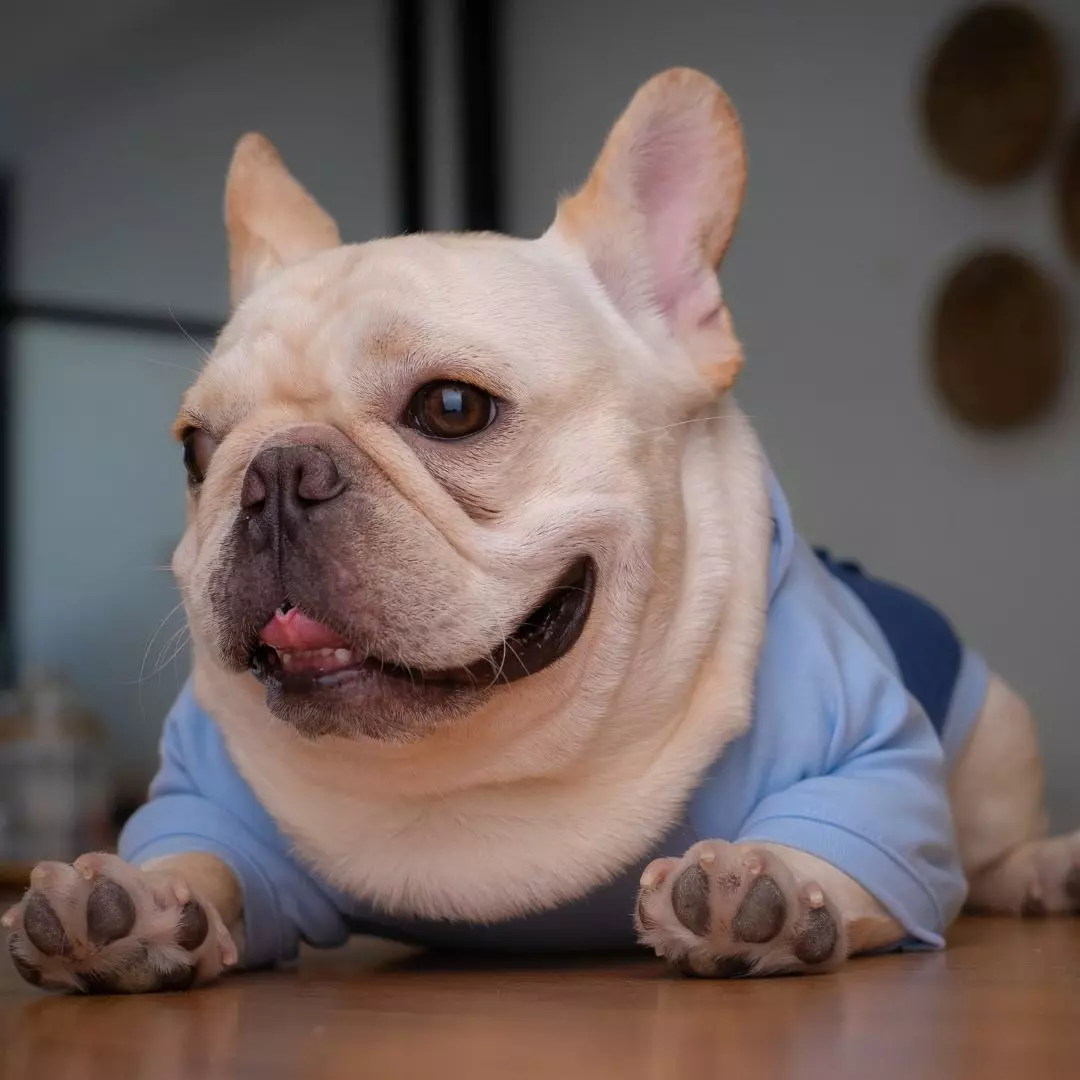
Boss, a five-month-old Frenchie puppy on the larger side for the breed, developed a front-leg limp that didn't follow the typical few-days-and-gone pattern his family had seen before with minor bumps. It came and went for nearly three weeks, worse after energetic play sessions. X-rays revealed a shoulder OCD lesion. Given the size and mobility of the fragment, his vet recommended arthroscopic surgery to remove it and smooth the joint surface. Boss spent five weeks on restricted activity afterward, with short leash walks only, before gradually returning to normal play. He's shown no recurrence of the limp since.
Key takeaway: A puppy limp that keeps recurring over weeks, rather than settling after a few days, is worth imaging rather than repeated rounds of rest and wait-and-see.
It results from abnormal cartilage-to-bone conversion during rapid growth, likely influenced by genetics, growth rate, and mechanical stress on developing joints, though the exact combination varies by individual dog.
Most commonly between four and eight months old, during the period of fastest growth, though milder cases can go undetected until secondary arthritis develops later.
X-rays often show the characteristic lesion, though CT or arthroscopy may be used for a more detailed look, especially if the initial X-ray is inconclusive but symptoms persist.
Many cases benefit from arthroscopic surgery to remove the loose cartilage flap and smooth the joint surface, particularly when the flap has partially or fully detached.
You can't fully prevent an inherited tendency, but avoiding rapid overfeeding and excessive high-impact exercise during the growth window can reduce the odds of a clinically significant lesion.
Some degree of secondary arthritis is common in an affected joint over time, which is why early treatment and long-term joint support matter even after initial recovery.
Arthroscopic treatment typically runs from about $2,500 to $4,500 depending on the joint involved and the surgical center.
A cartilage flap that fails to attach properly to bone during growth, causing joint pain and potential loose fragments inside the joint.
Most often between four and eight months old, during a puppy's fastest growth period.
Not always, but many cases with a loose or detached flap benefit from arthroscopic removal.
Arthroscopic surgery commonly runs $2,500–$4,500 depending on the joint and facility.
Yes, rapid growth from calorie-dense overfeeding is a recognized risk factor.
A one-page prep sheet for this condition: the signs, the questions to ask, what to get priced. Unlocks here.
You get: Vet visit prep sheet
No spam. One-click unsubscribe. See our privacy policy.
Preview page 1 before you decide.

