Costs
Cheaper breed to raise?
The Chinese Shar-Pei, considerably cheaper at $1,400-$2,900 versus the French Bulldog's $2,500-$4,500 in year one.

Quick answer
Cheaper breed to raise?
The Chinese Shar-Pei, considerably cheaper at $1,400-$2,900 versus the French Bulldog's $2,500-$4,500 in year one.
Chinese Shar-Pei or French Bulldog? On paper they differ most on good for first-time owners, and on the scales Chinese Shar-Pei is the heavier at 45–60 lbs. Here is how the two compare on everything that shapes an ordinary week.
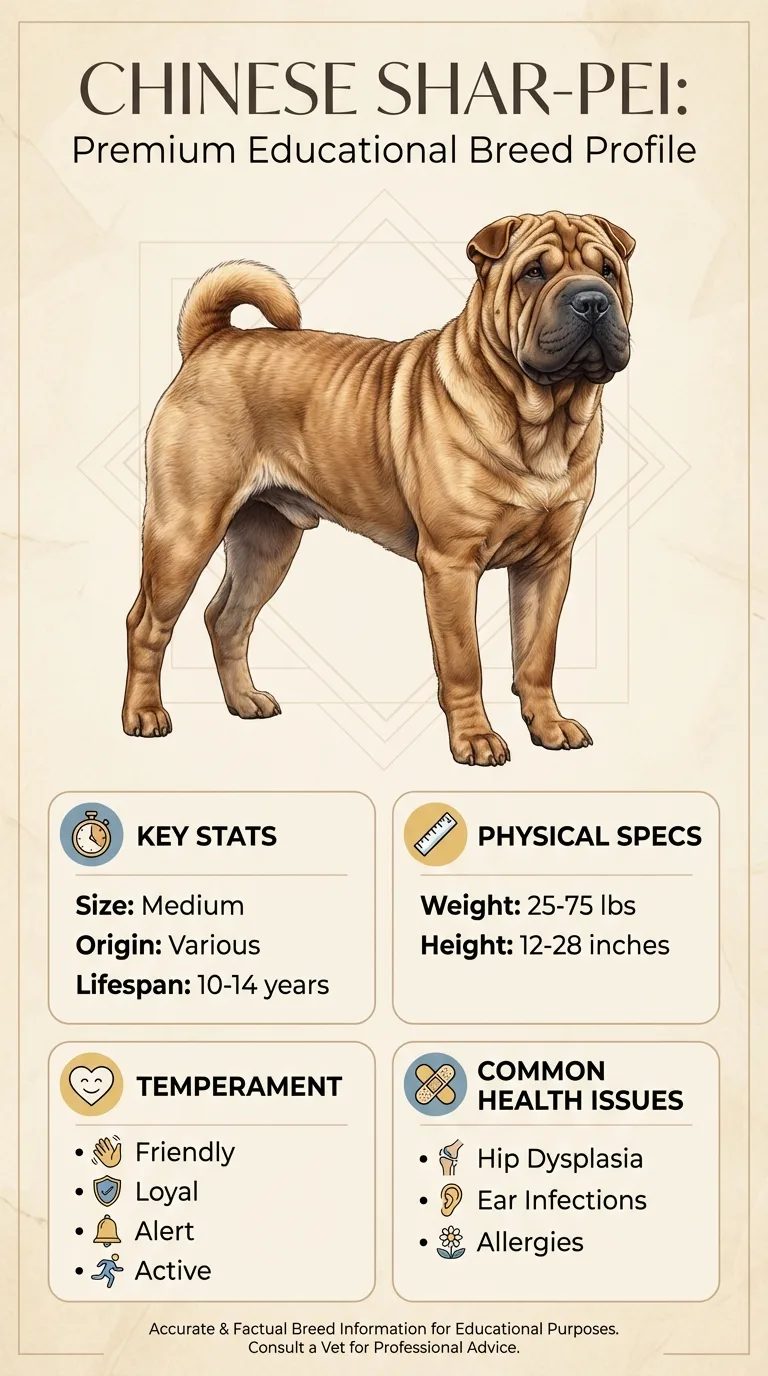
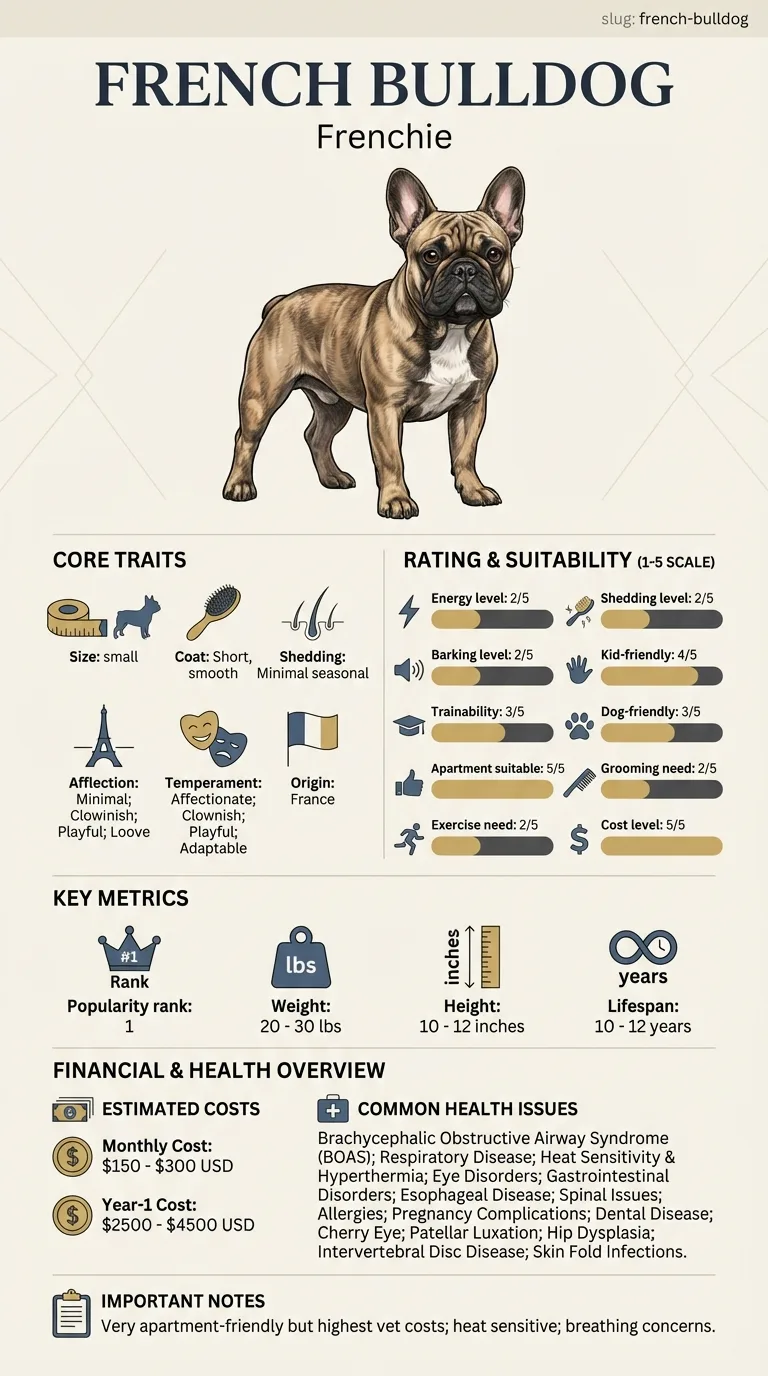
This is for someone already down to Chinese Shar-Pei and French Bulldog and deciding between them. For this pair the decision usually turns on good for first-time owners and tolerates being alone, so those are covered first and in most detail. Anyone choosing from a flat has a clear answer here: French Bulldog rates 5/5 against 4/5. It is written for the decision rather than the breed history.
Between Chinese Shar-Pei and French Bulldog, good for first-time owners is what separates them, and French Bulldog is the lower-effort dog of the two to keep.
Choose Chinese Shar-Pei if you want a dog that is more watchful with visitors.
Choose French Bulldog if you are in a flat or a smaller home, this is your first dog and the dog will be alone during the working day.
| Feature | chinese shar pei | french bulldog | Winner |
|---|---|---|---|
| Size class | medium | small | Equal |
| Weight | 45–60 lbs | 20–30 lbs | Equal |
| Height | 18–20 in | 10–12 in | Equal |
| Lifespan | 8–12 years | 10–12 years | french bulldog |
| Exercise need | Low (2/5) | Low (2/5) | Equal |
| Grooming need | Low (2/5) | Low (2/5) | Equal |
| Shedding | Low (2/5) | Low (2/5) | Equal |
| Energy level | Low (2/5) | Low (2/5) | Equal |
| Barking | Low (2/5) | Low (2/5) | Equal |
| Apartment suitability | High (4/5) | Very high (5/5) | french bulldog |
| Good for first-time owners | Low (2/5) | Very high (5/5) | french bulldog |
| Tolerates being alone | Moderate (3/5) | Very high (5/5) | french bulldog |
| Trainability | Low (2/5) | Moderate (3/5) | french bulldog |
| Good with kids | Moderate (3/5) | High (4/5) | french bulldog |
| Good with other dogs | Low (2/5) | Moderate (3/5) | french bulldog |
| Friendly to strangers | Low (2/5) | Moderate (3/5) | french bulldog |
| Cost level | High (4/5) | Very high (5/5) | chinese shar pei |
| Coat | Short and harsh | Short, smooth | Equal |
| Origin | Various | France | Equal |
| Typical monthly cost | $100–$200 | $150–$300 | Equal |
| Typical first-year cost | $1,400–$2,900 | $2,500–$4,500 | Equal |
Both breeds land in modest size territory, but the Chinese Shar-Pei's medium 45-to-60-pound, 18-to-20-inch frame is still meaningfully larger than the French Bulldog's small 20-to-30-pound, 10-to-12-inch build. The French Bulldog's short, stocky, bat-eared silhouette is unmistakable and close to the ground, while the Shar-Pei stands taller with its own distinctive wrinkled coat and blocky head. Anyone picturing a truly compact companion dog will find the French Bulldog closer to that image, while the Shar-Pei offers a sturdier, more substantial presence without moving into large-breed territory. Neither breed requires major lifestyle accommodations for size alone, but the gap between them is still real.
Exercise need and energy level tie exactly here, both breeds rated low (2/5) on each measure. The French Bulldog's playful, clownish temperament shows up more in short bursts of indoor antics than in a need for long walks or runs, and the Chinese Shar-Pei's calm, independent nature fits the same low-key pattern. This is one of the more evenly matched categories on the whole page — households looking for a genuinely low-exercise dog will find either breed satisfies that requirement equally well. The real differentiators between these two lie elsewhere, particularly in health risk and household compatibility, covered further down this page.
Grooming and shedding also tie at low (2/5) for both breeds. The French Bulldog's short, smooth coat and the Chinese Shar-Pei's short, harsh coat both keep brushing to a minimal, occasional task rather than a weekly chore. Neither breed sheds heavily or mats, so buyers choosing between them can largely set coat maintenance aside as a deciding factor. That said, the Shar-Pei's wrinkles bring a separate, non-coat-related care routine — regular cleaning of its skin folds — that the smoother-skinned French Bulldog doesn't need in the same way, even though the French Bulldog has its own skin fold infections listed among its health concerns.
Both breeds are strong apartment candidates, but the French Bulldog edges ahead at very high (5/5) apartment suitability against the Shar-Pei's high (4/5), and both rate low (2/5) for barking, so noise isn't a concern for either. The real standout is alone-time tolerance: the French Bulldog rates very high (5/5), one of the best scores on this table, compared to the Shar-Pei's moderate (3/5). For apartment dwellers who work long hours, that gap matters — a French Bulldog is markedly more comfortable with solo stretches than the Shar-Pei, even though both breeds are otherwise well suited to small-space living.
The French Bulldog rates very high (5/5) for first-time-owner suitability and moderate (3/5) for trainability, an approachable combination for someone new to dog ownership even if it isn't the fastest learner. The Chinese Shar-Pei rates low (2/5) on both measures, its independent, reserved temperament making it a more demanding project for a beginner. A first-time owner drawn to either breed's looks should weigh this gap seriously: the French Bulldog's adaptable, affectionate nature tends to forgive training missteps more readily than the Shar-Pei's, which often benefits from professional guidance and a more experienced hand.
The French Bulldog rates high (4/5) with kids, moderate (3/5) with other dogs, and moderate (3/5) with strangers, all ahead of the Chinese Shar-Pei's moderate (3/5) with kids, low (2/5) with other dogs, and low (2/5) with strangers. That gap reflects the French Bulldog's affectionate, playful, adaptable temperament against the Shar-Pei's more reserved, independent nature. Families with kids or a busy visitor schedule will generally find the French Bulldog the easier fit, though neither breed rates as strongly with other dogs as some family-oriented breeds elsewhere on this site, so multi-dog households should still plan careful introductions with either choice.
Lifespans sit close, 10 to 12 years for the French Bulldog against 8 to 12 for the Chinese Shar-Pei, but the health picture diverges sharply: the French Bulldog's list runs to fifteen conditions, led by brachycephalic obstructive airway syndrome (BOAS), respiratory disease, and heat sensitivity and hyperthermia tied to its flat face, alongside eye disorders, gastrointestinal disorders, esophageal disease, spinal issues, allergies, dental disease, cherry eye, patellar luxation, hip dysplasia, intervertebral disc disease, and skin fold infections. The Shar-Pei's five-item list — skin fold dermatitis, entropion, familial Shar-Pei fever, hypothyroidism, and ear infections — is far shorter. French Bulldog owners in particular should plan for breathing-related monitoring and heat precautions given how much of the list centers on its brachycephalic structure.
The French Bulldog carries the highest cost rating on this comparison, very high (5/5), against the Chinese Shar-Pei's high (4/5), and the dollar figures show why: the French Bulldog runs $150 to $300 monthly and a striking $2,500 to $4,500 in year one, versus the Shar-Pei's $100 to $200 monthly and $1,400 to $2,900. That premium likely reflects the French Bulldog's extensive health-monitoring needs tied to its brachycephalic structure, along with breed popularity driving up purchase price. Buyers drawn to the French Bulldog's looks should budget well beyond the Shar-Pei's already-substantial costs, particularly for potential respiratory or spinal care down the line.
Chinese Shar-Pei weighs 45–60 lbs and lives 8–12 years; French Bulldog weighs 20–30 lbs and lives 10–12 years. The two diverge most on good for first-time owners and tolerates being alone. They are level on barking, energy level and exercise need, so those cannot decide it. In the table, a "winner" means easier for an ordinary household — not better. Size, coat and origin are recorded without a verdict. Because both breeds are scored the same way, the gaps are reliable even where the absolute numbers are rough.

The French Bulldog, considerably so — $2,500-$4,500 in year one versus $1,400-$2,900 for the Shar-Pei, reflecting its very high (5/5) cost rating and extensive health-monitoring needs.
Yes, it rates very high (5/5) for first-time-owner suitability, far above the Shar-Pei's low (2/5).
The French Bulldog, rated very high (5/5) for alone-tolerance versus the Shar-Pei's moderate (3/5).
Its flat face drives most of its fifteen listed conditions, including BOAS, respiratory disease, heat sensitivity, and spinal issues, making it one of the higher health-risk breeds on this site.
No — both rate low (2/5) for exercise need and energy level, making them well matched for low-activity households.
The French Bulldog, rated high (4/5) versus the Shar-Pei's moderate (3/5).
Neither — both rate low (2/5) for shedding.
The Chinese Shar-Pei, considerably cheaper at $1,400-$2,900 versus the French Bulldog's $2,500-$4,500 in year one.
The French Bulldog, rated very high (5/5) versus the Shar-Pei's high (4/5).
The French Bulldog, with fifteen flagged conditions versus five for the Shar-Pei.
The French Bulldog, rated moderate (3/5) versus the Shar-Pei's low (2/5).
Secure checkout on Stripe. We never see your card.
7-day money-back guarantee. Instant access.
Health information here is general and is not veterinary advice. If your dog shows pain, sudden behaviour change, or worsening symptoms, consult a licensed veterinarian.
Some links on this site are affiliate links. We may earn a commission at no extra cost to you, and we only suggest products we believe are helpful for dog owners.
We research and check what we publish, but we do not warrant that any figure, date, price, or statement is accurate, complete, or current, and we accept no liability for any loss, cost, injury, or other harm arising from the use of this site. Use it as one reference among several. You remain responsible for your own decisions and for your dog's care - confirm anything that matters with a licensed veterinarian or another qualified professional before you act on it. Full disclaimer.
Match your lifestyle to the right dog.
Take quizNot sure which breed is right for you? Take our 2-minute quiz to find out.
Take the quiz