Living
Which should you pick overall?
The Frenchie for low-key, low-exercise households; the Vizsla only if you're genuinely active and rarely leave a dog alone for long.

Quick answer
Which should you pick overall?
The Frenchie for low-key, low-exercise households; the Vizsla only if you're genuinely active and rarely leave a dog alone for long.
French Bulldog or Vizsla? On paper they differ most on apartment suitability, and on the scales Vizsla is the heavier at 45–65 lbs. Here is how the two compare on everything that shapes an ordinary week.
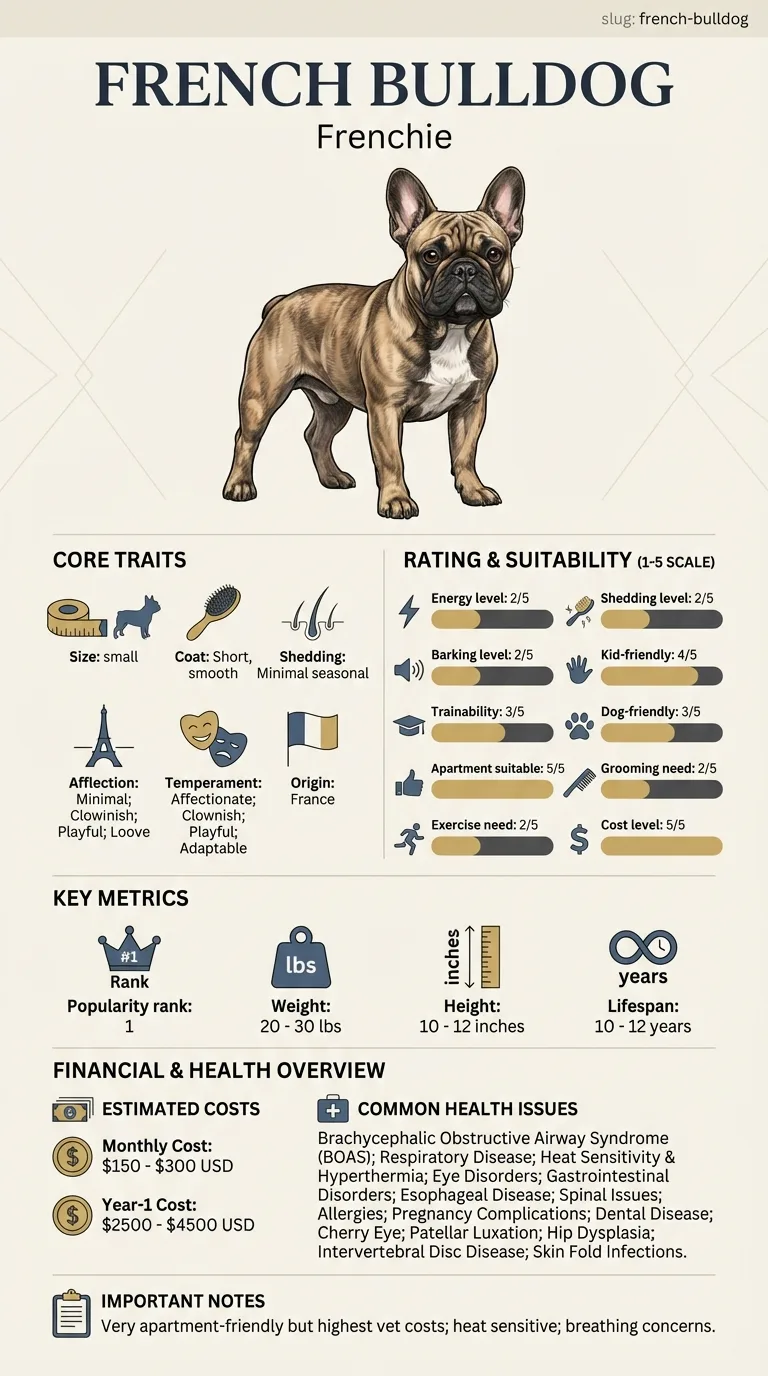
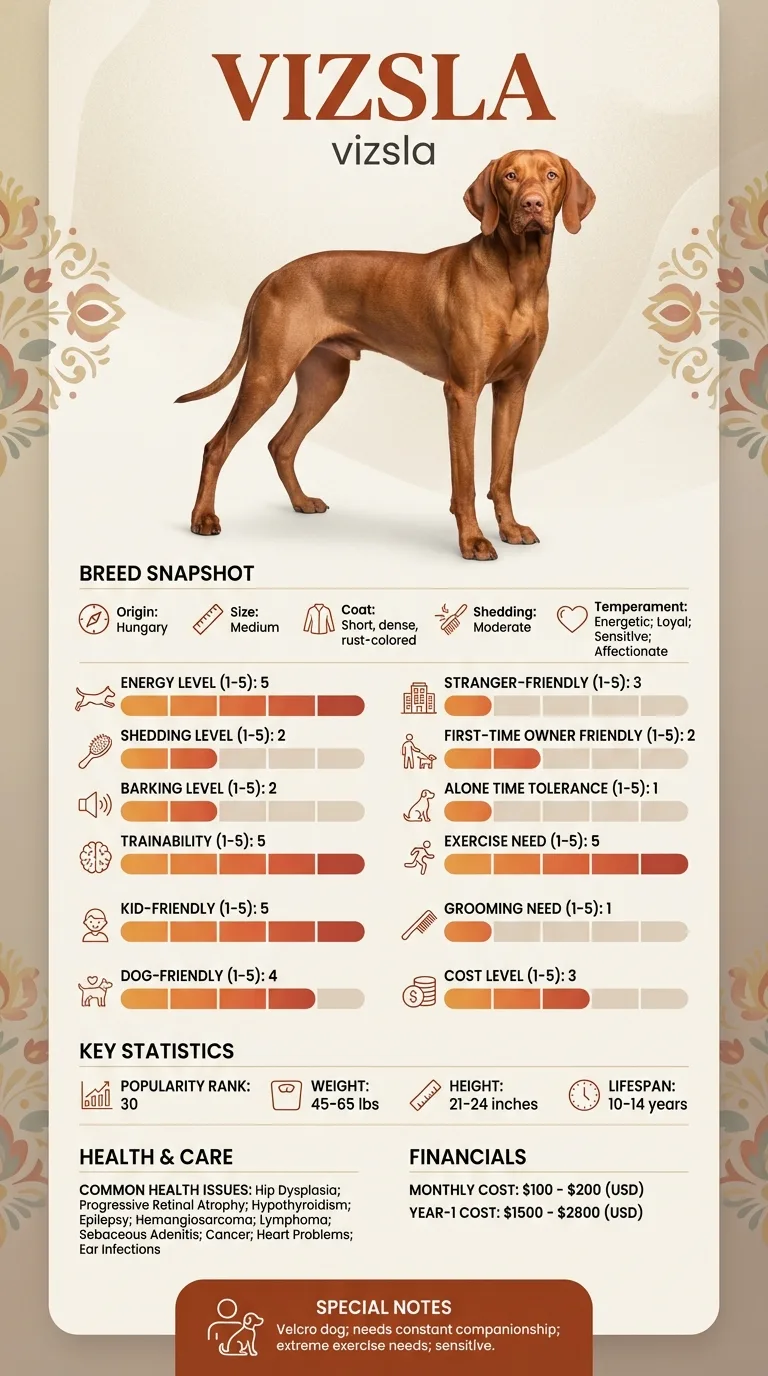
This is for someone already down to French Bulldog and Vizsla and deciding between them. For this pair the decision usually turns on apartment suitability and tolerates being alone, so those are covered first and in most detail. Anyone choosing from a flat has a clear answer here: French Bulldog rates 5/5 against 1/5. It is written for the decision rather than the breed history.
Between French Bulldog and Vizsla, apartment suitability is what separates them, and French Bulldog is the lower-effort dog of the two to keep.
Choose French Bulldog if you are in a flat or a smaller home, this is your first dog and your walking routine is modest.
Choose Vizsla if you do not want a standing grooming appointment, there are young children at home and you already have another dog.
| Feature | french bulldog | vizsla | Winner |
|---|---|---|---|
| Size class | small | medium | Equal |
| Weight | 20–30 lbs | 45–65 lbs | Equal |
| Height | 10–12 in | 21–24 in | Equal |
| Lifespan | 10–12 years | 10–14 years | vizsla |
| Exercise need | Low (2/5) | Very high (5/5) | french bulldog |
| Grooming need | Low (2/5) | Very low (1/5) | vizsla |
| Shedding | Low (2/5) | Low (2/5) | Equal |
| Energy level | Low (2/5) | Very high (5/5) | Equal |
| Barking | Low (2/5) | Low (2/5) | Equal |
| Apartment suitability | Very high (5/5) | Very low (1/5) | french bulldog |
| Good for first-time owners | Very high (5/5) | Low (2/5) | french bulldog |
| Tolerates being alone | Very high (5/5) | Very low (1/5) | french bulldog |
| Trainability | Moderate (3/5) | Very high (5/5) | vizsla |
| Good with kids | High (4/5) | Very high (5/5) | vizsla |
| Good with other dogs | Moderate (3/5) | High (4/5) | vizsla |
| Friendly to strangers | Moderate (3/5) | Moderate (3/5) | Equal |
| Cost level | Very high (5/5) | Moderate (3/5) | vizsla |
| Coat | Short, smooth | Short, dense, rust-colored | Equal |
| Origin | France | Hungary | Equal |
| Typical monthly cost | $150–$300 | $100–$200 | Equal |
| Typical first-year cost | $2,500–$4,500 | $1,500–$2,800 | Equal |
The Vizsla's lean, athletic 45-65 lb frame has almost nothing in common with the Frenchie's compact, dense 20-30 lb build beyond a shared short coat. Standing 21-24 in at the shoulder against the Frenchie's 10-12 in, the Vizsla is built like a pointer — because that's exactly what it is, bred to run and hunt for hours in the field.
The Vizsla's exercise need rates very high (5/5), matching a very high 5/5 energy level, against the Frenchie's low 2/5 on both counts. This is one of the more demanding breeds in this entire site's comparisons — a Vizsla under-exercised doesn't just get restless, it can become genuinely difficult to live with. Think an hour or more of vigorous activity daily, not a leisurely walk — this breed was built to run alongside a horse or hunt for hours in open country.
Here the Frenchie loses its usual low-grooming edge: the Vizsla rates very low (1/5) for grooming need, actually beating the Frenchie's already-low 2/5, thanks to an extremely short, close coat that needs almost no maintenance. Shedding ties at low (2/5) for both. If ease of coat care is the whole decision, the Vizsla technically wins it. A quick weekly wipe-down is about all a Vizsla's coat asks for, which makes it one of the lowest-maintenance coats of any breed in this whole comparison set.
Barking ties low (2/5) for both. But alone tolerance is the standout number for the Vizsla: a very low 1/5, tied for the worst in this entire comparison set, against the Frenchie's 5/5. Vizslas are famously "velcro dogs" that bond intensely to their people and struggle badly with isolation — apartment suitability follows suit at very low (1/5) versus the Frenchie's 5/5.
First-time-owner suitability favors the Frenchie sharply, 5/5 against the Vizsla's low 2/5 — its intensity and exercise demands aren't a great match for a beginner. Trainability flips that: very high (5/5) for the Vizsla against the Frenchie's moderate (3/5). This is a genuinely smart, biddable breed, but one that needs an experienced hand to channel that intelligence productively. Without that outlet, a Vizsla's intelligence tends to turn into anxious or destructive behavior rather than the calm, biddable temperament its trainability score suggests on paper.
The Vizsla edges ahead with both kids (very high 5/5 vs. high 4/5) and other dogs (high 4/5 vs. moderate 3/5). Strangers tie at moderate (3/5) for both. Its affectionate, people-oriented temperament — described in a word as sensitive — tends to extend naturally to kids and other animals once its exercise needs are actually met. That sensitivity cuts both ways, though — a Vizsla raised without enough exercise or attention can become anxious around a busy household rather than the easygoing companion its scores suggest.
The Vizsla's 10-14 year lifespan range overlaps with the Frenchie's 10-12 but can extend further. Its ten-item health list is notably cancer-heavy — hemangiosarcoma, lymphoma, and cancer all appear separately, alongside hip dysplasia, PRA, and heart problems. The Frenchie's fifteen-item list stays centered on its flat face and spine instead. Hip dysplasia is the one shared condition. That cancer prevalence is worth discussing with a vet early, since routine screenings can catch some of these conditions before they become serious.
The Vizsla is cheaper to keep despite being more than double the Frenchie's weight: $100-200 monthly and $1,500-2,800 in year one, against the Frenchie's $150-300 and $2,500-4,500. Cost level reflects it directly — moderate (3/5) for the Vizsla, very high (5/5) for the Frenchie. Its low-maintenance coat helps keep that number down further, since grooming bills — one of the bigger recurring costs for many breeds — barely factor into a Vizsla's upkeep.
French Bulldog weighs 20–30 lbs and lives 10–12 years; Vizsla weighs 45–65 lbs and lives 10–14 years. The two diverge most on apartment suitability, tolerates being alone and exercise need and 4 other rated axes. They are level on barking, shedding and friendly to strangers, so those cannot decide it. In the table, a "winner" means easier for an ordinary household — not better. Size, coat and origin are recorded without a verdict. Because both breeds are scored the same way, the gaps are reliable even where the absolute numbers are rough.

Dramatically more — very high (5/5) exercise need and energy level, against a low 2/5 on both for the Frenchie. Vizslas were bred as all-day field dogs.
Not well — a very low 1/5 rating, among the lowest in this entire site, against the Frenchie's 5/5. Vizslas are known as intensely bonded 'velcro dogs' that struggle with isolation.
The Vizsla, slightly — very low (1/5) need against the Frenchie's already-low (2/5), thanks to an extremely short, low-maintenance coat.
Very — rated very high (5/5), ahead of the Frenchie's already strong 4/5.
The Vizsla — $1,500-2,800 in year one against the Frenchie's $2,500-4,500, despite weighing over twice as much.
Only hip dysplasia overlaps. The Vizsla's list is notably cancer-heavy, listing hemangiosarcoma, lymphoma, and cancer separately; the Frenchie's problems are respiratory and spinal instead.
Not really — it rates a low 2/5 for first-time owners against the Frenchie's 5/5, largely due to its very high exercise and companionship demands.
The Frenchie for low-key, low-exercise households; the Vizsla only if you're genuinely active and rarely leave a dog alone for long.
The Vizsla is cheaper at $100-200 versus the Frenchie's $150-300, despite its larger size.
The Vizsla, dramatically — very high (5/5) need against the Frenchie's low (2/5).
The Vizsla's range runs 10-14 years, potentially longer than the Frenchie's 10-12.
Secure checkout on Stripe. We never see your card.
7-day money-back guarantee. Instant access.

Health information here is general and is not veterinary advice. If your dog shows pain, sudden behaviour change, or worsening symptoms, consult a licensed veterinarian.
Some links on this site are affiliate links. We may earn a commission at no extra cost to you, and we only suggest products we believe are helpful for dog owners.
We research and check what we publish, but we do not warrant that any figure, date, price, or statement is accurate, complete, or current, and we accept no liability for any loss, cost, injury, or other harm arising from the use of this site. Use it as one reference among several. You remain responsible for your own decisions and for your dog's care - confirm anything that matters with a licensed veterinarian or another qualified professional before you act on it. Full disclaimer.
Match your lifestyle to the right dog.
Take quizNot sure which breed is right for you? Take our 2-minute quiz to find out.
Take the quiz