Living
Which should you pick overall?
Go Frenchie if you want the lowest-effort dog to leave alone; go Mini Poodle if you can handle grooming appointments and want several extra years together.

Quick answer
Which should you pick overall?
Go Frenchie if you want the lowest-effort dog to leave alone; go Mini Poodle if you can handle grooming appointments and want several extra years together.
French Bulldog or Poodle (Miniature)? On paper they differ most on grooming need, and on the scales French Bulldog is the heavier at 20–30 lbs. Here is how the two compare on everything that shapes an ordinary week.
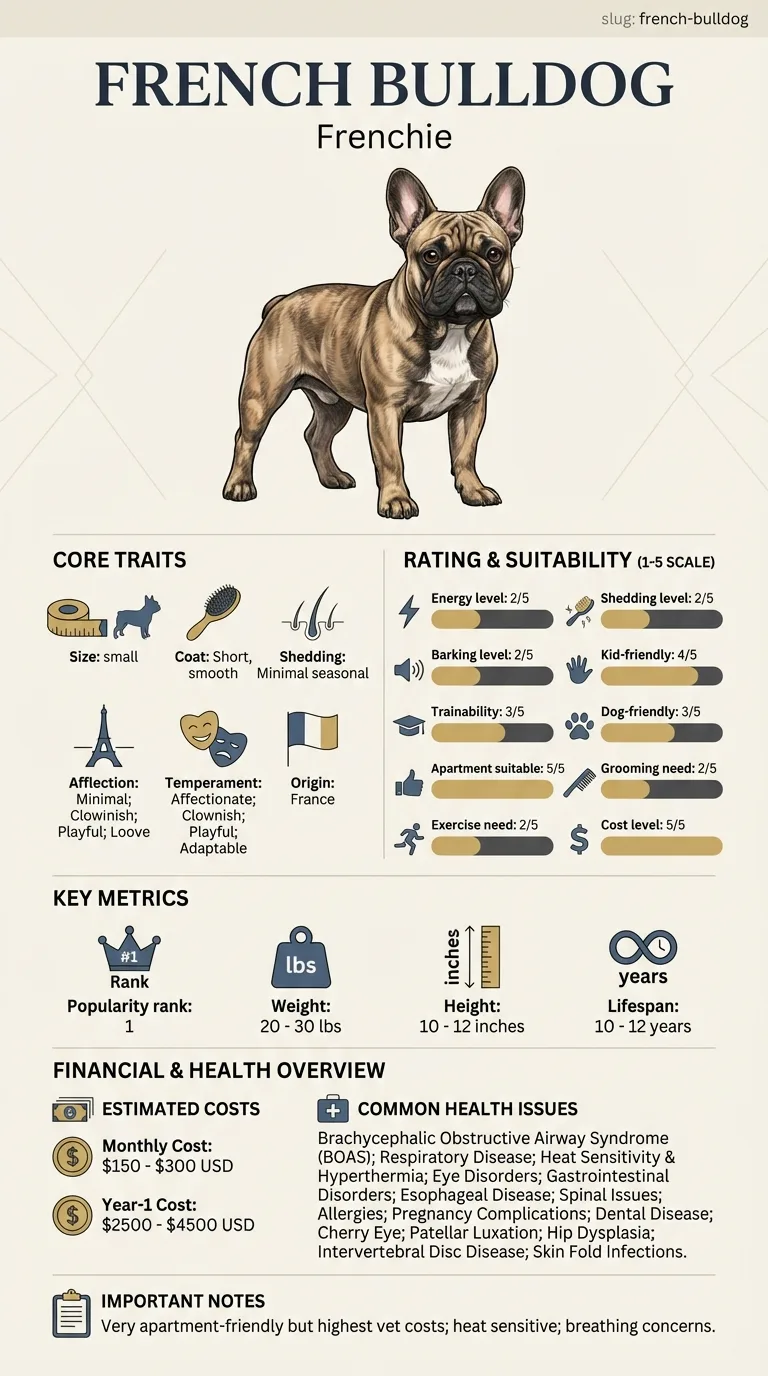
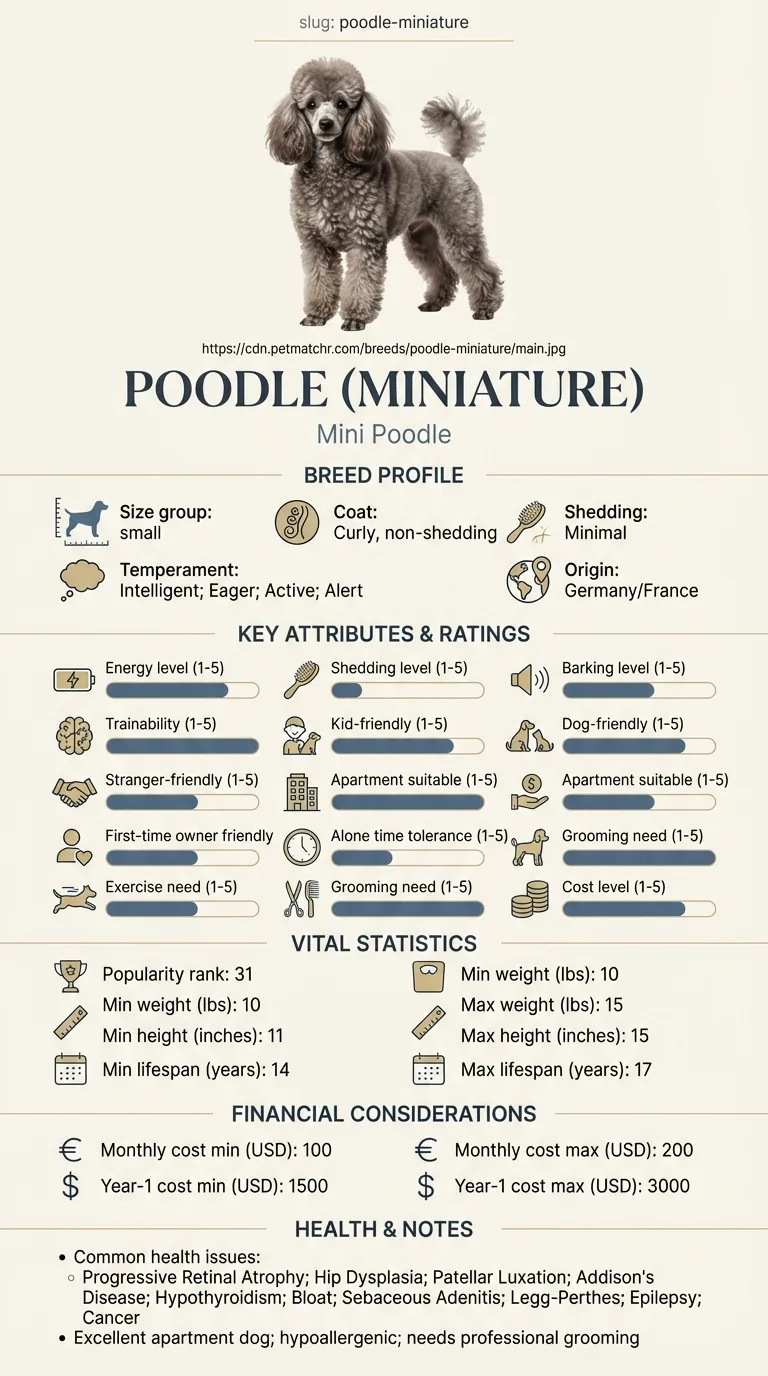
This is for someone already down to French Bulldog and Poodle (Miniature) and deciding between them. For this pair the decision usually turns on grooming need and tolerates being alone, so those are covered first and in most detail. Both rate 5/5 for flats, so housing does not settle this one. The focus throughout is on daily consequences rather than breed background.
Between French Bulldog and Poodle (Miniature), grooming need is what separates them, and French Bulldog is the lower-effort dog of the two to keep.
Choose French Bulldog if this is your first dog, you do not want a standing grooming appointment and your walking routine is modest.
Choose Poodle (Miniature) if shedding is a problem in your house, you already have another dog and you want a dog that picks up training quickly.
| Feature | french bulldog | poodle miniature | Winner |
|---|---|---|---|
| Size class | small | small | Equal |
| Weight | 20–30 lbs | 10–15 lbs | Equal |
| Height | 10–12 in | 11–15 in | Equal |
| Lifespan | 10–12 years | 14–17 years | poodle miniature |
| Exercise need | Low (2/5) | Moderate (3/5) | french bulldog |
| Grooming need | Low (2/5) | Very high (5/5) | french bulldog |
| Shedding | Low (2/5) | Very low (1/5) | poodle miniature |
| Energy level | Low (2/5) | High (4/5) | Equal |
| Barking | Low (2/5) | Moderate (3/5) | french bulldog |
| Apartment suitability | Very high (5/5) | Very high (5/5) | Equal |
| Good for first-time owners | Very high (5/5) | Moderate (3/5) | french bulldog |
| Tolerates being alone | Very high (5/5) | Low (2/5) | french bulldog |
| Trainability | Moderate (3/5) | Very high (5/5) | poodle miniature |
| Good with kids | High (4/5) | High (4/5) | Equal |
| Good with other dogs | Moderate (3/5) | High (4/5) | poodle miniature |
| Friendly to strangers | Moderate (3/5) | Moderate (3/5) | Equal |
| Cost level | Very high (5/5) | High (4/5) | poodle miniature |
| Coat | Short, smooth | Curly, non-shedding | Equal |
| Origin | France | Germany/France | Equal |
| Typical monthly cost | $150–$300 | $100–$200 | Equal |
| Typical first-year cost | $2,500–$4,500 | $1,500–$3,000 | Equal |
Both dogs are classified small, which undersells how differently they carry that classification. The Frenchie runs 20-30 lbs on a dense, low, wide-boned frame, while the Miniature Poodle is barely half that at 10-15 lbs despite standing a little taller (11-15 in versus 10-12 in). One is a compact brick; the other is light, leggy, and built for movement rather than mass.
The Frenchie rates a low 2/5 for exercise need — short walks and indoor play genuinely cover it, partly because its flat face makes sustained exertion risky anyway. The Mini Poodle sits at moderate (3/5) need with a high 4/5 energy level, wanting daily structured activity, not just a lap around the block. Skip that with a Poodle and the energy shows up as chewing or barking instead.
This is close to a flip. The Frenchie is low-maintenance to groom (2/5) but still sheds a little (2/5), plus its skin folds need regular wiping. The Mini Poodle is the opposite: grooming need is very high (5/5) — expect a clip every four to six weeks — but shedding is nearly nonexistent at 1/5. You're choosing between a wipe-down routine and a standing groomer appointment.
Both score a full 5/5 for apartment suitability, so square footage isn't the deciding factor here. Barking favors the Frenchie (2/5 low versus 3/5 moderate for the Poodle). The real gap is solo time: the Frenchie tolerates being alone at 5/5, while the Mini Poodle drops to 2/5 low — a meaningful problem if your schedule keeps you out of the house for long stretches.
The Frenchie is rated 5/5 for first-time owners with only moderate trainability (3/5) — it doesn't need much teaching to fit into a house. The Mini Poodle drops to 3/5 for first-timers despite very high trainability (5/5), because that intelligence needs active direction. Handed to a first-time owner who doesn't engage it, a Mini Poodle's smarts turn into problem-solving you didn't ask for.
With kids, it's a dead heat at 4/5 apiece. With other dogs the Poodle edges ahead, rated high (4/5) against the Frenchie's moderate (3/5) sociability. Both read as moderate (3/5) with strangers — neither is a natural greeter, and neither is standoffish enough to worry about. If you routinely host visitors or take your dog to dog parks, the Poodle's slight edge with other dogs is worth factoring in, though neither breed needs special handling around new people.
Lifespan is the biggest number in this whole comparison: 10-12 years for the Frenchie versus 14-17 for the Mini Poodle, a gap of up to five years. The Frenchie's 15-item health list is dominated by its flat face — BOAS, heat sensitivity, spinal and eye issues. The Poodle's shorter list leans eye and joint (PRA, hip dysplasia) plus Addison's and epilepsy. Hip dysplasia and patellar luxation are the only conditions both share.
Monthly costs sit close — $150-300 for the Frenchie against $100-200 for the Mini Poodle — but the first year tells the fuller story: $2,500-4,500 versus $1,500-3,000. The Frenchie's premium comes from brachycephalic-related vet care; the Poodle's comes from that recurring grooming bill rather than medical surprises. Neither dog is cheap, but they get expensive in different departments. Budget for the Poodle's grooming appointments the same way you'd budget for a subscription bill — predictable and recurring — while setting aside a larger emergency-vet cushion for the Frenchie.
French Bulldog weighs 20–30 lbs and lives 10–12 years; Poodle (Miniature) weighs 10–15 lbs and lives 14–17 years. The two diverge most on grooming need, tolerates being alone and energy level and 2 other rated axes. They are level on apartment suitability, good with kids and friendly to strangers, so those cannot decide it. The table below marks a winner only where one breed is genuinely easier for a typical owner; size and origin are facts rather than merits and stay level. Ratings come from one source applied to both breeds, so they are meaningful against each other rather than as absolute scores.

By weight, the Mini Poodle wins easily at 10-15 lbs against the Frenchie's 20-30 lbs, even though the Poodle can stand a few inches taller. Weight, not height, is what you'll feel picking either one up.
The Mini Poodle, rated very low (1/5) versus the Frenchie's low (2/5). Neither will cover your couch, but the Poodle comes closer to shedding nothing at all.
The Frenchie, rated 5/5 for first-time owners against the Poodle's 3/5. The Poodle's very high trainability (5/5) can close that gap, but only if you're prepared to actually train it.
Yes, both score a perfect 5/5 for apartment suitability. The tiebreaker for renters is really alone-time tolerance, where the Frenchie has a clear edge.
The Mini Poodle, with a first-year estimate of $1,500-3,000 against the Frenchie's $2,500-4,500. Factor in that the Poodle's cost is mostly predictable grooming, while the Frenchie's includes less predictable vet visits.
Only two: hip dysplasia and patellar luxation appear on both lists. Beyond that the Frenchie's problems are airway- and spine-driven while the Poodle's are eye, joint, and endocrine-driven.
The Mini Poodle, and not by a small margin — 14-17 years compared to the Frenchie's 10-12.
Go Frenchie if you want the lowest-effort dog to leave alone; go Mini Poodle if you can handle grooming appointments and want several extra years together.
Roughly $150-300 for a Frenchie and $100-200 for a Mini Poodle, though the Poodle's cost is more grooming, the Frenchie's more vet care.
The Mini Poodle, at moderate (3/5) need versus the Frenchie's low (2/5) — plan on a real daily outing, not just a stroll.
The Mini Poodle, typically 14-17 years versus the Frenchie's 10-12.
Secure checkout on Stripe. We never see your card.
7-day money-back guarantee. Instant access.

Health information here is general and is not veterinary advice. If your dog shows pain, sudden behaviour change, or worsening symptoms, consult a licensed veterinarian.
Some links on this site are affiliate links. We may earn a commission at no extra cost to you, and we only suggest products we believe are helpful for dog owners.
We research and check what we publish, but we do not warrant that any figure, date, price, or statement is accurate, complete, or current, and we accept no liability for any loss, cost, injury, or other harm arising from the use of this site. Use it as one reference among several. You remain responsible for your own decisions and for your dog's care - confirm anything that matters with a licensed veterinarian or another qualified professional before you act on it. Full disclaimer.
Match your lifestyle to the right dog.
Take quizNot sure which breed is right for you? Take our 2-minute quiz to find out.
Take the quiz