Living
Which is the better overall choice?
If cost and long-term health risk matter most, the Boston has the edge on both. If you specifically want a dog that handles alone time well, the Frenchie's 5/5 rating there stands out.

Quick answer
Which is the better overall choice?
If cost and long-term health risk matter most, the Boston has the edge on both. If you specifically want a dog that handles alone time well, the Frenchie's 5/5 rating there stands out.
Boston Terrier or French Bulldog? On paper they differ most on tolerates being alone, and on the scales French Bulldog is the heavier at 20–30 lbs. Here is how the two compare on everything that shapes an ordinary week.
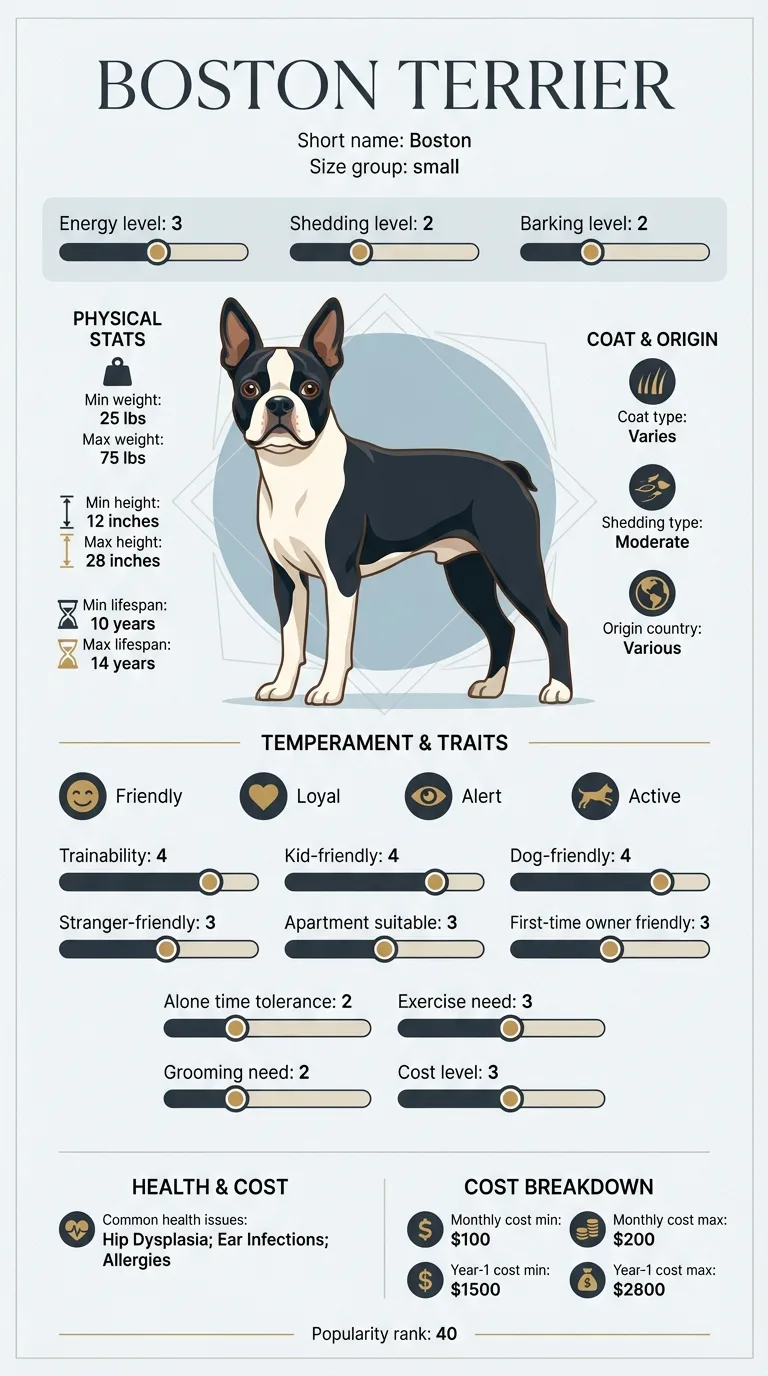
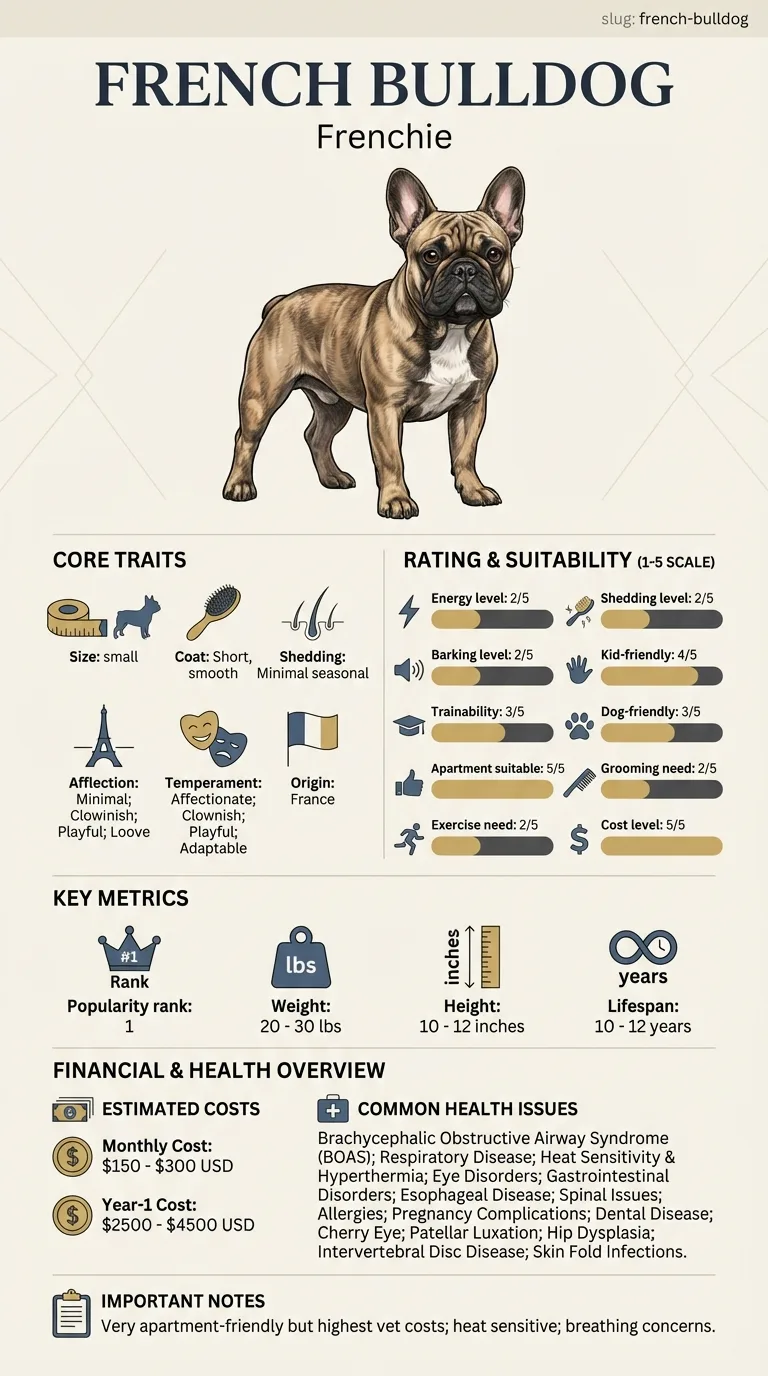
This is for someone already down to Boston Terrier and French Bulldog and deciding between them. For this pair the decision usually turns on tolerates being alone and cost level, so those are covered first and in most detail. Both rate 5/5 for flats, so housing does not settle this one. It is written for the decision rather than the breed history.
Between Boston Terrier and French Bulldog, tolerates being alone is what separates them, and French Bulldog is the lower-effort dog of the two to keep.
Choose Boston Terrier if you do not want a standing grooming appointment, there are young children at home and you already have another dog.
Choose French Bulldog if the dog will be alone during the working day and you want a dog that is more watchful with visitors.
| Feature | boston terrier | french bulldog | Winner |
|---|---|---|---|
| Size class | small | small | Equal |
| Weight | 12–25 lbs | 20–30 lbs | Equal |
| Height | 15–17 in | 10–12 in | Equal |
| Lifespan | 11–13 years | 10–12 years | boston terrier |
| Exercise need | Low (2/5) | Low (2/5) | Equal |
| Grooming need | Very low (1/5) | Low (2/5) | boston terrier |
| Shedding | Low (2/5) | Low (2/5) | Equal |
| Energy level | Moderate (3/5) | Low (2/5) | Equal |
| Barking | Low (2/5) | Low (2/5) | Equal |
| Apartment suitability | Very high (5/5) | Very high (5/5) | Equal |
| Good for first-time owners | Very high (5/5) | Very high (5/5) | Equal |
| Tolerates being alone | Moderate (3/5) | Very high (5/5) | french bulldog |
| Trainability | High (4/5) | Moderate (3/5) | boston terrier |
| Good with kids | Very high (5/5) | High (4/5) | boston terrier |
| Good with other dogs | High (4/5) | Moderate (3/5) | boston terrier |
| Friendly to strangers | High (4/5) | Moderate (3/5) | boston terrier |
| Cost level | Moderate (3/5) | Very high (5/5) | boston terrier |
| Coat | Short and smooth | Short, smooth | Equal |
| Origin | Various | France | Equal |
| Typical monthly cost | $80–$150 | $150–$300 | Equal |
| Typical first-year cost | $1,100–$2,300 | $2,500–$4,500 | Equal |
These two look more alike than most pairs on this site, but the numbers tell a different story. The Boston stands taller at 15-17 inches while the Frenchie is a stockier 10-12; weight overlaps some, 12-25 lbs versus 20-30. In practice the Frenchie reads as the heavier, more compact of the two, while the Boston is the leggier, lighter build.
Exercise need ties at low (2/5) for both, and energy level tilts slightly toward the Boston at moderate (3/5) versus the Frenchie's low (2/5). Neither is an athlete, and that's by design, both are brachycephalic breeds whose flat faces make hard exertion genuinely risky, not just unnecessary. Watch both closely in heat regardless of the low exercise score, restricted airways make overheating a real risk even on a short walk.
Both breeds are low-maintenance coats, but the Boston edges out even the Frenchie: 1/5 grooming versus 2/5, with shedding tied at low (2/5) for both. The difference is small in practice, an occasional brush covers either dog. The bigger grooming task with both breeds isn't the coat at all, it's keeping facial wrinkles and skin folds clean and dry to head off irritation, something the numbers above don't fully capture.
Both score a perfect 5/5 for apartment suitability and a low 2/5 for barking, so neither will bother the neighbors or need more space than a one-bedroom offers. The one real gap: the Frenchie tolerates being alone very well (5/5) while the Boston is only moderate (3/5). If your schedule means long stretches away from home, that difference is worth weighing.
The Boston trains a notch easier, high (4/5) versus the Frenchie's moderate (3/5), and both rate very high (5/5) for first-time owners, so either is a reasonable first dog. The trainability gap shows up mostly in stubbornness: Frenchies are famously food-motivated but also famously willing to ignore a command they've decided isn't worth their time.
The Boston edges the Frenchie across the board here: good with kids (5/5 vs 4/5), good with other dogs (4/5 vs 3/5), and friendly to strangers (4/5 vs 3/5). Neither gap is huge, but they're consistent, the Boston reads as the more universally social of the two. Temperament lists agree: the Boston is friendly, lively, comical, adaptable; the Frenchie is affectionate, clownish, playful, adaptable, with a bit more one-owner attachment.
This is the widest gap in the whole comparison. The Boston's health list runs five items; the Frenchie's runs fifteen, including BOAS, heat sensitivity, spinal issues, and intervertebral disc disease on top of the usual brachycephalic risks. Lifespan reflects it, 11-13 years for the Boston versus 10-12 for the Frenchie. Both share BOAS and patellar luxation as overlapping concerns, but the Frenchie's risk list is simply longer.
Cost is where the Boston pulls clearly ahead: $80-$150 monthly versus $150-$300 for the Frenchie, and $1,100-$2,300 versus $2,500-$4,500 in year one, the Frenchie rates a full 5/5 on cost against the Boston's moderate 3/5. Some of that gap is breeding cost, but the longer health list above means ongoing vet bills are likely to run higher for the Frenchie too.
Boston Terrier weighs 12–25 lbs and lives 11–13 years; French Bulldog weighs 20–30 lbs and lives 10–12 years. The two diverge most on tolerates being alone and cost level. They are level on apartment suitability, barking and exercise need, so those cannot decide it. In the table, a "winner" means easier for an ordinary household — not better. Size, coat and origin are recorded without a verdict. Because both breeds are scored the same way, the gaps are reliable even where the absolute numbers are rough.

Close, but not identical. The Boston is taller (15-17 in) and lighter (12-25 lbs); the Frenchie is shorter (10-12 in) and can weigh more (20-30 lbs). Picture the Frenchie as more compact and blocky, the Boston as leaner.
The Boston, by a clear margin. Its health list runs five conditions against the Frenchie's fifteen, and it lives slightly longer on average (11-13 years versus 10-12). Both are brachycephalic and share BOAS risk, but the Frenchie's list extends well beyond airway issues.
Cost rates 5/5 for the Frenchie versus 3/5 for the Boston, $150-$300 a month against $80-$150. Higher purchase prices and a longer list of potential health issues both feed into that gap.
Both score very high (5/5) for first-time owners, so either works. The Boston trains slightly more easily (4/5 versus 3/5), but the gap is minor enough that temperament fit matters more than the score.
The Frenchie, at 5/5 versus the Boston's 3/5. It's one of the few categories where the Frenchie clearly outscores the Boston.
No, both are low shedders (2/5), and grooming is minimal for either (1/5 Boston, 2/5 Frenchie). The real coat-adjacent task with both is cleaning facial wrinkles, not brushing.
The Boston, in both categories, 5/5 with kids and 4/5 with other dogs, against the Frenchie's 4/5 and 3/5. Not a dramatic gap, but a consistent one.
If cost and long-term health risk matter most, the Boston has the edge on both. If you specifically want a dog that handles alone time well, the Frenchie's 5/5 rating there stands out.
About double, $150-$300 versus the Boston's $80-$150, and the first-year gap is even wider, $2,500-$4,500 versus $1,100-$2,300.
No, both rate low (2/5). Neither breed's flat face is built for hard exertion, so short walks suit both.
The Frenchie, with fifteen listed conditions against the Boston's five, including spinal and respiratory issues beyond the shared airway concerns.
Secure checkout on Stripe. We never see your card.
7-day money-back guarantee. Instant access.



Health information here is general and is not veterinary advice. If your dog shows pain, sudden behaviour change, or worsening symptoms, consult a licensed veterinarian.
Some links on this site are affiliate links. We may earn a commission at no extra cost to you, and we only suggest products we believe are helpful for dog owners.
We research and check what we publish, but we do not warrant that any figure, date, price, or statement is accurate, complete, or current, and we accept no liability for any loss, cost, injury, or other harm arising from the use of this site. Use it as one reference among several. You remain responsible for your own decisions and for your dog's care - confirm anything that matters with a licensed veterinarian or another qualified professional before you act on it. Full disclaimer.
Match your lifestyle to the right dog.
Take quizNot sure which breed is right for you? Take our 2-minute quiz to find out.
Take the quiz