Health
What is genetic load?
A population-level measure of accumulated harmful gene variants within a breed's gene pool.

Quick answer
What is genetic load?
A population-level measure of accumulated harmful gene variants within a breed's gene pool.
This isn't about any one gene or any one disease — it's a measure of just how much genetic 'baggage' the breed as a whole is carrying compared to other purebred populations.
This matters most for prospective owners trying to understand the breed's health risks holistically before committing, and for anyone involved in breeding decisions who wants to understand the population-level forces at play beyond any single condition.
This guide is not medical advice. If your dog shows pain, sudden behavior change, or worsening symptoms, consult a licensed veterinarian.
Some links may be affiliate links. We may earn a commission at no extra cost to you. We only suggest products we believe are helpful for dog owners.
We research and check what we publish, but we do not warrant that any figure, date, price, or statement is accurate, complete, or current, and we accept no liability for any loss, cost, injury, or other harm arising from the use of this site. Use it as one reference among several. You remain responsible for your own decisions and for your dog's care - confirm anything that matters with a licensed veterinarian or another qualified professional before you act on it. Full disclaimer.
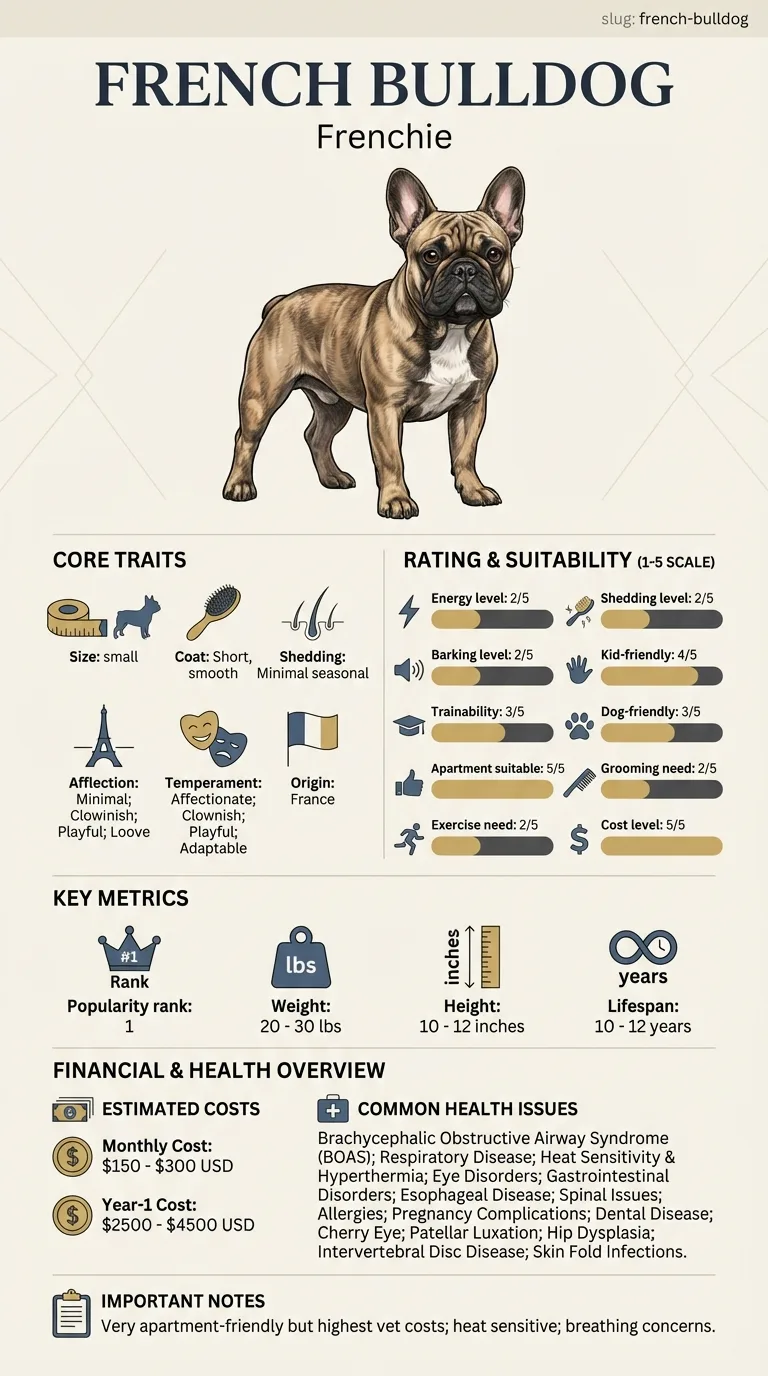
Genetic load refers to the accumulated burden of harmful gene variants carried within a breed's overall population gene pool. French Bulldogs have been documented with among the highest genetic load of any studied breed, a population-level statistic that helps explain, in aggregate, why the breed appears so frequently across such a wide range of separate, individually distinct health conditions.
This is a breed-wide population statistic rather than an individual diagnosis, documented in genetic research comparing genetic load across studied dog breeds, with French Bulldogs consistently appearing among the breeds carrying the highest measured burden.
The breed's explosive rise in popularity concentrated breeding within a smaller pool of dogs than ideal, and selection for specific exaggerated traits — the flattened face chief among them — likely carried along nearby harmful genetic variants through linkage, a well-documented phenomenon in population genetics across many species, not unique to dogs.
This is fundamentally a genetic and breeding-history phenomenon rather than an environmentally driven one; the practical environmental lever available is breeding practice itself — prioritizing genetic diversity and available health testing — rather than anything in an individual dog's daily environment.
Discuss genetic load and its practical implications with your vet when considering breeding a French Bulldog, or simply to understand which specific, testable conditions might be worth screening for given the breed's documented risk profile.
Because genetic load is an abstract, population-level concept, a few common misunderstandings distort what it actually means for individual dogs.
See all French Bulldog health problems, which breeds are prone to genetic load, or the full French Bulldog breed guide for temperament, exercise needs and ownership costs.
Genetic load is a population-level statistic that changes slowly, over many breeding generations, rather than something with any short-term timeline relevant to an individual dog or owner.
Success at the individual level means using available information (breeder practices, genetic testing, health screening) to make informed decisions, while success at the breed level would mean a gradual reduction in genetic load through sustained, diversity-focused breeding practices over time.
French Bulldogs experienced an extraordinarily rapid rise in popularity over a relatively short period, and that popularity surge meant breeding was concentrated within a smaller pool of dogs than would be ideal for maintaining genetic diversity, especially early in the surge before demand caught up with a wider breeding population.
Selective breeding for specific, exaggerated physical traits — the flattened face, the compact body, particular coat colors — can inadvertently carry along harmful variants linked to those same genes or located nearby on the same chromosomes, a phenomenon geneticists call linkage.
Over successive generations, without deliberate, widespread efforts to test for and select against specific harmful variants, this combination of a concentrated breeding population and trait-linked genetic hitchhiking led to today's documented high genetic load — not because of any single decision, but because of how the breed's population history unfolded as a whole.

A breeder specializing in French Bulldogs, after reading about the breed's documented high genetic load, began prioritizing genetic diversity testing alongside traditional health screening in her breeding decisions, occasionally passing on a physically striking dog in favor of one with better genetic diversity markers. Prospective buyers researching her program specifically asked about this approach, and she was able to walk them through her reasoning and the available testing behind her breeding pairs, giving them a much clearer picture of the actual risk profile of a specific litter rather than just the breed-wide statistic.
Key takeaway: Genetic load is a breed-wide, slow-moving statistic, but individual breeders and buyers who engage with it thoughtfully can still make meaningfully better-informed decisions within that larger picture.
It's a population genetics measure of the accumulated burden of harmful gene variants carried within a breed's overall gene pool, reflecting cumulative risk across the population rather than describing any single dog or disease.
A combination of rapid, popularity-driven breeding within a concentrated population and selective breeding for specific exaggerated physical traits, which can inadvertently carry along linked harmful gene variants over generations.
Not necessarily — it's a population-level statistic reflecting overall risk, not a guarantee for any individual dog, many of whom live healthy lives despite the breed's documented genetic load.
Yes, through sustained, careful breeding practices that prioritize genetic diversity and actively test for and select against known harmful variants, though this requires effort across many generations rather than a quick fix.
It provides a population-level explanation for why so many separate conditions — orthopedic, respiratory, neurological, and others — are documented at elevated rates in the same breed, rather than each condition being an isolated coincidence.
That's a personal decision, but it's worth going in informed and seeking breeders who prioritize health testing and genetic diversity, since responsible breeding choices can meaningfully affect an individual puppy's actual risk.
Ask about genetic diversity considerations in their breeding program, whether they conduct available genetic and health tests, and whether they can speak knowledgeably about known health risks in their specific lines.
A population-level measure of accumulated harmful gene variants within a breed's gene pool.
Rapid, popularity-driven breeding within a concentrated population, plus selection for exaggerated traits linked to harmful variants.
No, it reflects population-level risk, not a certainty for any individual dog.
Yes, through sustained, diversity-focused breeding practices across many generations.
Choose breeders who prioritize genetic diversity and available health testing.
A one-page prep sheet for this condition: the signs, the questions to ask, what to get priced. Unlocks here.
You get: Vet visit prep sheet
No spam. One-click unsubscribe. See our privacy policy.
Preview page 1 before you decide.