Living
Which one should most people pick?
If you want low upkeep and quiet, go Boston. If you want an active dog that will happily hike with you, the Corgi's exercise drive (4/5) fits better despite the extra grooming and barking.

Quick answer
Which one should most people pick?
If you want low upkeep and quiet, go Boston. If you want an active dog that will happily hike with you, the Corgi's exercise drive (4/5) fits better despite the extra grooming and barking.
Boston Terrier or Pembroke Welsh Corgi? On paper they differ most on exercise need, and on the scales Pembroke Welsh Corgi is the heavier at 24–30 lbs. Here is how the two compare on everything that shapes an ordinary week.
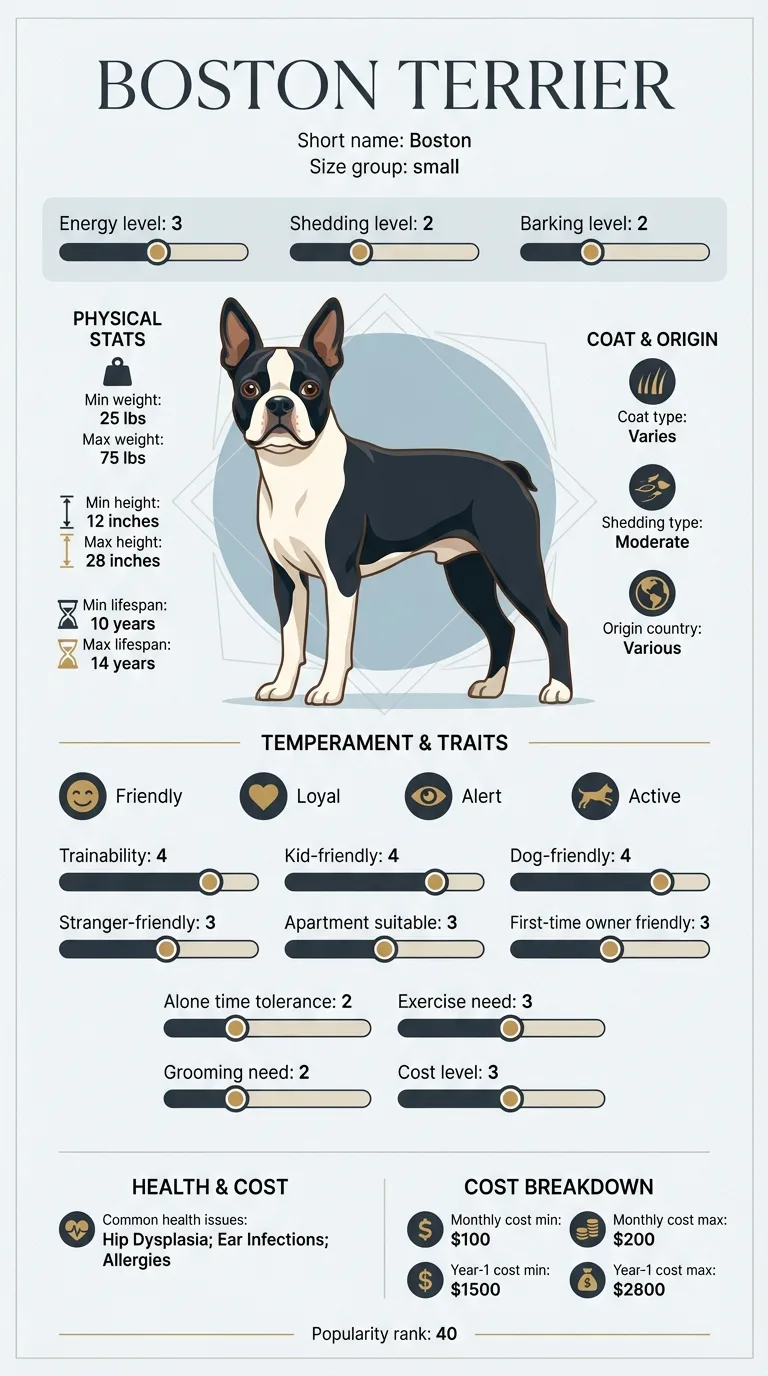
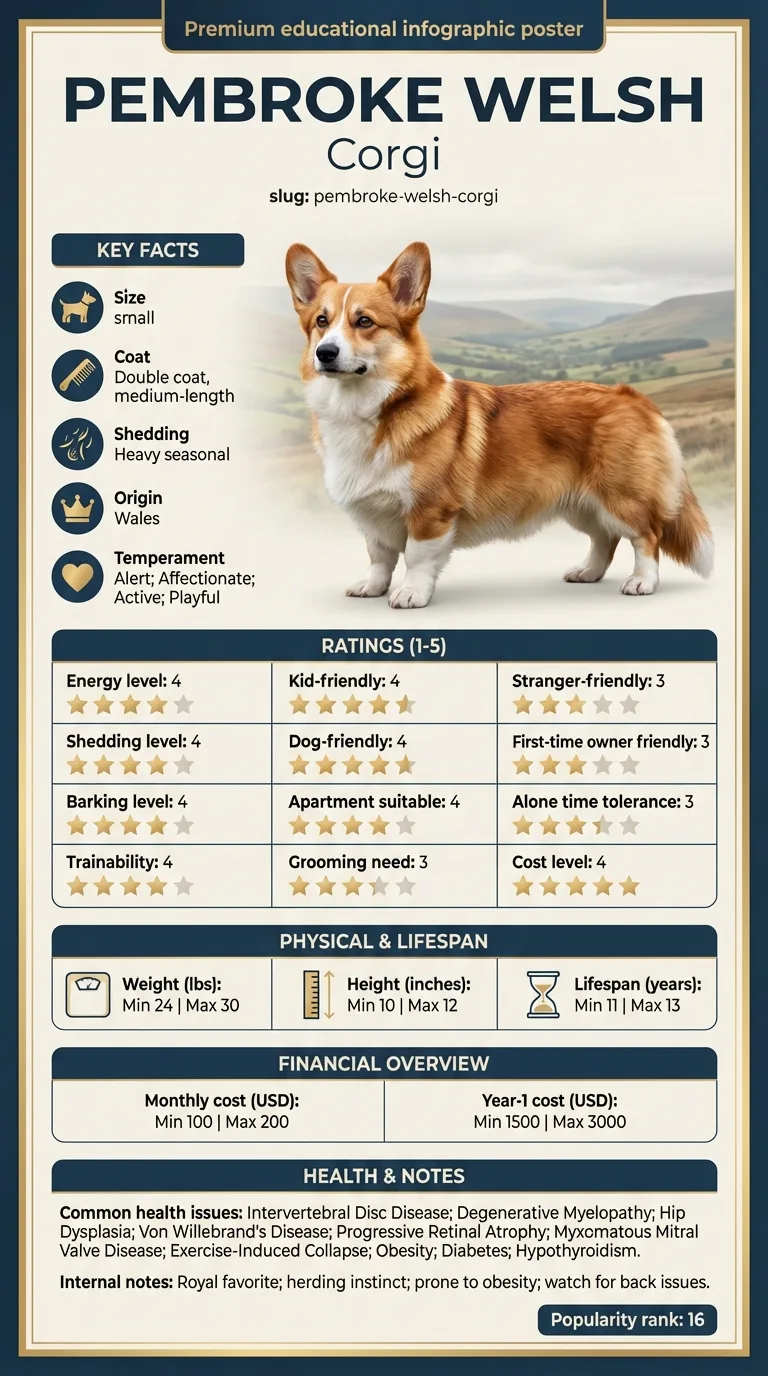
This is for someone already down to Boston Terrier and Pembroke Welsh Corgi and deciding between them. For this pair the decision usually turns on exercise need and grooming need, so those are covered first and in most detail. Anyone choosing from a flat has a clear answer here: Boston Terrier rates 5/5 against 4/5. It is written for the decision rather than the breed history.
Between Boston Terrier and Pembroke Welsh Corgi, exercise need is what separates them, and Boston Terrier is the lower-effort dog of the two to keep.
Choose Boston Terrier if you are in a flat or a smaller home, this is your first dog and you do not want a standing grooming appointment.
Choose Pembroke Welsh Corgi if you want a dog that can keep up with an active routine and you want a dog that is more watchful with visitors.
| Feature | boston terrier | pembroke welsh corgi | Winner |
|---|---|---|---|
| Size class | small | small | Equal |
| Weight | 12–25 lbs | 24–30 lbs | Equal |
| Height | 15–17 in | 10–12 in | Equal |
| Lifespan | 11–13 years | 11–13 years | Equal |
| Exercise need | Low (2/5) | High (4/5) | boston terrier |
| Grooming need | Very low (1/5) | Moderate (3/5) | boston terrier |
| Shedding | Low (2/5) | High (4/5) | boston terrier |
| Energy level | Moderate (3/5) | High (4/5) | Equal |
| Barking | Low (2/5) | High (4/5) | boston terrier |
| Apartment suitability | Very high (5/5) | High (4/5) | boston terrier |
| Good for first-time owners | Very high (5/5) | Moderate (3/5) | boston terrier |
| Tolerates being alone | Moderate (3/5) | Moderate (3/5) | Equal |
| Trainability | High (4/5) | High (4/5) | Equal |
| Good with kids | Very high (5/5) | High (4/5) | boston terrier |
| Good with other dogs | High (4/5) | High (4/5) | Equal |
| Friendly to strangers | High (4/5) | Moderate (3/5) | boston terrier |
| Cost level | Moderate (3/5) | High (4/5) | boston terrier |
| Coat | Short and smooth | Double coat, medium-length | Equal |
| Origin | Various | Wales | Equal |
| Typical monthly cost | $80–$150 | $100–$200 | Equal |
| Typical first-year cost | $1,100–$2,300 | $1,500–$3,000 | Equal |
The Boston Terrier stands 15-17 inches tall but weighs a modest 12-25 lbs on a compact, square frame. A Pembroke Welsh Corgi runs the opposite way: only 10-12 inches tall, low to the ground, yet often heavier at 24-30 lbs, packed onto that long back. Despite the different silhouettes both land in the small bracket, and both top out around 11-13 years on average.
The Corgi was bred to move cattle and it still acts like it - exercise need rates 4/5 against the Boston's 2/5. A short leash walk and some indoor play satisfies a Boston; a Corgi wants a real job or a long walk most days, and skipping that tends to show up as restlessness or extra barking. Energy level itself ties as moderate-to-high for both, so the gap is really about how much outlet each dog needs, not how lively either one feels day to day.
This is the widest gap on the whole comparison. The Boston's coat needs almost nothing - 1/5 for grooming, 2/5 for shedding - a weekly wipe-down covers it. The Corgi carries a double coat that sheds heavily (4/5) and blows its coat twice a year, so budget for a vacuum upgrade and regular brushing if you go Corgi. That grooming gap is one of the more predictable differences on this whole page - it shows up every single week, not just at the vet.
Both are rated fine for apartments, but the Boston edges it at 5/5 versus 4/5, mostly because of barking - Corgis are vocal (4/5) where Bostons stay relatively quiet (2/5). If you share walls, that difference is the one your neighbors will notice first. Both breeds tolerate being alone at a middling 3/5, so neither is a great match for owners gone ten-plus hours a day.
Trainability ties at 4/5 for both breeds, but the Boston scores higher for first-time owners, 5/5 versus 3/5. Corgis are smart enough to learn fast and stubborn enough to test you on it - herding instinct means some will nip at heels or chase moving objects, which needs early redirection. A Boston's more agreeable temperament tends to forgive training inconsistency in a way the more independent-minded Corgi does not.
Both breeds are solid with kids and other dogs, though the Boston rates a notch higher with kids (5/5 vs 4/5) and with strangers (4/5 vs 3/5). Corgis tend to be a little more reserved around new people, which is not a flaw, just a trait to plan for if you host often. With other dogs both tie at a strong 4/5, so dog-park compatibility is not a differentiator here.
The two breeds carry different risk profiles. The Boston's issues center on its flat face and eyes - BOAS, cataracts, corneal ulcers - plus patellar luxation and deafness. The Corgi's long spine and short legs put it at real risk for IVDD and degenerative myelopathy, and its list also includes hip dysplasia, heart disease and metabolic issues like diabetes and hypothyroidism. Lifespan is identical on paper at 11-13 years, so neither breed has a longevity edge to lean on.
Monthly costs run close - $80-150 for the Boston, $100-200 for the Corgi - but the first-year gap is real: $1,100-2,300 versus $1,500-3,000. Cost level itself reflects that split, rated moderate for the Boston and high for the Corgi. Grooming tools, a bigger food bowl for the heavier dog, and routine vet visits all add up on the Corgi side. If your budget is tight, that few-hundred-dollar first-year gap is worth pricing out in your own area before you commit.
Boston Terrier weighs 12–25 lbs and lives 11–13 years; Pembroke Welsh Corgi weighs 24–30 lbs and lives 11–13 years. The two diverge most on exercise need, grooming need and shedding and 2 other rated axes. They are level on tolerates being alone, good with other dogs and trainability, so those cannot decide it. In the table, a "winner" means easier for an ordinary household — not better. Size, coat and origin are recorded without a verdict. Because both breeds are scored the same way, the gaps are reliable even where the absolute numbers are rough.

By height, the Boston Terrier is taller at 15-17 inches versus the Corgi's 10-12 inches. By weight, though, the Corgi is often heavier, at 24-30 lbs against the Boston's 12-25 lbs. Both count as small breeds despite the very different builds.
The Corgi, by a clear margin - it rates 4/5 for shedding thanks to a double coat, versus 2/5 for the short-coated Boston. Expect regular brushing and seasonal coat blowouts with a Corgi.
The Boston rates 5/5 for first-time owners against the Corgi's 3/5. Corgis are trainable but bring herding instincts, like nipping and chasing, that take some active management from someone new to dogs.
Yes, both score well (Boston 5/5, Corgi 4/5), but the Corgi barks more (4/5 vs 2/5), which matters more than square footage if you have close neighbors.
The Boston runs $80-150 a month and the Corgi $100-200. Over a first year that is $1,100-2,300 for the Boston against $1,500-3,000 for the Corgi.
Not directly - their risk lists do not overlap. The Boston's problems trace to its flat face and eyes; the Corgi's trace to its long spine and to hip and heart issues. Lifespan is the same either way, 11-13 years.
The Boston, clearly - 2/5 on barking versus the Corgi's 4/5. If a quiet household matters to you, that is the deciding stat.
If you want low upkeep and quiet, go Boston. If you want an active dog that will happily hike with you, the Corgi's exercise drive (4/5) fits better despite the extra grooming and barking.
$80-150 for a Boston, $100-200 for a Corgi - close enough that food and vet care matter more than the breed choice itself.
The Boston is low-need (2/5) - a walk and some play covers it. The Corgi is high-need (4/5) and was bred to work all day, so it wants a real outlet.
Both average 11-13 years, so lifespan is not a tiebreaker here - go by lifestyle fit instead.
Secure checkout on Stripe. We never see your card.
7-day money-back guarantee. Instant access.


Health information here is general and is not veterinary advice. If your dog shows pain, sudden behaviour change, or worsening symptoms, consult a licensed veterinarian.
Some links on this site are affiliate links. We may earn a commission at no extra cost to you, and we only suggest products we believe are helpful for dog owners.
We research and check what we publish, but we do not warrant that any figure, date, price, or statement is accurate, complete, or current, and we accept no liability for any loss, cost, injury, or other harm arising from the use of this site. Use it as one reference among several. You remain responsible for your own decisions and for your dog's care - confirm anything that matters with a licensed veterinarian or another qualified professional before you act on it. Full disclaimer.
Match your lifestyle to the right dog.
Take quizNot sure which breed is right for you? Take our 2-minute quiz to find out.
Take the quiz