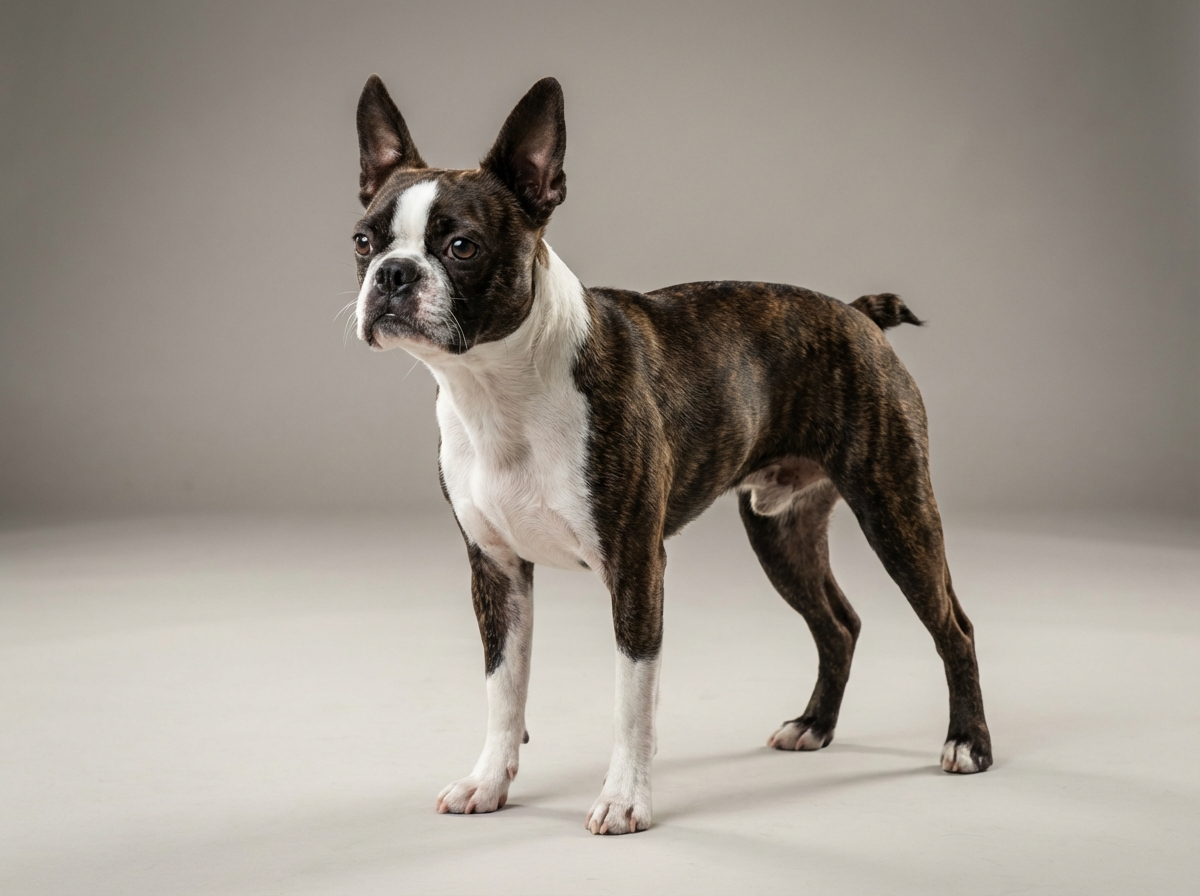
Health
What is the classic first sign?
Sudden lameness on a back leg, often with intermittent mild lameness in the weeks beforehand that had been dismissed as nothing.

Quick answer
What is the classic first sign?
Sudden lameness on a back leg, often with intermittent mild lameness in the weeks beforehand that had been dismissed as nothing.
The rabbit your dog was chasing did not cause this. It was simply the last straw for a ligament that had been failing quietly since the previous summer.
Owners whose Boston came in from the garden holding up a back leg, people choosing between surgical techniques and confused by the options, and anyone whose dog has already done one knee and is worried about the other.
This guide is not medical advice. If your dog shows pain, sudden behavior change, or worsening symptoms, consult a licensed veterinarian.
Some links may be affiliate links. We may earn a commission at no extra cost to you. We only suggest products we believe are helpful for dog owners.
We research and check what we publish, but we do not warrant that any figure, date, price, or statement is accurate, complete, or current, and we accept no liability for any loss, cost, injury, or other harm arising from the use of this site. Use it as one reference among several. You remain responsible for your own decisions and for your dog's care - confirm anything that matters with a licensed veterinarian or another qualified professional before you act on it. Full disclaimer.
Cruciate ligament rupture in dogs is usually the endpoint of gradual degeneration rather than a single traumatic injury. The ligament weakens over months under abnormal loading, and then fails during ordinary activity. In Boston Terriers, documented patellar luxation is a significant contributor, because a kneecap tracking off-line changes the forces the cruciate must resist. The second knee frequently follows within a couple of years.
Cruciate disease is one of the most frequent orthopaedic conditions in dogs overall. In Boston Terriers it is not listed among the core documented problems, but patellar luxation is - and the strong association between the two means Boston owners meet cruciate disease more often than the breed lists alone would suggest.
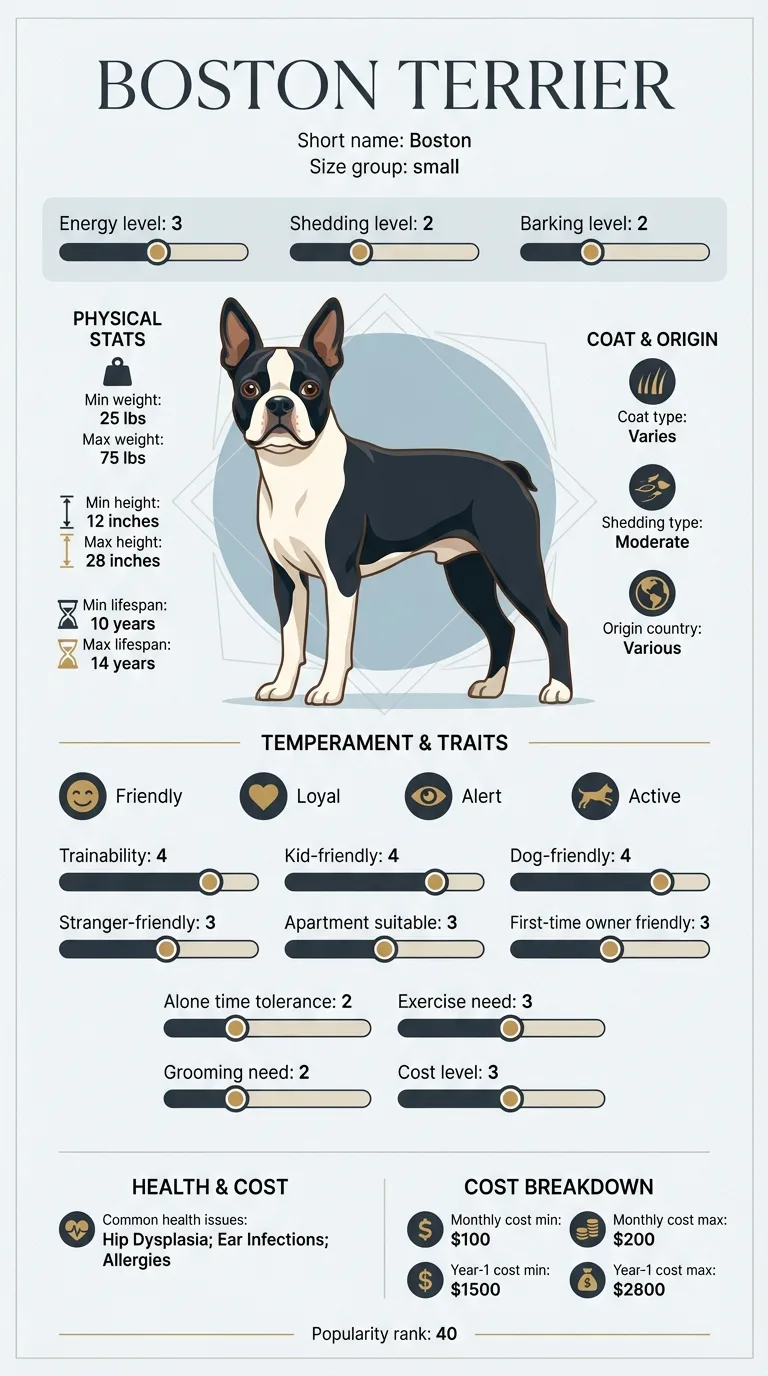
The link runs through the kneecap. Patellar luxation is documented in this breed, and a kneecap that leaves its groove changes the line of pull across the joint, introducing rotation the cruciate ligament must resist on every stride. A compact, muscular 12 to 25 pound dog with a lively temperament generates real force through that joint, and the modest exercise requirement typical of the breed means many Bostons carry more weight and less hind-limb muscle than is ideal for a marginal ligament.
Household flooring is a genuine factor - a dog that skids on laminate loads its knees unpredictably many times a day. Furniture height matters through repeated landings. The exercise pattern matters more than the total: a dog that is sedentary all week and then does something strenuous at the weekend asks an unconditioned ligament for a peak effort, which is precisely the pattern in which failures occur.
Book an appointment for any hind-limb lameness lasting more than a day or two, for a dog that sits with one back leg kicked out sideways, or for intermittent skipping on a back leg. Seek same-day attention if a leg is suddenly non-weight-bearing, if there was a yelp followed by lameness, or if the knee is hot and swollen. Sudden weakness in both hind limbs, dragging of the back feet, or loss of bladder control is a different and more urgent problem involving the spine rather than the knee, and needs emergency assessment.
See all Boston Terrier health problems, which breeds are prone to cruciate ligament injuries, or the full Boston Terrier breed guide for temperament, exercise needs and ownership costs.
Post-surgical recovery runs eight to twelve weeks of strictly graduated activity, with most dogs weight-bearing comfortably within two to three weeks and back to full function around three to four months. Conservative management in a small dog takes longer and is less predictable. Arthritis then progresses slowly for the rest of the dog's life.
A dog using the leg normally at a walk and a trot, with symmetrical thigh muscle mass, no lameness after rest, and a maintained lean weight. The realistic definition includes some arthritis in that joint - what you are aiming for is arthritis that never limits the dog.
Two things load a dog's cruciate ligament abnormally, and Boston Terriers are exposed to one of them by breed.
Patellar luxation is on this breed's documented health list. A kneecap that slips out of its groove changes how the quadriceps pulls across the joint, and an off-axis pull means the knee no longer flexes and extends in a clean plane. Every step introduces a small rotational component the cruciate has to resist, and a ligament resisting a force it was not designed for degrades over time.
The second factor is the slope of the top of the shin bone. In dogs, the tibial plateau tilts backward, so weight-bearing generates a constant forward shear that the cruciate opposes. Steeper slopes mean higher shear, and slope varies between individuals.
Add bodyweight to either of those and the arithmetic worsens. On a dog that should weigh 12 to 25 pounds, two or three extra pounds is a large proportional increase in the force crossing a compromised ligament thousands of times a day.
This explains why cruciate rupture in dogs so often has no dramatic history, and why the dog frequently has mild intermittent lameness in the weeks before the day it finally fails.

This is the part owners are least prepared for. Because the underlying problem is degenerative and usually affects both knees, a substantial proportion of dogs rupture the second cruciate within a year or two of the first. Planning for that possibility from day one changes the decisions you make.
Gemma's Boston, Nutmeg, had been doing something odd on her left back leg for about a year - a couple of skipping steps after getting up, then normal walking. Two vets had felt a mildly luxating patella and agreed it was not currently causing a problem. On a Sunday in October, Nutmeg jumped off a low wall and came up three-legged. The cruciate had gone completely. Surgery went well, and the surgeon made a point of examining the right knee too, noting mild instability and a kneecap doing the same thing. Gemma took that seriously. Nutmeg came down two pounds over the following four months, finished a full rehabilitation programme, and had rugs put down through the hallway. Three years on, the right knee has held. Gemma is fairly sure that is not luck.
Key takeaway: The intermittent skip that nobody worried about was the warning. Treat a luxating kneecap as a cruciate problem in slow motion, and act on the second leg before it fails.
Usually sudden hind-limb lameness, often with the toe just touching the ground. Many dogs improve partially over a week or two, which convinces owners it is healing, then deteriorate again as the unstable joint becomes inflamed.
A ruptured ligament does not repair itself. Some small dogs stabilise reasonably well with conservative management, weight control and rehabilitation, but the joint remains unstable and arthritis progresses. Surgery gives more predictable outcomes in most cases.
Both stabilising sutures outside the joint and procedures that alter the geometry of the shin bone are used in small breeds, and the choice depends on the dog's size, tibial slope, activity level and the surgeon's experience. Ask why the recommended option suits your particular dog.
It is the same disease earlier on. Partial tears typically progress to complete rupture, which is why a partly torn ligament is treated as a knee already on the way rather than an injury that might settle.
Some degree of arthritis follows cruciate disease regardless of treatment. Surgery slows its progression by stabilising the joint; it does not prevent it. Long-term weight control and muscle maintenance make a real difference to how much it matters.
A large proportion of affected dogs rupture the second cruciate within a couple of years, because the underlying degeneration is usually bilateral. That is a reason to prepare rather than to panic.
Absolutely, and it is the part owners most often shorten. A dog that feels well at three weeks and is allowed to run can undo the repair. Follow the graduated plan to the letter.
Sudden lameness on a back leg, often with intermittent mild lameness in the weeks beforehand that had been dismissed as nothing.
Yes. Patellar luxation is documented in this breed and it loads the cruciate abnormally, which is why the two problems so often appear in the same dog.
Knee stabilisation surgery is a significant cost per leg, and many dogs eventually need both. Check whether your insurance treats the second knee as a separate condition.
Keeping the dog lean, non-slip flooring, and completing the full rehabilitation programme rather than stopping when the dog seems better.
A one-page prep sheet for this condition: the signs, the questions to ask, what to get priced. Unlocks here.
You get: Vet visit prep sheet
No spam. One-click unsubscribe. See our privacy policy.
Preview page 1 before you decide.