Boston Terrier vs Siberian Husky: Which Suits Your Home?
Quick answer
Boston Terrier or Siberian Husky — which fits most households?
The Boston, for the vast majority of owners — it rates 5/5 for first-timers and apartment living, versus the Husky's 1/5 on both. The Husky needs a specific kind of home: active, fenced, experienced.
Boston Terrier or Siberian Husky? On paper they differ most on apartment suitability, and on the scales Siberian Husky is the heavier at 45–60 lbs. Here is how the two compare on everything that shapes an ordinary week.
This is for someone already down to Boston Terrier and Siberian Husky and deciding between them. For this pair the decision usually turns on apartment suitability and good for first-time owners, so those are covered first and in most detail. Anyone choosing from a flat has a clear answer here: Boston Terrier rates 5/5 against 1/5. Breed history is left out; what follows is what you will actually live with.
Quick verdict
Between Boston Terrier and Siberian Husky, apartment suitability is what separates them, and Boston Terrier is the lower-effort dog of the two to keep.
Choose boston terrier if...
Choose Boston Terrier if you are in a flat or a smaller home, this is your first dog and you do not want a standing grooming appointment.
Choose siberian husky if...
Choose Siberian Husky if you want a dog that can keep up with an active routine.
Head-to-head comparison
Feature
boston terrier
siberian husky
Winner
Size class
small
large
Equal
Weight
12–25 lbs
45–60 lbs
Equal
Height
15–17 in
20–23 in
Equal
Lifespan
11–13 years
12–14 years
siberian husky
Exercise need
Low (2/5)
Very high (5/5)
boston terrier
Grooming need
Very low (1/5)
Moderate (3/5)
boston terrier
Shedding
Low (2/5)
Very high (5/5)
boston terrier
Energy level
Moderate (3/5)
Very high (5/5)
Equal
Barking
Low (2/5)
Moderate (3/5)
boston terrier
Apartment suitability
Very high (5/5)
Very low (1/5)
boston terrier
Good for first-time owners
Very high (5/5)
Very low (1/5)
boston terrier
Tolerates being alone
Moderate (3/5)
Very low (1/5)
boston terrier
Trainability
High (4/5)
Low (2/5)
boston terrier
Good with kids
Very high (5/5)
Very high (5/5)
Equal
Good with other dogs
High (4/5)
High (4/5)
Equal
Friendly to strangers
High (4/5)
High (4/5)
Equal
Cost level
Moderate (3/5)
Moderate (3/5)
Equal
Coat
Short and smooth
Double coat, medium-length
Equal
Origin
Various
Russia
Equal
Typical monthly cost
$80–$150
$100–$200
Equal
Typical first-year cost
$1,100–$2,300
$1,500–$2,800
Equal
Deep dive
Size and build
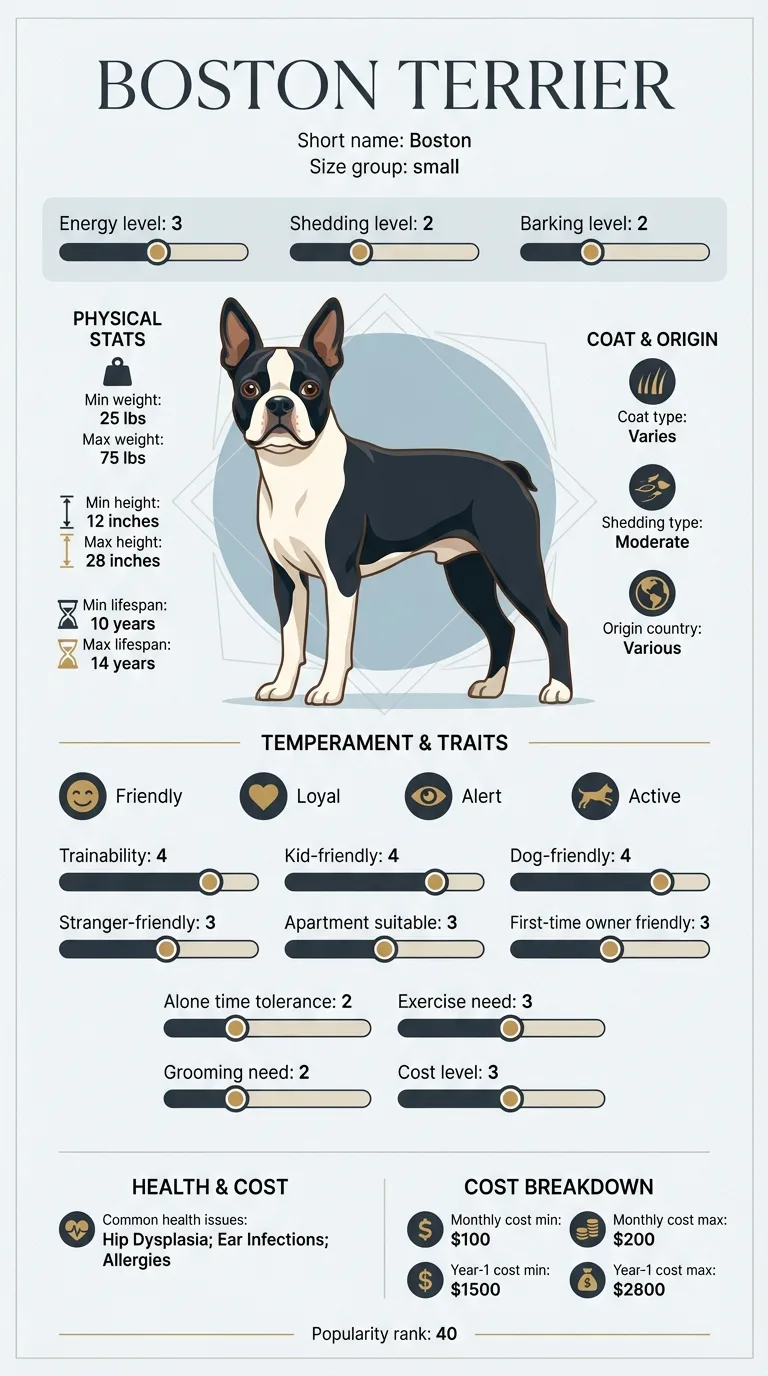
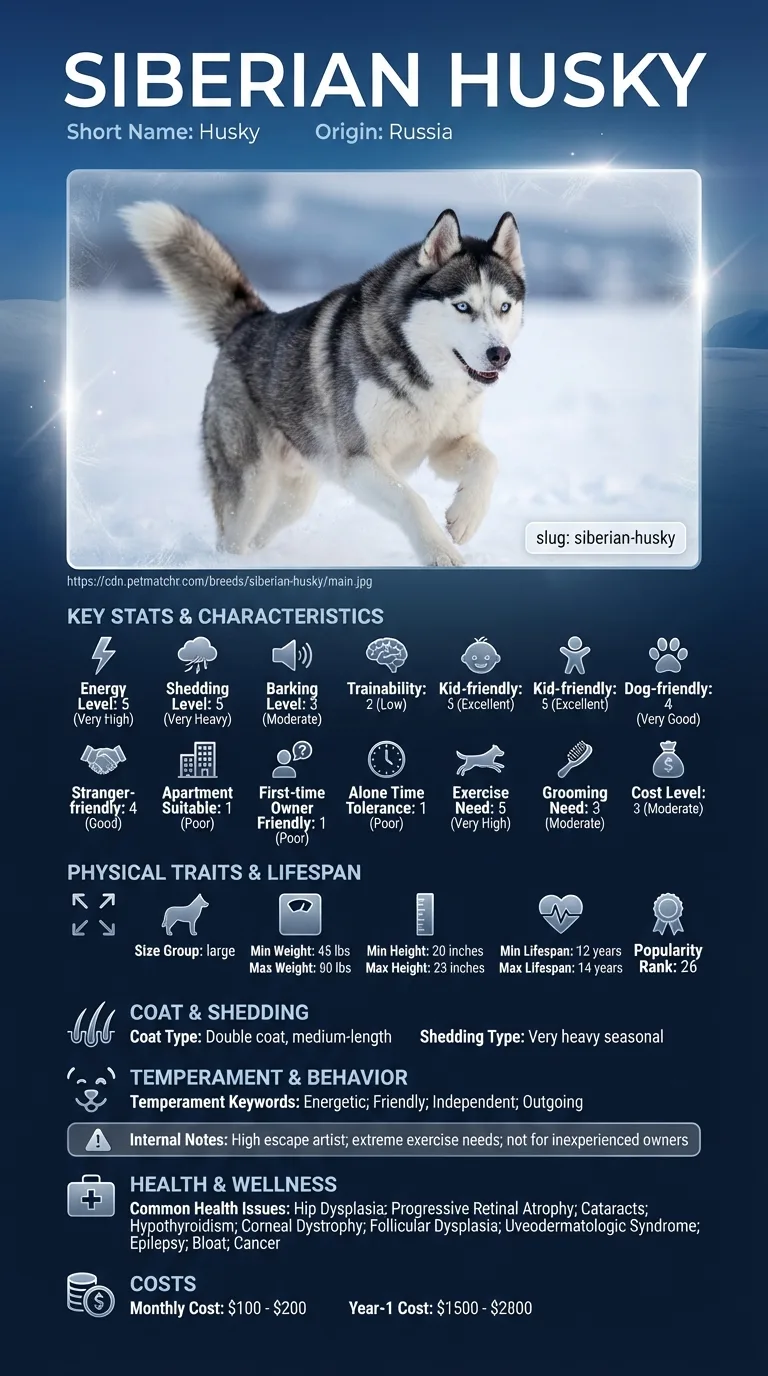
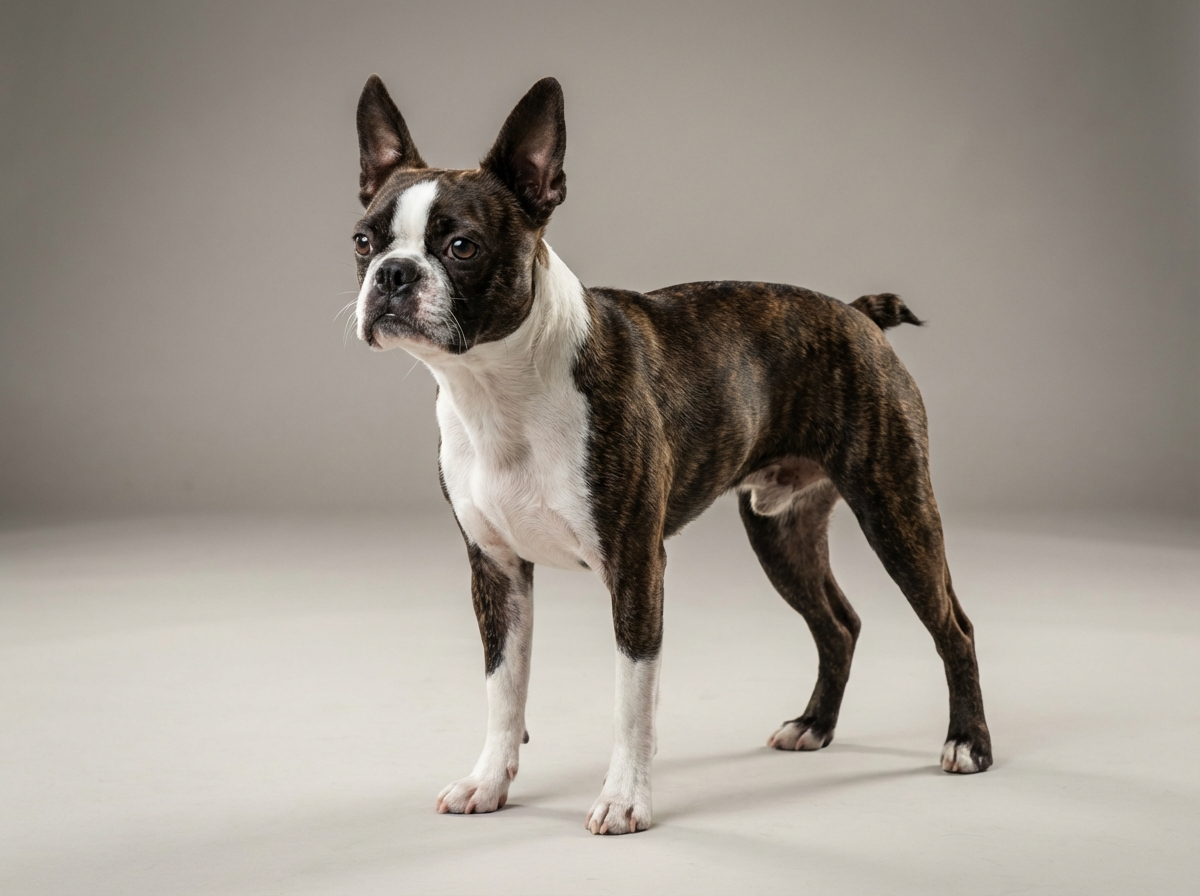
There's no subtlety to this size difference. A Siberian Husky runs 45 to 60 pounds and 20 to 23 inches — built for pulling sleds across snow for hours. A Boston Terrier tops out at 25 pounds and 17 inches, built for exactly none of that. If you're picturing these two side by side, picture a real gap, not a rounding error.
Energy and exercise
The Husky rates a 5/5 for both exercise need and energy — as high as this data goes. It was bred to run long distances daily, and that instinct doesn't switch off in a backyard. The Boston's 2/5 exercise need is a completely different animal, satisfied by short walks and some couch time. Committing to a Husky without a serious daily exercise plan is asking for a demolished house.
Grooming and shedding
The Husky's double coat rates a moderate 3/5 for grooming but a full 5/5 for shedding — it blows its undercoat twice a year in a way that genuinely surprises new owners. The Boston needs almost no grooming (1/5) and sheds lightly (2/5). If you own dark furniture and value your vacuum's motor, that shedding gap is worth sitting with.
Apartment living, noise and time alone
The Boston rates a full 5/5 for apartment living; the Husky rates a 1/5 — about as clear a mismatch as this data shows. Add in the Husky's rock-bottom 1/5 tolerance for being alone, and you have a dog that's genuinely unsuited to small-space, work-all-day living. The Boston, tolerating alone time at a moderate 3/5, is simply the more forgiving choice for anyone without a yard.
Training and owner experience
The gap here is stark: the Boston rates 5/5 for first-time owners and 4/5 for trainability, while the Husky rates just 1/5 for first-timers and 2/5 for trainability. Huskies are notoriously independent and were bred to problem-solve on their own, which makes them a poor fit for anyone hoping obedience training will come easily.
Kids, other dogs and visitors
Both breeds actually score well with kids (5/5 each) and other dogs (4/5 each), and the Husky matches the Boston's 4/5 friendliness to strangers. Socially, this pairing is closer than the exercise and training numbers suggest — a well-exercised Husky can be a genuinely warm family dog, it's just the exercise and containment side of the equation that trips owners up.
Health and lifespan
The Husky edges the Boston on lifespan, 12 to 14 years versus 11 to 13, and carries a longer health list that includes hip dysplasia, epilepsy, bloat, and cancer. Cataracts show up in both breeds' data. The Boston's shorter list stays concentrated around its flat face and eyes, a narrower but still real set of risks to plan for.
Cost to keep
Both land at a moderate 3/5 cost rating, though the Husky runs a bit higher in real numbers: $100–$200 monthly against the Boston's $80–$150, and $1,500–$2,800 in year one versus $1,100–$2,300. Food alone accounts for some of that gap given the weight difference, before you even factor in a securely fenced yard, which a Husky effectively requires.
Boston Terrier vs Siberian Husky at a glance
Boston Terrier weighs 12–25 lbs and lives 11–13 years; Siberian Husky weighs 45–60 lbs and lives 12–14 years. The two diverge most on apartment suitability, good for first-time owners and exercise need and 5 other rated axes. They are level on cost level, good with other dogs and good with kids, so those cannot decide it. The comparison marks an easier option only where one exists. Facts like weight and country of origin are not scored. Both dogs are rated from the same dataset, which is what makes the numbers comparable with each other even though any individual dog sits somewhere inside its breed's range.
Boston Terrier vs Siberian Husky: Which Suits Your Home? - Boston Terrier vs Siberian Husky at a glance
Frequently asked questions
How much bigger is a Husky than a Boston Terrier?
Substantially — a Husky runs 45 to 60 pounds against the Boston's 12 to 25, roughly double to triple the weight, plus several extra inches of height.
Can a Husky live in an apartment?
Not comfortably, based on this data — it rates just 1/5 for apartment suitability and 1/5 for tolerating being alone. The Boston Terrier, at 5/5 on apartment fit, is built for exactly the living situation the Husky struggles with.
Is a Husky a good first dog?
Rarely — it rates 1/5 for first-time owners and 2/5 for trainability, reflecting its independent, high-energy nature. The Boston Terrier's 5/5 first-timer rating makes it the far more realistic starting point.
Which sheds more?
The Husky, dramatically — a 5/5 shedding rating from its double coat, which blows out seasonally. The Boston's 2/5 is a fraction of that.
What does each cost monthly?
$80-150 for the Boston Terrier, $100-200 for the Husky — a real but not enormous gap, mostly driven by food volume and coat care.
Do these breeds share health risks?
Cataracts appear in both breeds' data. Otherwise their risk profiles differ substantially — the Husky's list includes hip dysplasia, epilepsy, bloat, and cancer, while the Boston's centers on its short muzzle and eyes.
Are Huskies good with kids?
Yes, according to this data — a full 5/5, matching the Boston Terrier exactly. The challenge with a Husky is rarely the family dynamic; it's the exercise and containment demands.
Boston Terrier or Siberian Husky — which fits most households?
The Boston, for the vast majority of owners — it rates 5/5 for first-timers and apartment living, versus the Husky's 1/5 on both. The Husky needs a specific kind of home: active, fenced, experienced.
Costs
What's the cost difference?
The Husky runs a bit higher, $100-200 monthly versus $80-150 for the Boston, mostly from food and coat care.
Behavior
Which needs more exercise?
The Husky, at a maxed-out 5/5 versus the Boston's 2/5 — it needs serious daily activity, not a short walk.
Health
Which lives longer?
The Husky, typically 12-14 years versus 11-13 for the Boston.
Related DogBreedCompass guides
Boston Terrier breed guide – Readers comparing the two usually want the full profile of Boston Terrier before deciding.
Siberian Husky breed guide – The same for Siberian Husky, so the comparison can be checked against the detail.
Boston Terrier vs Pug – Pug is the closest breed to Boston Terrier on the measured axes, so it is the natural next comparison.
Health information here is general and is not veterinary advice. If your dog shows pain, sudden behaviour change, or worsening symptoms, consult a licensed veterinarian.
Some links on this site are affiliate links. We may earn a commission at no extra cost to you, and we only suggest products we believe are helpful for dog owners.
We research and check what we publish, but we do not warrant that any figure, date, price, or statement is accurate, complete, or current, and we accept no liability for any loss, cost, injury, or other harm arising from the use of this site. Use it as one reference among several. You remain responsible for your own decisions and for your dog's care - confirm anything that matters with a licensed veterinarian or another qualified professional before you act on it. Full disclaimer.