Health
What are the first signs of hypothyroidism in a dog?
Unexplained weight gain on the same food, a dull thinning coat, and seeking out warm places. Lethargy usually follows rather than leads.

Quick answer
What are the first signs of hypothyroidism in a dog?
Unexplained weight gain on the same food, a dull thinning coat, and seeking out warm places. Lethargy usually follows rather than leads.
The most reliable early sign is not lethargy. It is a dog gaining weight on the exact same bowl of food it has eaten for years.
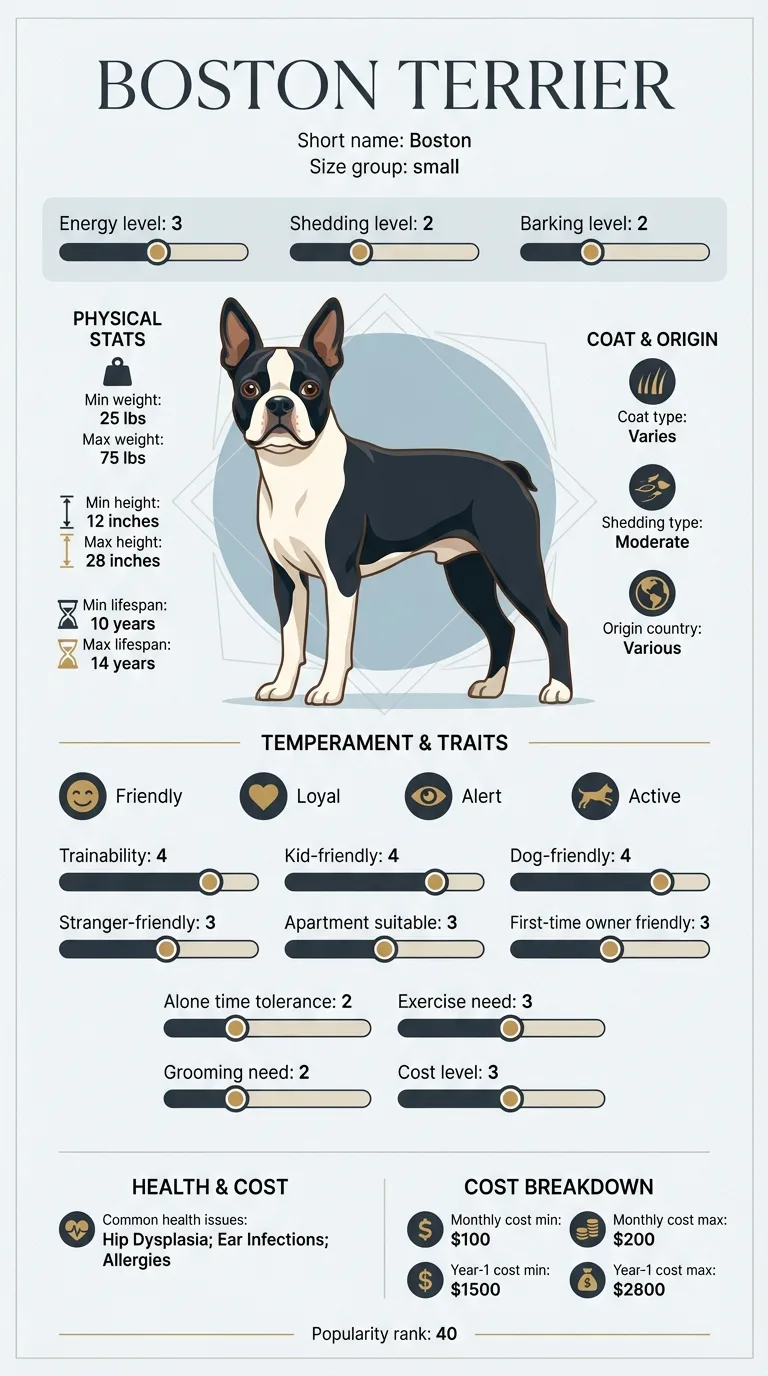
Owners of Bostons in the four to ten range who have watched a comical, lively dog become oddly settled, and who have been told the bloodwork is borderline and to test again later.
This guide is not medical advice. If your dog shows pain, sudden behavior change, or worsening symptoms, consult a licensed veterinarian.
Some links may be affiliate links. We may earn a commission at no extra cost to you. We only suggest products we believe are helpful for dog owners.
Hypothyroidism is an underactive thyroid gland producing insufficient hormone to maintain normal metabolic rate. In dogs it is almost always acquired in middle age rather than congenital. The presentation is a slow, whole-body slowdown rather than any single dramatic symptom, which is exactly why it goes unrecognised for months.
Hypothyroidism is one of the more frequently diagnosed canine endocrine disorders overall, but it is not a signature Boston Terrier condition. The breed's documented issues are brachycephalic airway syndrome, patellar luxation, cataracts, corneal ulcers and deafness. In practice a Boston showing the classic cluster gets tested like any other dog, and most turn out to have something else.
There is no strong breed-specific predisposition described in Boston Terriers, and this page should not be read as claiming one. Two general points still apply. The breed's compact 12 to 25 pound frame means a small absolute weight gain represents a large proportional change, so the metabolic slowdown becomes visible early. And the short smooth coat makes skin and hair changes conspicuous in a way a thick double coat would hide.
Environment does not cause the gland to fail, but it shapes how quickly the consequences show. A dog already carrying extra weight, already exercising less because of heat or airway limits, or already prone to skin problems will cross the visible threshold sooner. Concurrent illness and certain medications suppress thyroid readings, which is an environmental factor in the sense that it affects diagnosis rather than disease.
Book an appointment for unexplained weight gain, symmetrical hair thinning without itching, repeated skin or ear infections, or a distinct drop in energy over weeks to months. Ask specifically about a full thyroid panel rather than a single value. Seek urgent care instead if lethargy is sudden rather than gradual, if the gums are pale, if breathing is laboured at rest, or if the dog collapses, because those point at acute problems that have nothing to do with the thyroid.
See all Boston Terrier health problems, which breeds are prone to hypothyroidism, or the full Boston Terrier breed guide for temperament, exercise needs and ownership costs.
Expect two to four weeks for energy to lift after treatment starts, six to eight weeks before the first dose-check blood test, and two to four months for coat and skin to visibly recover. Weight normalises over a similar period with portion control. Dose adjustments in the first six months are normal rather than a sign anything is wrong.
A dog back to its own baseline personality, at a stable weight, with a coat that has filled in and skin infections that have stopped recurring. Success is not a normal thyroid gland. The gland does not recover, and medication continues for life.
No single sign means much. Hypothyroidism is recognised by a group of changes appearing together over months.
A single low total thyroid hormone result does not diagnose hypothyroidism, and acting on one is the most common error in this area.
The reason is that thyroid hormone levels drop in response to other illnesses. A dog with an infection, a chronic inflammatory problem, or significant pain will often show a low reading simply because the body has dialled metabolism down while it deals with something else. Treating that dog with thyroid supplementation does not help and delays finding the real problem.
Several medications also suppress the numbers, including some anti-inflammatories and anticonvulsants. Any current medication should be on the form when the sample goes off.
A fuller panel measures more than one marker, usually including a free hormone fraction and a pituitary signalling hormone. When the thyroid gland itself is failing, the pituitary shouts louder, so a high signalling hormone alongside low thyroid output is the pattern that makes the diagnosis solid.
Timing matters too. Ideally the dog is otherwise well, is not on suppressing medication, and has not just been through an illness. If the picture is genuinely borderline, retesting in six to eight weeks is a reasonable and common plan rather than a stalling tactic.
One more caution specific to short-muzzled breeds: lethargy and exercise intolerance in a Boston are far more often airway-driven than thyroid-driven. A thyroid panel is worth running, and it is also worth asking whether breathing has been assessed properly.

If you think your Boston has hypothyroidism, the plan is three steps: write down what you have seen and when it started, book a veterinary appointment rather than waiting for the next flare, and take video of the behaviour or symptom before you go — the thing you are worried about rarely happens in the consulting room. Screening in the parents covers brachycephalic airway syndrome (boas), patellar luxation, cataracts.
What the vet visit should produce is a diagnosis and a written plan, not just reassurance: what is being ruled out, what the monitoring interval is, and which signs mean you come back sooner. Ask what the treatment costs across a year rather than per visit, because that is the number that decides whether you are managing this condition or reacting to it.
Between appointments, keep a short log — dates, what you saw, what changed. It is the single most useful thing an owner brings to a follow-up, and for hypothyroidism it is often what separates a clear pattern from a guess.
Gus turned six and, over about eight months, became a different dog. He stopped meeting his owner Fran at the door. He gained three pounds on a diet she had not changed since he was two. He started sleeping pressed against the radiator in a house where he had spent every previous summer lying on the bathroom tiles. Fran mentioned it almost in passing at his annual vaccination, framed as him mellowing with age. Her vet took the radiator detail seriously. A full thyroid panel showed low hormone output with a raised pituitary signal, the combination that makes the diagnosis firm. Gus started daily replacement therapy in March. By the end of the month he was meeting her at the door again. The bald patches over his flanks took until July to fill in, and Fran had to cut his portions by a fifth to shift the three pounds. He is nine now and, in her words, has been himself for three years.
Key takeaway: The detail that cracked the case was a heat-seeking Boston Terrier, which is close to a contradiction in terms. Small behavioural reversals are worth mentioning even when they sound trivial.
The breeds most strongly associated with it are Golden Retrievers, Dobermans, Irish Setters and several others. Bostons are not among the classic high-risk breeds, and their documented health problems run to airway, kneecap and eye conditions. Hypothyroidism occurs across many breeds, so it stays on the list of things to test for when the signs cluster.
Most dogs are diagnosed somewhere between four and ten years old. It is uncommon in puppies and young adults, so a lethargic two-year-old Boston is more likely to have an airway, orthopaedic or behavioural explanation than a thyroid one.
It is one of the more satisfying diagnoses in veterinary medicine because replacement therapy works well. It is lifelong, given daily, and requires periodic blood monitoring to keep the dose right, but a correctly treated dog usually returns close to its previous self.
Energy and demeanour often lift within two to four weeks. Skin and coat take much longer, commonly two to four months, because hair has to grow. Weight comes off over a similar period and only if food is managed alongside the medication.
Reduced activity, less engagement and more sleeping are well recognised. Claims that it causes aggression are much weaker and contested in the literature. If a Boston has become genuinely reactive, look for pain, fear or a learned pattern before attributing it to the thyroid.
No. Once the dose is right, metabolic rate returns toward normal and weight becomes manageable again. Owners still need to reduce portions during the transition, because the dog has usually been eating for a higher metabolic rate than it currently has.
Unexplained weight gain on the same food, a dull thinning coat, and seeking out warm places. Lethargy usually follows rather than leads.
With a thyroid panel measuring several markers rather than a single hormone value, interpreted alongside the dog's overall health and any current medications.
Typically modest, often in the range of a few tens of dollars monthly for a 12 to 25 pound dog, plus periodic monitoring bloodwork.
No diet or supplement replaces thyroid hormone. Diet matters only for managing the weight gained while the gland was underactive.
A one-page prep sheet for this condition: the signs, the questions to ask, what to get priced. Unlocks here.
You get: Vet visit prep sheet
No spam. One-click unsubscribe. See our privacy policy.
Preview page 1 before you decide.