Boston Terrier vs Cane Corso: Which Suits Your Home?
Quick answer
Boston Terrier or Cane Corso - which fits your life?
If you live in an apartment, are new to dogs, or don't have an hour a day for exercise, the Boston Terrier fits better on every relevant score. The Cane Corso suits an experienced owner with space and time for serious daily activity.
Boston Terrier or Cane Corso? On paper they differ most on apartment suitability, and on the scales Cane Corso is the heavier at 90–110 lbs. Here is how the two compare on everything that shapes an ordinary week.
This is for someone already down to Boston Terrier and Cane Corso and deciding between them. For this pair the decision usually turns on apartment suitability and good for first-time owners, so those are covered first and in most detail. Anyone choosing from a flat has a clear answer here: Boston Terrier rates 5/5 against 1/5. Breed history is left out; what follows is what you will actually live with.
Quick verdict
Between Boston Terrier and Cane Corso, apartment suitability is what separates them, and Boston Terrier is the lower-effort dog of the two to keep.
Choose boston terrier if...
Choose Boston Terrier if you are in a flat or a smaller home, this is your first dog and you do not want a standing grooming appointment.
Choose cane corso if...
Choose Cane Corso if you want a dog that can keep up with an active routine and you want a dog that is more watchful with visitors.
Head-to-head comparison
Feature
boston terrier
cane corso
Winner
Size class
small
giant
Equal
Weight
12–25 lbs
90–110 lbs
Equal
Height
15–17 in
24–28 in
Equal
Lifespan
11–13 years
9–12 years
boston terrier
Exercise need
Low (2/5)
High (4/5)
boston terrier
Grooming need
Very low (1/5)
Low (2/5)
boston terrier
Shedding
Low (2/5)
Moderate (3/5)
boston terrier
Energy level
Moderate (3/5)
High (4/5)
Equal
Barking
Low (2/5)
Moderate (3/5)
boston terrier
Apartment suitability
Very high (5/5)
Very low (1/5)
boston terrier
Good for first-time owners
Very high (5/5)
Very low (1/5)
boston terrier
Tolerates being alone
Moderate (3/5)
Low (2/5)
boston terrier
Trainability
High (4/5)
High (4/5)
Equal
Good with kids
Very high (5/5)
Moderate (3/5)
boston terrier
Good with other dogs
High (4/5)
Low (2/5)
boston terrier
Friendly to strangers
High (4/5)
Low (2/5)
boston terrier
Cost level
Moderate (3/5)
Very high (5/5)
boston terrier
Coat
Short and smooth
Short, dense
Equal
Origin
Various
Italy
Equal
Typical monthly cost
$80–$150
$150–$300
Equal
Typical first-year cost
$1,100–$2,300
$2,000–$4,000
Equal
Deep dive
Size and build
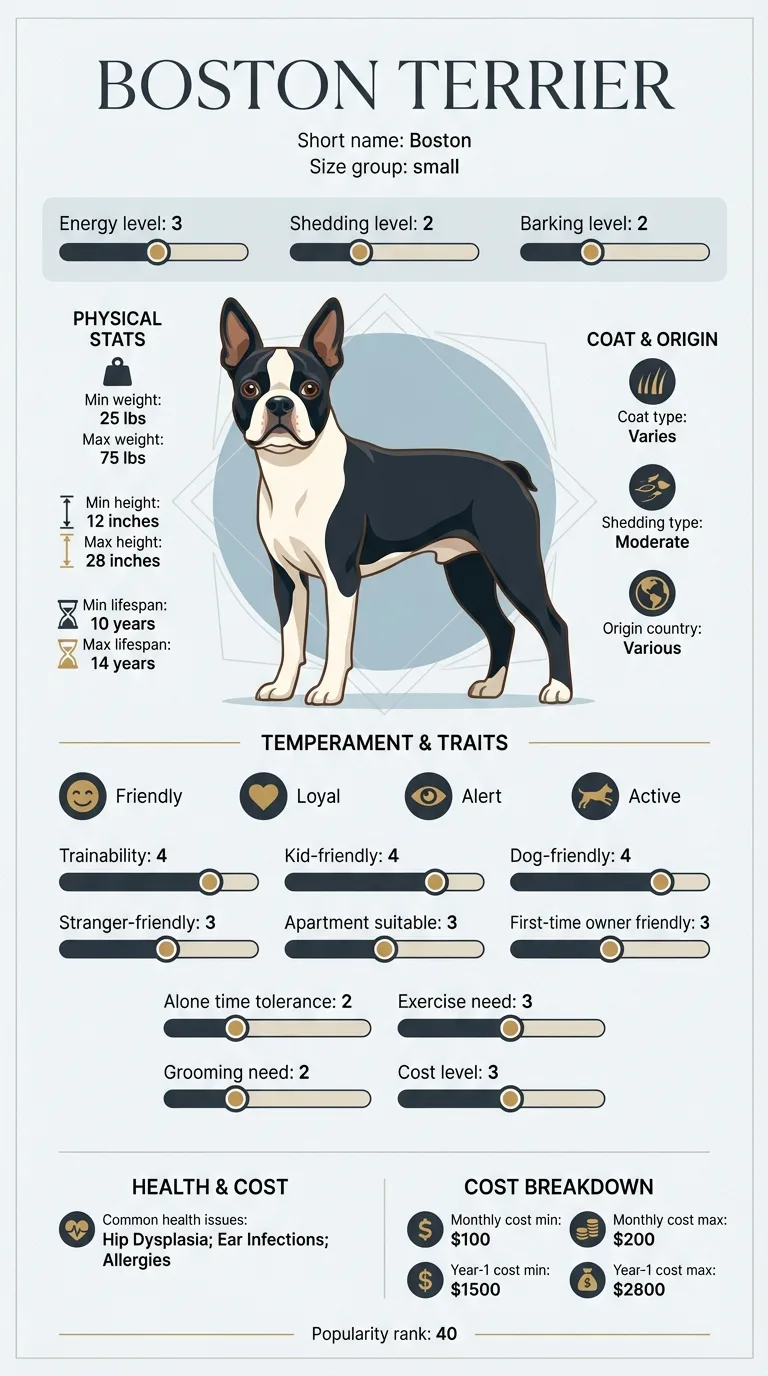
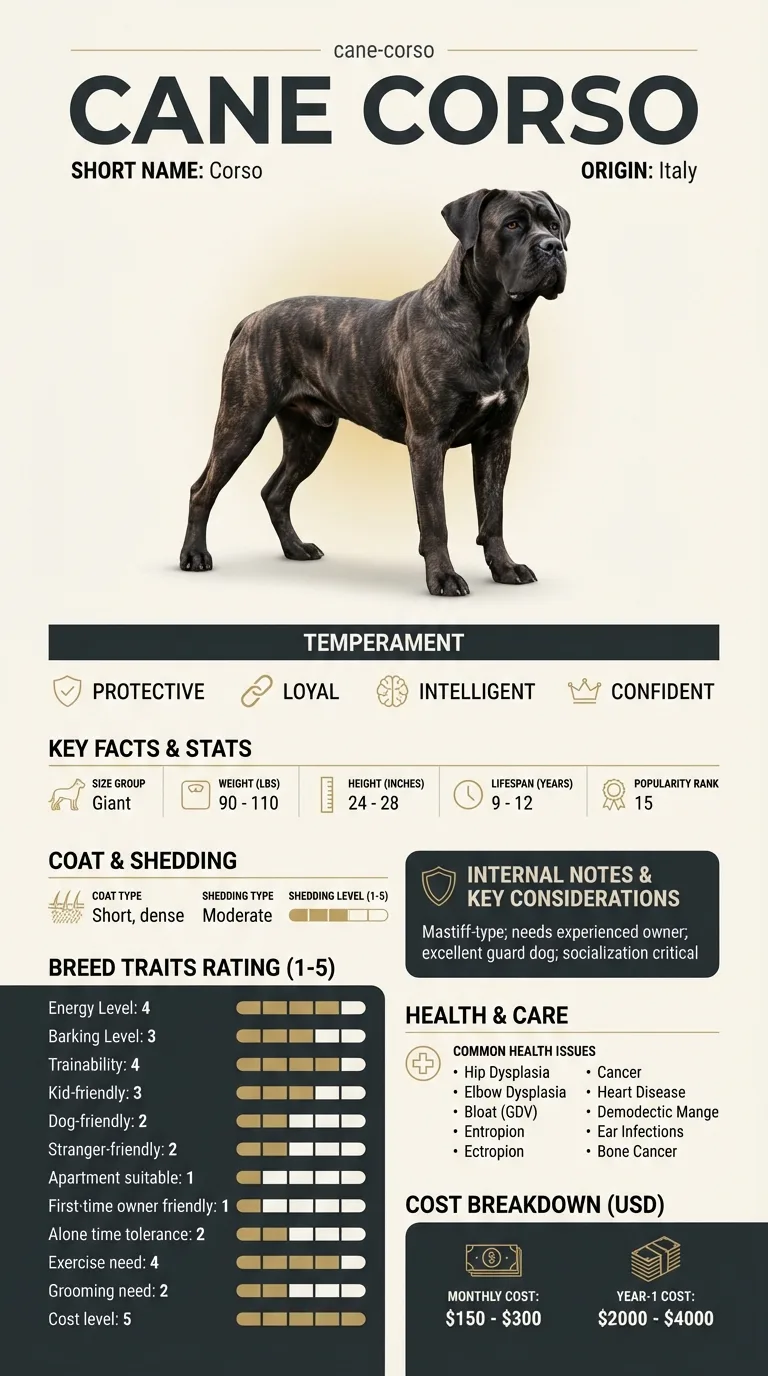
This is a genuine size mismatch: the Boston Terrier weighs 12-25 lbs and stands 15-17 inches, while the Cane Corso is a giant breed at 90-110 lbs and 24-28 inches. You're comparing a lap-sized dog to one that can put its paws on your shoulders. Living space and furniture wear should factor into this decision as much as looks do.
Energy and exercise
The Cane Corso needs high exercise (4/5) against the Boston's low (2/5) - expect real daily work, not a stroll around the block, if you choose the Corso. Energy level tells a similar story: moderate (3/5) for the Boston, high (4/5) for the Corso. An under-exercised Cane Corso is a management problem; an under-exercised Boston is just a bored one.
Grooming and shedding
Both breeds are low-maintenance coat-wise, but not equally. The Boston scores 1/5 for grooming and 2/5 for shedding; the Corso is close behind at 2/5 and 3/5. Neither needs a groomer, though the Corso's larger surface area means more hair volume even at a similar shedding rating, so vacuuming frequency will still differ noticeably between the two despite the close scores.
Apartment living, noise and time alone
The gap here is stark: Boston Terriers score 5/5 for apartment suitability, Cane Corsos score 1/5. Barking follows the same pattern - low (2/5) for the Boston, moderate (3/5) for the Corso. A Cane Corso in a small apartment is workable only with serious daily exercise; it isn't the breed's natural fit, and a bored, under-exercised Corso in a confined space tends to become a genuine handling problem rather than a minor annoyance.
Training and owner experience
Trainability actually ties at high (4/5) for both - the Corso is not hard to teach. The real gap is experience level required: Boston Terriers rate 5/5 for first-time owners, Cane Corsos rate 1/5. A Corso's size and protective instincts mean handling mistakes have bigger consequences, which is why breed guides steer new owners away from it, no matter how trainable the dog turns out to be in practice.
Kids, other dogs and visitors
With kids, the Boston rates very high (5/5) and the Corso moderate (3/5) - supervision matters more with a 100-lb dog around small children regardless of temperament. The pattern repeats with other dogs (4/5 vs. 2/5) and strangers (4/5 vs. 2/5): the Corso is a guardian breed, reserved and protective by design, while the Boston is built to be everybody's friend.
Health and lifespan
Lifespan favors the Boston, 11-13 years against the Corso's 9-12. The Corso's health list runs to serious large-breed concerns - hip and elbow dysplasia, bloat, and both cancer and bone cancer - while the Boston's issues center on its brachycephalic airway and eyes. Both lists deserve a conversation with a vet before you commit, but the Corso's carries a heavier long-term monitoring load.
Cost to keep
Monthly costs run $80-$150 for the Boston versus $150-$300 for the Corso, and first-year costs are $1,100-$2,300 against $2,000-$4,000. Food volume alone explains part of the gap - a 100-lb dog eats a lot more than a 20-lb one - before you even factor in the Corso's larger-breed health risks, which tend to bring bigger vet bills when something does go wrong.
Boston Terrier vs Cane Corso at a glance
Boston Terrier weighs 12–25 lbs and lives 11–13 years; Cane Corso weighs 90–110 lbs and lives 9–12 years. The two diverge most on apartment suitability, good for first-time owners and exercise need and 4 other rated axes. Almost every rated axis separates them at least slightly. The comparison marks an easier option only where one exists. Facts like weight and country of origin are not scored. Both dogs are rated from the same dataset, which is what makes the numbers comparable with each other even though any individual dog sits somewhere inside its breed's range.
Boston Terrier vs Cane Corso: Which Suits Your Home? - Boston Terrier vs Cane Corso at a glance
Frequently asked questions
Can a Cane Corso live in an apartment?
It's rated 1 out of 5 for apartment suitability, the lowest score on this comparison, mostly due to its size and high exercise need. It can work with a dedicated daily exercise routine, but it's not the breed's natural environment the way it is for the Boston Terrier, which scores a full 5/5.
Is a Cane Corso a good first dog?
Not according to the data here - it rates 1/5 for first-time owners versus the Boston Terrier's 5/5. The size and protective instincts of a Corso mean handling errors carry more weight than they would with a smaller, friendlier breed.
How much bigger is a Cane Corso than a Boston Terrier?
Considerably - the Corso weighs 90-110 lbs against the Boston's 12-25 lbs, a difference of roughly four to eight times the body weight.
Which needs more exercise?
The Cane Corso, rated high (4/5) versus the Boston's low (2/5). Skipping the Corso's exercise needs tends to show up as behavior problems, not just extra energy.
What does each cost per month?
$80-$150 for the Boston and $150-$300 for the Cane Corso - the larger dog costs roughly double to feed and maintain.
Do they share any health risks?
Not really - their lists don't overlap. The Boston's issues are airway and eye-related; the Corso's are joint and cancer-related, typical of a large, fast-growing breed.
Is the Cane Corso good with kids?
It rates moderate (3/5), against the Boston Terrier's very high (5/5). A Corso can do fine with children in an experienced household, but it needs more supervision and structure than the Boston does.
Boston Terrier or Cane Corso - which fits your life?
If you live in an apartment, are new to dogs, or don't have an hour a day for exercise, the Boston Terrier fits better on every relevant score. The Cane Corso suits an experienced owner with space and time for serious daily activity.
Costs
What's the monthly cost difference?
$80-$150 for the Boston Terrier versus $150-$300 for the Cane Corso - the Corso costs roughly double to keep, mainly from food volume and size.
Behavior
How much daily exercise does each need?
The Boston is low-exercise (2/5) and fine with short walks. The Cane Corso is high-exercise (4/5) and needs real daily work to stay manageable.
Health
Which breed lives longer?
The Boston Terrier, at 11-13 years versus the Cane Corso's 9-12 years.
Related DogBreedCompass guides
Boston Terrier breed guide – Readers comparing the two usually want the full profile of Boston Terrier before deciding.
Cane Corso breed guide – The same for Cane Corso, so the comparison can be checked against the detail.
Boston Terrier vs Pug – Pug is the closest breed to Boston Terrier on the measured axes, so it is the natural next comparison.
Cane Corso vs Rottweiler – Rottweiler sits closest to Cane Corso, which makes it the alternative worth ruling out.
Boston Terrier vs Rottweiler – Rottweiler is the other breed Cane Corso is most often weighed against.
Cane Corso health problems – The health pages set out what each breed is actually screened for.
Health information here is general and is not veterinary advice. If your dog shows pain, sudden behaviour change, or worsening symptoms, consult a licensed veterinarian.
Some links on this site are affiliate links. We may earn a commission at no extra cost to you, and we only suggest products we believe are helpful for dog owners.
We research and check what we publish, but we do not warrant that any figure, date, price, or statement is accurate, complete, or current, and we accept no liability for any loss, cost, injury, or other harm arising from the use of this site. Use it as one reference among several. You remain responsible for your own decisions and for your dog's care - confirm anything that matters with a licensed veterinarian or another qualified professional before you act on it. Full disclaimer.