Behavior
Quieter around the house?
The Pug, rated Low (2/5) barking versus the Sheltie's Very high (5/5).

Quick answer
Quieter around the house?
The Pug, rated Low (2/5) barking versus the Sheltie's Very high (5/5).
Pug or Shetland Sheepdog? On paper they differ most on barking, and on the scales Shetland Sheepdog is the heavier at 15–25 lbs. Here is how the two compare on everything that shapes an ordinary week.
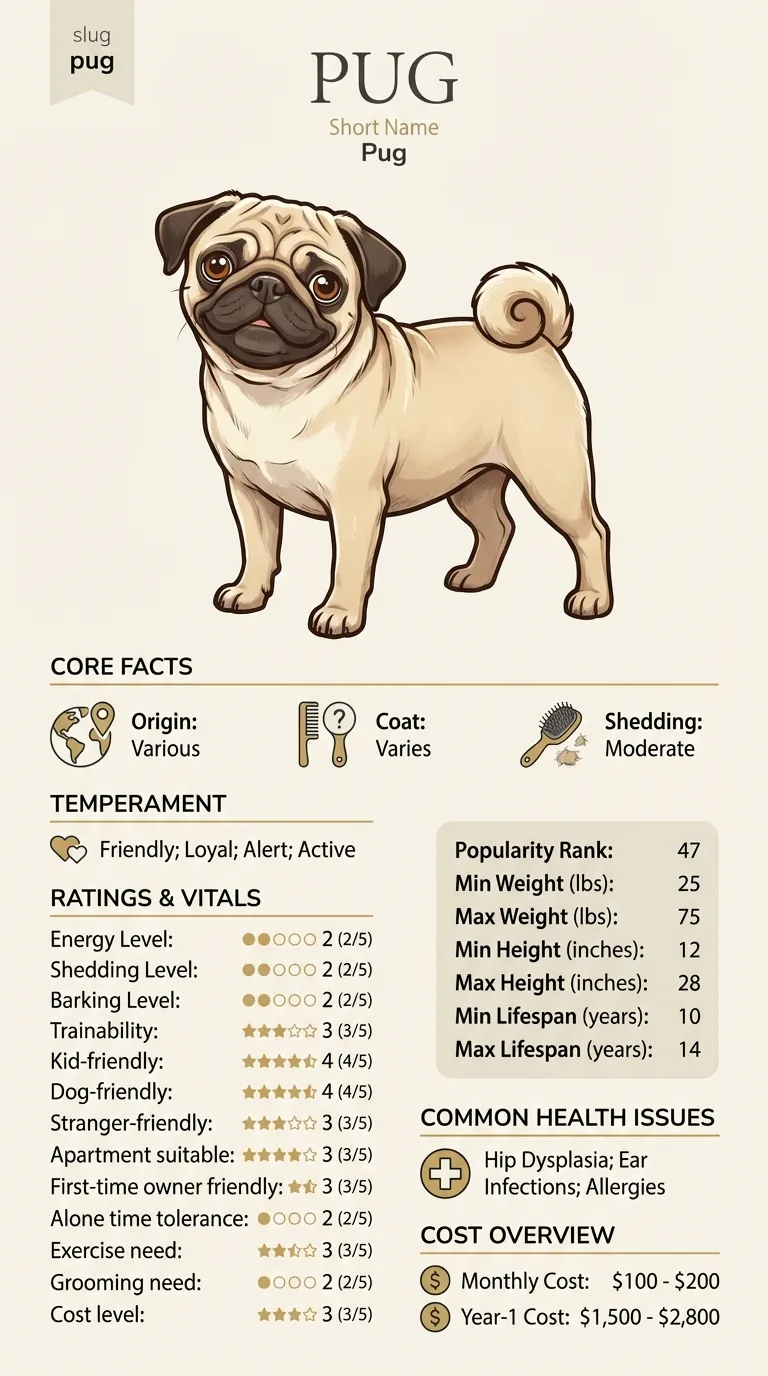
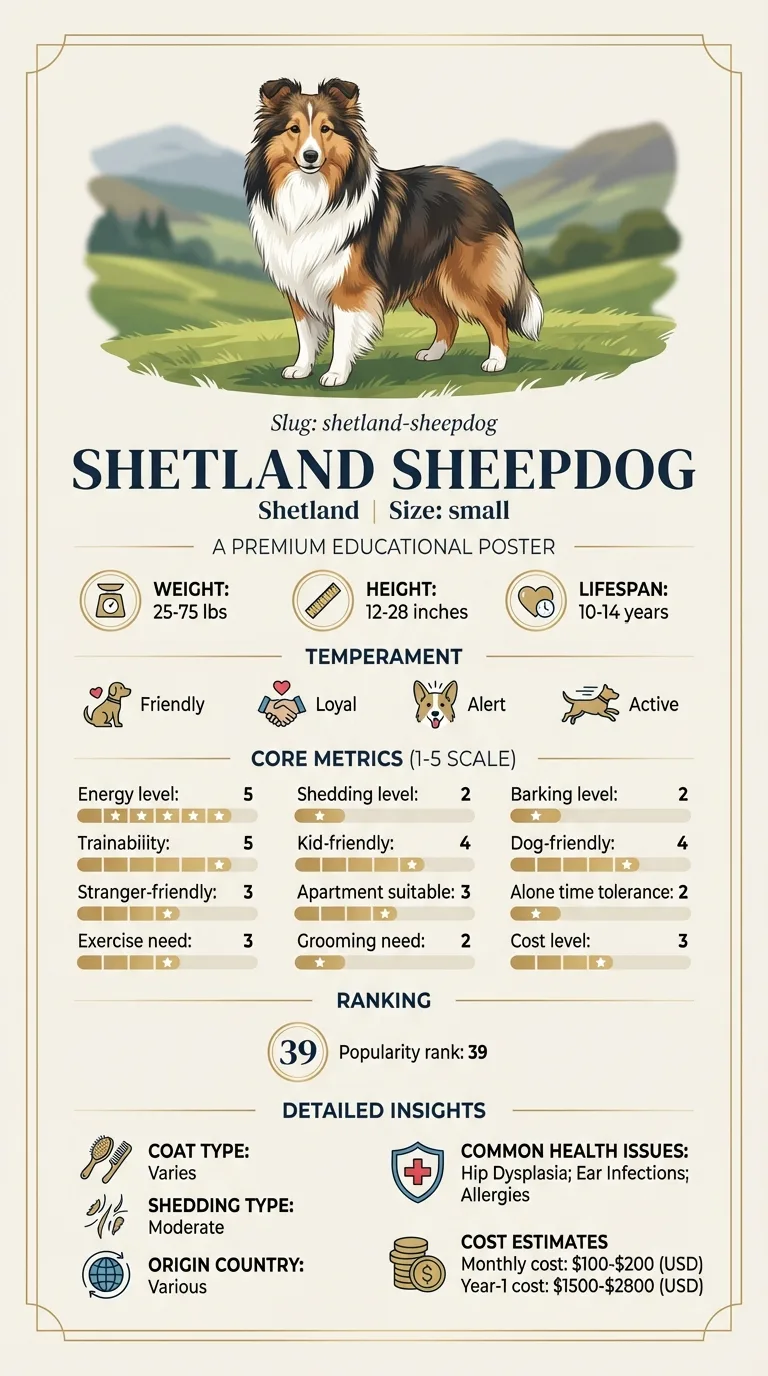
This is for someone already down to Pug and Shetland Sheepdog and deciding between them. For this pair the decision usually turns on barking and exercise need, so those are covered first and in most detail. Anyone choosing from a flat has a clear answer here: Pug rates 5/5 against 3/5. Breed history is left out; what follows is what you will actually live with.
Between Pug and Shetland Sheepdog, barking is what separates them, and Pug is the lower-effort dog of the two to keep.
Choose Pug if you are in a flat or a smaller home, this is your first dog and you do not want a standing grooming appointment.
Choose Shetland Sheepdog if you want a dog that picks up training quickly, you want a dog that can keep up with an active routine and you want a dog that is more watchful with visitors.
| Feature | pug | shetland sheepdog | Winner |
|---|---|---|---|
| Size class | small | small | Equal |
| Weight | 14–18 lbs | 15–25 lbs | Equal |
| Height | 10–13 in | 13–16 in | Equal |
| Lifespan | 13–15 years | 12–14 years | pug |
| Exercise need | Low (2/5) | High (4/5) | pug |
| Grooming need | Low (2/5) | High (4/5) | pug |
| Shedding | High (4/5) | High (4/5) | Equal |
| Energy level | Low (2/5) | High (4/5) | Equal |
| Barking | Low (2/5) | Very high (5/5) | pug |
| Apartment suitability | Very high (5/5) | Moderate (3/5) | pug |
| Good for first-time owners | Very high (5/5) | High (4/5) | pug |
| Tolerates being alone | Low (2/5) | Low (2/5) | Equal |
| Trainability | Moderate (3/5) | Very high (5/5) | shetland sheepdog |
| Good with kids | Very high (5/5) | High (4/5) | pug |
| Good with other dogs | High (4/5) | High (4/5) | Equal |
| Friendly to strangers | Very high (5/5) | Low (2/5) | pug |
| Cost level | Moderate (3/5) | Moderate (3/5) | Equal |
| Coat | Short, smooth double coat | Long, dense double coat | Equal |
| Origin | Various | Various | Equal |
| Typical monthly cost | $80–$150 | $80–$150 | Equal |
| Typical first-year cost | $1,100–$2,300 | $1,100–$2,300 | Equal |
Both breeds fall into the small class, but the Shetland Sheepdog runs a bit larger across the board: 15–25 pounds and 13–16 inches versus the Pug's 14–18 pounds and 10–13 inches. The difference in silhouette is more dramatic than the numbers suggest — the Sheltie is a miniature herding dog with a long, fine-boned frame built for agility and quick direction changes, while the Pug is a compact, square-bodied companion breed with a flat face and no working history behind its shape. Either dog suits a small home, but the Sheltie's herding instincts mean it moves and thinks like a much bigger working dog.
Exercise need separates these two clearly: Low (2/5) for the Pug against High (4/5) for the Shetland Sheepdog, a breed built to herd sheep across Scottish hillsides all day and still carrying that drive. A Sheltie left without a job — a fetch session, an agility course, herding-style games — tends to invent its own, often through fence-running or excessive barking. The Pug's low exercise need is partly a health necessity given its brachycephalic airway, so it's genuinely satisfied with short walks, while the Sheltie needs sustained daily activity to avoid becoming an anxious, over-alert version of itself.
Grooming need is Low (2/5) for the Pug against High (4/5) for the Shetland Sheepdog, whose long, dense double coat mats easily around the ears, legs, and britches without regular brushing. Shedding, though, is tied at High (4/5) for both breeds — the Sheltie blows its coat seasonally in dramatic fashion, while the Pug sheds steadily year-round despite its short coat. Anyone drawn to the Sheltie's beautiful coat should budget real weekly time for brushing it out, while Pug owners get a lower-maintenance routine but the same amount of hair to vacuum in the end.
Barking is the number to focus on: Low (2/5) for the Pug against Very high (5/5) for the Shetland Sheepdog, a breed famous even among herding dogs for its vocal, alert nature. That instinct to sound off at every doorbell, passerby, or falling leaf makes apartment life harder than the Sheltie's Moderate (3/5) apartment score alone suggests — noise complaints are the realistic risk, not space. The Pug's Very high (5/5) apartment rating and near-silent Low (2/5) barking make it the far easier fit for thin-walled buildings or noise-sensitive neighbors.
The Shetland Sheepdog is one of the most trainable breeds on this site, rated Very high (5/5) against the Pug's Moderate (3/5) — a reflection of its herding intelligence and eagerness to work with a handler. Both breeds still score well for first-time owners, Very high (5/5) for the Pug and a close High (4/5) for the Sheltie, so neither is a poor choice for a novice. The practical difference is that a Sheltie rewards structured training and mental engagement, described in its own temperament list as Bright and Sensitive, while a Pug does fine with a simpler, more relaxed routine.
Friendliness to strangers is where these breeds diverge most: Very high (5/5) for the Pug against just Low (2/5) for the Shetland Sheepdog, whose temperament list includes 'Sensitive' and whose herding heritage makes it naturally reserved and watchful around unfamiliar people. With kids, the Pug edges ahead too, Very high (5/5) versus High (4/5) for the Sheltie, though a well-socialized Sheltie is still a devoted family dog — just less likely to greet a stranger at the park with the Pug's instant enthusiasm. Sociability with other dogs is tied at High (4/5) for both.
Lifespan runs slightly longer for the Pug at 13–15 years against the Sheltie's 12–14, though both are solidly long-lived small breeds. Each carries a five-item health list shaped by very different genetics: the Shetland Sheepdog's includes Collie Eye Anomaly and MDR1 Drug Sensitivity, both linked to its herding-collie ancestry — the MDR1 mutation in particular means certain common medications must be dosed carefully or avoided. The Pug's list — Brachycephalic Airway Syndrome, Pug Dog Encephalitis, Corneal Ulcers, Hemivertebrae, Obesity — centers on its flat face and compact spine instead. A DNA test for MDR1 status is worth requesting from any Sheltie breeder.
Cost is essentially identical on paper: both breeds rate Moderate (3/5), with matching monthly ranges of $80–$150 and matching first-year estimates of $1,100–$2,300. In practice, the Sheltie's High (4/5) grooming need can push actual spending higher than the Pug's if an owner opts for professional coat care rather than doing it themselves, while the Pug's obesity risk can drive food and vet costs up if portions aren't controlled carefully. On paper these two are the closest financial match anywhere in this comparison, so temperament and exercise needs — not budget — should be the deciding factor.
Pug weighs 14–18 lbs and lives 13–15 years; Shetland Sheepdog weighs 15–25 lbs and lives 12–14 years. The two diverge most on barking, exercise need and friendly to strangers and 4 other rated axes. They are level on tolerates being alone, cost level and good with other dogs, so those cannot decide it. The comparison marks an easier option only where one exists. Facts like weight and country of origin are not scored. Both dogs are rated from the same dataset, which is what makes the numbers comparable with each other even though any individual dog sits somewhere inside its breed's range.

The Shetland Sheepdog by a wide margin — Very high (5/5) versus the Pug's Low (2/5) — making it the noisier choice for close-quarters living.
Yes, notably so — Very high (5/5) trainability versus the Pug's Moderate (3/5), thanks to its herding-dog intelligence.
The Pug, rated Very high (5/5) versus the Sheltie's Low (2/5); Shelties tend to be reserved with people they don't know.
Yes — High (4/5) versus the Pug's Low (2/5); Shelties were bred to herd all day and need a real outlet for that energy.
The Shetland Sheepdog, due to the MDR1 gene mutation common in herding breeds, which affects how it processes certain medications.
No — the Pug needs only Low (2/5) grooming while the long-coated Sheltie needs High (4/5), despite both shedding at the same High (4/5) rate.
They're rated identically on paper (Moderate, same monthly and first-year ranges), though the Sheltie's coat care can push real costs slightly higher.
The Pug, rated Low (2/5) barking versus the Sheltie's Very high (5/5).
The Shetland Sheepdog, rated Very high (5/5) versus the Pug's Moderate (3/5).
The Pug, rated Very high (5/5) versus the Sheltie's Low (2/5).
The Shetland Sheepdog, rated High (4/5) versus the Pug's Low (2/5).
See every pug comparison.
Secure checkout on Stripe. We never see your card.
7-day money-back guarantee. Instant access.
Health information here is general and is not veterinary advice. If your dog shows pain, sudden behaviour change, or worsening symptoms, consult a licensed veterinarian.
Some links on this site are affiliate links. We may earn a commission at no extra cost to you, and we only suggest products we believe are helpful for dog owners.
We research and check what we publish, but we do not warrant that any figure, date, price, or statement is accurate, complete, or current, and we accept no liability for any loss, cost, injury, or other harm arising from the use of this site. Use it as one reference among several. You remain responsible for your own decisions and for your dog's care - confirm anything that matters with a licensed veterinarian or another qualified professional before you act on it. Full disclaimer.
Match your lifestyle to the right dog.
Take quizNot sure which breed is right for you? Take our 2-minute quiz to find out.
Take the quiz